DNA Isolation Techniques: Basics &
Applications
DNA isolation
• DNA isolation means extracting out DNA from the cell under
laboratory conditions
• Involves procedure/ steps
• Chemicals (Buffers and solutions)
• Equipments
DNA was isolated for the first time by Friedrich Miescher in 1989.
Isolation techniques vary from samples to sample (plants, animals, microbes,
viruses)
Protocols are usually named after scientists who first described the procedure or
on the name of principle chemical component
Eg. Dellaporta method, CTAB method, SDS method
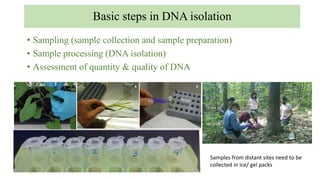
• Sampling (sample collection and sample preparation)
• Sample processing (DNA isolation)
• Assessment of quantity & quality of DNA
Basic steps in DNA isolation
Samples from distant sites need to be
collected in ice/ gel packs
Four steps are used to extract out DNA from the rest of the cell:
1. Lysis- to break up the cells
2. Separation- separating out DNA from other biomolecules
3. Precipitation- obtaining separated DNA
4. Wash- cleaning DNA
5. Resuspension- Dissolving
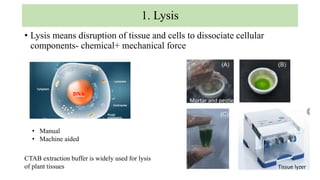
1. Lysis
• Lysis means disruption of tissue and cells to dissociate cellular
components- chemical+ mechanical force
DNA
• Manual
• Machine aided
CTAB extraction buffer is widely used for lysis
of plant tissues
Mortar and pestle
Tissue lyzer
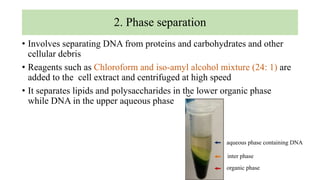
2. Phase separation
• Involves separating DNA from proteins and carbohydrates and other
cellular debris
• Reagents such as Chloroform and iso-amyl alcohol mixture (24: 1) are
added to the cell extract and centrifuged at high speed
• It separates lipids and polysaccharides in the lower organic phase
while DNA in the upper aqueous phase
aqueous phase containing DNA
organic phase
inter phase
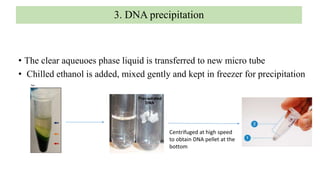
• The clear aqueuoes phase liquid is transferred to new micro tube
• Chilled ethanol is added, mixed gently and kept in freezer for precipitation
3. DNA precipitation
Centrifuged at high speed
to obtain DNA pellet at the
bottom
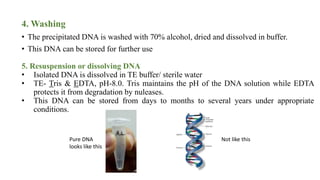
5. Resuspension or dissolving DNA
• Isolated DNA is dissolved in TE buffer/ sterile water
• TE- Tris & EDTA, pH-8.0. Tris maintains the pH of the DNA solution while EDTA
protects it from degradation by nuleases.
• This DNA can be stored from days to months to several years under appropriate
conditions.
• The precipitated DNA is washed with 70% alcohol, dried and dissolved in buffer.
• This DNA can be stored for further use
4. Washing
Pure DNA
looks like this
Not like this
Buffers & Solutions
• Lysis buffer/ Extraction buffer
• Chloroform isoamyl alcohol mixture
• Alcohol (Isopropanol/ ethanol)
• TE buffer
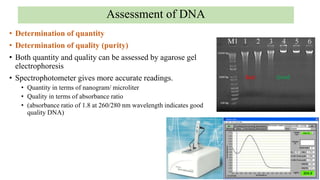
• Determination of quantity
• Determination of quality (purity)
• Both quantity and quality can be assessed by agarose gel
electrophoresis
• Spectrophotometer gives more accurate readings.
• Quantity in terms of nanogram/ microliter
• Quality in terms of absorbance ratio
• (absorbance ratio of 1.8 at 260/280 nm wavelength indicates good
quality DNA)
Good
Bad
Assessment of DNA
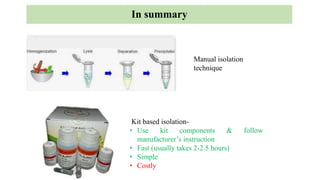
In summary
Manual isolation
technique
Kit based isolation-
• Use kit components & follow
manufacturer’s instruction
• Fast (usually takes 2-2.5 hours)
• Simple
• Costly
Applications:
• DNA isolation is the starting point for number of genetic
studies
• To study genetic diversity
• To identify and study genes responsible for economically important
traits
• Diagnostic
• To understand genetic basis of disease and insect resistance
Thanks for your attention

DNA isolation the very basics.pptx

  • 1.
    DNA Isolation Techniques:Basics & Applications
  • 2.
    DNA isolation • DNAisolation means extracting out DNA from the cell under laboratory conditions • Involves procedure/ steps • Chemicals (Buffers and solutions) • Equipments DNA was isolated for the first time by Friedrich Miescher in 1989. Isolation techniques vary from samples to sample (plants, animals, microbes, viruses) Protocols are usually named after scientists who first described the procedure or on the name of principle chemical component Eg. Dellaporta method, CTAB method, SDS method
  • 3.
    • Sampling (samplecollection and sample preparation) • Sample processing (DNA isolation) • Assessment of quantity & quality of DNA Basic steps in DNA isolation Samples from distant sites need to be collected in ice/ gel packs
  • 4.
    Four steps areused to extract out DNA from the rest of the cell: 1. Lysis- to break up the cells 2. Separation- separating out DNA from other biomolecules 3. Precipitation- obtaining separated DNA 4. Wash- cleaning DNA 5. Resuspension- Dissolving
  • 5.
    1. Lysis • Lysismeans disruption of tissue and cells to dissociate cellular components- chemical+ mechanical force DNA • Manual • Machine aided CTAB extraction buffer is widely used for lysis of plant tissues Mortar and pestle Tissue lyzer
  • 6.
    2. Phase separation •Involves separating DNA from proteins and carbohydrates and other cellular debris • Reagents such as Chloroform and iso-amyl alcohol mixture (24: 1) are added to the cell extract and centrifuged at high speed • It separates lipids and polysaccharides in the lower organic phase while DNA in the upper aqueous phase aqueous phase containing DNA organic phase inter phase
  • 7.
    • The clearaqueuoes phase liquid is transferred to new micro tube • Chilled ethanol is added, mixed gently and kept in freezer for precipitation 3. DNA precipitation Centrifuged at high speed to obtain DNA pellet at the bottom
  • 8.
    5. Resuspension ordissolving DNA • Isolated DNA is dissolved in TE buffer/ sterile water • TE- Tris & EDTA, pH-8.0. Tris maintains the pH of the DNA solution while EDTA protects it from degradation by nuleases. • This DNA can be stored from days to months to several years under appropriate conditions. • The precipitated DNA is washed with 70% alcohol, dried and dissolved in buffer. • This DNA can be stored for further use 4. Washing Pure DNA looks like this Not like this
  • 9.
    Buffers & Solutions •Lysis buffer/ Extraction buffer • Chloroform isoamyl alcohol mixture • Alcohol (Isopropanol/ ethanol) • TE buffer
  • 10.
    • Determination ofquantity • Determination of quality (purity) • Both quantity and quality can be assessed by agarose gel electrophoresis • Spectrophotometer gives more accurate readings. • Quantity in terms of nanogram/ microliter • Quality in terms of absorbance ratio • (absorbance ratio of 1.8 at 260/280 nm wavelength indicates good quality DNA) Good Bad Assessment of DNA
  • 11.
    In summary Manual isolation technique Kitbased isolation- • Use kit components & follow manufacturer’s instruction • Fast (usually takes 2-2.5 hours) • Simple • Costly
  • 12.
    Applications: • DNA isolationis the starting point for number of genetic studies • To study genetic diversity • To identify and study genes responsible for economically important traits • Diagnostic • To understand genetic basis of disease and insect resistance
  • 13.
    Thanks for yourattention