The Central Dogma
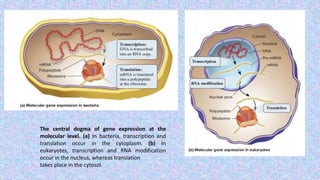
The central dogma of gene expression at the
molecular level. (a) In bacteria, transcription and
translation occur in the cytoplasm. (b) In
eukaryotes, transcription and RNA modification
occur in the nucleus, whereas translation
takes place in the cytosol.
DNA Replication
• Must occur before a cell can divide to produce two genetically
identical daughter cells
• The original DNA strands are used as templates for the synthesis of
new DNA strands
• Researchers in the late 1950s considered three different models for
the mechanism of DNA replication (Figure 1)
Figure 1. Three proposed mechanisms
for DNA replication. The strands of the
original (parental) double helix are shown
in red. Two rounds of replication are
illustrated, with the daughter strands
shown in blue.
DNA Replication
• DNA Replication Proceeds According to
the AT/GC Rule:
• An adenine (A) in one strand bonds with
a thymine (T) in the opposite strand, or a
guanine (G) bonds with a cytosine.
• Figure 2. DNA replication according to
the AT/GC rule. (a) The mechanism of
DNA replication as originally proposed
by Watson and Crick. As you see, the
synthesis of one newly made strand
(the leading strand on the left side)
occurs in the direction toward the
replication fork, whereas the synthesis
of the other newly made strand (the
lagging strand on the right side) occurs
in small segments away from the fork.
(b) DNA replication produces two
copies of DNA with the same sequence
of bases as the original DNA molecule.
DNA Replication
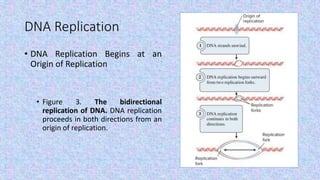
• DNA Replication Begins at an
Origin of Replication
• Figure 3. The bidirectional
replication of DNA. DNA replication
proceeds in both directions from an
origin of replication.
DNA Replication
• DNA Replication Requires the Action of Several Different Proteins
• DNA helicase: At each fork, DNA helicase binds to one DNA strand and travels
in the 5ʹ to 3ʹ direction .It uses energy from ATP to break hydrogen bonds
between base pairs and thereby separates the DNA strands. This keeps the fork
moving forward.
• DNA topoisomerase: The action of DNA helicase can cause knots (called
supercoils) to form just ahead of the replication fork. These knots are alleviated
by another enzyme called DNA topoisomerase.
• Single-strand binding proteins: After the two DNA strands have separated, they
must remain that way so they can act as templates to make complementary
daughter strands. The function of single-strand binding proteins is to coat both
of the single strands of template DNA and prevent them from re-forming a
double helix.
• Single-strand binding proteins: After the two DNA strands have
separated, they must remain that way so they can act as templates to
make complementary daughter strands. The function of single-strand
binding proteins is to coat both of the single strands of template DNA
and prevent them from re-forming a double helix.
Figure 4. Proteins that facilitate the formation and movement of the replication fork.
DNA Replication
• DNA Replication Requires the Action of Several Different Proteins
• DNA polymerase: This enzyme is responsible for covalently linking nucleotides
together to form DNA strands. The name indicates that this enzyme makes a
polymer of DNA nucleotides.
• DNA primase: DNA polymerase is unable to begin DNA synthesis on a bare
template strand. A different enzyme called DNA primase is required if the
template strand is bare. DNA primase makes a complementary primer, which is
actually a short segment of RNA, typically 10 to 12 nucleotides in length that
starts, or primes, the process of DNA replication.
• DNA primase: DNA polymerase is unable to begin DNA synthesis on a
bare template strand. A different enzyme called DNA primase is
required if the template strand is bare. DNA primase makes a
complementary primer, which is actually a short segment of RNA,
typically 10 to 12 nucleotides in length that starts, or primes, the
process of DNA replication.
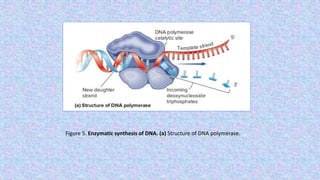
Figure 5. Enzymatic synthesis of DNA. (a) Structure of DNA polymerase.
Figure 5. Enzymatic synthesis of DNA. (b) DNA polymerase breaks the bond between the first and
second phosphate in an incoming deoxynucleoside triphosphate, causing the release of pyrophosphate.
This provides the energy to form a covalent bond between the resulting deoxynucleoside
monophosphate and the previous nucleotide in the growing strand. The pyrophosphate is broken down
to two phosphates..
Figure 6. 6 Enzymatic features of DNA polymerase. (a) DNA polymerase needs a
primer to begin DNA synthesis, and (b) it synthesizes DNA only in the 5΄ to 3΄ direction.
DNA Replication
• Leading and Lagging DNA Strands
Are Made Differently
• Figure 7. Synthesis of new DNA
strands. The separation of DNA at
the origin of replication produces
two replication forks that move in
opposite directions. New DNA
strands are made near the opening
of each fork. The leading strand is
made continuously in the same
direction the fork is moving. The
lagging strand is made as small
pieces (Okazaki fragments) in the
opposite direction. Eventually, these
small pieces are connected to each
other to form a continuous lagging
strand.
DNA Replication
• DNA Replication Is Very Accurate
• Three factors explain such a remarkably high fidelity for DNA
replication:
1. Hydrogen bonding between A and T or between G and C is more stable than
between mismatched pairs.
2. The active site of DNA polymerase is unlikely to catalyze bond formation
between adjacent nucleotides if a mismatched base pair is formed.
.
• 3. DNA polymerase can identify a mismatched nucleotide and remove
it from the daughter strand. This event, called proofreading, occurs
when DNA polymerase detects a mismatch and then reverses its
direction and digests the linkages between nucleotides at the end of a
newly made strand in the 3ʹ to 5ʹ direction. Once it passes the
mismatched base and removes it, DNA polymerase then continues to
synthesize DNA in the 5ʹ to 3ʹ direction.
Transcription
• At the Molecular Level, a Gene Is Transcribed and Produces a Functional
Product
• What is the definition of a gene?
• At the molecular level, a gene is defined as an
organized unit of nucleotide sequences that enables a
segment of DNA to be transcribed into RNA and
ultimately results in the formation of a functional
product.
• A gene is composed of specific base sequences organized in a way
that allows the DNA to be transcribed into RNA.
• Promoter: A site in the DNA where transcription begins
• Terminator: A site in the DNA where transcription ends
• Regulatory sequences: Sequences that function as sites for the binding of
regulatory proteins that affect the rate of transcription.
Figure 8. A bacterial protein-encoding gene as a transcriptional unit.
Transcription
• During Transcription, RNA Polymerase Uses a DNA Template to Make
RNA
• Transcription occurs in three stages, called:
• Initiation
• Elongation
• and Termination
Figure 9. Stages of transcription. Transcription can be divided into initiation, elongation, and termination
stages. The inset emphasizes the direction of RNA synthesis and base pairing between the DNA template
strand and RNA.
Transcription
• RNA Modifications in
Eukaryotes
• Figure 10. Modifications to
eukaryotic pre-mRNA that are
needed to produce a mature
mRNA molecule. Note: Most
RNA molecules are spliced after
the pre-mRNA is completely
synthesized. However, for some
of them, splicing may begin
before transcription of the pre-
mRNA is completed.
Transcription
• RNA Modifications in Eukaryotes
• The ends of eukaryotic pre-mrnas
are modified by the addition of a 5ʹ
cap and a 3ʹ poly A tail
• Figure 11. Modifications that occur
at the ends of mRNA in eukaryotic
cells. (a) A guanosine cap is
attached to the 5ʹ end. This guanine
base is modified by the attachment
of a methyl group. The linkage
between the cap and the mRNA is a
5ʹ to 5ʹ linkage. (b) A poly A tail is
added to the 3ʹ end.
Transcription
• RNA Modifications in
Eukaryotes
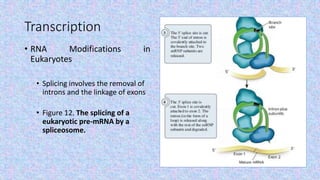
• Splicing involves the removal of
introns and the linkage of exons
• Figure 12. The splicing of a
eukaryotic pre-mRNA by a
spliceosome.
Transcription
• RNA Modifications in
Eukaryotes
• Splicing involves the removal of
introns and the linkage of exons
• Figure 12. The splicing of a
eukaryotic pre-mRNA by a
spliceosome.
Translation and the Genetic Code
• The genetic code specifies the
amino acids within a polypeptide
Translation and the Genetic Code
• During Translation, mRNA Is Used
to Make a Polypeptide with a
Specific Amino Acid Sequence
• Figure 13. The organization of a
bacterial mRNA as a translational
unit. The string of colored balls
represents a sequence of amino
acids in a polypeptide. During and
following translation, a sequence
of amino acids folds into a more
compact structure.
Translation and the Genetic Code
• DNA Stores Information, Whereas mRNA and tRNA Access That
Information to Make a Polypeptide
Figure 14. Relationships
among the coding
sequence of a gene, the
coding sequence of an
mRNA, the anticodons of
tRNA, and the amino
acid sequence of a
polypeptide.
• Machinery of Translation
Translation and the Genetic Code
• Machinery of Translation
Figure 15. Structure of tRNA. (a) The two-
dimensional or secondary structure of
tRNA is that of a cloverleaf, with the
anticodon within the middle loop. The 3ʹ
single-stranded region is where an amino
acid can attach. (b) The actual three-
dimensional structure of tRNA folds in on
itself.
Translation and the Genetic Code
• Machinery of Translation
• Components of ribosomal subunits
form Functional sites for translation
Figure 16. Ribosome structure. (b) A
schematic model emphasizing functional
sites in the ribosome and showing bound
mRNA and tRNA with an attached
polypeptide. The amino acids are
depicted as different-colored balls to
emphasize that translation produces a
polypeptide with a specific amino acid
sequence.
Translation and the Genetic Code
• Stages of Translation
• Like transcription, the process of translation occurs in three stages called initiation,
elongation, and termination.
1. During initiation, an mRNA, the first tRNA, and the ribosomal subunits
assemble into a complex.
2. In the elongation stage, the ribosome moves in the 5ʹ to 3ʹ direction from
the start codon in the mRNA toward the stop codon, synthesizing a
polypeptide according to the sequence of codons in the mRNA.
3. Finally, the process is terminated when the ribosome reaches a stop codon
and the complex disassembles, releasing the completed polypeptide.
Figure 17. Initiation of
translation in bacteria
Figure 18. Elongation stage
of translation in bacteria.
Figure 18. Elongation stage
of translation in bacteria.
Figure 18. Elongation stage
of translation in bacteria.
Figure 18. Elongation stage
of translation in bacteria.
LETS TRY THIS !
• https://media.hhmi.org/biointeractive/click/ge
netic-medicine-interactive/

The Central Dogma.pptx

  • 1.
  • 2.
    The central dogmaof gene expression at the molecular level. (a) In bacteria, transcription and translation occur in the cytoplasm. (b) In eukaryotes, transcription and RNA modification occur in the nucleus, whereas translation takes place in the cytosol.
  • 3.
    DNA Replication • Mustoccur before a cell can divide to produce two genetically identical daughter cells • The original DNA strands are used as templates for the synthesis of new DNA strands • Researchers in the late 1950s considered three different models for the mechanism of DNA replication (Figure 1)
  • 4.
    Figure 1. Threeproposed mechanisms for DNA replication. The strands of the original (parental) double helix are shown in red. Two rounds of replication are illustrated, with the daughter strands shown in blue.
  • 5.
    DNA Replication • DNAReplication Proceeds According to the AT/GC Rule: • An adenine (A) in one strand bonds with a thymine (T) in the opposite strand, or a guanine (G) bonds with a cytosine. • Figure 2. DNA replication according to the AT/GC rule. (a) The mechanism of DNA replication as originally proposed by Watson and Crick. As you see, the synthesis of one newly made strand (the leading strand on the left side) occurs in the direction toward the replication fork, whereas the synthesis of the other newly made strand (the lagging strand on the right side) occurs in small segments away from the fork. (b) DNA replication produces two copies of DNA with the same sequence of bases as the original DNA molecule.
  • 6.
    DNA Replication • DNAReplication Begins at an Origin of Replication • Figure 3. The bidirectional replication of DNA. DNA replication proceeds in both directions from an origin of replication.
  • 7.
    DNA Replication • DNAReplication Requires the Action of Several Different Proteins • DNA helicase: At each fork, DNA helicase binds to one DNA strand and travels in the 5ʹ to 3ʹ direction .It uses energy from ATP to break hydrogen bonds between base pairs and thereby separates the DNA strands. This keeps the fork moving forward. • DNA topoisomerase: The action of DNA helicase can cause knots (called supercoils) to form just ahead of the replication fork. These knots are alleviated by another enzyme called DNA topoisomerase. • Single-strand binding proteins: After the two DNA strands have separated, they must remain that way so they can act as templates to make complementary daughter strands. The function of single-strand binding proteins is to coat both of the single strands of template DNA and prevent them from re-forming a double helix.
  • 8.
    • Single-strand bindingproteins: After the two DNA strands have separated, they must remain that way so they can act as templates to make complementary daughter strands. The function of single-strand binding proteins is to coat both of the single strands of template DNA and prevent them from re-forming a double helix.
  • 9.
    Figure 4. Proteinsthat facilitate the formation and movement of the replication fork.
  • 10.
    DNA Replication • DNAReplication Requires the Action of Several Different Proteins • DNA polymerase: This enzyme is responsible for covalently linking nucleotides together to form DNA strands. The name indicates that this enzyme makes a polymer of DNA nucleotides. • DNA primase: DNA polymerase is unable to begin DNA synthesis on a bare template strand. A different enzyme called DNA primase is required if the template strand is bare. DNA primase makes a complementary primer, which is actually a short segment of RNA, typically 10 to 12 nucleotides in length that starts, or primes, the process of DNA replication.
  • 11.
    • DNA primase:DNA polymerase is unable to begin DNA synthesis on a bare template strand. A different enzyme called DNA primase is required if the template strand is bare. DNA primase makes a complementary primer, which is actually a short segment of RNA, typically 10 to 12 nucleotides in length that starts, or primes, the process of DNA replication.
  • 12.
    Figure 5. Enzymaticsynthesis of DNA. (a) Structure of DNA polymerase.
  • 13.
    Figure 5. Enzymaticsynthesis of DNA. (a) Structure of DNA polymerase. Figure 5. Enzymatic synthesis of DNA. (b) DNA polymerase breaks the bond between the first and second phosphate in an incoming deoxynucleoside triphosphate, causing the release of pyrophosphate. This provides the energy to form a covalent bond between the resulting deoxynucleoside monophosphate and the previous nucleotide in the growing strand. The pyrophosphate is broken down to two phosphates..
  • 14.
    Figure 6. 6Enzymatic features of DNA polymerase. (a) DNA polymerase needs a primer to begin DNA synthesis, and (b) it synthesizes DNA only in the 5΄ to 3΄ direction.
  • 15.
    DNA Replication • Leadingand Lagging DNA Strands Are Made Differently • Figure 7. Synthesis of new DNA strands. The separation of DNA at the origin of replication produces two replication forks that move in opposite directions. New DNA strands are made near the opening of each fork. The leading strand is made continuously in the same direction the fork is moving. The lagging strand is made as small pieces (Okazaki fragments) in the opposite direction. Eventually, these small pieces are connected to each other to form a continuous lagging strand.
  • 16.
    DNA Replication • DNAReplication Is Very Accurate • Three factors explain such a remarkably high fidelity for DNA replication: 1. Hydrogen bonding between A and T or between G and C is more stable than between mismatched pairs. 2. The active site of DNA polymerase is unlikely to catalyze bond formation between adjacent nucleotides if a mismatched base pair is formed. .
  • 17.
    • 3. DNApolymerase can identify a mismatched nucleotide and remove it from the daughter strand. This event, called proofreading, occurs when DNA polymerase detects a mismatch and then reverses its direction and digests the linkages between nucleotides at the end of a newly made strand in the 3ʹ to 5ʹ direction. Once it passes the mismatched base and removes it, DNA polymerase then continues to synthesize DNA in the 5ʹ to 3ʹ direction.
  • 19.
    Transcription • At theMolecular Level, a Gene Is Transcribed and Produces a Functional Product • What is the definition of a gene? • At the molecular level, a gene is defined as an organized unit of nucleotide sequences that enables a segment of DNA to be transcribed into RNA and ultimately results in the formation of a functional product.
  • 20.
    • A geneis composed of specific base sequences organized in a way that allows the DNA to be transcribed into RNA. • Promoter: A site in the DNA where transcription begins • Terminator: A site in the DNA where transcription ends • Regulatory sequences: Sequences that function as sites for the binding of regulatory proteins that affect the rate of transcription.
  • 21.
    Figure 8. Abacterial protein-encoding gene as a transcriptional unit.
  • 22.
    Transcription • During Transcription,RNA Polymerase Uses a DNA Template to Make RNA • Transcription occurs in three stages, called: • Initiation • Elongation • and Termination
  • 23.
    Figure 9. Stagesof transcription. Transcription can be divided into initiation, elongation, and termination stages. The inset emphasizes the direction of RNA synthesis and base pairing between the DNA template strand and RNA.
  • 25.
    Transcription • RNA Modificationsin Eukaryotes • Figure 10. Modifications to eukaryotic pre-mRNA that are needed to produce a mature mRNA molecule. Note: Most RNA molecules are spliced after the pre-mRNA is completely synthesized. However, for some of them, splicing may begin before transcription of the pre- mRNA is completed.
  • 26.
    Transcription • RNA Modificationsin Eukaryotes • The ends of eukaryotic pre-mrnas are modified by the addition of a 5ʹ cap and a 3ʹ poly A tail • Figure 11. Modifications that occur at the ends of mRNA in eukaryotic cells. (a) A guanosine cap is attached to the 5ʹ end. This guanine base is modified by the attachment of a methyl group. The linkage between the cap and the mRNA is a 5ʹ to 5ʹ linkage. (b) A poly A tail is added to the 3ʹ end.
  • 27.
    Transcription • RNA Modificationsin Eukaryotes • Splicing involves the removal of introns and the linkage of exons • Figure 12. The splicing of a eukaryotic pre-mRNA by a spliceosome.
  • 28.
    Transcription • RNA Modificationsin Eukaryotes • Splicing involves the removal of introns and the linkage of exons • Figure 12. The splicing of a eukaryotic pre-mRNA by a spliceosome.
  • 29.
    Translation and theGenetic Code • The genetic code specifies the amino acids within a polypeptide
  • 30.
    Translation and theGenetic Code • During Translation, mRNA Is Used to Make a Polypeptide with a Specific Amino Acid Sequence • Figure 13. The organization of a bacterial mRNA as a translational unit. The string of colored balls represents a sequence of amino acids in a polypeptide. During and following translation, a sequence of amino acids folds into a more compact structure.
  • 31.
    Translation and theGenetic Code • DNA Stores Information, Whereas mRNA and tRNA Access That Information to Make a Polypeptide Figure 14. Relationships among the coding sequence of a gene, the coding sequence of an mRNA, the anticodons of tRNA, and the amino acid sequence of a polypeptide.
  • 32.
    • Machinery ofTranslation Translation and the Genetic Code
  • 33.
    Translation and theGenetic Code • Machinery of Translation Figure 15. Structure of tRNA. (a) The two- dimensional or secondary structure of tRNA is that of a cloverleaf, with the anticodon within the middle loop. The 3ʹ single-stranded region is where an amino acid can attach. (b) The actual three- dimensional structure of tRNA folds in on itself.
  • 34.
    Translation and theGenetic Code • Machinery of Translation • Components of ribosomal subunits form Functional sites for translation Figure 16. Ribosome structure. (b) A schematic model emphasizing functional sites in the ribosome and showing bound mRNA and tRNA with an attached polypeptide. The amino acids are depicted as different-colored balls to emphasize that translation produces a polypeptide with a specific amino acid sequence.
  • 35.
    Translation and theGenetic Code • Stages of Translation • Like transcription, the process of translation occurs in three stages called initiation, elongation, and termination. 1. During initiation, an mRNA, the first tRNA, and the ribosomal subunits assemble into a complex. 2. In the elongation stage, the ribosome moves in the 5ʹ to 3ʹ direction from the start codon in the mRNA toward the stop codon, synthesizing a polypeptide according to the sequence of codons in the mRNA. 3. Finally, the process is terminated when the ribosome reaches a stop codon and the complex disassembles, releasing the completed polypeptide.
  • 36.
    Figure 17. Initiationof translation in bacteria
  • 37.
    Figure 18. Elongationstage of translation in bacteria.
  • 38.
    Figure 18. Elongationstage of translation in bacteria.
  • 39.
    Figure 18. Elongationstage of translation in bacteria.
  • 40.
    Figure 18. Elongationstage of translation in bacteria.
  • 42.
    LETS TRY THIS! • https://media.hhmi.org/biointeractive/click/ge netic-medicine-interactive/