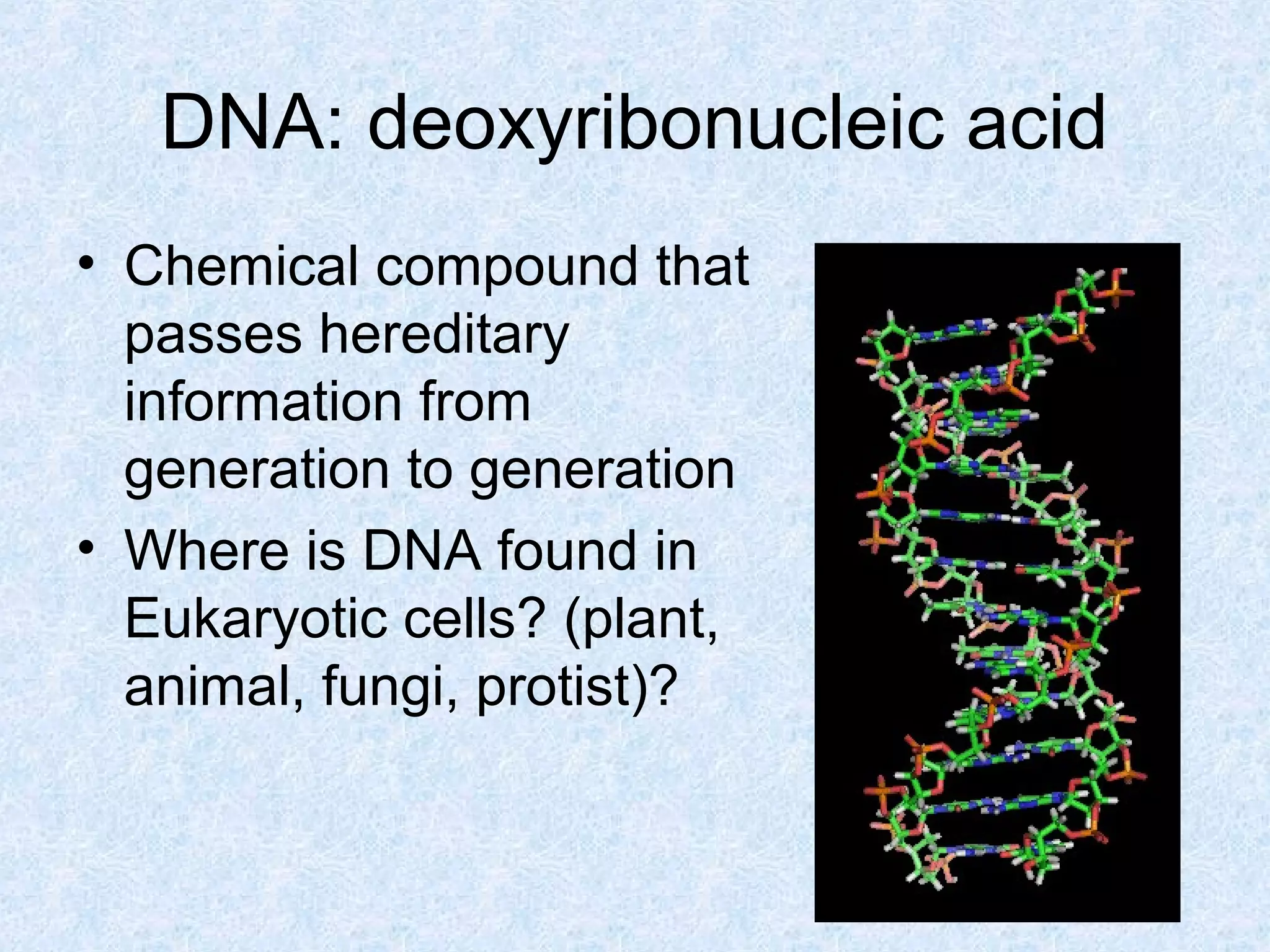
DNA: deoxyribonucleic acid
• Chemical compound that
passes hereditary
information from
generation to generation
• Where is DNA found in
Eukaryotic cells? (plant,
animal, fungi, protist)?
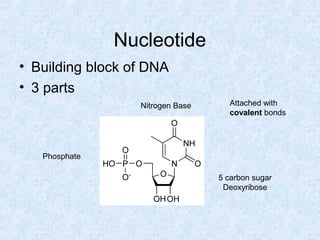
Nucleotide
• Building block of DNA
• 3 parts
Nitrogen Base
Phosphate
5 carbon sugar
Deoxyribose
Attached with
covalent bonds
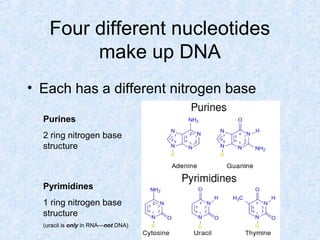
Four different nucleotides
make up DNA
• Each has a different nitrogen base
Purines
2 ring nitrogen base
structure
Pyrimidines
1 ring nitrogen base
structure
(uracil is only in RNA—not DNA)
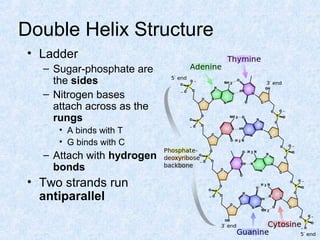
Double Helix Structure
• Ladder
– Sugar-phosphate are
the sides
– Nitrogen bases
attach across as the
rungs
• A binds with T
• G binds with C
– Attach with hydrogen
bonds
• Two strands run
antiparallel
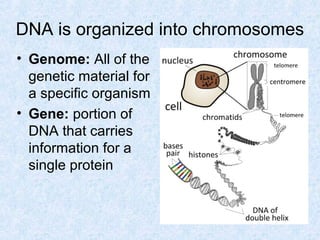
DNA is organized into chromosomes
• Genome: All of the
genetic material for
a specific organism
• Gene: portion of
DNA that carries
information for a
single protein
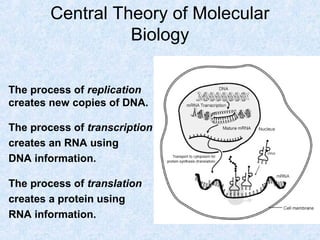
Central Theory of Molecular
Biology
The process of replication
creates new copies of DNA.
The process of transcription
creates an RNA using
DNA information.
The process of translation
creates a protein using
RNA information.
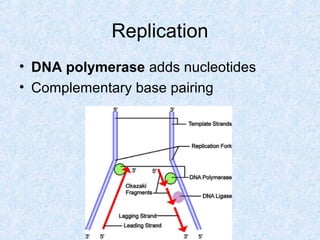
Replication
• DNA polymerase adds nucleotides
• Complementary base pairing
Semi-Conservative Replication
• Each new molecule consists of one old
strand and one new strand
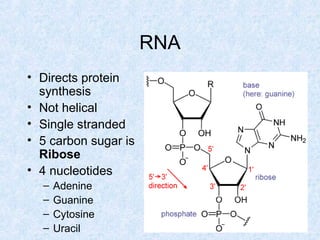
RNA
• Directs protein
synthesis
• Not helical
• Single stranded
• 5 carbon sugar is
Ribose
• 4 nucleotides
– Adenine
– Guanine
– Cytosine
– Uracil
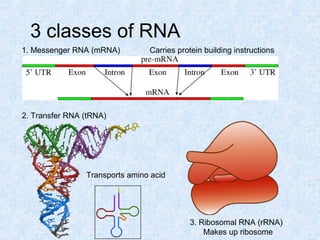
3 classes of RNA
1. Messenger RNA (mRNA)
2. Transfer RNA (tRNA)
3. Ribosomal RNA (rRNA)
Makes up ribosome
Carries protein building instructions
Transports amino acid
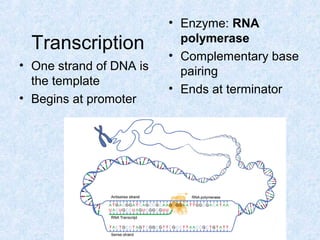
Transcription
• One strand of DNA is
the template
• Begins at promoter
• Enzyme: RNA
polymerase
• Complementary base
pairing
• Ends at terminator
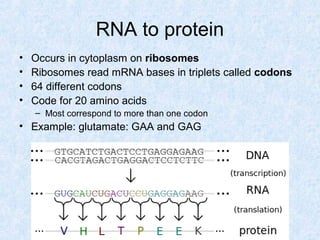
RNA to protein
• Occurs in cytoplasm on ribosomes
• Ribosomes read mRNA bases in triplets called codons
• 64 different codons
• Code for 20 amino acids
– Most correspond to more than one codon
• Example: glutamate: GAA and GAG
Codons
• Start codon: AUG
– Codes for methionine
– First amino acid
• UAA, UAG and UGA are stop codons
– Prevent further amino acid addition
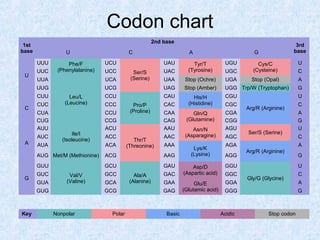
Codon chart
1st
base
2nd base
3rd
baseU C A G
U
UUU Phe/F
(Phenylalanine)
UCU
Ser/S
(Serine)
UAU Tyr/T
(Tyrosine)
UGU Cys/C
(Cysteine)
U
UUC UCC UAC UGC C
UUA
Leu/L
(Leucine)
UCA UAA Stop (Ochre) UGA Stop (Opal) A
UUG UCG UAG Stop (Amber) UGG Trp/W (Tryptophan) G
C
CUU CCU
Pro/P
(Proline)
CAU His/H
(Histidine)
CGU
Arg/R (Arginine)
U
CUC CCC CAC CGC C
CUA CCU CAA Gln/Q
(Glutamine)
CGA A
CUG CCG CAG CGG G
A
AUU
Ile/I
(Isoleucine)
ACU
Thr/T
(Threonine)
AAU Asn/N
(Asparagine)
AGU
Ser/S (Serine)
U
AUC ACC AAC AGC C
AUA ACA AAA
Lys/K
(Lysine)
AGA
Arg/R (Arginine)
A
AUG Met/M (Methionine) ACG AAG AGG G
G
GUU
Val/V
(Valine)
GCU
Ala/A
(Alanine)
GAU Asp/D
(Aspartic acid)
GGU
Gly/G (Glycine)
U
GUC GCC GAC GGC C
GUA GCA GAA Glu/E
(Glutamic acid)
GGA A
GUG GCG GAG GGG G
Key Nonpolar Polar Basic Acidic Stop codon
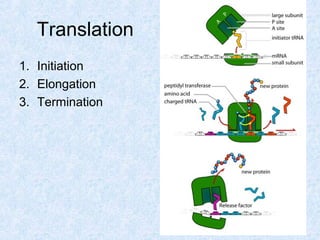
Translation
1. Initiation
2. Elongation
3. Termination
Today’s lab
• Extract DNA from strawberry
• Add extraction buffer
– Made of shampoo and salt
– Breaks open cells
– Helps to separate DNA from protein
• Add ethanol
– Precipitates out DNA
• Collect spool of DNA
• Take home if you want to

DNA Lab

  • 1.
    DNA: deoxyribonucleic acid •Chemical compound that passes hereditary information from generation to generation • Where is DNA found in Eukaryotic cells? (plant, animal, fungi, protist)?
  • 2.
    Nucleotide • Building blockof DNA • 3 parts Nitrogen Base Phosphate 5 carbon sugar Deoxyribose Attached with covalent bonds
  • 3.
    Four different nucleotides makeup DNA • Each has a different nitrogen base Purines 2 ring nitrogen base structure Pyrimidines 1 ring nitrogen base structure (uracil is only in RNA—not DNA)
  • 4.
    Double Helix Structure •Ladder – Sugar-phosphate are the sides – Nitrogen bases attach across as the rungs • A binds with T • G binds with C – Attach with hydrogen bonds • Two strands run antiparallel
  • 5.
    DNA is organizedinto chromosomes • Genome: All of the genetic material for a specific organism • Gene: portion of DNA that carries information for a single protein
  • 6.
    Central Theory ofMolecular Biology The process of replication creates new copies of DNA. The process of transcription creates an RNA using DNA information. The process of translation creates a protein using RNA information.
  • 7.
    Replication • DNA polymeraseadds nucleotides • Complementary base pairing
  • 8.
    Semi-Conservative Replication • Eachnew molecule consists of one old strand and one new strand
  • 9.
    RNA • Directs protein synthesis •Not helical • Single stranded • 5 carbon sugar is Ribose • 4 nucleotides – Adenine – Guanine – Cytosine – Uracil
  • 10.
    3 classes ofRNA 1. Messenger RNA (mRNA) 2. Transfer RNA (tRNA) 3. Ribosomal RNA (rRNA) Makes up ribosome Carries protein building instructions Transports amino acid
  • 11.
    Transcription • One strandof DNA is the template • Begins at promoter • Enzyme: RNA polymerase • Complementary base pairing • Ends at terminator
  • 12.
    RNA to protein •Occurs in cytoplasm on ribosomes • Ribosomes read mRNA bases in triplets called codons • 64 different codons • Code for 20 amino acids – Most correspond to more than one codon • Example: glutamate: GAA and GAG
  • 13.
    Codons • Start codon:AUG – Codes for methionine – First amino acid • UAA, UAG and UGA are stop codons – Prevent further amino acid addition
  • 14.
    Codon chart 1st base 2nd base 3rd baseUC A G U UUU Phe/F (Phenylalanine) UCU Ser/S (Serine) UAU Tyr/T (Tyrosine) UGU Cys/C (Cysteine) U UUC UCC UAC UGC C UUA Leu/L (Leucine) UCA UAA Stop (Ochre) UGA Stop (Opal) A UUG UCG UAG Stop (Amber) UGG Trp/W (Tryptophan) G C CUU CCU Pro/P (Proline) CAU His/H (Histidine) CGU Arg/R (Arginine) U CUC CCC CAC CGC C CUA CCU CAA Gln/Q (Glutamine) CGA A CUG CCG CAG CGG G A AUU Ile/I (Isoleucine) ACU Thr/T (Threonine) AAU Asn/N (Asparagine) AGU Ser/S (Serine) U AUC ACC AAC AGC C AUA ACA AAA Lys/K (Lysine) AGA Arg/R (Arginine) A AUG Met/M (Methionine) ACG AAG AGG G G GUU Val/V (Valine) GCU Ala/A (Alanine) GAU Asp/D (Aspartic acid) GGU Gly/G (Glycine) U GUC GCC GAC GGC C GUA GCA GAA Glu/E (Glutamic acid) GGA A GUG GCG GAG GGG G Key Nonpolar Polar Basic Acidic Stop codon
  • 15.
  • 16.
    Today’s lab • ExtractDNA from strawberry • Add extraction buffer – Made of shampoo and salt – Breaks open cells – Helps to separate DNA from protein • Add ethanol – Precipitates out DNA • Collect spool of DNA • Take home if you want to

Editor's Notes

  • #2 DNA orbit static. Authored by: 84user and Richard Wheeler. Located at: https://commons.wikimedia.org/wiki/File:DNA_orbit_animated_static_thumb.png. License: CC BY-SA.
  • #3 DAMP chemical structure. Authored by: Cacycle. Located at: https://en.wikipedia.org/wiki/File:DAMP_chemical_structure.png. License: Public Domain
  • #4 Modified from Nucleotides. Authored by: Boris. Located at: https://commons.wikimedia.org/wiki/File:Nucleotides_1.svg. License: Public Domain
  • #5 DNA chemical structure. Authored by: Madprime. Located at: https://commons.wikimedia.org/wiki/File:DNA_chemical_structure.svg. License: CC 0
  • #6 Human Genome. Provided by: CK-12. Located at: http://www.ck12.org/biology/Human-Chromosomes-and-Genes/lesson/Human-Chromosomes-and-Genes/. License: CC BY-NC
  • #7 MRNA Interaction. Authored by: Sverdrup. Located at: https://commons.wikimedia.org/wiki/File:MRNA-interaction.png. License: Public Domain
  • #8 DNA Replication from the Science Primer. Provided by: The National Center for Biotechnology Information. Located at: https://commons.wikimedia.org/wiki/File:Dnareplication.png. License: Public Domain
  • #9 DNA replication split. Authored by: Madprime. Located at: https://commons.wikimedia.org/wiki/File:DNA_replication_split.svg. License: CC 0
  • #10 RNA chemical structure. Authored by: Narayanese. Located at: https://commons.wikimedia.org/wiki/File:RNA_chemical_structure.GIF. License: CC BY-SA
  • #11 Pre-mRNA to mRNA. Authored by: TedE. Located at: https://commons.wikimedia.org/wiki/File:Pre-mRNA_to_mRNA.png. License: CC BY-SA TRNA-Phe yeast 1ehz. Authored by: Yikrazuul. Located at: https://commons.wikimedia.org/wiki/File:TRNA-Phe_yeast_1ehz.png. License: CC BY-SA Ribosme symbol. Authored by: Jerome Walker. Located at: https://commons.wikimedia.org/wiki/File:Ribosme_symbol.svg. License: CC BY
  • #12 Transcription (Gene Expression). Provided by: National Human Genome Research Institute. Located at: http://www.genome.gov/glossary/. License: Public Domain
  • #13 Genetic Code. Authored by: Madprime. Located at: https://commons.wikimedia.org/wiki/File:Genetic_code.svg. License: CC 0
  • #15 Table from https://en.wikipedia.org/wiki/Genetic_code. License: CC BY-SA
  • #16 TRNA ribosomes diagram. Authored by: LadyofHats. Located at: https://commons.wikimedia.org/wiki/File:TRNA_ribosomes_diagram_en.svg. License: Public Domain