By: Siddhant Chitale
Contents:
1. Initial Discoveries
2. Griffith’s experiment and Transformation principal
3. Experiment
4. Conclusion
5. DNA and genetic material
6. Avery, MacLeod and McCarty’s conclusions
Initial discoveries
• The search for Genetic material started during the mid-nineteenth
century.
• The principle of inheritance was discovered by Mendel.
• Even though the chromosomal components were identified, the
material which is responsible for inheritance remained unanswered.
• It took a long time for the acceptance of DNA as the genetic
transformation.
Griffith’s Experiment
• Griffith experiment was a stepping stone for the
discovery of genetic material.
• Frederick Griffith’s experiments were conducted with
Streptococcus pneumoniae.
• During the experiment, Griffith cultured
Streptococcus pneumoniae bacteria which showed
two patterns of growth.
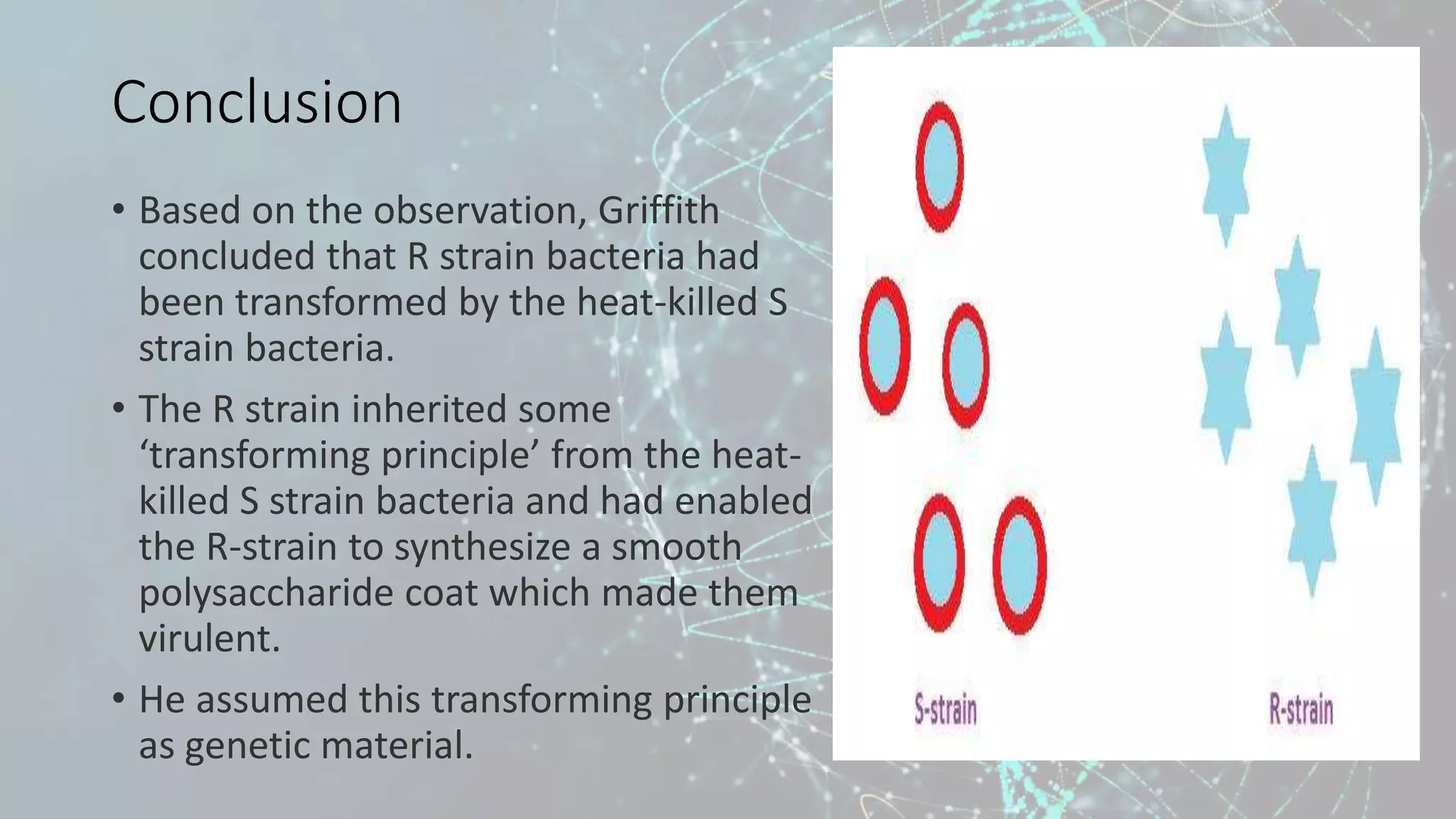
• One culture plate consisted of smooth shiny colonies
(S) while other consisted of rough colonies (R).
• The difference was due to the presence of mucous
coat in S strain bacteria, whereas the R strain
bacteria lacked them.
Experiment
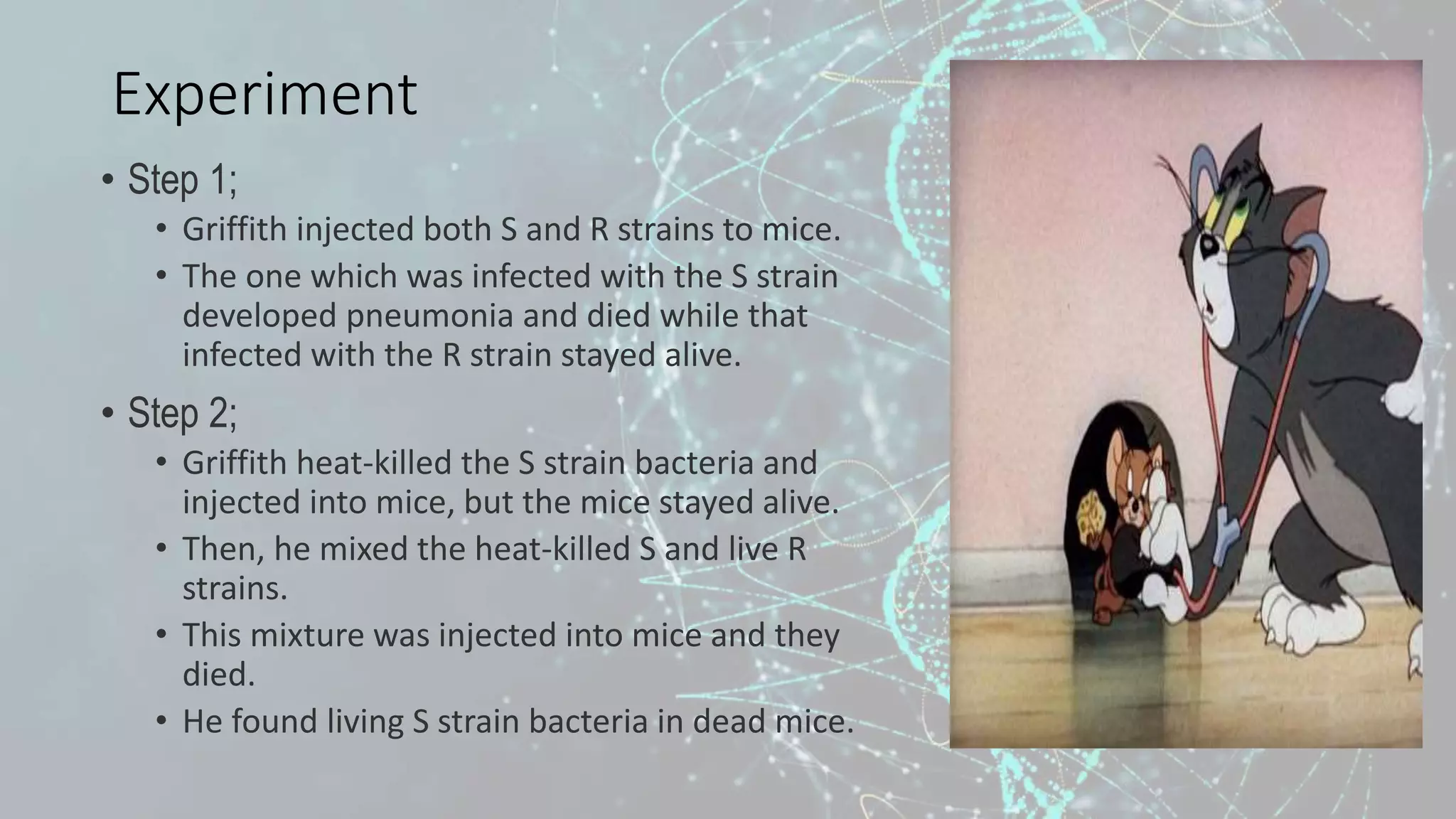
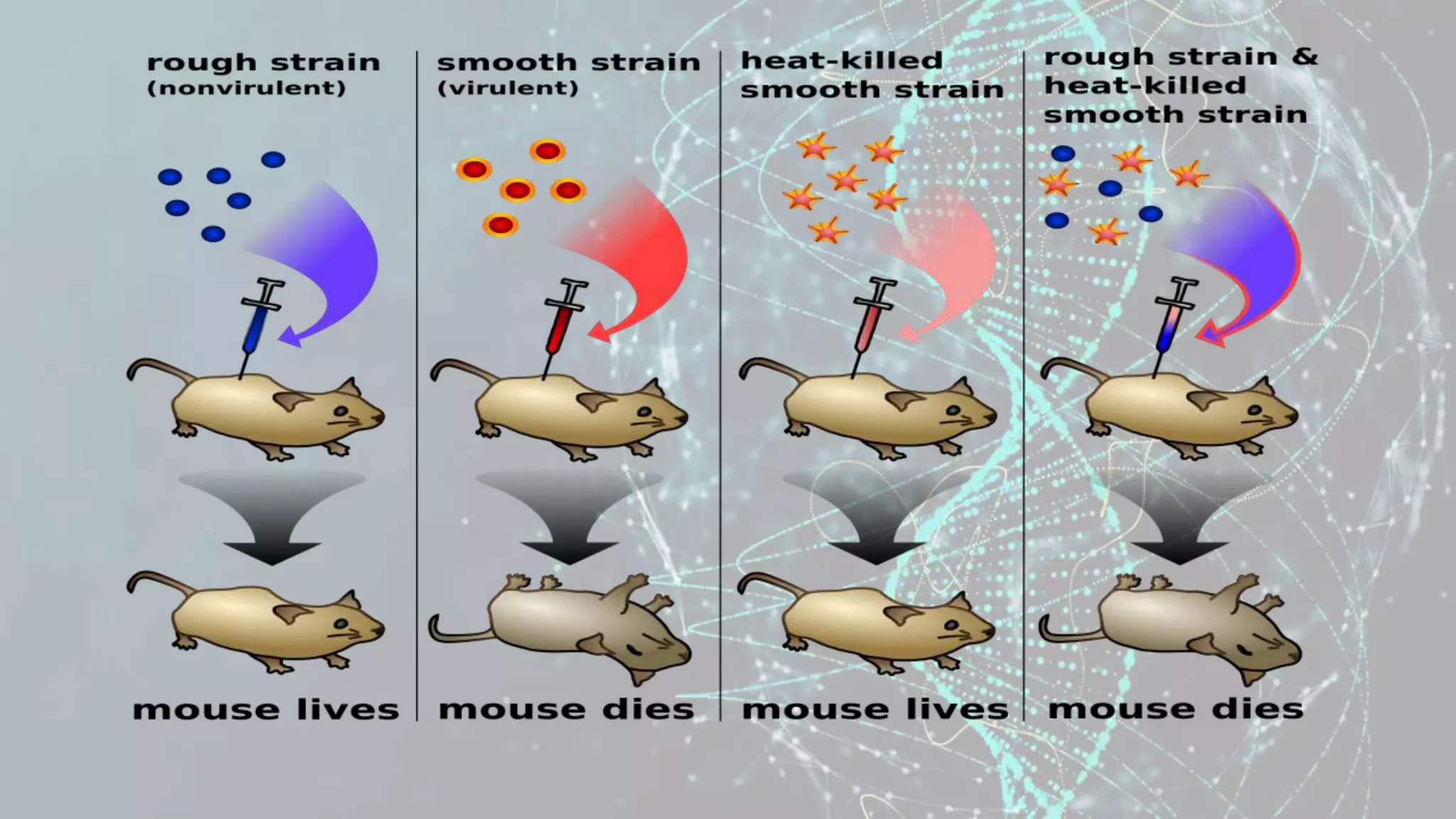
• Step 1;
• Griffith injected both S and R strains to mice.
• The one which was infected with the S strain
developed pneumonia and died while that
infected with the R strain stayed alive.
• Step 2;
• Griffith heat-killed the S strain bacteria and
injected into mice, but the mice stayed alive.
• Then, he mixed the heat-killed S and live R
strains.
• This mixture was injected into mice and they
died.
• He found living S strain bacteria in dead mice.
Conclusion
• Based on the observation, Griffith
concluded that R strain bacteria had
been transformed by the heat-killed S
strain bacteria.
• The R strain inherited some
‘transforming principle’ from the heat-
killed S strain bacteria and had enabled
the R-strain to synthesize a smooth
polysaccharide coat which made them
virulent.
• He assumed this transforming principle
as genetic material.
DNA and Genetic material
• Griffith’s experiment was a turning point towards the discovery of
hereditary material.
• However, it failed to explain the biochemistry of genetic material.
• Hence, a group of scientists, Oswald Avery, Colin MacLeod and
Maclyn McCarty continued the Griffith experiment in search of
biochemical nature of the hereditary material.
• Their discovery revised the concept of protein as genetic material
to DNA.
Avery, MacLeod and McCarty’s conclusion
• They extracted and purified proteins, DNA, RNA and other
biomolecules from the heat-killed S strain bacteria.
• They discovered that DNA is the genetic material and it is alone
responsible for the transformation of the R strain bacteria.
• They observed that protein-digesting enzymes (proteases) and RNA-
digesting enzymes (RNases) didn’t inhibit transformation but DNase
did.
• Although it was not accepted by all, they concluded DNA as genetic
material.
~THE
END
-HOPE YOU ENJOYED.

Griffith experiment

  • 1.
  • 2.
    Contents: 1. Initial Discoveries 2.Griffith’s experiment and Transformation principal 3. Experiment 4. Conclusion 5. DNA and genetic material 6. Avery, MacLeod and McCarty’s conclusions
  • 3.
    Initial discoveries • Thesearch for Genetic material started during the mid-nineteenth century. • The principle of inheritance was discovered by Mendel. • Even though the chromosomal components were identified, the material which is responsible for inheritance remained unanswered. • It took a long time for the acceptance of DNA as the genetic transformation.
  • 4.
    Griffith’s Experiment • Griffithexperiment was a stepping stone for the discovery of genetic material. • Frederick Griffith’s experiments were conducted with Streptococcus pneumoniae. • During the experiment, Griffith cultured Streptococcus pneumoniae bacteria which showed two patterns of growth. • One culture plate consisted of smooth shiny colonies (S) while other consisted of rough colonies (R). • The difference was due to the presence of mucous coat in S strain bacteria, whereas the R strain bacteria lacked them.
  • 5.
    Experiment • Step 1; •Griffith injected both S and R strains to mice. • The one which was infected with the S strain developed pneumonia and died while that infected with the R strain stayed alive. • Step 2; • Griffith heat-killed the S strain bacteria and injected into mice, but the mice stayed alive. • Then, he mixed the heat-killed S and live R strains. • This mixture was injected into mice and they died. • He found living S strain bacteria in dead mice.
  • 7.
    Conclusion • Based onthe observation, Griffith concluded that R strain bacteria had been transformed by the heat-killed S strain bacteria. • The R strain inherited some ‘transforming principle’ from the heat- killed S strain bacteria and had enabled the R-strain to synthesize a smooth polysaccharide coat which made them virulent. • He assumed this transforming principle as genetic material.
  • 8.
    DNA and Geneticmaterial • Griffith’s experiment was a turning point towards the discovery of hereditary material. • However, it failed to explain the biochemistry of genetic material. • Hence, a group of scientists, Oswald Avery, Colin MacLeod and Maclyn McCarty continued the Griffith experiment in search of biochemical nature of the hereditary material. • Their discovery revised the concept of protein as genetic material to DNA.
  • 9.
    Avery, MacLeod andMcCarty’s conclusion • They extracted and purified proteins, DNA, RNA and other biomolecules from the heat-killed S strain bacteria. • They discovered that DNA is the genetic material and it is alone responsible for the transformation of the R strain bacteria. • They observed that protein-digesting enzymes (proteases) and RNA- digesting enzymes (RNases) didn’t inhibit transformation but DNase did. • Although it was not accepted by all, they concluded DNA as genetic material.
  • 10.