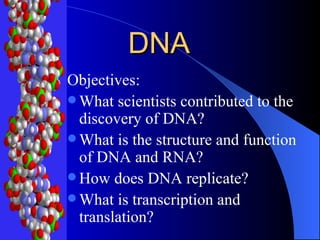
DNA Objectives: What scientists contributed to the discovery of DNA? What is the structure and function of DNA and RNA? How does DNA replicate? What is transcription and translation? jj
History Rosalind Franklin, and her colleague Maurice Wilkins,  in 1950 X-Rayed DNA to determine the basic structure.  In 1953 Scientists Watson and Crick used evidence from other scientists to determine the structure of DNA. X-ray photograph taken by Roseland Franklin
Structure of DNA Monomers = nucleotides Each nucleotide contains 3 basic parts: Millions of these bases combine to form DNA! a 5-carbon sugar (deoxyribose) a phosphate group and one of four nitrogen bases base sugar P
DNA structure – nitrogen bases The 4 different bases are Adenine, Thymine, Cytosine, and Guanine. They pair to form the ladder-like structure that is DNA A sugar P T sugar P A pairs with T C sugar P G sugar P C pairs with G
What Does DNA Stand For? D =  Deoxyribose sugar NA =  Nucleic Acid Deoxyribonucleic acid
DNA structure – nitrogen bases Millions Base pairs long! Twists to double helix shape
The double helix looks like a double twisted ladder This is further twisted and packed into chromosomes in the nucleus.
Draw your own DNA strand Use the format on the left Strand should be 8 base pairs long Include a key telling what A, G, C, T, S, and P stand for A, G, C, and T can be in any order, but must be paired correctly! A s P T s P C s P G s P
DNA Replication                                                                                             DNA before replication The 2 strands unzip, exposing the nucleotides The free “floating” nucleotides pair with the exposed nucleotides, forming 2 identical chains.
Replicate your own DNA strand Use scissors to cut your DNA in half (normally enzymes do this job) Tape or glue your 2 new strands. Draw in the missing Nucleic Acids to complete your two strands. A s P C s P T s P G s P


Dna

  • 1.
    DNA Objectives: Whatscientists contributed to the discovery of DNA? What is the structure and function of DNA and RNA? How does DNA replicate? What is transcription and translation? jj
  • 2.
    History Rosalind Franklin,and her colleague Maurice Wilkins, in 1950 X-Rayed DNA to determine the basic structure. In 1953 Scientists Watson and Crick used evidence from other scientists to determine the structure of DNA. X-ray photograph taken by Roseland Franklin
  • 3.
    Structure of DNAMonomers = nucleotides Each nucleotide contains 3 basic parts: Millions of these bases combine to form DNA! a 5-carbon sugar (deoxyribose) a phosphate group and one of four nitrogen bases base sugar P
  • 4.
    DNA structure –nitrogen bases The 4 different bases are Adenine, Thymine, Cytosine, and Guanine. They pair to form the ladder-like structure that is DNA A sugar P T sugar P A pairs with T C sugar P G sugar P C pairs with G
  • 5.
    What Does DNAStand For? D = Deoxyribose sugar NA = Nucleic Acid Deoxyribonucleic acid
  • 6.
    DNA structure –nitrogen bases Millions Base pairs long! Twists to double helix shape
  • 7.
    The double helixlooks like a double twisted ladder This is further twisted and packed into chromosomes in the nucleus.
  • 8.
    Draw your ownDNA strand Use the format on the left Strand should be 8 base pairs long Include a key telling what A, G, C, T, S, and P stand for A, G, C, and T can be in any order, but must be paired correctly! A s P T s P C s P G s P
  • 9.
    DNA Replication                                                                                            DNA before replication The 2 strands unzip, exposing the nucleotides The free “floating” nucleotides pair with the exposed nucleotides, forming 2 identical chains.
  • 10.
    Replicate your ownDNA strand Use scissors to cut your DNA in half (normally enzymes do this job) Tape or glue your 2 new strands. Draw in the missing Nucleic Acids to complete your two strands. A s P C s P T s P G s P
  • 11.
  • 12.