Implementing Technology-Enhanced Learning @ DMU, 2010-13 Richard Hall (rhall1@dmu.ac.uk, @hallymk1) e-Learning Co-ordinator, National Teaching Fellow
Some things to think about An audit of technologies and how they inter-relate. What gaps, overlaps or omissions exist? A focus upon one of three possible scenarios,  identifying the technologies that [should] support each scenario. Is our vision of joined-up systems viable?
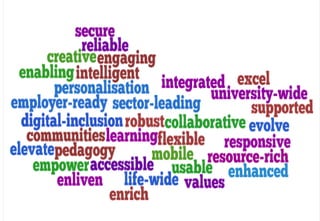
Delivery of a sector-leading environment that frames staff/student engagement with TEL
 
What is TEL at DMU? DMU-managed technologies Portal: MyDMU and Gmail Virtual Learning Environment: Blackboard for programme management, learning materials and communication; social media via blogs and wikis multimedia via podcasts and streaming video; Turnitin for plagiarism detection; and Course Genie and Articulate for content enhancement. Library systems: Talis; ASK; DORA etc.
What is TEL at DMU? Non-DMU tech supported via professional development User-generated media: external blogs, wikis, googledocs [for reflection and shared writing] Social networks: Facebook, Ning [for group-work] Multimedia: iTunes, YouTube [for module/student content] Aggregation of content: RSS, Google Reader etc [for module content] Social bookmarking: diigo, delicious [for module content and reading lists]
Blackboard usage: 2007-10 2007–08 2008–09 2009–10 [to April] Total logins 1,320,489   1,579,027   1,212,674   Active Students 20,677  20,574  22,358   Active Staff 1,704  1,933  1,822  Live modules on Bb 1,327  1,810  1,856  Live courses as a proportion of the validated curriculum  61.2%  83.7%  85.8%
An overview of the DMU context Increasing usage of our systems over past 36 months Evidence of integrated and sophisticated development: a mixed economy Emerging Champions’ networks in each Faculty Emerging departmental or programme strategies New models for professional development R&D capacity related to TEL is growing: Pathfinder; Benchmarking; Transitions; Placements; GreenICT; OERs; NTFS
Student evaluations  developing personalisation in a social context networking, access and participation interpreting feedback  through networks towards critical literacy and the co-creation of knowledge
Staff self-evaluation Most popular tools: Blackboard; YouTube; wikis and blogs; social networks Used primarily for information and resource management  Multimedia, mobiles and assessment are priority areas Positive student feedback but need more support to enhance learning  A mixed view of Web 2.0 tools: understanding and encouragement to use Differentiated use within programmes
What is the place of social media in the twenty-first century University? DEMOS Edgeless University/Resilient Nation: what is the idea of the University? Digital Economy  Act: what is the idea of co-producion? JISC Report,  Thriving in the 21st century ; FutureLab,  Beyond current horizons :   what is the idea of learning? Committee of Inquiry into the impact on HE of  students’ use of Web 2.0 : what is the idea of teaching? Revised  HEFCE  Strategy: what is the place of social media in HE?
Spaces for digital work and study LLiDA  report (2009)   there is a tension between recognising an ‘entitlement’ to basic digital literacy, and recognising technology practice as diverse and constitutive of personal identity, including identity in different peer, subject and workplace communities, and individual styles of participation Literacies emerge through authentic, well-designed tasks in meaningful contexts
The ‘Realtime’ student generation Expectations 38% wanted lectures to be broadcast on the WEB 81% wanted lecturers to use Instant Messaging to communicate with them 67% said that 'technology' experience would influence their choice of University “ The University sector cannot ignore the impact technology experience will have on student intake and associated revenue streams” “ Access to technology is now a heavily consumer driven experience, and this will create demands on IT departments across sectors to offer a wider range of devices and services than expected by past or even existing IT users” Source: Logicalis Survey “The Rise of The UK Realtime Generation” 2007
Ravensbourne, 2008
Beyond DMU: student view “ A real focus on trying to get a sense of academic community back into our institutions” “ active participants or effective co-producers of their education [rather than seen in terms of] heavy, utilitarian language” Aaron Porter , VP HE (NUS), on Higher Ambitions [23/11/09] A focus on diversity of provision, student demands and increasing debt at the June 2010  Escalate  conference
Caveats a tendency for both teachers and learners to ‘rein in’ these potentially radical and challenging effects of the new media formations, to control and constrain them within more orthodox understandings of authorship, assessment, collaboration and formal learning Hemmi  et al ., JCAL, 25(1), 2009 educational technology as a profoundly social, cultural and political concern Selwyn, JCAL, 26(1), 2010
Taking forward change How is our development of technology impacted at these levels? Institutional: a vision of the University: private or social enterprise? Tags: affiliation; complexity; openness Individual: a focus on *the learner*. What about staff? Tags: inclusive networks; mentoring; personalisation Curricula: what about progressive pedagogy? Tag: co-production; co-governance
Taking forward change: a programme of work @ DMU Strategic: how does edtech enable our educational and social values? Institutional: how do we address differential experience, expertise, demand and workloads? Professional: how does edtech underpin professional identity? Learner: how do we make and act upon good-enough decisions? Think people, tech, data, policy, process, outcomes, benefits, projects
Taking forward change: benefits Enhanced resilience of DMU’s academic provision. Increased recognition within the HE sector of DMU as a leading TEL provider. Enhanced flexibility and efficiency of core business processes and systems related to TEL.
Taking forward change: outcomes Integration of core and personal technologies A coherent infrastructure and value-added services that are reliable, consistent and readily accessible on and off campus. Organisational and policy structures that support the agile delivery of TEL. Learners will develop their own digital identities through PLEs. Academic teams will demonstrate enhanced integration of TEL. An accredited development pathway for practitioners. Increased capacity for research and EIG related to TEL.
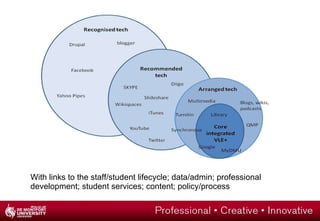
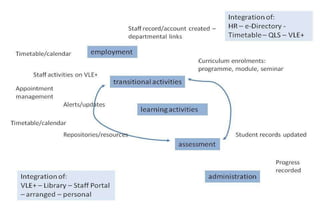
With links to the staff/student lifecycle; data/admin; professional development; student services; content; policy/process
 
 
Taking forward change: planning Scoping projects e-Administration/e-Services/e-Content Professional/Learning literacies/research marketing of TEL @ DMU Programme plan Delivery/governance
Taking forward change:  energy, carbon, cash It is estimated that ICT accounts for 2% of global carbon dioxide emissions  (same as airline industry) , and that its use in UK further and higher education generates over 500,000 tonnes of carbon dioxide emissions pa. [ 1.75% in delivery of services, 0.25% in production processes.] The UK government has a target to reduce carbon dioxide emissions by 26% from 1990 levels by 2020 Personal computing (PCs, laptops, monitors) is the main area of ICT-related energy consumption in UK universities and colleges, at 40–50% of the total, and digital printing is a further 10–16% JISC Susteit Report 2009
“ the overall energy use is growing at a much faster rate than technological development and deployment can offset. According to the Smart2020 report the footprint of the ICT industry is set to rise [0.5 GtCO2e today] to 1.4 GtCO2e in 2020; ie a 280% increase at global level, largely due to the expected increased take-up of ICT in developing economies.” (ICT for Energy Efficiency EU Report)  “ While the sector plans to significantly step up the energy efficiency of its products and services, ICT’s largest influence will be by enabling energy efficiencies in other sectors, an opportunity that could deliver carbon savings five times larger than the total emissions from the entire ICT sector in 2020.” (SMART2020 Report 2008) Taking forward change: r ebound/behaviours
Licensing This presentation is licensed under a Creative Commons, Attribution-Non-Commercial-Share Alike 2.0 UK: England & Wales license See: http://creativecommons.org/licenses/by-nc-sa/2.0/uk/

Developing Technology-Enhanced Learning at DMU

  • 1.
    Implementing Technology-Enhanced Learning@ DMU, 2010-13 Richard Hall (rhall1@dmu.ac.uk, @hallymk1) e-Learning Co-ordinator, National Teaching Fellow
  • 2.
    Some things tothink about An audit of technologies and how they inter-relate. What gaps, overlaps or omissions exist? A focus upon one of three possible scenarios, identifying the technologies that [should] support each scenario. Is our vision of joined-up systems viable?
  • 3.
    Delivery of asector-leading environment that frames staff/student engagement with TEL
  • 4.
  • 5.
    What is TELat DMU? DMU-managed technologies Portal: MyDMU and Gmail Virtual Learning Environment: Blackboard for programme management, learning materials and communication; social media via blogs and wikis multimedia via podcasts and streaming video; Turnitin for plagiarism detection; and Course Genie and Articulate for content enhancement. Library systems: Talis; ASK; DORA etc.
  • 6.
    What is TELat DMU? Non-DMU tech supported via professional development User-generated media: external blogs, wikis, googledocs [for reflection and shared writing] Social networks: Facebook, Ning [for group-work] Multimedia: iTunes, YouTube [for module/student content] Aggregation of content: RSS, Google Reader etc [for module content] Social bookmarking: diigo, delicious [for module content and reading lists]
  • 7.
    Blackboard usage: 2007-102007–08 2008–09 2009–10 [to April] Total logins 1,320,489 1,579,027 1,212,674 Active Students 20,677 20,574 22,358 Active Staff 1,704 1,933 1,822 Live modules on Bb 1,327 1,810 1,856 Live courses as a proportion of the validated curriculum 61.2% 83.7% 85.8%
  • 8.
    An overview ofthe DMU context Increasing usage of our systems over past 36 months Evidence of integrated and sophisticated development: a mixed economy Emerging Champions’ networks in each Faculty Emerging departmental or programme strategies New models for professional development R&D capacity related to TEL is growing: Pathfinder; Benchmarking; Transitions; Placements; GreenICT; OERs; NTFS
  • 9.
    Student evaluations developing personalisation in a social context networking, access and participation interpreting feedback through networks towards critical literacy and the co-creation of knowledge
  • 10.
    Staff self-evaluation Mostpopular tools: Blackboard; YouTube; wikis and blogs; social networks Used primarily for information and resource management Multimedia, mobiles and assessment are priority areas Positive student feedback but need more support to enhance learning A mixed view of Web 2.0 tools: understanding and encouragement to use Differentiated use within programmes
  • 11.
    What is theplace of social media in the twenty-first century University? DEMOS Edgeless University/Resilient Nation: what is the idea of the University? Digital Economy Act: what is the idea of co-producion? JISC Report, Thriving in the 21st century ; FutureLab, Beyond current horizons : what is the idea of learning? Committee of Inquiry into the impact on HE of students’ use of Web 2.0 : what is the idea of teaching? Revised HEFCE Strategy: what is the place of social media in HE?
  • 12.
    Spaces for digitalwork and study LLiDA report (2009) there is a tension between recognising an ‘entitlement’ to basic digital literacy, and recognising technology practice as diverse and constitutive of personal identity, including identity in different peer, subject and workplace communities, and individual styles of participation Literacies emerge through authentic, well-designed tasks in meaningful contexts
  • 13.
    The ‘Realtime’ studentgeneration Expectations 38% wanted lectures to be broadcast on the WEB 81% wanted lecturers to use Instant Messaging to communicate with them 67% said that 'technology' experience would influence their choice of University “ The University sector cannot ignore the impact technology experience will have on student intake and associated revenue streams” “ Access to technology is now a heavily consumer driven experience, and this will create demands on IT departments across sectors to offer a wider range of devices and services than expected by past or even existing IT users” Source: Logicalis Survey “The Rise of The UK Realtime Generation” 2007
  • 14.
  • 15.
    Beyond DMU: studentview “ A real focus on trying to get a sense of academic community back into our institutions” “ active participants or effective co-producers of their education [rather than seen in terms of] heavy, utilitarian language” Aaron Porter , VP HE (NUS), on Higher Ambitions [23/11/09] A focus on diversity of provision, student demands and increasing debt at the June 2010 Escalate conference
  • 16.
    Caveats a tendencyfor both teachers and learners to ‘rein in’ these potentially radical and challenging effects of the new media formations, to control and constrain them within more orthodox understandings of authorship, assessment, collaboration and formal learning Hemmi et al ., JCAL, 25(1), 2009 educational technology as a profoundly social, cultural and political concern Selwyn, JCAL, 26(1), 2010
  • 17.
    Taking forward changeHow is our development of technology impacted at these levels? Institutional: a vision of the University: private or social enterprise? Tags: affiliation; complexity; openness Individual: a focus on *the learner*. What about staff? Tags: inclusive networks; mentoring; personalisation Curricula: what about progressive pedagogy? Tag: co-production; co-governance
  • 18.
    Taking forward change:a programme of work @ DMU Strategic: how does edtech enable our educational and social values? Institutional: how do we address differential experience, expertise, demand and workloads? Professional: how does edtech underpin professional identity? Learner: how do we make and act upon good-enough decisions? Think people, tech, data, policy, process, outcomes, benefits, projects
  • 19.
    Taking forward change:benefits Enhanced resilience of DMU’s academic provision. Increased recognition within the HE sector of DMU as a leading TEL provider. Enhanced flexibility and efficiency of core business processes and systems related to TEL.
  • 20.
    Taking forward change:outcomes Integration of core and personal technologies A coherent infrastructure and value-added services that are reliable, consistent and readily accessible on and off campus. Organisational and policy structures that support the agile delivery of TEL. Learners will develop their own digital identities through PLEs. Academic teams will demonstrate enhanced integration of TEL. An accredited development pathway for practitioners. Increased capacity for research and EIG related to TEL.
  • 21.
    With links tothe staff/student lifecycle; data/admin; professional development; student services; content; policy/process
  • 22.
  • 23.
  • 24.
    Taking forward change:planning Scoping projects e-Administration/e-Services/e-Content Professional/Learning literacies/research marketing of TEL @ DMU Programme plan Delivery/governance
  • 25.
    Taking forward change: energy, carbon, cash It is estimated that ICT accounts for 2% of global carbon dioxide emissions (same as airline industry) , and that its use in UK further and higher education generates over 500,000 tonnes of carbon dioxide emissions pa. [ 1.75% in delivery of services, 0.25% in production processes.] The UK government has a target to reduce carbon dioxide emissions by 26% from 1990 levels by 2020 Personal computing (PCs, laptops, monitors) is the main area of ICT-related energy consumption in UK universities and colleges, at 40–50% of the total, and digital printing is a further 10–16% JISC Susteit Report 2009
  • 26.
    “ the overallenergy use is growing at a much faster rate than technological development and deployment can offset. According to the Smart2020 report the footprint of the ICT industry is set to rise [0.5 GtCO2e today] to 1.4 GtCO2e in 2020; ie a 280% increase at global level, largely due to the expected increased take-up of ICT in developing economies.” (ICT for Energy Efficiency EU Report) “ While the sector plans to significantly step up the energy efficiency of its products and services, ICT’s largest influence will be by enabling energy efficiencies in other sectors, an opportunity that could deliver carbon savings five times larger than the total emissions from the entire ICT sector in 2020.” (SMART2020 Report 2008) Taking forward change: r ebound/behaviours
  • 27.
    Licensing This presentationis licensed under a Creative Commons, Attribution-Non-Commercial-Share Alike 2.0 UK: England & Wales license See: http://creativecommons.org/licenses/by-nc-sa/2.0/uk/

Editor's Notes

  • #14 New students come from a BSF background NTU stats show that technology is in the top 4 or factors when deciding upon a course and HEI Talk about benefits in recruitment, retention and satisfaction JISC InfoNet report ‘Exploring the Tangible Benefits of e-Learning’