Methacton School District Instructional Planning Models Cindy H. Goldsworthy, Ed. D. Evidence to Action, K-12 Consulting [email_address] December 13, 2010 9:00-3:00
Today’s Outcomes Discuss rationale & importance of instructional planning models Define and describe key components of evidence-based instructional planning model Review specific instructional planning models widely utilized in schools across PA/USA Determine plan of action for further study – work of committee
Welcome and Introductions Who is here? Collective experience of group!
Teaching today… “ Teaching is NOT rocket science. It is, in fact, far more complex and demanding work than rocket science”  (Richard Elmore, professor of education leadership at Harvard Graduate School of Education).
Teachers are Designers “ as essential act of our profession is the crafting of curriculum and learning experiences to meet specified purposes”  (Wiggins & McTighe, 2005)
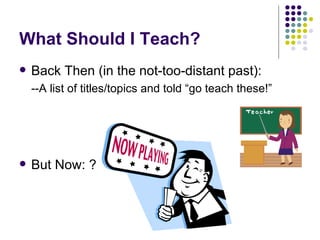
What Should I Teach? Back Then (in the not-too-distant past): --A list of titles/topics and told “go teach these!” But Now: ?
Today’s Demands – Public Education 21 st  century challenges Preparing kids for the world they will live & work in Keeping kids engaged in school while they live in a fast-moving world Global competition Legislative mandates NCLB & IDEIA Growth models & accountability Change, Change, Change! Common Core Standards The Art and Science of Teaching
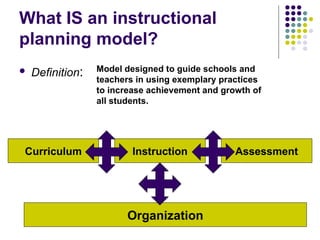
What IS an instructional planning model? Definition : Curriculum Instruction Assessment Organization Model designed to guide schools and teachers in using exemplary practices to increase achievement and growth of all students.
What It Is.. A shared planning model – for curriculum development, instructional delivery, and assessing students’ learning and how to organize for instruction, intervention, and climate Requires: Shared beliefs about teaching and learning Shared knowledge base on best practices Results in: A defined “way of doing business” that is both consistent and pervasive across an entire school system
Preliminary Key Discussion Points What do we all believe is the mission of Methacton relative to teaching and learning? What learning principles do we all agree upon? How frequently do we review/discuss/revise our thinking around this?
Why do districts implement instructional planning models? To align curriculum, instruction, and assessment To ensure consistency across teachers, grade levels, and courses To build or enhance a system-level focus on teaching and learning Your thoughts?
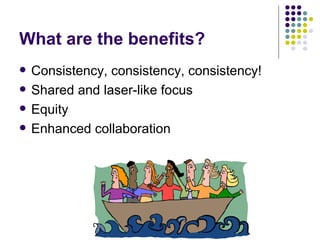
What are the benefits? Consistency, consistency, consistency! Shared and laser-like focus Equity  Enhanced collaboration
What are the challenges? Requires multi-year action plan Requires professional development focused on key components of instructional  model Requires teacher ownership and commitment across the system (not isolated pockets or buildings) Other?
So, what’s the goal again??? Develop a “language of instruction”  (Marzano)   - - -a district wide model of planning and delivering curriculum and instruction Develop a formal document that articulates the model at the district level and allow for schools within the district to add to the district model to reflect their unique interests   (Heartland Area Education Agency)
Current Status Building on what currently exists… Questions to ponder: Does Methacton have… a defined and shared method/model for planning courses? a defined and shared method/model for designing units? a defined and shared method for developing and writing curriculum? a defined and shared method for planning lessons? a defined and shared process for identifying and naming learning targets? (EQ? learning objective?) defined and shared knowledge about “teaching for understanding?” a defined and shared belief system about how students learn most effectively? Defined and shared beliefs and practices relative to assessing students’ learning? YOUR questions???
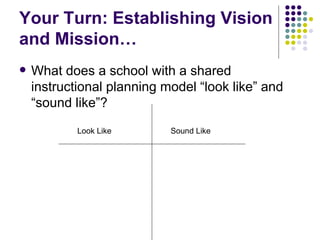
Your Turn: Establishing Vision and Mission… What does a school with a shared instructional planning model “look like” and “sound like”? Look Like Sound Like
Defining this Group’s Work! Choose an instructional planning model Create your own “hybrid” approach by assimilating the best components of existing models OR
Specific Models to Study Learning Focused Schools Dimensions of Learning Understanding by Design
UBD (Understanding by Design) Understanding by Design , or UbD, is an increasingly popular tool for educational planning focused on "teaching for understanding.” The emphasis of UbD is on "backward design", the practice of looking at the outcomes in order to design curriculum units, performance assessments, and classroom instruction. The UbD framework was designed by nationally recognized educators Grant Wiggins and Jay McTighe, and published by the Association for Supervision and Curriculum Development. According to Wiggins, "The potential of UbD for curricular improvement has struck a chord in American education. Over 250,000 educators own the book. Over 30,000 Handbooks are in use. More than 150 University education classes use the book as a text.”
More on UBD It is not a prescriptive program. It is not a philosophy of education, nor does it require a belief in any single pedagogical system or approach. It is focused on the design of curricular units (as opposed to individual lesson plans or broader programs)."
UBD Backward design Understanding by Design relies on what Wiggins and McTighe call "backward design" (also known as "backwards planning"). Teachers, according to UbD proponents, traditionally start curriculum planning with activities and textbooks instead of identifying classroom learning goals and planning towards that goal. In backward design, the teacher starts with classroom outcomes and then plans the curriculum, choosing activities and materials that help determine student ability and foster student learning.
Dimensions of Learning Dimensions of Learning is a comprehensive model that uses what researchers and theorists know about learning to define the learning process. Its premise is that five types of thinking (defined by DOL) are essential to successful learning. Developed by Marzano & Pickering (McREL) Research co-sponsored by McREL & ASCD
Dimensions of Learning Published in 1991 – new editions since then Based on research and field-tested in early 90’s The Dimensions framework is designed to help teachers…  maintain a focus on learning;  study the learning process; and  plan curriculum, instruction, and assessment that takes into account the five critical aspects of learning.
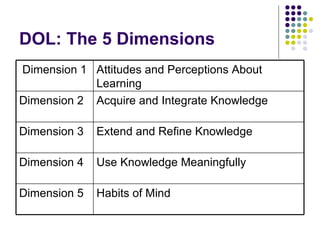
DOL: The 5 Dimensions Dimension 1 Attitudes and Perceptions About Learning Dimension 2 Acquire and Integrate Knowledge Dimension 3 Extend and Refine Knowledge Dimension 4 Use Knowledge Meaningfully Dimension 5 Habits of Mind
Learning Focused Schools Developed by Dr. Max Thompson (Learning Concepts) www.LearningFocused.com Developed in early 1990’s – materials revised, enhanced, expanded Widely used in PA and variety of states across PA Based on work of Marzano, Reeves, and others
More on LFS Based on four main components Curriculum Instruction Assessment Organization Emphasizes the importance of planning and organizing for instruction Focus on extending thinking and refining knowledge
Hybrid? Choose components from existing programs to develop customized model Components are all based in research and grounded in knowledge of what makes schools effective Advantage: customized to Methacton’s needs Disadvantage: requires commitment and time
Advantages & Disadvantages Cindy’s thoughts….  What  Matters…YOUR  thoughts!!!!
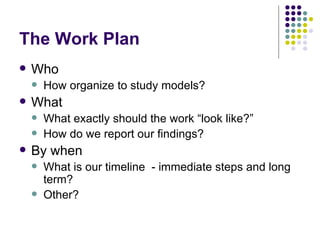
The Work Plan Who  How organize to study models? What What exactly should the work “look like?” How do we report our findings? By when What is our timeline  - immediate steps and long term? Other?
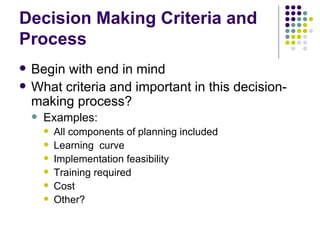
Decision Making Criteria and Process Begin with end in mind What criteria and important in this decision-making process? Examples: All components of planning included Learning  curve Implementation feasibility Training required Cost Other?
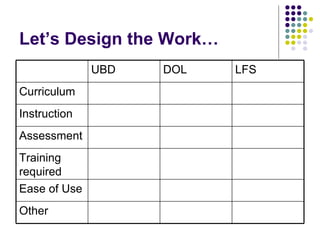
Let’s Design the Work… UBD DOL LFS Curriculum Instruction Assessment Training required Ease of Use Other
Steps in reviewing materials… Review the materials and resources provided Independently & collectively Network with others Other implementers Use internet to gather additional information on each model Read the background and evidence Use (provided) worksheets as guide as you review
Suggested Resource Review Questions: What is the background on the model (history, purpose, etc.)? To what degree has the model and its components been based on proven evidence? Are the materials “user-friendly?” Is the model comprehensive, i.e., does it contain quality information on curriculum, instruction, and assessment or will it need supplemental resources? How much training is needed (or required by its authors) for implementation to occur? What is the cost to purchase materials? Recurring costs? What are advantages and disadvantages that you see? What else have you learned about the model? Other questions?????????
Moving Forward Communicating the work of this committee How? To whom? When? Managing feedback, fears, and rumors
Action Steps… YOUR thoughts?
Resources Brown, D. S. (1988). Twelve middle-school teachers planning.  The Elementary School Journal , 89(l), 69-87.  Condon, D., & Maggs, A. (I986). Direct instruction research: An international focus.  International Journal of Special Education , 1, 35-47.  Doyle, W. (1984).  Effective classroom practices for secondary schools . R & D Report No. 619 1. Austin: Texas University Research and Development Center for Teacher Education.  Gagne, E. D. (I985). Strategies for effective teaching and learning. In  The cognitive psychology of school learning . Boston: Little, Brown.  Marzano, R.J. (1992). A Different Kind of Classroom: Teaching with Dimensions of Learning. Alexandria, VA: Association for Supervision and Curriculum Development. Sousa, D. (1997). How the Brain Learns: New Insights into the Teaching/Learning Process (Audiotape). Reston, VA: National Association of Secondary School Principals. Sousa, D. (1995). How the Brain Learns. Reston, VA: National Association of Secondary School Principals. Tileston, D.W. (2002). What Every Teacher Should Know About Planning. Thousand Oaks, CA: Corwin Press. Wiggins, Grant, and Jay McTighe. (1998). Understanding by Design, Alexandria, Virginia: Association for Supervision and Curriculum Development.
Resources, con’t. Gagne, R. M., & Briggs, L. J. (I 974).  Principles of instructional design . New York: Holt, Rinehart & Winston.  Gerston, R. (1986). Direct instruction: A research-based approach to curriculum design and teaching.  Exceptional Children,  53, 17-3 1.  Kallison, J. M. (I986). Effects of lesson organization on achievement.  American Educational Research Journal , 23(2), 337-347.  Moore, J. (I986). Direct instruction: A model of instructional design.  Educational Psychology , 6, 201-229.  Pratton, J., & Hates, L. W. (I985). The effects of active participation on student learning.  Journal of Educational Research , 79, 210-215.  Rosenshine, B., & Stevens, R. (I986). Teaching functions. In M. C. Wittrock (Ed.),  Handbook of Research on Training  (3rd ed., pp. 3 75-3 9 1). New York: Macmillan.
Closing Thoughts… “ Education is the passing on of the accumulated wisdom of generations to children, and we passionately believe in its importance because we know that it holds the promise of a “better life for each child, and for us all, collectively .”  (Willingham, Daniel T)

Instructional models

  • 1.
    Methacton School DistrictInstructional Planning Models Cindy H. Goldsworthy, Ed. D. Evidence to Action, K-12 Consulting [email_address] December 13, 2010 9:00-3:00
  • 2.
    Today’s Outcomes Discussrationale & importance of instructional planning models Define and describe key components of evidence-based instructional planning model Review specific instructional planning models widely utilized in schools across PA/USA Determine plan of action for further study – work of committee
  • 3.
    Welcome and IntroductionsWho is here? Collective experience of group!
  • 4.
    Teaching today… “Teaching is NOT rocket science. It is, in fact, far more complex and demanding work than rocket science” (Richard Elmore, professor of education leadership at Harvard Graduate School of Education).
  • 5.
    Teachers are Designers“ as essential act of our profession is the crafting of curriculum and learning experiences to meet specified purposes” (Wiggins & McTighe, 2005)
  • 6.
    What Should ITeach? Back Then (in the not-too-distant past): --A list of titles/topics and told “go teach these!” But Now: ?
  • 7.
    Today’s Demands –Public Education 21 st century challenges Preparing kids for the world they will live & work in Keeping kids engaged in school while they live in a fast-moving world Global competition Legislative mandates NCLB & IDEIA Growth models & accountability Change, Change, Change! Common Core Standards The Art and Science of Teaching
  • 8.
    What IS aninstructional planning model? Definition : Curriculum Instruction Assessment Organization Model designed to guide schools and teachers in using exemplary practices to increase achievement and growth of all students.
  • 9.
    What It Is..A shared planning model – for curriculum development, instructional delivery, and assessing students’ learning and how to organize for instruction, intervention, and climate Requires: Shared beliefs about teaching and learning Shared knowledge base on best practices Results in: A defined “way of doing business” that is both consistent and pervasive across an entire school system
  • 10.
    Preliminary Key DiscussionPoints What do we all believe is the mission of Methacton relative to teaching and learning? What learning principles do we all agree upon? How frequently do we review/discuss/revise our thinking around this?
  • 11.
    Why do districtsimplement instructional planning models? To align curriculum, instruction, and assessment To ensure consistency across teachers, grade levels, and courses To build or enhance a system-level focus on teaching and learning Your thoughts?
  • 12.
    What are thebenefits? Consistency, consistency, consistency! Shared and laser-like focus Equity Enhanced collaboration
  • 13.
    What are thechallenges? Requires multi-year action plan Requires professional development focused on key components of instructional model Requires teacher ownership and commitment across the system (not isolated pockets or buildings) Other?
  • 14.
    So, what’s thegoal again??? Develop a “language of instruction” (Marzano) - - -a district wide model of planning and delivering curriculum and instruction Develop a formal document that articulates the model at the district level and allow for schools within the district to add to the district model to reflect their unique interests (Heartland Area Education Agency)
  • 15.
    Current Status Buildingon what currently exists… Questions to ponder: Does Methacton have… a defined and shared method/model for planning courses? a defined and shared method/model for designing units? a defined and shared method for developing and writing curriculum? a defined and shared method for planning lessons? a defined and shared process for identifying and naming learning targets? (EQ? learning objective?) defined and shared knowledge about “teaching for understanding?” a defined and shared belief system about how students learn most effectively? Defined and shared beliefs and practices relative to assessing students’ learning? YOUR questions???
  • 16.
    Your Turn: EstablishingVision and Mission… What does a school with a shared instructional planning model “look like” and “sound like”? Look Like Sound Like
  • 17.
    Defining this Group’sWork! Choose an instructional planning model Create your own “hybrid” approach by assimilating the best components of existing models OR
  • 18.
    Specific Models toStudy Learning Focused Schools Dimensions of Learning Understanding by Design
  • 19.
    UBD (Understanding byDesign) Understanding by Design , or UbD, is an increasingly popular tool for educational planning focused on "teaching for understanding.” The emphasis of UbD is on "backward design", the practice of looking at the outcomes in order to design curriculum units, performance assessments, and classroom instruction. The UbD framework was designed by nationally recognized educators Grant Wiggins and Jay McTighe, and published by the Association for Supervision and Curriculum Development. According to Wiggins, "The potential of UbD for curricular improvement has struck a chord in American education. Over 250,000 educators own the book. Over 30,000 Handbooks are in use. More than 150 University education classes use the book as a text.”
  • 20.
    More on UBDIt is not a prescriptive program. It is not a philosophy of education, nor does it require a belief in any single pedagogical system or approach. It is focused on the design of curricular units (as opposed to individual lesson plans or broader programs)."
  • 21.
    UBD Backward designUnderstanding by Design relies on what Wiggins and McTighe call "backward design" (also known as "backwards planning"). Teachers, according to UbD proponents, traditionally start curriculum planning with activities and textbooks instead of identifying classroom learning goals and planning towards that goal. In backward design, the teacher starts with classroom outcomes and then plans the curriculum, choosing activities and materials that help determine student ability and foster student learning.
  • 22.
    Dimensions of LearningDimensions of Learning is a comprehensive model that uses what researchers and theorists know about learning to define the learning process. Its premise is that five types of thinking (defined by DOL) are essential to successful learning. Developed by Marzano & Pickering (McREL) Research co-sponsored by McREL & ASCD
  • 23.
    Dimensions of LearningPublished in 1991 – new editions since then Based on research and field-tested in early 90’s The Dimensions framework is designed to help teachers… maintain a focus on learning; study the learning process; and plan curriculum, instruction, and assessment that takes into account the five critical aspects of learning.
  • 24.
    DOL: The 5Dimensions Dimension 1 Attitudes and Perceptions About Learning Dimension 2 Acquire and Integrate Knowledge Dimension 3 Extend and Refine Knowledge Dimension 4 Use Knowledge Meaningfully Dimension 5 Habits of Mind
  • 25.
    Learning Focused SchoolsDeveloped by Dr. Max Thompson (Learning Concepts) www.LearningFocused.com Developed in early 1990’s – materials revised, enhanced, expanded Widely used in PA and variety of states across PA Based on work of Marzano, Reeves, and others
  • 26.
    More on LFSBased on four main components Curriculum Instruction Assessment Organization Emphasizes the importance of planning and organizing for instruction Focus on extending thinking and refining knowledge
  • 27.
    Hybrid? Choose componentsfrom existing programs to develop customized model Components are all based in research and grounded in knowledge of what makes schools effective Advantage: customized to Methacton’s needs Disadvantage: requires commitment and time
  • 28.
    Advantages & DisadvantagesCindy’s thoughts….  What Matters…YOUR thoughts!!!!
  • 29.
    The Work PlanWho How organize to study models? What What exactly should the work “look like?” How do we report our findings? By when What is our timeline - immediate steps and long term? Other?
  • 30.
    Decision Making Criteriaand Process Begin with end in mind What criteria and important in this decision-making process? Examples: All components of planning included Learning curve Implementation feasibility Training required Cost Other?
  • 31.
    Let’s Design theWork… UBD DOL LFS Curriculum Instruction Assessment Training required Ease of Use Other
  • 32.
    Steps in reviewingmaterials… Review the materials and resources provided Independently & collectively Network with others Other implementers Use internet to gather additional information on each model Read the background and evidence Use (provided) worksheets as guide as you review
  • 33.
    Suggested Resource ReviewQuestions: What is the background on the model (history, purpose, etc.)? To what degree has the model and its components been based on proven evidence? Are the materials “user-friendly?” Is the model comprehensive, i.e., does it contain quality information on curriculum, instruction, and assessment or will it need supplemental resources? How much training is needed (or required by its authors) for implementation to occur? What is the cost to purchase materials? Recurring costs? What are advantages and disadvantages that you see? What else have you learned about the model? Other questions?????????
  • 34.
    Moving Forward Communicatingthe work of this committee How? To whom? When? Managing feedback, fears, and rumors
  • 35.
  • 36.
    Resources Brown, D.S. (1988). Twelve middle-school teachers planning. The Elementary School Journal , 89(l), 69-87. Condon, D., & Maggs, A. (I986). Direct instruction research: An international focus. International Journal of Special Education , 1, 35-47. Doyle, W. (1984). Effective classroom practices for secondary schools . R & D Report No. 619 1. Austin: Texas University Research and Development Center for Teacher Education. Gagne, E. D. (I985). Strategies for effective teaching and learning. In The cognitive psychology of school learning . Boston: Little, Brown. Marzano, R.J. (1992). A Different Kind of Classroom: Teaching with Dimensions of Learning. Alexandria, VA: Association for Supervision and Curriculum Development. Sousa, D. (1997). How the Brain Learns: New Insights into the Teaching/Learning Process (Audiotape). Reston, VA: National Association of Secondary School Principals. Sousa, D. (1995). How the Brain Learns. Reston, VA: National Association of Secondary School Principals. Tileston, D.W. (2002). What Every Teacher Should Know About Planning. Thousand Oaks, CA: Corwin Press. Wiggins, Grant, and Jay McTighe. (1998). Understanding by Design, Alexandria, Virginia: Association for Supervision and Curriculum Development.
  • 37.
    Resources, con’t. Gagne,R. M., & Briggs, L. J. (I 974). Principles of instructional design . New York: Holt, Rinehart & Winston. Gerston, R. (1986). Direct instruction: A research-based approach to curriculum design and teaching. Exceptional Children, 53, 17-3 1. Kallison, J. M. (I986). Effects of lesson organization on achievement. American Educational Research Journal , 23(2), 337-347. Moore, J. (I986). Direct instruction: A model of instructional design. Educational Psychology , 6, 201-229. Pratton, J., & Hates, L. W. (I985). The effects of active participation on student learning. Journal of Educational Research , 79, 210-215. Rosenshine, B., & Stevens, R. (I986). Teaching functions. In M. C. Wittrock (Ed.), Handbook of Research on Training (3rd ed., pp. 3 75-3 9 1). New York: Macmillan.
  • 38.
    Closing Thoughts… “Education is the passing on of the accumulated wisdom of generations to children, and we passionately believe in its importance because we know that it holds the promise of a “better life for each child, and for us all, collectively .” (Willingham, Daniel T)