Professional Learning
              Communities
Graettinger-Terril Community School District
                            March 12, 2012
IF...
IF...


If I were a kid here at G-T (EL, MS, HS),
how would I know GTCSD is on the path
to becoming a high achieving school
and/or what would it take to continue on
this path?
IF...
We Are Your PLC!
We Are Your PLC!


Some entertainment to start our day off
right!
We Are Your PLC!


Some entertainment to start our day off
right!
http://www.youtube.com/watch?
v=7CsGao_i1BM
First...
First...

Jot down a definition of the term
Professional Learning Community
First...

Jot down a definition of the term
Professional Learning Community
Do you consider G-T CSD a PLC?
First...

Jot down a definition of the term
Professional Learning Community
Do you consider G-T CSD a PLC?
  Why or Why Not?
First...

Jot down a definition of the term
Professional Learning Community
Do you consider G-T CSD a PLC?
  Why or Why Not?
What professional development have you
personally done in the area of PLCs,
Assessment, and/or Interventions?
What is a PLC?
What is a PLC?

“An ongoing process in which educators work
collaboratively in recurring cycles of collective
inquiry and action research to achieve better results
for the students they serve...”
What is a PLC?

“An ongoing process in which educators work
collaboratively in recurring cycles of collective
inquiry and action research to achieve better results
for the students they serve...”
“A PLC is composed of collaborative teams whose
members work interdependently to achieve common
goals for which members are mutually accountable”
What is a PLC?

“An ongoing process in which educators work
collaboratively in recurring cycles of collective
inquiry and action research to achieve better results
for the students they serve...”
“A PLC is composed of collaborative teams whose
members work interdependently to achieve common
goals for which members are mutually accountable”
              from Learning by Doing, 2nd ed
What is a PLC?

“An ongoing process in which educators work
collaboratively in recurring cycles of collective
inquiry and action research to achieve better results
for the students they serve...”
“A PLC is composed of collaborative teams whose
members work interdependently to achieve common
goals for which members are mutually accountable”
              from Learning by Doing, 2nd ed
What is a PLC?

“An ongoing process in which educators work
collaboratively in recurring cycles of collective
inquiry and action research to achieve better results
for the students they serve...”
“A PLC is composed of collaborative teams whose
members work interdependently to achieve common
goals for which members are mutually accountable”
              from Learning by Doing, 2nd ed
What is a PLC?

“An ongoing process in which educators work
collaboratively in recurring cycles of collective
inquiry and action research to achieve better results
for the students they serve...”
“A PLC is composed of collaborative teams whose
members work interdependently to achieve common
goals for which members are mutually accountable”
              from Learning by Doing, 2nd ed
What PLCs are not...


A Program
What PLCs are not...


A Program
Wednesday Morning Meetings
What PLCs are not...


A Program
Wednesday Morning Meetings
Something the District “did” Last Year
What PLCs are not...


A Program
Wednesday Morning Meetings
Something the District “did” Last Year
A Book Study Group
The 3 Big Ideas of PLCs


A Focus on Learning
The 3 Big Ideas of PLCs


A Focus on Learning
A Culture of Collaboration
The 3 Big Ideas of PLCs


A Focus on Learning
A Culture of Collaboration
A Focus on Results
Big Idea #1: A Focus on Learning

  http://www.youtube.com/watch?v=FTeIA8l_Jl8&feature=related
Big Idea #1: A Focus on Learning

  http://www.youtube.com/watch?v=FTeIA8l_Jl8&feature=related


  All students can learn at high levels
Big Idea #1: A Focus on Learning

  http://www.youtube.com/watch?v=FTeIA8l_Jl8&feature=related


  All students can learn at high levels
  Teams take responsibility for that
  learning
Big Idea #1: A Focus on Learning

  http://www.youtube.com/watch?v=FTeIA8l_Jl8&feature=related


  All students can learn at high levels
  Teams take responsibility for that
  learning
  Adults are learning too
Current Practice


Do we provide targeted, differentiated,
research-based instruction to our
students?
Are our assessment and grading
practices aligned to support extending
learning time?
Big Idea #2: A Culture of Collaboration


  Educators work collaboratively to foster
  the learning of all students and accept
  collective responsibility for that learning
Big Idea #2: A Culture of Collaboration


  Educators work collaboratively to foster
  the learning of all students and accept
  collective responsibility for that learning
  Work of teams is to gain clarity around
  essential learning targets, develop common
  formative assessments and analyze data to
  increase student achievement
Big Idea #3: A Focus on Results

Teams develop and pursue measurable
improvement goals
Big Idea #3: A Focus on Results

Teams develop and pursue measurable
improvement goals
Teams review results of common formative
assessments to discover strengths and
weaknesses in their individual teaching in
order to learn from on another
Big Idea #3: A Focus on Results

Teams develop and pursue measurable
improvement goals
Teams review results of common formative
assessments to discover strengths and
weaknesses in their individual teaching in
order to learn from on another
Teams use data to identify students who need
additional time and support
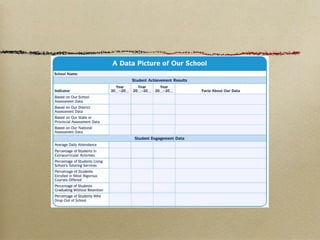
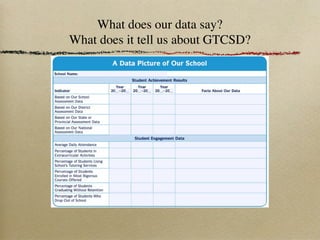
What does our data say?
What does it tell us about GTCSD?
What does our data say?
What does it tell us about GTCSD?
What does our data say?
    What does it tell us about GTCSD?


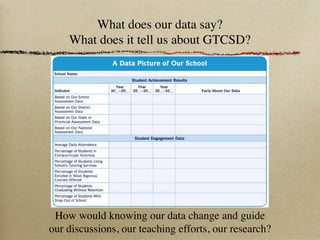
 How would knowing our data change and guide
our discussions, our teaching efforts, our research?
What does our data say?
    What does it tell us about GTCSD?


 How would knowing our data change and guide
our discussions, our teaching efforts, our research?
Where do we rate?
Where do we rate?

Learning should not be an accident; it should be
determined, assessed, and revisited through a systematic
approach...
Where do we rate?

Learning should not be an accident; it should be
determined, assessed, and revisited through a systematic
approach...
   Can we honestly say that we are approaching
   education, instruction and learning, with research-
   based and efficient methods?
Where do we rate?

Learning should not be an accident; it should be
determined, assessed, and revisited through a systematic
approach...
   Can we honestly say that we are approaching
   education, instruction and learning, with research-
   based and efficient methods?
       Regardless of “research-based” - is what we are
       doing working? What is the evidence that what we
       are currently doing is working?
Where do we rate?

Learning should not be an accident; it should be
determined, assessed, and revisited through a systematic
approach...
   Can we honestly say that we are approaching
   education, instruction and learning, with research-
   based and efficient methods?
       Regardless of “research-based” - is what we are
       doing working? What is the evidence that what we
       are currently doing is working?
If not, what is holding us back? What are the barriers?
Where do we want to send our kids?


 “Henry Higgins School” - where “We
 believe all kids can learn...and we will
 work to help all students achieve high
 standards of learning.”
Take a minute and discuss with a partner...

 What does our “District’s Purpose, Mission, Vision, Goals,
 Collective Commitments” mean to us?
Take a minute and discuss with a partner...

 What does our “District’s Purpose, Mission, Vision, Goals,
 Collective Commitments” mean to us?
     Mission: Why do we exist?
Take a minute and discuss with a partner...

 What does our “District’s Purpose, Mission, Vision, Goals,
 Collective Commitments” mean to us?
     Mission: Why do we exist?
     Vision: What do we hope to become?
Take a minute and discuss with a partner...

 What does our “District’s Purpose, Mission, Vision, Goals,
 Collective Commitments” mean to us?
     Mission: Why do we exist?
     Vision: What do we hope to become?
     Collective Commitments: What commitments must we make
     to create the school or district that will improve our ability
     to fulfill our purpose?
Take a minute and discuss with a partner...

 What does our “District’s Purpose, Mission, Vision, Goals,
 Collective Commitments” mean to us?
     Mission: Why do we exist?
     Vision: What do we hope to become?
     Collective Commitments: What commitments must we make
     to create the school or district that will improve our ability
     to fulfill our purpose?
     Goals: What goals will we use to monitor our progress?
Take a minute and discuss with a partner...

  What does our “District’s Purpose, Mission, Vision, Goals,
  Collective Commitments” mean to us?
      Mission: Why do we exist?
      Vision: What do we hope to become?
      Collective Commitments: What commitments must we make
      to create the school or district that will improve our ability
      to fulfill our purpose?
      Goals: What goals will we use to monitor our progress?

If you were to share this information with a new teacher,
     how would you summarize in your own words,
        through examples, stories, evidence, etc.?
Don’t tell me you believe
  “all kids can learn”…
tell me what you’re doing
      about the kids
   who aren’t learning.
        -- Rick DuFour

Intro to PLCs

  • 1.
    Professional Learning Communities Graettinger-Terril Community School District March 12, 2012
  • 2.
  • 3.
    IF... If I werea kid here at G-T (EL, MS, HS), how would I know GTCSD is on the path to becoming a high achieving school and/or what would it take to continue on this path?
  • 4.
  • 5.
  • 6.
    We Are YourPLC! Some entertainment to start our day off right!
  • 7.
    We Are YourPLC! Some entertainment to start our day off right! http://www.youtube.com/watch? v=7CsGao_i1BM
  • 8.
  • 9.
    First... Jot down adefinition of the term Professional Learning Community
  • 10.
    First... Jot down adefinition of the term Professional Learning Community Do you consider G-T CSD a PLC?
  • 11.
    First... Jot down adefinition of the term Professional Learning Community Do you consider G-T CSD a PLC? Why or Why Not?
  • 12.
    First... Jot down adefinition of the term Professional Learning Community Do you consider G-T CSD a PLC? Why or Why Not? What professional development have you personally done in the area of PLCs, Assessment, and/or Interventions?
  • 13.
  • 14.
    What is aPLC? “An ongoing process in which educators work collaboratively in recurring cycles of collective inquiry and action research to achieve better results for the students they serve...”
  • 15.
    What is aPLC? “An ongoing process in which educators work collaboratively in recurring cycles of collective inquiry and action research to achieve better results for the students they serve...” “A PLC is composed of collaborative teams whose members work interdependently to achieve common goals for which members are mutually accountable”
  • 16.
    What is aPLC? “An ongoing process in which educators work collaboratively in recurring cycles of collective inquiry and action research to achieve better results for the students they serve...” “A PLC is composed of collaborative teams whose members work interdependently to achieve common goals for which members are mutually accountable” from Learning by Doing, 2nd ed
  • 17.
    What is aPLC? “An ongoing process in which educators work collaboratively in recurring cycles of collective inquiry and action research to achieve better results for the students they serve...” “A PLC is composed of collaborative teams whose members work interdependently to achieve common goals for which members are mutually accountable” from Learning by Doing, 2nd ed
  • 18.
    What is aPLC? “An ongoing process in which educators work collaboratively in recurring cycles of collective inquiry and action research to achieve better results for the students they serve...” “A PLC is composed of collaborative teams whose members work interdependently to achieve common goals for which members are mutually accountable” from Learning by Doing, 2nd ed
  • 19.
    What is aPLC? “An ongoing process in which educators work collaboratively in recurring cycles of collective inquiry and action research to achieve better results for the students they serve...” “A PLC is composed of collaborative teams whose members work interdependently to achieve common goals for which members are mutually accountable” from Learning by Doing, 2nd ed
  • 20.
  • 21.
    What PLCs arenot... A Program
  • 22.
    What PLCs arenot... A Program Wednesday Morning Meetings
  • 23.
    What PLCs arenot... A Program Wednesday Morning Meetings Something the District “did” Last Year
  • 24.
    What PLCs arenot... A Program Wednesday Morning Meetings Something the District “did” Last Year A Book Study Group
  • 25.
    The 3 BigIdeas of PLCs
  • 26.
    The 3 BigIdeas of PLCs A Focus on Learning
  • 27.
    The 3 BigIdeas of PLCs A Focus on Learning A Culture of Collaboration
  • 28.
    The 3 BigIdeas of PLCs A Focus on Learning A Culture of Collaboration A Focus on Results
  • 29.
    Big Idea #1:A Focus on Learning
  • 30.
    Big Idea #1:A Focus on Learning http://www.youtube.com/watch?v=FTeIA8l_Jl8&feature=related
  • 31.
    Big Idea #1:A Focus on Learning http://www.youtube.com/watch?v=FTeIA8l_Jl8&feature=related All students can learn at high levels
  • 32.
    Big Idea #1:A Focus on Learning http://www.youtube.com/watch?v=FTeIA8l_Jl8&feature=related All students can learn at high levels Teams take responsibility for that learning
  • 33.
    Big Idea #1:A Focus on Learning http://www.youtube.com/watch?v=FTeIA8l_Jl8&feature=related All students can learn at high levels Teams take responsibility for that learning Adults are learning too
  • 34.
    Current Practice Do weprovide targeted, differentiated, research-based instruction to our students? Are our assessment and grading practices aligned to support extending learning time?
  • 35.
    Big Idea #2:A Culture of Collaboration
  • 36.
    Big Idea #2:A Culture of Collaboration Educators work collaboratively to foster the learning of all students and accept collective responsibility for that learning
  • 37.
    Big Idea #2:A Culture of Collaboration Educators work collaboratively to foster the learning of all students and accept collective responsibility for that learning Work of teams is to gain clarity around essential learning targets, develop common formative assessments and analyze data to increase student achievement
  • 38.
    Big Idea #3:A Focus on Results
  • 39.
    Big Idea #3:A Focus on Results Teams develop and pursue measurable improvement goals
  • 40.
    Big Idea #3:A Focus on Results Teams develop and pursue measurable improvement goals Teams review results of common formative assessments to discover strengths and weaknesses in their individual teaching in order to learn from on another
  • 41.
    Big Idea #3:A Focus on Results Teams develop and pursue measurable improvement goals Teams review results of common formative assessments to discover strengths and weaknesses in their individual teaching in order to learn from on another Teams use data to identify students who need additional time and support
  • 43.
    What does ourdata say? What does it tell us about GTCSD?
  • 44.
    What does ourdata say? What does it tell us about GTCSD?
  • 45.
    What does ourdata say? What does it tell us about GTCSD? How would knowing our data change and guide our discussions, our teaching efforts, our research?
  • 46.
    What does ourdata say? What does it tell us about GTCSD? How would knowing our data change and guide our discussions, our teaching efforts, our research?
  • 47.
  • 48.
    Where do werate? Learning should not be an accident; it should be determined, assessed, and revisited through a systematic approach...
  • 49.
    Where do werate? Learning should not be an accident; it should be determined, assessed, and revisited through a systematic approach... Can we honestly say that we are approaching education, instruction and learning, with research- based and efficient methods?
  • 50.
    Where do werate? Learning should not be an accident; it should be determined, assessed, and revisited through a systematic approach... Can we honestly say that we are approaching education, instruction and learning, with research- based and efficient methods? Regardless of “research-based” - is what we are doing working? What is the evidence that what we are currently doing is working?
  • 51.
    Where do werate? Learning should not be an accident; it should be determined, assessed, and revisited through a systematic approach... Can we honestly say that we are approaching education, instruction and learning, with research- based and efficient methods? Regardless of “research-based” - is what we are doing working? What is the evidence that what we are currently doing is working? If not, what is holding us back? What are the barriers?
  • 52.
    Where do wewant to send our kids?
  • 53.
    Where do wewant to send our kids? “Henry Higgins School” - where “We believe all kids can learn...and we will work to help all students achieve high standards of learning.”
  • 54.
    Take a minuteand discuss with a partner...
  • 55.
    Take a minuteand discuss with a partner... What does our “District’s Purpose, Mission, Vision, Goals, Collective Commitments” mean to us?
  • 56.
    Take a minuteand discuss with a partner... What does our “District’s Purpose, Mission, Vision, Goals, Collective Commitments” mean to us? Mission: Why do we exist?
  • 57.
    Take a minuteand discuss with a partner... What does our “District’s Purpose, Mission, Vision, Goals, Collective Commitments” mean to us? Mission: Why do we exist? Vision: What do we hope to become?
  • 58.
    Take a minuteand discuss with a partner... What does our “District’s Purpose, Mission, Vision, Goals, Collective Commitments” mean to us? Mission: Why do we exist? Vision: What do we hope to become? Collective Commitments: What commitments must we make to create the school or district that will improve our ability to fulfill our purpose?
  • 59.
    Take a minuteand discuss with a partner... What does our “District’s Purpose, Mission, Vision, Goals, Collective Commitments” mean to us? Mission: Why do we exist? Vision: What do we hope to become? Collective Commitments: What commitments must we make to create the school or district that will improve our ability to fulfill our purpose? Goals: What goals will we use to monitor our progress?
  • 60.
    Take a minuteand discuss with a partner... What does our “District’s Purpose, Mission, Vision, Goals, Collective Commitments” mean to us? Mission: Why do we exist? Vision: What do we hope to become? Collective Commitments: What commitments must we make to create the school or district that will improve our ability to fulfill our purpose? Goals: What goals will we use to monitor our progress? If you were to share this information with a new teacher, how would you summarize in your own words, through examples, stories, evidence, etc.?
  • 61.
    Don’t tell meyou believe “all kids can learn”… tell me what you’re doing about the kids who aren’t learning. -- Rick DuFour