Return of Shree Ram To Ayodhyaa
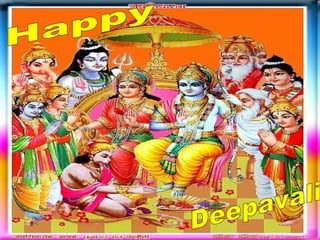
The most famous legend behind the celebrations of Diwali is
about the prince of Ayodhya Nagri - Lord Shree Ram. The
king of Lanka, Ravana, kidnapped Ram's wife - Sita from the
jungle, where they were staying as per the instructions of
King Dashratha, father of Lord Ram. In order to freed Sita
from Ravana's custody, Ram attacked him. This was
followed by a war, in which, Ram defeated Ravan and
released Sita from his custody. On the arrival of Lord Ram
along with his wife Sita, people of Ayodhya decorated their
homes as well as the city of Ayodhyaa by lighting tiny diyas
all over, in order to welcome their beloved prince Shree Ram
and Devi Sita.
Incarnation of Goddess Lakshmi
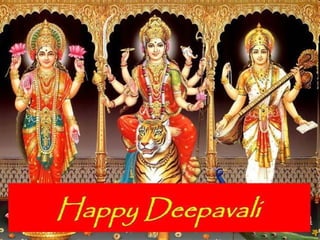
On the auspicious new moon day, which is 'Amavasyaa' of
the Hindi month of Kartik, the Goddess of wealth and
prosperity - Lakshmi was incarnated. She appeared during
the churning of the ocean, which is known as 'Samudra
Manthan', by the demons on one side and 'Devataas'
(Gods) on the other side. Therefore, the worship of
Goddess Lakshmi, the Lakshmi Pujan, on the day of Diwali,
became a tradition.
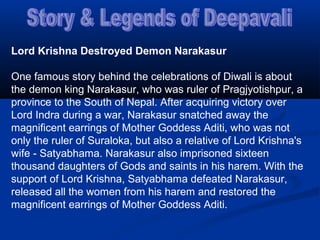
Lord Krishna Destroyed Demon Narakasur
One famous story behind the celebrations of Diwali is about
the demon king Narakasur, who was ruler of Pragjyotishpur, a
province to the South of Nepal. After acquiring victory over
Lord Indra during a war, Narakasur snatched away the
magnificent earrings of Mother Goddess Aditi, who was not
only the ruler of Suraloka, but also a relative of Lord Krishna's
wife - Satyabhama. Narakasur also imprisoned sixteen
thousand daughters of Gods and saints in his harem. With the
support of Lord Krishna, Satyabhama defeated Narakasur,
released all the women from his harem and restored the
magnificent earrings of Mother Goddess Aditi.
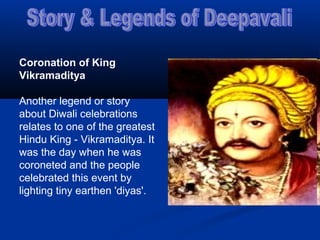
Coronation of King
Vikramaditya
Another legend or story
about Diwali celebrations
relates to one of the greatest
Hindu King - Vikramaditya. It
was the day when he was
coroneted and the people
celebrated this event by
lighting tiny earthen 'diyas'.
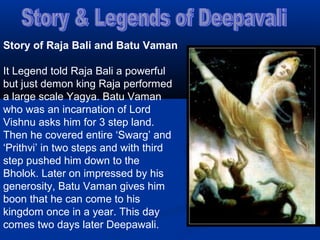
Story of Raja Bali and Batu Vaman
It Legend told Raja Bali a powerful
but just demon king Raja performed
a large scale Yagya. Batu Vaman
who was an incarnation of Lord
Vishnu asks him for 3 step land.
Then he covered entire ‘Swarg’ and
‘Prithvi’ in two steps and with third
step pushed him down to the
Bholok. Later on impressed by his
generosity, Batu Vaman gives him
boon that he can come to his
kingdom once in a year. This day
comes two days later Deepawali.
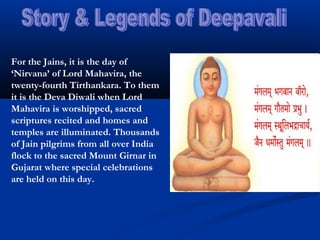
For the Jains, it is the day of
‘Nirvana’ of Lord Mahavira, the
twenty-fourth Tirthankara. To them
it is the Deva Diwali when Lord
Mahavira is worshipped, sacred
scriptures recited and homes and
temples are illuminated. Thousands
of Jain pilgrims from all over India
flock to the sacred Mount Girnar in
Gujarat where special celebrations
are held on this day.
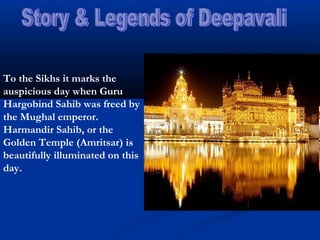
To the Sikhs it marks the
auspicious day when Guru
Hargobind Sahib was freed by
the Mughal emperor.
Harmandir Sahib, or the
Golden Temple (Amritsar) is
beautifully illuminated on this
day.
Diwali As Harvest Festival
Diwali signifies Harvest Festival. As it occurs at the end of a
cropping season and has along with the above customs, a few others
that reinforce the hypothesis of its having originated as a harvest
festival. Every harvest normally spelt prosperity. The celebration
was first started in India by farmers after they reaped their
harvests. They celebrated with joy and offered praises to God for
granting them a good crop.
On the second day of Deepavali, a ritual that is strongly suggestive
of the origin of Deepavali as an harvest festival is performed.
Worship of the Goddess of Wealth, Laxmi and performance of Aarti are
a part of the harvest festival. On this day delicacies are prepared
from pounded semi-cooked rice called Poha or Pauva. This rice is
taken from the fresh harvest available at that time. This custom is
prevalent both in rural and urban areas especially in Western India.
In rural areas, Diwali signifies only this aspect. The reason being
the fact that Diwali which is celebrated sometime in October/November
co-incides with the end of a harvesting season, known as the Kharif
season when the fresh crop of rice is available. Therefore, Diwali is
also considered by many rural hindus to be the harvest festival when
farmers offer prayers, and express their gratitude to the Almighty
for the bounty they received from him.
Regional Names of Deepavali in India
Before Diwali
Days before Diwali, people start decorating their
homes, preparing sweets, light up their homes
with colorful lights, buy new clothes & Jewelry.
But in some Indian regions the rituals of Diwali
starts off two days before Danteras, ie the first
day of Diwali. Such festival are:
Agyaras: The Patels and the Vaishnavs begin
their Diwali celebrations before Dhan Teras, on
the 11th day of Ashwin. The day is devoted to
preparing the choicest snacks and savories.
Wagh Baras: This day signifies the importance of
women in society. Women in the house are
worshiped and they buy new clothes and jewelry.
First Day
Dhanatrayodashi
Dhantrayodashi a special ritual is accomplished which is called Deepdaan. In it
lamps are lit for every individual in the family and ancestors and they are
floated in a river or pond.
Yamadeepdaan
In India, the festival of Dhanteras is also known as Yamadeepdaan. This name
is associated with Sixteen-year old son of King Hima was doomed to die but
the dedication of his young wife made Yam, the God of Death, return back.
Dhan Teyras
On Dhan Teyras, fast is kept and the worship is done by lighting an earthen
lamp on the main entrance of the house and offering water, vermilion, rice,
jaggery and flowers to Yamaraj.
Asweyuja Bahula Thrayodasi / Dhantheran
In few South Indian States this festival is known as Asweyuja Bahula
Thrayodasi or Dhantheran. This day is marked by buying new utensils and
silver/gold items.
Second Day
Choti Diwal
Choti Diwali or 'Small Diwali' is Diwali on a smaller scale, with fewer lights lit and fewer
crackers burst. This day is known as Choti Diwali in most North Indian States.
Narkachaturdashi
Celebrated in all South Indian states, God Yama is worshiped on this day to get over the fear
of demon Narakasura. People make an effigy of Narakasura, and burn it. Later, they take bath
and burst crackers.
Roop Chaturdashi
In all north Indian States, the second day of Diwali is also known as Roop Chaturdashi. On
this day, Hindus takes a ritual bath and perform Sadhana (Meditation) for gain of beauty and
magnetism.
Kali Choudas
The day before Divali is called Kali Chaudas and on this day, a head wash and application of
kajal in the eyes is believed to keep away the kali nazar (evil eye).
Mahanisha / Kali Puja
The festival of Diwali is known as Mahanisha in Bengal. It is believed that Maha Kali
appeared on this day, accompanied by 64,000 yoginis.
Divvela Panduga / Divili Panduga
Divvela Panduga, also known as Divili Panduga is one of the most significant festival of
Andhra Pradesh that include the legend of Narakaasura, decoration of house by rangolis, oil
lamps and celebration with fire crakers.
Third Day
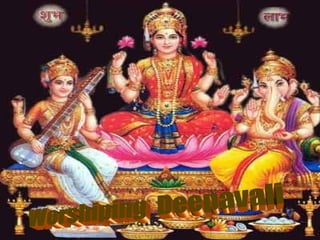
Laxmi Pujan
Diwali is synonymous with laxmi pujan. Houses are decorated,
Goddess laxmi is worshiped and the women do "aarti" to their
husbands, while praying for his long life.
Chopda Pujan
Diwali also represents the start of a new business year so all
businesses close their accounts and present them to Lakshmi and
Ganesh during the Chopda Pujan.
Deva Divali
Among Jains, Diwali is known as Deva Divali. It is on this day that
Lord Mahavira is worshiped, sacred scriptures are recited and homes
and temples are illuminated.
Sukhsuptika
Among the Kashmiri Pandit, the festival of lights is known as
Sukhsuptika, which literally means sleep with happiness.
Kaumudi Mahostavam
In some part of Andhra Pradesh the festival of Diwali is known as
Kaumudi Mahotsavam.
Third Day
Badhausar
In Gujarat, Diwali is known as Badhausar. On this day, Lakshmi is believed to visit
the homes that are well lit. So, families decorate their houses with light, flowers
and paper chains.
Balindra Pooja
Diwali is also known as Balindra Pooja in many South Indian States. In the
morning, a pooja offering oil to Krishna is performed.
Karthigai Deepam
On Karthigai Deepam, people clean their houses and draw 'Kolams' (Rangoli) in
front of the house and also place some lamps on it.
Thalai Deepavali
The first Diwali of the newly wed in Tamil Nadu is known as Thalai Deepavali.
Sharda Pujan
To augur success, those involved in trade and business do pujan of their new
ledgers. This is known as Sharda Pujan.
Bandi Chhor Diwas
Diwali is celebrated as Bandi Chhor Divas by Sikhs throughout India. The story of
Divali for the Sikhs is a story of the Sikh struggle for freedom.
Diyari
The festival of Diwali is known as Diyari among the Sindhis. They celebrate this
Fourth Day
Goverdhan puja
Govardhan Puja is an occasion to worship Lord Krishna and Govardhan Mount near
Mathura.
Bestavarsh
The fourth day is celebrated as new year and the families celebrate it by dressing in new
clothes, wearing jewelry and visiting family members.
Gudi Padava
The association of the New Year termed as Padava with Diwali also substantiates the
harvest festival theory.
Varsha Pratipada/ Pratipad Padwa
The Fourth day is also called Varsha Pratipada or Pratipad Padwa that marks the
coronation of King Vikramaditya and Vikaram-Samvat was started from this Padwa day.
Annakoot
On the fourth day, Annakoot is celebrated in observance of the episode in Sri Krishna's
childhood, in which He gave protection to the cowherd clan of Vrindavan from the wrath of
Indra.
Bali Padyam / Bali Pratipada
In Karnataka and other states, the fourth day is celebrated as Bali Paadyami or Bali
Pratipada, commemorating the annual visit of demon king Bali to his subjects on Earth.
Muharat Pujan
All business establishments and families perform muharat pujan or veneration of their
books.
Fifth Day
Bhai Phota
In Bengal this event is called 'Bhai Phota'. Two days after Kali puja, 'Bhai Phota' is
celebrated. On this day, sisters keep a fast and invite their brothers to be felicitated.
Bhaubeej / Bhav-Bij
The fifth day of Diwali is known as Bhaubeej or Bhav-Bij among the Marathi speaking
community.
Bhai-Tika
The last day of Diwali is known as Bhai Tika in Nepal. Also known as brother and
sister day, sister pray to Yamraja for her brother's long life and prosperity.
Yamadwitheya / Bhathru Dwithiya
As the legend goes Yamraj, the God of Death visited his sister Yamuna on this
particular day. That is why this day of Bhayyaduj is also known by the name of
"Yama-Dwitiya" or Bhathru Dwithiya.
Gorehabba
A unique festival celebrated by a remote village of Karnataka, Gorehabba fills joy and
enthusiasm in people's life. On this day the villagers start playing with the cow dung
and there are also a few interesting rituals that are done.
Bhatri Ditya: A festival in tune with the Diwali celebration, Bhatri Ditya is a special
occasion amongst brothers and sisters and is observed as a symbol of love and
affection.
Bhathru Dwithiya
Bhathru Dwithiya is a significant Hindu festival that lay utmost importance to the love
shared between a brother and his sister. Various rituals and customs are followed
Deepwali
Deepwali
Deepwali
Deepwali

Deepwali

  • 10.
    Return of ShreeRam To Ayodhyaa The most famous legend behind the celebrations of Diwali is about the prince of Ayodhya Nagri - Lord Shree Ram. The king of Lanka, Ravana, kidnapped Ram's wife - Sita from the jungle, where they were staying as per the instructions of King Dashratha, father of Lord Ram. In order to freed Sita from Ravana's custody, Ram attacked him. This was followed by a war, in which, Ram defeated Ravan and released Sita from his custody. On the arrival of Lord Ram along with his wife Sita, people of Ayodhya decorated their homes as well as the city of Ayodhyaa by lighting tiny diyas all over, in order to welcome their beloved prince Shree Ram and Devi Sita.
  • 12.
    Incarnation of GoddessLakshmi On the auspicious new moon day, which is 'Amavasyaa' of the Hindi month of Kartik, the Goddess of wealth and prosperity - Lakshmi was incarnated. She appeared during the churning of the ocean, which is known as 'Samudra Manthan', by the demons on one side and 'Devataas' (Gods) on the other side. Therefore, the worship of Goddess Lakshmi, the Lakshmi Pujan, on the day of Diwali, became a tradition.
  • 14.
    Lord Krishna DestroyedDemon Narakasur One famous story behind the celebrations of Diwali is about the demon king Narakasur, who was ruler of Pragjyotishpur, a province to the South of Nepal. After acquiring victory over Lord Indra during a war, Narakasur snatched away the magnificent earrings of Mother Goddess Aditi, who was not only the ruler of Suraloka, but also a relative of Lord Krishna's wife - Satyabhama. Narakasur also imprisoned sixteen thousand daughters of Gods and saints in his harem. With the support of Lord Krishna, Satyabhama defeated Narakasur, released all the women from his harem and restored the magnificent earrings of Mother Goddess Aditi.
  • 15.
    Coronation of King Vikramaditya Anotherlegend or story about Diwali celebrations relates to one of the greatest Hindu King - Vikramaditya. It was the day when he was coroneted and the people celebrated this event by lighting tiny earthen 'diyas'.
  • 16.
    Story of RajaBali and Batu Vaman It Legend told Raja Bali a powerful but just demon king Raja performed a large scale Yagya. Batu Vaman who was an incarnation of Lord Vishnu asks him for 3 step land. Then he covered entire ‘Swarg’ and ‘Prithvi’ in two steps and with third step pushed him down to the Bholok. Later on impressed by his generosity, Batu Vaman gives him boon that he can come to his kingdom once in a year. This day comes two days later Deepawali.
  • 17.
    For the Jains,it is the day of ‘Nirvana’ of Lord Mahavira, the twenty-fourth Tirthankara. To them it is the Deva Diwali when Lord Mahavira is worshipped, sacred scriptures recited and homes and temples are illuminated. Thousands of Jain pilgrims from all over India flock to the sacred Mount Girnar in Gujarat where special celebrations are held on this day.
  • 18.
    To the Sikhsit marks the auspicious day when Guru Hargobind Sahib was freed by the Mughal emperor. Harmandir Sahib, or the Golden Temple (Amritsar) is beautifully illuminated on this day.
  • 19.
    Diwali As HarvestFestival Diwali signifies Harvest Festival. As it occurs at the end of a cropping season and has along with the above customs, a few others that reinforce the hypothesis of its having originated as a harvest festival. Every harvest normally spelt prosperity. The celebration was first started in India by farmers after they reaped their harvests. They celebrated with joy and offered praises to God for granting them a good crop. On the second day of Deepavali, a ritual that is strongly suggestive of the origin of Deepavali as an harvest festival is performed. Worship of the Goddess of Wealth, Laxmi and performance of Aarti are a part of the harvest festival. On this day delicacies are prepared from pounded semi-cooked rice called Poha or Pauva. This rice is taken from the fresh harvest available at that time. This custom is prevalent both in rural and urban areas especially in Western India. In rural areas, Diwali signifies only this aspect. The reason being the fact that Diwali which is celebrated sometime in October/November co-incides with the end of a harvesting season, known as the Kharif season when the fresh crop of rice is available. Therefore, Diwali is also considered by many rural hindus to be the harvest festival when farmers offer prayers, and express their gratitude to the Almighty for the bounty they received from him.
  • 20.
    Regional Names ofDeepavali in India Before Diwali Days before Diwali, people start decorating their homes, preparing sweets, light up their homes with colorful lights, buy new clothes & Jewelry. But in some Indian regions the rituals of Diwali starts off two days before Danteras, ie the first day of Diwali. Such festival are: Agyaras: The Patels and the Vaishnavs begin their Diwali celebrations before Dhan Teras, on the 11th day of Ashwin. The day is devoted to preparing the choicest snacks and savories. Wagh Baras: This day signifies the importance of women in society. Women in the house are worshiped and they buy new clothes and jewelry.
  • 21.
    First Day Dhanatrayodashi Dhantrayodashi aspecial ritual is accomplished which is called Deepdaan. In it lamps are lit for every individual in the family and ancestors and they are floated in a river or pond. Yamadeepdaan In India, the festival of Dhanteras is also known as Yamadeepdaan. This name is associated with Sixteen-year old son of King Hima was doomed to die but the dedication of his young wife made Yam, the God of Death, return back. Dhan Teyras On Dhan Teyras, fast is kept and the worship is done by lighting an earthen lamp on the main entrance of the house and offering water, vermilion, rice, jaggery and flowers to Yamaraj. Asweyuja Bahula Thrayodasi / Dhantheran In few South Indian States this festival is known as Asweyuja Bahula Thrayodasi or Dhantheran. This day is marked by buying new utensils and silver/gold items.
  • 22.
    Second Day Choti Diwal ChotiDiwali or 'Small Diwali' is Diwali on a smaller scale, with fewer lights lit and fewer crackers burst. This day is known as Choti Diwali in most North Indian States. Narkachaturdashi Celebrated in all South Indian states, God Yama is worshiped on this day to get over the fear of demon Narakasura. People make an effigy of Narakasura, and burn it. Later, they take bath and burst crackers. Roop Chaturdashi In all north Indian States, the second day of Diwali is also known as Roop Chaturdashi. On this day, Hindus takes a ritual bath and perform Sadhana (Meditation) for gain of beauty and magnetism. Kali Choudas The day before Divali is called Kali Chaudas and on this day, a head wash and application of kajal in the eyes is believed to keep away the kali nazar (evil eye). Mahanisha / Kali Puja The festival of Diwali is known as Mahanisha in Bengal. It is believed that Maha Kali appeared on this day, accompanied by 64,000 yoginis. Divvela Panduga / Divili Panduga Divvela Panduga, also known as Divili Panduga is one of the most significant festival of Andhra Pradesh that include the legend of Narakaasura, decoration of house by rangolis, oil lamps and celebration with fire crakers.
  • 23.
    Third Day Laxmi Pujan Diwaliis synonymous with laxmi pujan. Houses are decorated, Goddess laxmi is worshiped and the women do "aarti" to their husbands, while praying for his long life. Chopda Pujan Diwali also represents the start of a new business year so all businesses close their accounts and present them to Lakshmi and Ganesh during the Chopda Pujan. Deva Divali Among Jains, Diwali is known as Deva Divali. It is on this day that Lord Mahavira is worshiped, sacred scriptures are recited and homes and temples are illuminated. Sukhsuptika Among the Kashmiri Pandit, the festival of lights is known as Sukhsuptika, which literally means sleep with happiness. Kaumudi Mahostavam In some part of Andhra Pradesh the festival of Diwali is known as Kaumudi Mahotsavam.
  • 24.
    Third Day Badhausar In Gujarat,Diwali is known as Badhausar. On this day, Lakshmi is believed to visit the homes that are well lit. So, families decorate their houses with light, flowers and paper chains. Balindra Pooja Diwali is also known as Balindra Pooja in many South Indian States. In the morning, a pooja offering oil to Krishna is performed. Karthigai Deepam On Karthigai Deepam, people clean their houses and draw 'Kolams' (Rangoli) in front of the house and also place some lamps on it. Thalai Deepavali The first Diwali of the newly wed in Tamil Nadu is known as Thalai Deepavali. Sharda Pujan To augur success, those involved in trade and business do pujan of their new ledgers. This is known as Sharda Pujan. Bandi Chhor Diwas Diwali is celebrated as Bandi Chhor Divas by Sikhs throughout India. The story of Divali for the Sikhs is a story of the Sikh struggle for freedom. Diyari The festival of Diwali is known as Diyari among the Sindhis. They celebrate this
  • 25.
    Fourth Day Goverdhan puja GovardhanPuja is an occasion to worship Lord Krishna and Govardhan Mount near Mathura. Bestavarsh The fourth day is celebrated as new year and the families celebrate it by dressing in new clothes, wearing jewelry and visiting family members. Gudi Padava The association of the New Year termed as Padava with Diwali also substantiates the harvest festival theory. Varsha Pratipada/ Pratipad Padwa The Fourth day is also called Varsha Pratipada or Pratipad Padwa that marks the coronation of King Vikramaditya and Vikaram-Samvat was started from this Padwa day. Annakoot On the fourth day, Annakoot is celebrated in observance of the episode in Sri Krishna's childhood, in which He gave protection to the cowherd clan of Vrindavan from the wrath of Indra. Bali Padyam / Bali Pratipada In Karnataka and other states, the fourth day is celebrated as Bali Paadyami or Bali Pratipada, commemorating the annual visit of demon king Bali to his subjects on Earth. Muharat Pujan All business establishments and families perform muharat pujan or veneration of their books.
  • 26.
    Fifth Day Bhai Phota InBengal this event is called 'Bhai Phota'. Two days after Kali puja, 'Bhai Phota' is celebrated. On this day, sisters keep a fast and invite their brothers to be felicitated. Bhaubeej / Bhav-Bij The fifth day of Diwali is known as Bhaubeej or Bhav-Bij among the Marathi speaking community. Bhai-Tika The last day of Diwali is known as Bhai Tika in Nepal. Also known as brother and sister day, sister pray to Yamraja for her brother's long life and prosperity. Yamadwitheya / Bhathru Dwithiya As the legend goes Yamraj, the God of Death visited his sister Yamuna on this particular day. That is why this day of Bhayyaduj is also known by the name of "Yama-Dwitiya" or Bhathru Dwithiya. Gorehabba A unique festival celebrated by a remote village of Karnataka, Gorehabba fills joy and enthusiasm in people's life. On this day the villagers start playing with the cow dung and there are also a few interesting rituals that are done. Bhatri Ditya: A festival in tune with the Diwali celebration, Bhatri Ditya is a special occasion amongst brothers and sisters and is observed as a symbol of love and affection. Bhathru Dwithiya Bhathru Dwithiya is a significant Hindu festival that lay utmost importance to the love shared between a brother and his sister. Various rituals and customs are followed