Holi   A Very Popular Hindu Spring Festival Celebrated in many countries. Celebrated all over India  Many Flavors. The Festival of Colors
 
When is it Celebrated ? Celebrated on the Purnima of Hindu Lunar Calendar Month of Phalgun Purnmashi = Purnima = Punam = Full Moon Day Later part of February or early March
When did it Start ?   V ery ancient tradition. Mentioned in very early religious works such as Jaimini's Purvamimamsa-sutras ,  Kathaka-grhya-sutras.  Existed several centuries BCE.  Vishnu Purana Bhagvatam  Other Historical Scriptures
Many Names of Holi   Vasanta Mahotsava – The Great Festival of Vasanta (Spring) - Most of the places  Kamotsva – Associated with story of Kama (The God of love) Dolyatra – Festival of Swings   - Eastern regions of India Phagwah - A festival of Phagun (Last month of Hindu calendar)   - Many Countries and Northern regions India Rangapanchami – The colourful fifth day of Chaitra (First    month of Hindu Lunar Calendar) - Many regions of India Holi – Most common name
Celebration over Several Days   Some Regions – Over 2 days Some Regions – Over 5 days
Story of Holika Hiranyakashipu  - A tyrant the demon king Penance  -  Hiranyakashipu had a very long and severe penance  Boon by Brahma  - Made him almost impossible to be killed. He was not be killed  During day time or night  Inside a house or outside a house  Not on earth or in sky  Neither by a man nor by an animal Neither with an  astra(long range weapons)  nor with a  shastra(short range weapons) Prahalad  - Hiranyakashipu's son was a great devotee of  Lord Vishnu .  Holika  – A wicked sister of Hiranyakashipu had boon not to be burnt in fire. Holika sat with Prahalad in fire. Prahalad came out unhurt and Holika tuned  into ashes.  Bonfire  - Is lit at night to signify burning of Holika, a symbol of evil.  Celebration of victory of good over evil.
The king’s sister, Holika, agreed to help the king. She was thought to have magical powers which made her fireproof. Holika took Prahlad to the top of a bonfire and the bonfire was lit. Holika expected Prahlad to die. Instead, it was Holika who died and again Prahlad was saved.
Significance of Holika Holika - A symbol of evil. Collection of trash from houses collected during fall season of for several days till Purnima. Going round (pradakshina) the pire of woods/trash with water to contain evil qualities within limits.  Burning the Neem leaves – Burning the bitterness of life and taking up the sweatened medicinal value of Neem. Welcoming the Spring season with the bonfire.
Holika Dahan - Bonfire
Kama Mahotsava Kama Dev  -  The god of love.  Arrow of Kama  – Kama fired his arrow of love at  Lord Shiva  to break his penance and help  Parvati  marry him. Kama's body  - Burnt to ashes by the gaze of  Shiva   Rati  – Wife of Kama For the sake of Rati (passion), Shiva resurrected  Kama, but only as a astral form, representing  the true emotional state of love rather  than  physical lust.  Holi  - Celebrated in commemoration  of the  resurrection Kama Dev as the festival of colors.
Dhulandi Second day  is celebrated in most part of India. People go around until afternoon sprinkling  Gulal  (colored powder) and water at each other. A special drink is prepared called  thandai  which can be laced with  bhang   (mild intoxicant) At noon, the craziness comes to an end and everyone heads to either the river, the bathtub or swimming pool. People invite each other to their houses for  feasts  and  celebrations  later in the evening
Festival processions and dancing take place.


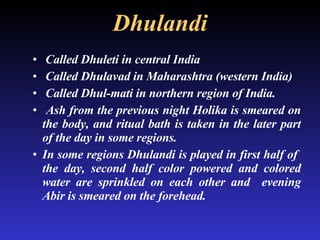
Dhulandi Called Dhuleti in central India Called Dhulavad in Maharashtra (western India) Called Dhul-mati in northern region of India. Ash from the previous night Holika is smeared on the body, and ritual bath is taken in the later part of the day in some regions. In some regions Dhulandi is played in first half of  the day, second half color powered and colored water are sprinkled on each other and  evening Abir is smeared on the forehead.
Rangapanchami Rangapanchami occurs five days later on Panchami (fifth day after the Poornamashi/full  moon), marking  the end of festivities of colors.
Gulal and Colored Powders
Medical Significance The festival occurs at the onset of  Spring .  Weather  change,  Prone to cause  viral fever  and  cold . Gulal  (Colored Powder) - Made of  medicinal  plants like Neem – Azidaricta Indica Kumkum – Colored Turmeric Haldi - Turmeric Bilva – Fruit bearing medicinal tree
Celebration in Vrindavan   Vrindavan  – A city in India where  Lord Krishna  grew up The Festival  - Celebrated for 16 days until Rangpanchmi in  Holy memory of the divine love of  Radha - Krishna .  Popularity  - Lord Krishna is believed to have popularized the  festival by playing pranks on the  Gopis .  Dark Complexion of Krishna  - Krishna used to be complain  to his mother about the contrast between his dark  color and his consort Radha's fair color.  Color on Radha’s Face  - Krishna's mother decided to apply  colour to Radha's face. The celebrations officially  usher in spring, the  season of love . Since ages Holi is the most popular festival of Vrindavan.
Krishna Celebrating Holi   A painting of Rajsthani style at the Smithsonian Institute, USA
 
 
Holi in Mathura Holi was also the name of a female demon Putana who tried to Krishna, by feeding him poisoned nipples to suckle. The miracle baby Krishna sucked so intensely that he drained the she demon of her life. She was burnt on the pyre next day.  It is one of the major celebrations in Mathura.
Economic Significance   A Festival to Celebrate Good Harvest and Fertility of Land New Seasonal Crop comes home during spring. A Festival of Farmers India was a land of farmers/villagers Importance for business community as new purchases are made on this occasion.
Social Significance   Gathering of people from different sections of society irrespective of their social and economic status Coming together of males and females to sprinkle colors on each other Enacting divine love of Radha-Krishna Forgiving enmities and shed differences  Teenagers spend the day celebrating in the streets Adults extend the hand of peace and friendship  People enjoy sprinkling abir, gulal and colored water on each other Distribution of sweets and having feast together. Family Get-Together
Invincible Dhundhi In the ancient time, during the reign of very first king, Prithu, there was a terrible ogress called Dhundhi. She had performed severe penances and had won several boons from the deities that made her almost invincible. She loved to devour children. However, due to a curse of Lord Shiva, she was not so immune to the pranks and abuses of young boys. One day, the courageous boys of the village decided to get rid of her forever. They got intoxicated on bhaang and drunk and then followed Dhundhi beyond the boundary of the village, beating drums, making loud noise, shouting obscenities and hurling insults at her and continued doing this until she left the village for good. This is the reason that even today young boys are allowed to indulge themselves in rowdiness, using rude words and intoxication on Holi.
Dolapurnima or Dolayatra   Instead of the exuberant and joyous celebrations that are witnessed elsewhere, Bengal observes this festival in a quiet and dignified manner as Dolapurnima or Dolayatra (the festival of the swing). The festival, said to have been initiated by the king Indradyumn in Vrindavan. It is spread over 3 or 5 days, starting from the sukla Chaturdasi(14 th ) of Phalguna month. A celebration in honor of Agni (The Fire God) and worship of Govinda (Krishna) in image on a swing are the important features. The fire kindled on the first day is to be preserved till the last day. The swing is to be rocked 21 times at the end of the festival. The day is also celebrated as the birthday of the great poet saint, Sri Krishna Chaitanya (A.D. 1486-1533), in Bengal, Orissa, Mathura and Vrindavan. the festival of the swing   The Festival of Swings
Celebration in Pusti-Marga Temples   Pushti-Marga  temples, spread throughout North and Western States of India, celebrate the festival in a way reminiscent of rajput courts. The Deity are liberally sprinkled with perfumes, saffron water, kesudo, and covered in sandalwood as well as the white and pink powder, abir and gulal. Joyous celebration is accompanied by classical music, poetry and folk songs appropriate for the occasion. Deity's white clothes' are soon transformed into a mass of color as gold and silver syringes spray colorful water on all participants. The celebrations officially usher in the pleasant season of love, spring. In the Pushti-Marga temples, the festivities last for almost a month. Beginning on the day of Vasant-Panchami, the festivals last till the day after Holi. This helps to prolong the season of divine love and joy.
Other Regional Celebrations Tribesmen in central India celebrate in old traditional ways. In the towns of Rajasthan - Especially  Jaisalmer - the music's great, and  clouds of pink, green, and turquoise  powder fill the air.
 

Holi

  • 1.
    Holi A Very Popular Hindu Spring Festival Celebrated in many countries. Celebrated all over India Many Flavors. The Festival of Colors
  • 2.
  • 3.
    When is itCelebrated ? Celebrated on the Purnima of Hindu Lunar Calendar Month of Phalgun Purnmashi = Purnima = Punam = Full Moon Day Later part of February or early March
  • 4.
    When did itStart ? V ery ancient tradition. Mentioned in very early religious works such as Jaimini's Purvamimamsa-sutras , Kathaka-grhya-sutras. Existed several centuries BCE. Vishnu Purana Bhagvatam Other Historical Scriptures
  • 5.
    Many Names ofHoli Vasanta Mahotsava – The Great Festival of Vasanta (Spring) - Most of the places Kamotsva – Associated with story of Kama (The God of love) Dolyatra – Festival of Swings - Eastern regions of India Phagwah - A festival of Phagun (Last month of Hindu calendar) - Many Countries and Northern regions India Rangapanchami – The colourful fifth day of Chaitra (First month of Hindu Lunar Calendar) - Many regions of India Holi – Most common name
  • 6.
    Celebration over SeveralDays Some Regions – Over 2 days Some Regions – Over 5 days
  • 7.
    Story of HolikaHiranyakashipu - A tyrant the demon king Penance - Hiranyakashipu had a very long and severe penance Boon by Brahma - Made him almost impossible to be killed. He was not be killed During day time or night Inside a house or outside a house Not on earth or in sky Neither by a man nor by an animal Neither with an astra(long range weapons) nor with a shastra(short range weapons) Prahalad - Hiranyakashipu's son was a great devotee of Lord Vishnu . Holika – A wicked sister of Hiranyakashipu had boon not to be burnt in fire. Holika sat with Prahalad in fire. Prahalad came out unhurt and Holika tuned into ashes. Bonfire - Is lit at night to signify burning of Holika, a symbol of evil. Celebration of victory of good over evil.
  • 8.
    The king’s sister,Holika, agreed to help the king. She was thought to have magical powers which made her fireproof. Holika took Prahlad to the top of a bonfire and the bonfire was lit. Holika expected Prahlad to die. Instead, it was Holika who died and again Prahlad was saved.
  • 9.
    Significance of HolikaHolika - A symbol of evil. Collection of trash from houses collected during fall season of for several days till Purnima. Going round (pradakshina) the pire of woods/trash with water to contain evil qualities within limits. Burning the Neem leaves – Burning the bitterness of life and taking up the sweatened medicinal value of Neem. Welcoming the Spring season with the bonfire.
  • 10.
  • 11.
    Kama Mahotsava KamaDev - The god of love. Arrow of Kama – Kama fired his arrow of love at Lord Shiva to break his penance and help Parvati marry him. Kama's body - Burnt to ashes by the gaze of Shiva Rati – Wife of Kama For the sake of Rati (passion), Shiva resurrected Kama, but only as a astral form, representing the true emotional state of love rather than physical lust. Holi - Celebrated in commemoration of the resurrection Kama Dev as the festival of colors.
  • 12.
    Dhulandi Second day is celebrated in most part of India. People go around until afternoon sprinkling Gulal (colored powder) and water at each other. A special drink is prepared called thandai which can be laced with bhang (mild intoxicant) At noon, the craziness comes to an end and everyone heads to either the river, the bathtub or swimming pool. People invite each other to their houses for feasts and celebrations later in the evening
  • 13.
    Festival processions anddancing take place.
  • 14.
  • 15.
  • 16.
  • 17.
  • 18.
    Dhulandi Called Dhuletiin central India Called Dhulavad in Maharashtra (western India) Called Dhul-mati in northern region of India. Ash from the previous night Holika is smeared on the body, and ritual bath is taken in the later part of the day in some regions. In some regions Dhulandi is played in first half of the day, second half color powered and colored water are sprinkled on each other and evening Abir is smeared on the forehead.
  • 19.
    Rangapanchami Rangapanchami occursfive days later on Panchami (fifth day after the Poornamashi/full moon), marking the end of festivities of colors.
  • 20.
  • 21.
    Medical Significance Thefestival occurs at the onset of Spring . Weather change, Prone to cause viral fever and cold . Gulal (Colored Powder) - Made of medicinal plants like Neem – Azidaricta Indica Kumkum – Colored Turmeric Haldi - Turmeric Bilva – Fruit bearing medicinal tree
  • 22.
    Celebration in Vrindavan Vrindavan – A city in India where Lord Krishna grew up The Festival - Celebrated for 16 days until Rangpanchmi in Holy memory of the divine love of Radha - Krishna . Popularity - Lord Krishna is believed to have popularized the festival by playing pranks on the Gopis . Dark Complexion of Krishna - Krishna used to be complain to his mother about the contrast between his dark color and his consort Radha's fair color. Color on Radha’s Face - Krishna's mother decided to apply colour to Radha's face. The celebrations officially usher in spring, the season of love . Since ages Holi is the most popular festival of Vrindavan.
  • 23.
    Krishna Celebrating Holi A painting of Rajsthani style at the Smithsonian Institute, USA
  • 24.
  • 25.
  • 26.
    Holi in MathuraHoli was also the name of a female demon Putana who tried to Krishna, by feeding him poisoned nipples to suckle. The miracle baby Krishna sucked so intensely that he drained the she demon of her life. She was burnt on the pyre next day. It is one of the major celebrations in Mathura.
  • 27.
    Economic Significance A Festival to Celebrate Good Harvest and Fertility of Land New Seasonal Crop comes home during spring. A Festival of Farmers India was a land of farmers/villagers Importance for business community as new purchases are made on this occasion.
  • 28.
    Social Significance Gathering of people from different sections of society irrespective of their social and economic status Coming together of males and females to sprinkle colors on each other Enacting divine love of Radha-Krishna Forgiving enmities and shed differences Teenagers spend the day celebrating in the streets Adults extend the hand of peace and friendship People enjoy sprinkling abir, gulal and colored water on each other Distribution of sweets and having feast together. Family Get-Together
  • 29.
    Invincible Dhundhi Inthe ancient time, during the reign of very first king, Prithu, there was a terrible ogress called Dhundhi. She had performed severe penances and had won several boons from the deities that made her almost invincible. She loved to devour children. However, due to a curse of Lord Shiva, she was not so immune to the pranks and abuses of young boys. One day, the courageous boys of the village decided to get rid of her forever. They got intoxicated on bhaang and drunk and then followed Dhundhi beyond the boundary of the village, beating drums, making loud noise, shouting obscenities and hurling insults at her and continued doing this until she left the village for good. This is the reason that even today young boys are allowed to indulge themselves in rowdiness, using rude words and intoxication on Holi.
  • 30.
    Dolapurnima or Dolayatra Instead of the exuberant and joyous celebrations that are witnessed elsewhere, Bengal observes this festival in a quiet and dignified manner as Dolapurnima or Dolayatra (the festival of the swing). The festival, said to have been initiated by the king Indradyumn in Vrindavan. It is spread over 3 or 5 days, starting from the sukla Chaturdasi(14 th ) of Phalguna month. A celebration in honor of Agni (The Fire God) and worship of Govinda (Krishna) in image on a swing are the important features. The fire kindled on the first day is to be preserved till the last day. The swing is to be rocked 21 times at the end of the festival. The day is also celebrated as the birthday of the great poet saint, Sri Krishna Chaitanya (A.D. 1486-1533), in Bengal, Orissa, Mathura and Vrindavan. the festival of the swing The Festival of Swings
  • 31.
    Celebration in Pusti-MargaTemples Pushti-Marga temples, spread throughout North and Western States of India, celebrate the festival in a way reminiscent of rajput courts. The Deity are liberally sprinkled with perfumes, saffron water, kesudo, and covered in sandalwood as well as the white and pink powder, abir and gulal. Joyous celebration is accompanied by classical music, poetry and folk songs appropriate for the occasion. Deity's white clothes' are soon transformed into a mass of color as gold and silver syringes spray colorful water on all participants. The celebrations officially usher in the pleasant season of love, spring. In the Pushti-Marga temples, the festivities last for almost a month. Beginning on the day of Vasant-Panchami, the festivals last till the day after Holi. This helps to prolong the season of divine love and joy.
  • 32.
    Other Regional CelebrationsTribesmen in central India celebrate in old traditional ways. In the towns of Rajasthan - Especially Jaisalmer - the music's great, and clouds of pink, green, and turquoise powder fill the air.
  • 33.