BILINGUAL SECTION – MARÍA ESTHER DE LA ROSA
DIVIDING POLYNOMIALS
1. SOLVING THE DIVISION OF POLYNOMIALS
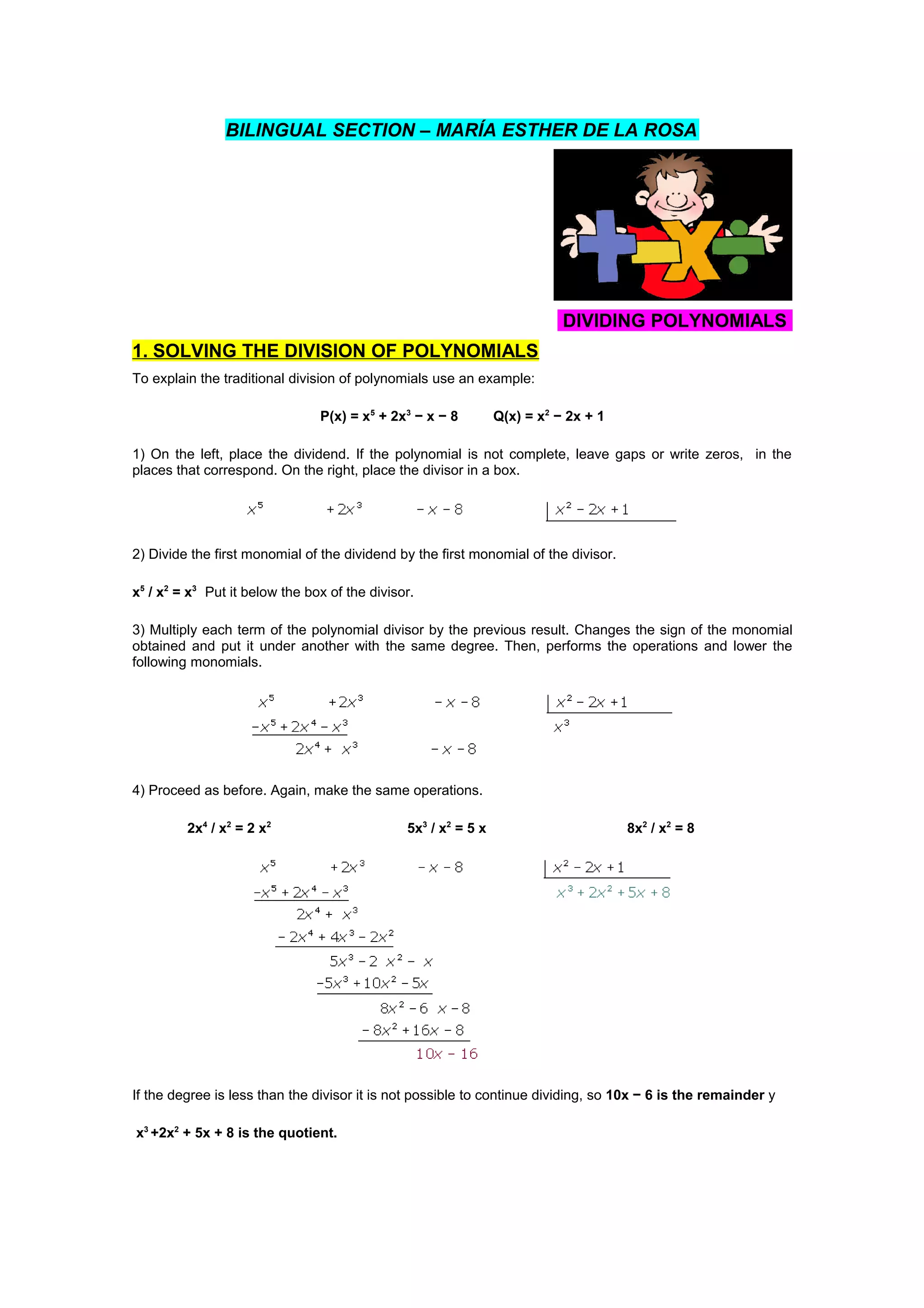
To explain the traditional division of polynomials use an example:
P(x) = x5
+ 2x3
− x − 8 Q(x) = x2
− 2x + 1
1) On the left, place the dividend. If the polynomial is not complete, leave gaps or write zeros, in the
places that correspond. On the right, place the divisor in a box.
2) Divide the first monomial of the dividend by the first monomial of the divisor.
x5
/ x2
= x3
Put it below the box of the divisor.
3) Multiply each term of the polynomial divisor by the previous result. Changes the sign of the monomial
obtained and put it under another with the same degree. Then, performs the operations and lower the
following monomials.
4) Proceed as before. Again, make the same operations.
2x4
/ x2
= 2 x2
5x3
/ x2
= 5 x 8x2
/ x2
= 8
If the degree is less than the divisor it is not possible to continue dividing, so 10x − 6 is the remainder y
x3
+2x2
+ 5x + 8 is the quotient.
2. RUFFINI´S RULE
To explain the steps of Ruffini's rule, we are going to use an example:
(x4
− 3x2
+ 2 ) : (x − 3)
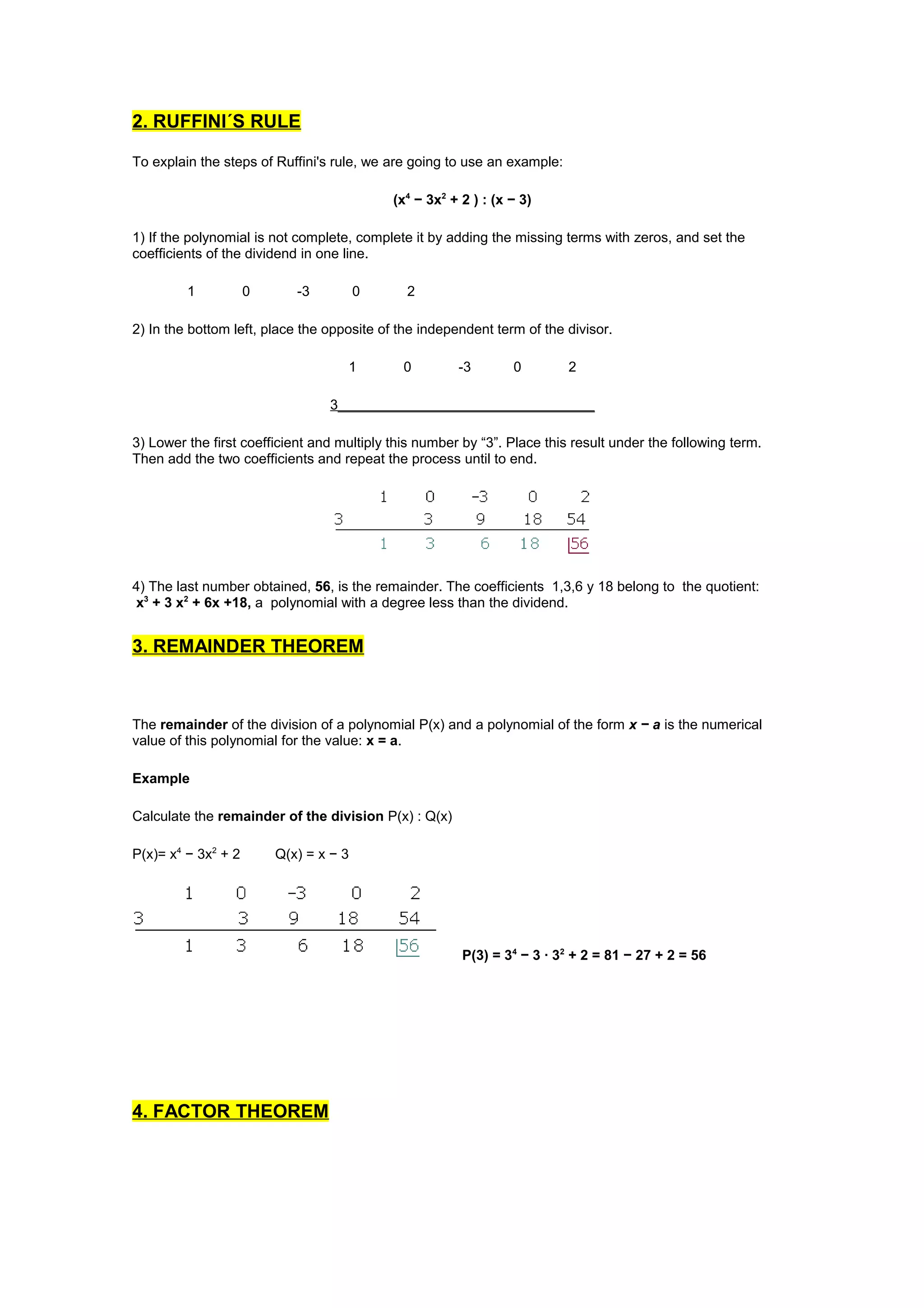
1) If the polynomial is not complete, complete it by adding the missing terms with zeros, and set the
coefficients of the dividend in one line.
1 0 -3 0 2
2) In the bottom left, place the opposite of the independent term of the divisor.
1 0 -3 0 2
3_________________________________
3) Lower the first coefficient and multiply this number by “3”. Place this result under the following term.
Then add the two coefficients and repeat the process until to end.
4) The last number obtained, 56, is the remainder. The coefficients 1,3,6 y 18 belong to the quotient:
x3
+ 3 x2
+ 6x +18, a polynomial with a degree less than the dividend.
3. REMAINDER THEOREM
The remainder of the division of a polynomial P(x) and a polynomial of the form x − a is the numerical
value of this polynomial for the value: x = a.
Example
Calculate the remainder of the division P(x) : Q(x)
P(x)= x4
− 3x2
+ 2 Q(x) = x − 3
P(3) = 34
− 3 · 32
+ 2 = 81 − 27 + 2 = 56
4. FACTOR THEOREM
The polynomial P(x) is divisible by a polynomial of the form (x − a) if and only if P(x = a) = 0.
The value x = a is called the root or zero of P(x).
Example: What are the roots of P(x) = x2
− 5x + 6 ?
P(2) = 22
− 5 · 2 + 6 = 4 − 10 + 6 = 0 P(3) = 32
− 5 · 3 + 6 = 9 − 15 + 6 = 0
Then x = 2 and x = 3 are roots or zeros of the polynomial: P(x) = x2
− 5x + 6
For each root type x = a corresponds to it by a binomial of the type (x − a). A polynomial can be
expressed in factors by writing it as a product of all the binomials of type (x − a), which will correspond to
the roots, x = a.
x2
− 5x + 6 = (x − 2) · (x − 3)
5. METHODS FOR FACTORING A POLYNOMIAL
1) All polynomials that do not have an independent term accept x = 0 as a root. We must REMOVE
THE COMMON FACTOR:
Examples
• x2
+ x = x · (x + 1) Roots: x = 0 and x = − 1
• x3
+ x2
= x2
(x + 1) The roots are: x = 0 that is a double root, and x = −1
• 2x4
+ 4x2
= 2x2
(x2
+ 2) It only has a root x = 0; since the polynomial, x2
+ 2, does not
have any value that annuls it.
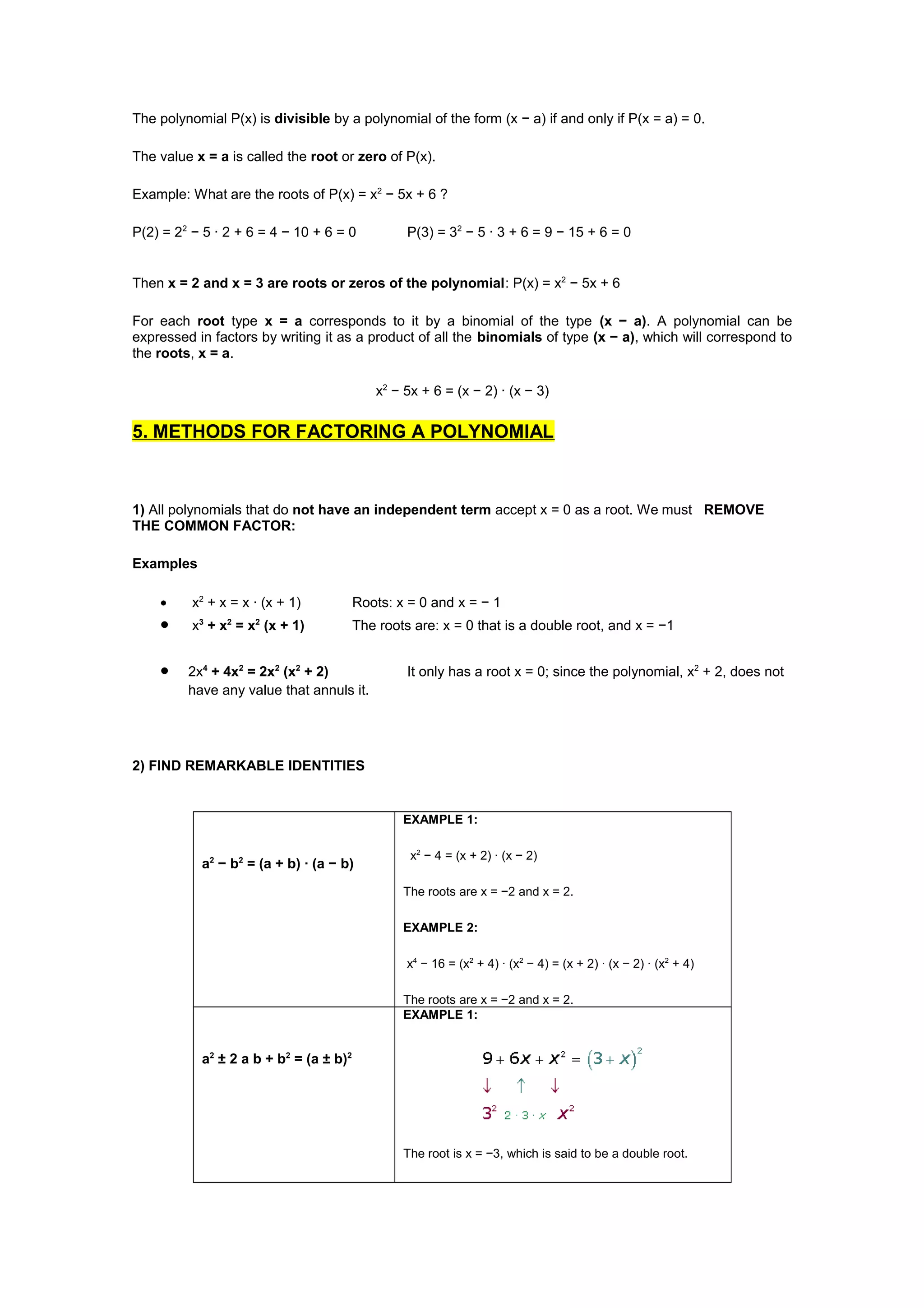
2) FIND REMARKABLE IDENTITIES
a2
− b2
= (a + b) · (a − b)
EXAMPLE 1:
x2
− 4 = (x + 2) · (x − 2)
The roots are x = −2 and x = 2.
EXAMPLE 2:
x4
− 16 = (x2
+ 4) · (x2
− 4) = (x + 2) · (x − 2) · (x2
+ 4)
The roots are x = −2 and x = 2.
a2
± 2 a b + b2
= (a ± b)2
EXAMPLE 1:
The root is x = −3, which is said to be a double root.
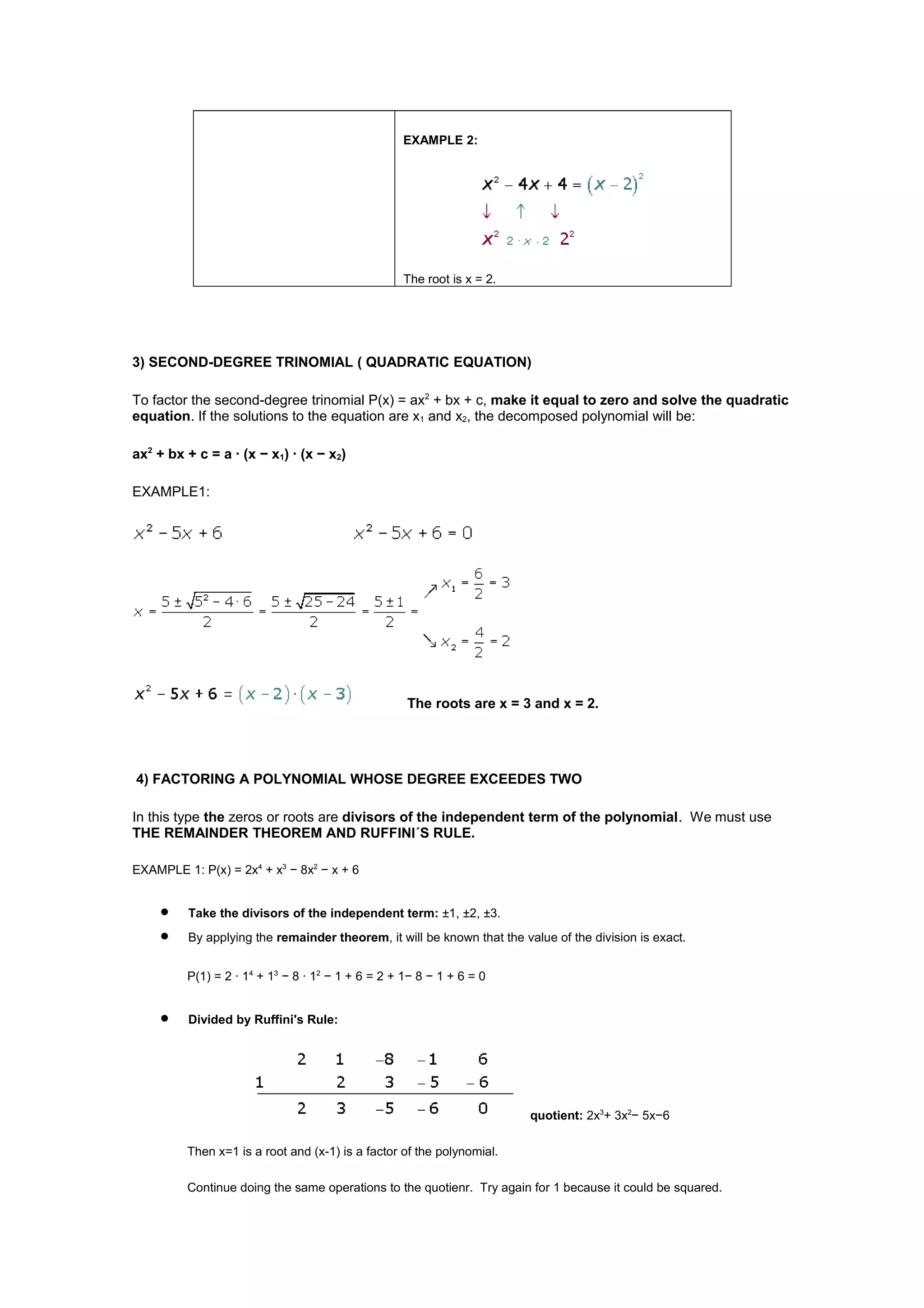
EXAMPLE 2:
The root is x = 2.
3) SECOND-DEGREE TRINOMIAL ( QUADRATIC EQUATION)
To factor the second-degree trinomial P(x) = ax2
+ bx + c, make it equal to zero and solve the quadratic
equation. If the solutions to the equation are x1 and x2, the decomposed polynomial will be:
ax2
+ bx + c = a · (x − x1) · (x − x2)
EXAMPLE1:
The roots are x = 3 and x = 2.
4) FACTORING A POLYNOMIAL WHOSE DEGREE EXCEEDES TWO
In this type the zeros or roots are divisors of the independent term of the polynomial. We must use
THE REMAINDER THEOREM AND RUFFINI´S RULE.
EXAMPLE 1: P(x) = 2x4
+ x3
− 8x2
− x + 6
• Take the divisors of the independent term: ±1, ±2, ±3.
• By applying the remainder theorem, it will be known that the value of the division is exact.
P(1) = 2 · 14
+ 13
− 8 · 12
− 1 + 6 = 2 + 1− 8 − 1 + 6 = 0
• Divided by Ruffini's Rule:
quotient: 2x3
+ 3x2
− 5x−6
Then x=1 is a root and (x-1) is a factor of the polynomial.
Continue doing the same operations to the quotienr. Try again for 1 because it could be squared.
P(1) = 2 · 13
+ 3 · 12
− 5 · 1 − 6≠ 0
P(−1) = 2 · (− 1)3
+ 3 · (− 1)2
− 5 · (− 1) − 6 = −2 + 3 + 5 − 6 = 0
quotient: 2x2
+ x −6
Then another root is x=-1 and (x +1) i a factor of the polynomial.
The last quotient can be found by applying the quadratic equation or the previous method, but the
disadvantage is that it will only give whole roots.
Rule out 1 and keep trying for −1.
P(−1) = 2 · (−1)2
+ (−1) − 6 ≠ 0
P(2) = 2 · 22
+ 2 − 6 ≠ 0
P(−2) = 2 · (−2)2
+ (−2) − 6 = 2 · 4 − 2 − 6 = 0
At last extract the common factor 2 in the quotient 2x − 3 = 2 (x − 3/2)
The factored polynomial is: P(x) = 2x4
+ x3
− 8x2
− x + 6 = 2 (x −1) · (x +1) · (x +2) · (x − 3/2)
The roots are: x = 1, x = − 1, x = −2 and x = 3/2
5) A polynomial is called IRREDUCIBLE OR PRIME when it cannot be decomposed into factors.
EXAMPLE: P(x) = x2
+ x + 1
6. OTHER ALGEBRAIC IDENTITIES
Cube of a Binomial
(a ± b)3
= a3
± 3 · a2
· b + 3 · a · b2
± b3
Example 1:
(x + 3)3
= x3
+ 3 · x2
· 3 + 3 · x · 32
+ 33
=
= x 3
+ 9x2
+ 27x + 27
Example 2:
(2x − 3)3
= (2x)3
− 3 · (2x)2
·3 + 3 · 2x · 32
− 33
=
= 8x 3
− 36x2
+ 54x − 27
Square of a Trinomial
(a + b + c)2
= a2
+ b2
+ c2
+ 2 · a · b + + 2 · a · c + 2 · b · c
Example 1:
(x2
− x + 1)2
=
(x2
)2
+ (−x)2
+ 12
+ 2 · x2
· (−x) + 2 x2
· 1 + 2 · (−x) · 1=
= x4
+ x2
+ 1 − 2x3
+ 2x2
− 2x=
= x4
− 2x3
+ 3x2
− 2x + 1
Cube of a Binomial
(a ± b)3
= a3
± 3 · a2
· b + 3 · a · b2
± b3
Example 1:
(x + 3)3
= x3
+ 3 · x2
· 3 + 3 · x · 32
+ 33
=
= x 3
+ 9x2
+ 27x + 27
Example 2:
(2x − 3)3
= (2x)3
− 3 · (2x)2
·3 + 3 · 2x · 32
− 33
=
= 8x 3
− 36x2
+ 54x − 27
Square of a Trinomial
(a + b + c)2
= a2
+ b2
+ c2
+ 2 · a · b + + 2 · a · c + 2 · b · c
Example 1:
(x2
− x + 1)2
=
(x2
)2
+ (−x)2
+ 12
+ 2 · x2
· (−x) + 2 x2
· 1 + 2 · (−x) · 1=
= x4
+ x2
+ 1 − 2x3
+ 2x2
− 2x=
= x4
− 2x3
+ 3x2
− 2x + 1

Dividing polynomials

  • 1.
    BILINGUAL SECTION –MARÍA ESTHER DE LA ROSA DIVIDING POLYNOMIALS 1. SOLVING THE DIVISION OF POLYNOMIALS To explain the traditional division of polynomials use an example: P(x) = x5 + 2x3 − x − 8 Q(x) = x2 − 2x + 1 1) On the left, place the dividend. If the polynomial is not complete, leave gaps or write zeros, in the places that correspond. On the right, place the divisor in a box. 2) Divide the first monomial of the dividend by the first monomial of the divisor. x5 / x2 = x3 Put it below the box of the divisor. 3) Multiply each term of the polynomial divisor by the previous result. Changes the sign of the monomial obtained and put it under another with the same degree. Then, performs the operations and lower the following monomials. 4) Proceed as before. Again, make the same operations. 2x4 / x2 = 2 x2 5x3 / x2 = 5 x 8x2 / x2 = 8 If the degree is less than the divisor it is not possible to continue dividing, so 10x − 6 is the remainder y x3 +2x2 + 5x + 8 is the quotient.
  • 2.
    2. RUFFINI´S RULE Toexplain the steps of Ruffini's rule, we are going to use an example: (x4 − 3x2 + 2 ) : (x − 3) 1) If the polynomial is not complete, complete it by adding the missing terms with zeros, and set the coefficients of the dividend in one line. 1 0 -3 0 2 2) In the bottom left, place the opposite of the independent term of the divisor. 1 0 -3 0 2 3_________________________________ 3) Lower the first coefficient and multiply this number by “3”. Place this result under the following term. Then add the two coefficients and repeat the process until to end. 4) The last number obtained, 56, is the remainder. The coefficients 1,3,6 y 18 belong to the quotient: x3 + 3 x2 + 6x +18, a polynomial with a degree less than the dividend. 3. REMAINDER THEOREM The remainder of the division of a polynomial P(x) and a polynomial of the form x − a is the numerical value of this polynomial for the value: x = a. Example Calculate the remainder of the division P(x) : Q(x) P(x)= x4 − 3x2 + 2 Q(x) = x − 3 P(3) = 34 − 3 · 32 + 2 = 81 − 27 + 2 = 56 4. FACTOR THEOREM
  • 3.
    The polynomial P(x)is divisible by a polynomial of the form (x − a) if and only if P(x = a) = 0. The value x = a is called the root or zero of P(x). Example: What are the roots of P(x) = x2 − 5x + 6 ? P(2) = 22 − 5 · 2 + 6 = 4 − 10 + 6 = 0 P(3) = 32 − 5 · 3 + 6 = 9 − 15 + 6 = 0 Then x = 2 and x = 3 are roots or zeros of the polynomial: P(x) = x2 − 5x + 6 For each root type x = a corresponds to it by a binomial of the type (x − a). A polynomial can be expressed in factors by writing it as a product of all the binomials of type (x − a), which will correspond to the roots, x = a. x2 − 5x + 6 = (x − 2) · (x − 3) 5. METHODS FOR FACTORING A POLYNOMIAL 1) All polynomials that do not have an independent term accept x = 0 as a root. We must REMOVE THE COMMON FACTOR: Examples • x2 + x = x · (x + 1) Roots: x = 0 and x = − 1 • x3 + x2 = x2 (x + 1) The roots are: x = 0 that is a double root, and x = −1 • 2x4 + 4x2 = 2x2 (x2 + 2) It only has a root x = 0; since the polynomial, x2 + 2, does not have any value that annuls it. 2) FIND REMARKABLE IDENTITIES a2 − b2 = (a + b) · (a − b) EXAMPLE 1: x2 − 4 = (x + 2) · (x − 2) The roots are x = −2 and x = 2. EXAMPLE 2: x4 − 16 = (x2 + 4) · (x2 − 4) = (x + 2) · (x − 2) · (x2 + 4) The roots are x = −2 and x = 2. a2 ± 2 a b + b2 = (a ± b)2 EXAMPLE 1: The root is x = −3, which is said to be a double root.
  • 4.
    EXAMPLE 2: The rootis x = 2. 3) SECOND-DEGREE TRINOMIAL ( QUADRATIC EQUATION) To factor the second-degree trinomial P(x) = ax2 + bx + c, make it equal to zero and solve the quadratic equation. If the solutions to the equation are x1 and x2, the decomposed polynomial will be: ax2 + bx + c = a · (x − x1) · (x − x2) EXAMPLE1: The roots are x = 3 and x = 2. 4) FACTORING A POLYNOMIAL WHOSE DEGREE EXCEEDES TWO In this type the zeros or roots are divisors of the independent term of the polynomial. We must use THE REMAINDER THEOREM AND RUFFINI´S RULE. EXAMPLE 1: P(x) = 2x4 + x3 − 8x2 − x + 6 • Take the divisors of the independent term: ±1, ±2, ±3. • By applying the remainder theorem, it will be known that the value of the division is exact. P(1) = 2 · 14 + 13 − 8 · 12 − 1 + 6 = 2 + 1− 8 − 1 + 6 = 0 • Divided by Ruffini's Rule: quotient: 2x3 + 3x2 − 5x−6 Then x=1 is a root and (x-1) is a factor of the polynomial. Continue doing the same operations to the quotienr. Try again for 1 because it could be squared.
  • 5.
    P(1) = 2· 13 + 3 · 12 − 5 · 1 − 6≠ 0 P(−1) = 2 · (− 1)3 + 3 · (− 1)2 − 5 · (− 1) − 6 = −2 + 3 + 5 − 6 = 0 quotient: 2x2 + x −6 Then another root is x=-1 and (x +1) i a factor of the polynomial. The last quotient can be found by applying the quadratic equation or the previous method, but the disadvantage is that it will only give whole roots. Rule out 1 and keep trying for −1. P(−1) = 2 · (−1)2 + (−1) − 6 ≠ 0 P(2) = 2 · 22 + 2 − 6 ≠ 0 P(−2) = 2 · (−2)2 + (−2) − 6 = 2 · 4 − 2 − 6 = 0 At last extract the common factor 2 in the quotient 2x − 3 = 2 (x − 3/2) The factored polynomial is: P(x) = 2x4 + x3 − 8x2 − x + 6 = 2 (x −1) · (x +1) · (x +2) · (x − 3/2) The roots are: x = 1, x = − 1, x = −2 and x = 3/2 5) A polynomial is called IRREDUCIBLE OR PRIME when it cannot be decomposed into factors. EXAMPLE: P(x) = x2 + x + 1 6. OTHER ALGEBRAIC IDENTITIES
  • 6.
    Cube of aBinomial (a ± b)3 = a3 ± 3 · a2 · b + 3 · a · b2 ± b3 Example 1: (x + 3)3 = x3 + 3 · x2 · 3 + 3 · x · 32 + 33 = = x 3 + 9x2 + 27x + 27 Example 2: (2x − 3)3 = (2x)3 − 3 · (2x)2 ·3 + 3 · 2x · 32 − 33 = = 8x 3 − 36x2 + 54x − 27 Square of a Trinomial (a + b + c)2 = a2 + b2 + c2 + 2 · a · b + + 2 · a · c + 2 · b · c Example 1: (x2 − x + 1)2 = (x2 )2 + (−x)2 + 12 + 2 · x2 · (−x) + 2 x2 · 1 + 2 · (−x) · 1= = x4 + x2 + 1 − 2x3 + 2x2 − 2x= = x4 − 2x3 + 3x2 − 2x + 1
  • 7.
    Cube of aBinomial (a ± b)3 = a3 ± 3 · a2 · b + 3 · a · b2 ± b3 Example 1: (x + 3)3 = x3 + 3 · x2 · 3 + 3 · x · 32 + 33 = = x 3 + 9x2 + 27x + 27 Example 2: (2x − 3)3 = (2x)3 − 3 · (2x)2 ·3 + 3 · 2x · 32 − 33 = = 8x 3 − 36x2 + 54x − 27 Square of a Trinomial (a + b + c)2 = a2 + b2 + c2 + 2 · a · b + + 2 · a · c + 2 · b · c Example 1: (x2 − x + 1)2 = (x2 )2 + (−x)2 + 12 + 2 · x2 · (−x) + 2 x2 · 1 + 2 · (−x) · 1= = x4 + x2 + 1 − 2x3 + 2x2 − 2x= = x4 − 2x3 + 3x2 − 2x + 1