
Unit 3
             Polynomials
Adding Polynomials
Subtracting Polynomials
Multiplying Polynomials


By Genny Simpson
Let’s Review!

Integer rules
Exponent rules
Combining like-terms
Before you can add or subtract polynomials you need to review the
integer rules.

To add integers, add if they have the same sign and keep the sign.
For instance -4 + -6 = -10 and 5 + 12 = 17.
Subtract if they have different signs and take the sign of the larger
number. For instance 10 + -6 = 4 and -10 + 6 = -4.

To subtract integers, change the subtraction sign to adding the
opposite and then follow the rules for addition. For instance -2 – 3 =
-2 + -3 = -5 and 6 – (-5) = 6 + 5 = 11.


  INTEGER RULES
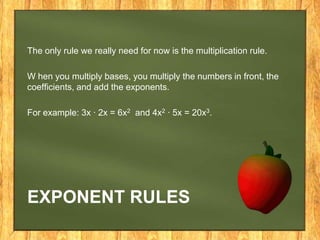
The only rule we really need for now is the multiplication rule.

W hen you multiply bases, you multiply the numbers in front, the
coefficients, and add the exponents.

For example: 3x · 2x = 6x2 and 4x2 · 5x = 20x3.


EXPONENT RULES
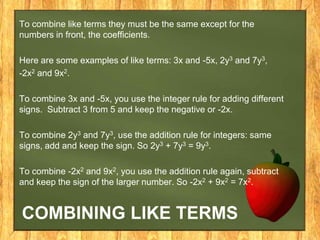
To combine like terms they must be the same except for the
numbers in front, the coefficients.

Here are some examples of like terms: 3x and -5x, 2y3 and 7y3,
-2x2 and 9x2.

To combine 3x and -5x, you use the integer rule for adding different
signs. Subtract 3 from 5 and keep the negative or -2x.

To combine 2y3 and 7y3, use the addition rule for integers: same
signs, add and keep the sign. So 2y3 + 7y3 = 9y3.

To combine -2x2 and 9x2, you use the addition rule again, subtract
and keep the sign of the larger number. So -2x2 + 9x2 = 7x2.


COMBINING LIKE TERMS
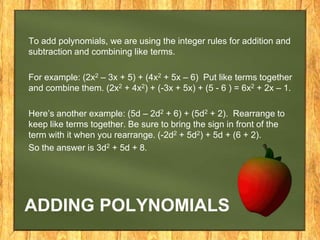
To add polynomials, we are using the integer rules for addition and
subtraction and combining like terms.

For example: (2x2 – 3x + 5) + (4x2 + 5x – 6) Put like terms together
and combine them. (2x2 + 4x2) + (-3x + 5x) + (5 - 6 ) = 6x2 + 2x – 1.

Here’s another example: (5d – 2d2 + 6) + (5d2 + 2). Rearrange to
keep like terms together. Be sure to bring the sign in front of the
term with it when you rearrange. (-2d2 + 5d2) + 5d + (6 + 2).
So the answer is 3d2 + 5d + 8.


ADDING POLYNOMIALS
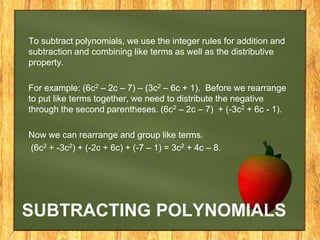
To subtract polynomials, we use the integer rules for addition and
subtraction and combining like terms as well as the distributive
property.

For example: (6c2 – 2c – 7) – (3c2 – 6c + 1). Before we rearrange
to put like terms together, we need to distribute the negative
through the second parentheses. (6c2 – 2c – 7) + (-3c2 + 6c - 1).

Now we can rearrange and group like terms.
(6c2 + -3c2) + (-2c + 6c) + (-7 – 1) = 3c2 + 4c – 8.


SUBTRACTING POLYNOMIALS
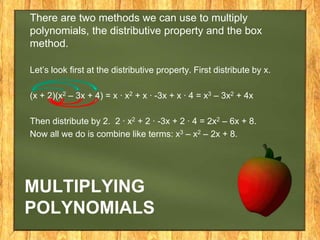
There are two methods we can use to multiply
polynomials, the distributive property and the box
method.

Let’s look first at the distributive property. First distribute by x.

(x + 2)(x2 – 3x + 4) = x · x2 + x · -3x + x · 4 = x3 – 3x2 + 4x

Then distribute by 2. 2 · x2 + 2 · -3x + 2 · 4 = 2x2 – 6x + 8.
Now all we do is combine like terms: x3 – x2 – 2x + 8.


MULTIPLYING
POLYNOMIALS
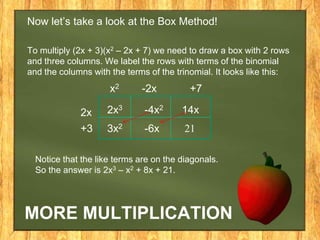
Now let’s take a look at the Box Method!

To multiply (2x + 3)(x2 – 2x + 7) we need to draw a box with 2 rows
and three columns. We label the rows with terms of the binomial
and the columns with the terms of the trinomial. It looks like this:
                     x2      -2x          +7

             2x     2x3       -4x2      14x
             +3     3x2       -6x        21

  Notice that the like terms are on the diagonals.
  So the answer is 2x3 – x2 + 8x + 21.


MORE MULTIPLICATION
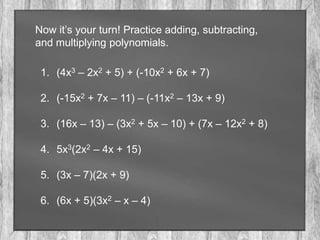
Now it’s your turn! Practice adding, subtracting,
and multiplying polynomials.

 1. (4x3 – 2x2 + 5) + (-10x2 + 6x + 7)

 2. (-15x2 + 7x – 11) – (-11x2 – 13x + 9)

 3. (16x – 13) – (3x2 + 5x – 10) + (7x – 12x2 + 8)

 4. 5x3(2x2 – 4x + 15)

 5. (3x – 7)(2x + 9)

 6. (6x + 5)(3x2 – x – 4)
Template Provided By


         www.animationfactory.com

500,000 Downloadable PowerPoint Templates, Animated
          Clip Art, Backgrounds and Videos

Unit 3 polynomials

  • 1.
    Unit 3 Polynomials Adding Polynomials Subtracting Polynomials Multiplying Polynomials By Genny Simpson
  • 2.
    Let’s Review! Integer rules Exponentrules Combining like-terms
  • 3.
    Before you canadd or subtract polynomials you need to review the integer rules. To add integers, add if they have the same sign and keep the sign. For instance -4 + -6 = -10 and 5 + 12 = 17. Subtract if they have different signs and take the sign of the larger number. For instance 10 + -6 = 4 and -10 + 6 = -4. To subtract integers, change the subtraction sign to adding the opposite and then follow the rules for addition. For instance -2 – 3 = -2 + -3 = -5 and 6 – (-5) = 6 + 5 = 11. INTEGER RULES
  • 4.
    The only rulewe really need for now is the multiplication rule. W hen you multiply bases, you multiply the numbers in front, the coefficients, and add the exponents. For example: 3x · 2x = 6x2 and 4x2 · 5x = 20x3. EXPONENT RULES
  • 5.
    To combine liketerms they must be the same except for the numbers in front, the coefficients. Here are some examples of like terms: 3x and -5x, 2y3 and 7y3, -2x2 and 9x2. To combine 3x and -5x, you use the integer rule for adding different signs. Subtract 3 from 5 and keep the negative or -2x. To combine 2y3 and 7y3, use the addition rule for integers: same signs, add and keep the sign. So 2y3 + 7y3 = 9y3. To combine -2x2 and 9x2, you use the addition rule again, subtract and keep the sign of the larger number. So -2x2 + 9x2 = 7x2. COMBINING LIKE TERMS
  • 6.
    To add polynomials,we are using the integer rules for addition and subtraction and combining like terms. For example: (2x2 – 3x + 5) + (4x2 + 5x – 6) Put like terms together and combine them. (2x2 + 4x2) + (-3x + 5x) + (5 - 6 ) = 6x2 + 2x – 1. Here’s another example: (5d – 2d2 + 6) + (5d2 + 2). Rearrange to keep like terms together. Be sure to bring the sign in front of the term with it when you rearrange. (-2d2 + 5d2) + 5d + (6 + 2). So the answer is 3d2 + 5d + 8. ADDING POLYNOMIALS
  • 7.
    To subtract polynomials,we use the integer rules for addition and subtraction and combining like terms as well as the distributive property. For example: (6c2 – 2c – 7) – (3c2 – 6c + 1). Before we rearrange to put like terms together, we need to distribute the negative through the second parentheses. (6c2 – 2c – 7) + (-3c2 + 6c - 1). Now we can rearrange and group like terms. (6c2 + -3c2) + (-2c + 6c) + (-7 – 1) = 3c2 + 4c – 8. SUBTRACTING POLYNOMIALS
  • 8.
    There are twomethods we can use to multiply polynomials, the distributive property and the box method. Let’s look first at the distributive property. First distribute by x. (x + 2)(x2 – 3x + 4) = x · x2 + x · -3x + x · 4 = x3 – 3x2 + 4x Then distribute by 2. 2 · x2 + 2 · -3x + 2 · 4 = 2x2 – 6x + 8. Now all we do is combine like terms: x3 – x2 – 2x + 8. MULTIPLYING POLYNOMIALS
  • 9.
    Now let’s takea look at the Box Method! To multiply (2x + 3)(x2 – 2x + 7) we need to draw a box with 2 rows and three columns. We label the rows with terms of the binomial and the columns with the terms of the trinomial. It looks like this: x2 -2x +7 2x 2x3 -4x2 14x +3 3x2 -6x 21 Notice that the like terms are on the diagonals. So the answer is 2x3 – x2 + 8x + 21. MORE MULTIPLICATION
  • 10.
    Now it’s yourturn! Practice adding, subtracting, and multiplying polynomials. 1. (4x3 – 2x2 + 5) + (-10x2 + 6x + 7) 2. (-15x2 + 7x – 11) – (-11x2 – 13x + 9) 3. (16x – 13) – (3x2 + 5x – 10) + (7x – 12x2 + 8) 4. 5x3(2x2 – 4x + 15) 5. (3x – 7)(2x + 9) 6. (6x + 5)(3x2 – x – 4)
  • 11.
    Template Provided By www.animationfactory.com 500,000 Downloadable PowerPoint Templates, Animated Clip Art, Backgrounds and Videos