DEPT OF DRVYAGUNA
DIURETICS& ANTIDIURETICS
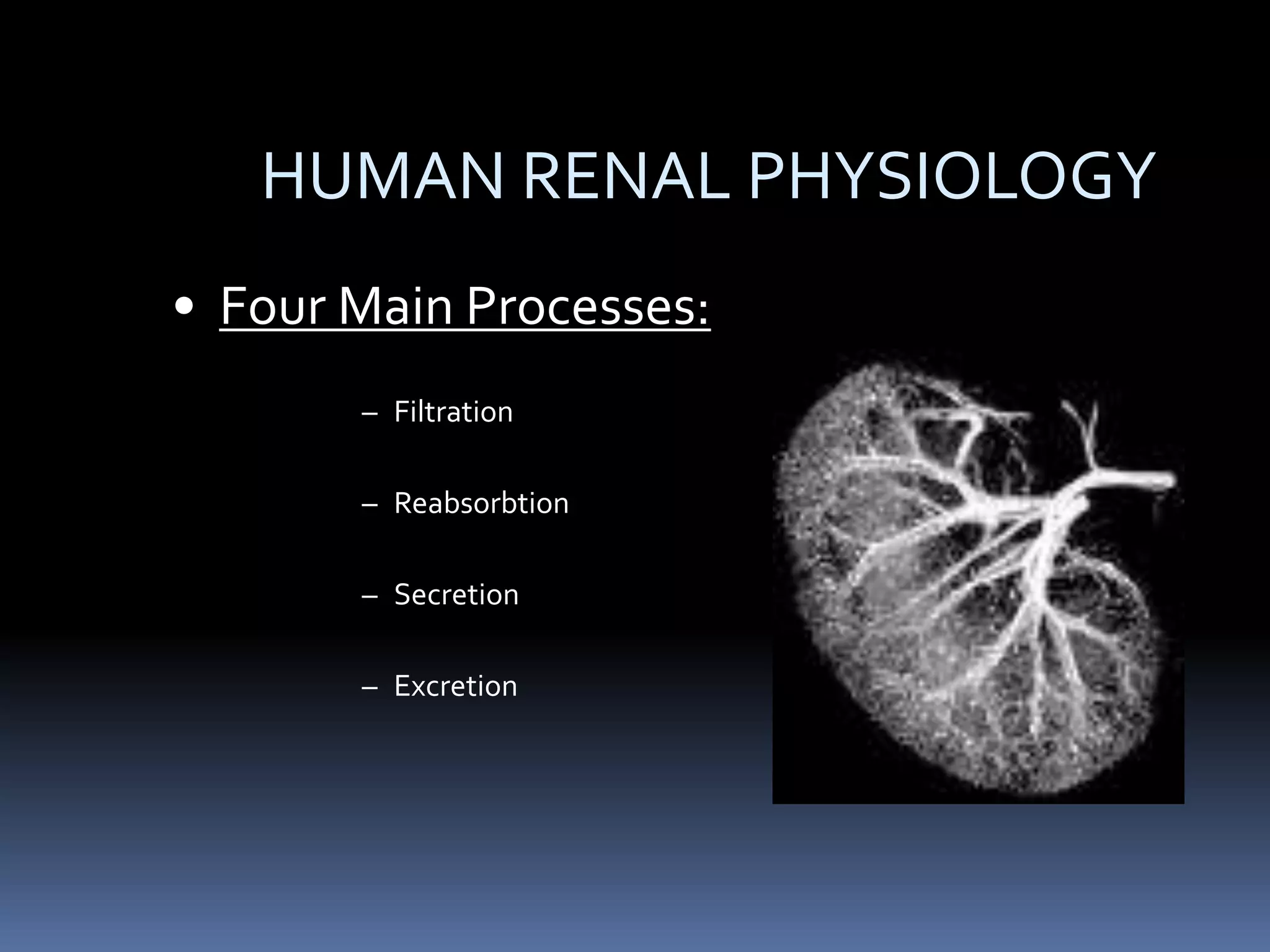
HUMAN RENAL PHYSIOLOGY
• Four Main Processes:
– Filtration
– Reabsorbtion
– Secretion
– Excretion
HUMAN RENAL PHYSIOLOGY
• Functions of the Kidney:
– Filtration:
– First step in urine formation
– Bulk transport of fluid from blood to
kidney tubule
» Isosmotic filtrate
» Blood cells and proteins don’t filter
– Result of hydraulic pressure
– GFR = 180 L/day
HUMAN RENAL PHYSIOLOGY
• Functions of the Kidney:
– Reabsorbtion:
• Process of returning filtered material to
bloodstream
• 99% of what is filtered
• May involve transport protein(s)
• Normally glucose is totally reabsorbed
HUMAN RENAL PHYSIOLOGY
• Functions of the Kidney:
–Secretion:
– Material added to lumen of kidney from
blood
– Active transport (usually) of toxins and
foreign substances
» Saccharine
» Penicillin
HUMAN RENAL PHYSIOLOGY
• Functions of the Kidney:
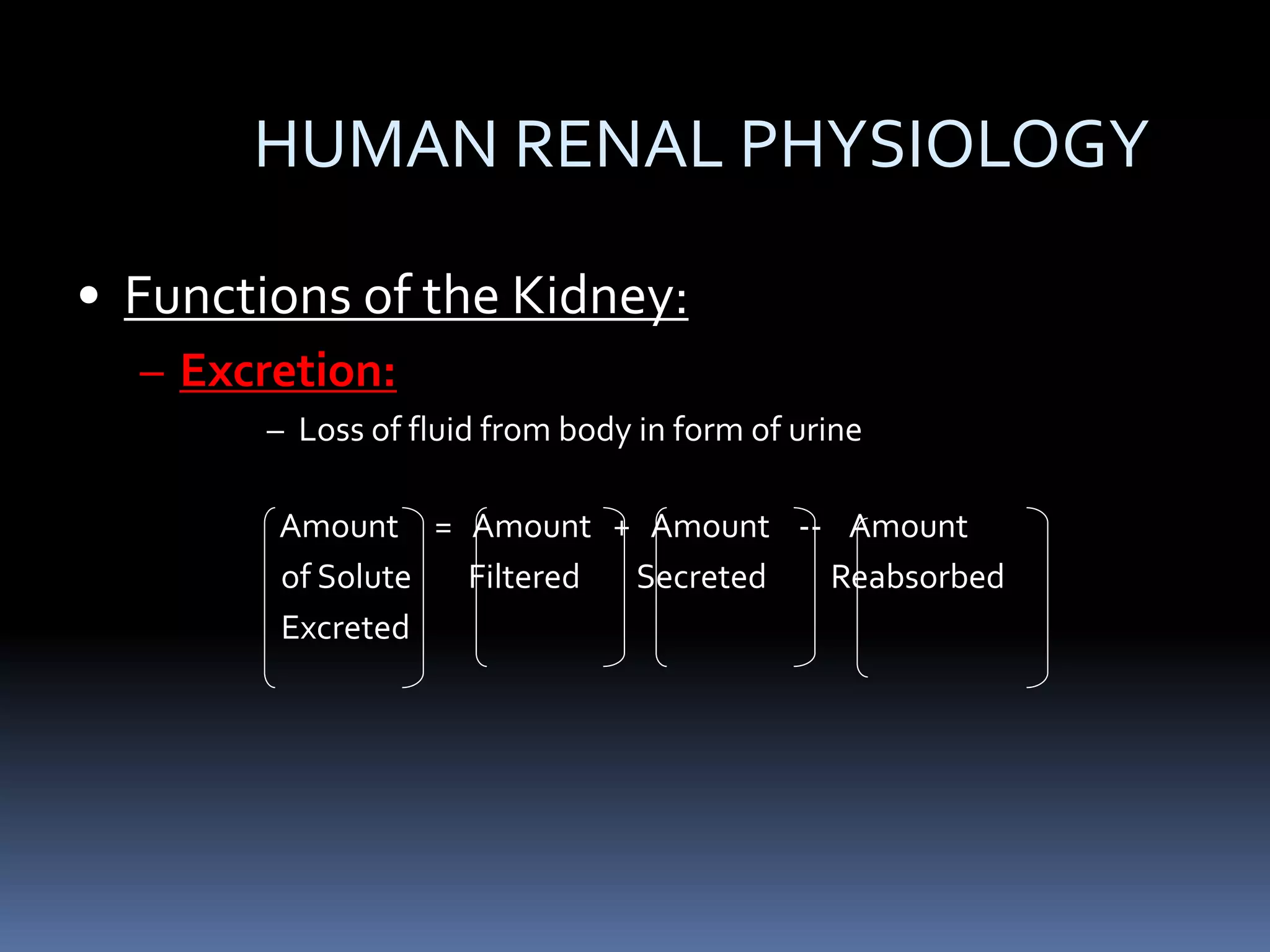
– Excretion:
– Loss of fluid from body in form of urine
Amount = Amount + Amount -- Amount
of Solute Filtered Secreted Reabsorbed
Excreted
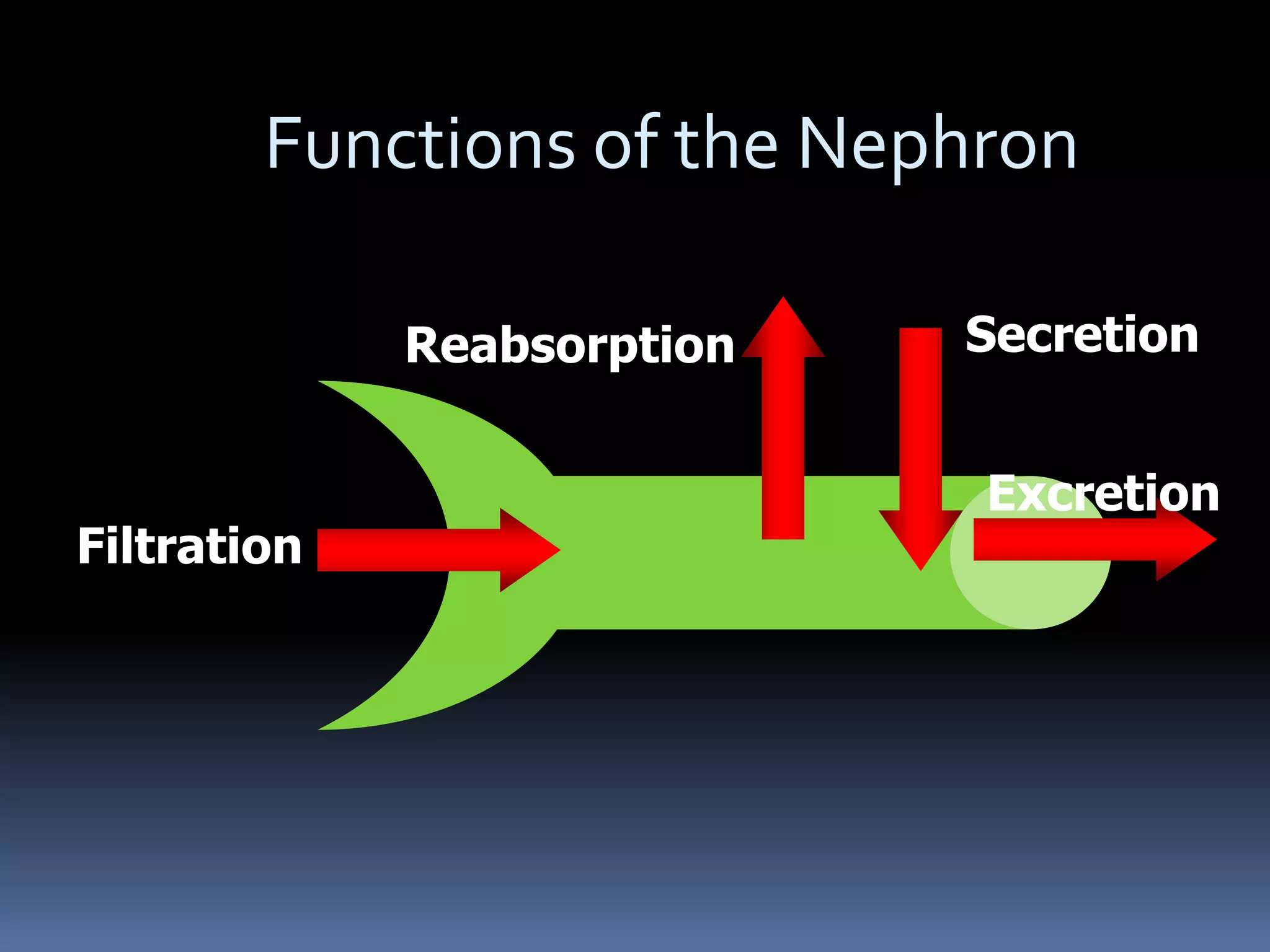
Functions of the Nephron
Filtration
Reabsorption Secretion
Excretion
 Diuretics are medicines that aid the
elimination of sodium (salt) and water from
the body.
 The oral forms of these drugs are sometimes
referred to as "water pills."
 Diuretics act by increasing the excretion by
the kidneys of sodium in the urine.
 When the kidneys excrete sodium, they
excrete water from the blood along with it.
 That decreases the amount of fluid flowing
through the blood vessels, which reduces
pressure on the walls of the arteries.
 Diuretics in general lower the amount of salt
and water in the body.
 Urine flow usually increases within hours of
the first dose, but diuretics may take several
weeks to treat conditions like high blood
pressure.
 Mechanisms of action & types of diuretics
depend on anatomical site.
LOOP DIURETICS
 Inhibits Na reabsorption (in tissue) by direct
action on ascending Loop of Henle.
 Onset of action of 30-45 minutes
 Side Effects: hyponatremia, hypokalemia .
 Loop diuretics, such as furosemide (Lasix) reduce
the ability of the body to reabsorb sodium at the
ascending loop part of the nephron which leads
to water retention in urine as water
 Used to control edematous states &
hypercalcemia.
POTASSIUM SPARING DIURETICS
 Inhibits Na reabsorption in the collecting
ducts and distal convoluted tubules.
 Common Medications: Spironolactone
(Aldactone).
 Side Effects: hyponatremia, hyperkalemia
HIGH CEILING DIURETICS
 High ceiling diuretics producing the
greatest diuresis
 Used when pts can't tolerate thiazides or
have impaired renal function.
More expensive with shorter duration of 1-4
hr.
NSAIDs can adversely affect antihypertensive
effect
OSMOTIC DIURETIC
 Causes a shift in fluid to move into the renal
tubules from the surrounding tissue.
 High osmolality of agents reduces reabsorption
of water
Produces greatest amount of urine output.
 Common Medications: Mannitol (Osmitrol)
Side Effects: Circulatory overload
Fluid &electrolyte imbalance. Drug retained in
EC space causes expansion of ECF. Pulmonary
congestion, thirst, blurry vision, convulsion,
Toxicity dependent on amount used.
THIAZIDE DIURETIC
 Inhibits Na, K & Cl resorption in the distal
convoluted tubule
Common Medication: hydrochlorothiazide
(HydroDIURIL)
Commonly used; least expensive.
 Frequent urination occurs due to elevated loss of
water that has not been retained from the body
as a result of a relationship with sodium loss
Side Effects: hypokalemia, hypercalcemia,
hyperlipidemia, hyperglycemia & hyperuricemia
Thiazide diuretics are considered to be
"potassium-wasting"
Carbonic Anhydrase Inhibitors
 Inhibit the enzyme named carbonic
anhydrase which is seen in the proximal
convoluted tubule part of the nephron.
 This results in the several effects including
bicarbonate retention, potassium retention in
urine and decreased absorption of sodium.
 Eg, acetazolamide and methazolamide
SIDE EFFECTS
Common side effects of diuretic drug
therapy:
 Orthostatic hypotension
Hypokalemia (exception: K+ sparing diuretics
such as spironolactone)
Hyponatremia
ANTIDIURETICS
 An antidiuretic is an agent or drug that,
administered to an organism, helps control
body water balance by reducing urination,
opposing diuresis.
 Antidiuretic hormones: ADH/Vasopressin: A
hormone secreted by the posterior lobe of
the pituitary gland that constricts blood
vessels, raises blood pressure, and reduces
excretion of urine. Also called antidiuretic
hormon
 ADH increases water permeability in the last
part of DCT and collecting duct .
 ADH stimulates the production of aquaporin
2 – water channel proteins at the time of
demand .
SYNTHETIC ADH
 Desmopressin"; Desmopressin(5) (trade
names: DDAVP, Stimate, Minirin) is a
synthetic replacement for the hormone
vasopressin, the hormone which reduces the
urine production. It may be taken nasallyiv
form or as a tablet.
 Most frequently forthe treatment of diabetes
insipidus(7) or nocturnal enuresis
LYTHOTRIPTICS
 The drugs which are used for the dissolution
of calculus in the bladder or kidneys
 Eg, Bergenia ligulata , Boerrhaevia diffusa etc
Hepatoprotection
 Hepatoprotection or antihepatotoxicity is the
ability to prevent damage to the liver.
 The liver plays a central role in transforming and
clearing chemicals and is susceptible to the
toxicity from these agents. Certain medicinal
agents, when taken in overdoses and sometimes
even when introduced within therapeutic ranges,
may injure the organ.
 More than 900 drugs have been implicated in
causing liver injury[1] and it is the most common
reason for a drug to be withdrawn from the
market.
HEPATOTOXICITY
. Several mechanisms are responsible for either
inducing hepatic injury or worsening the damage
process. Many chemicals damage mitochondria, an
intracellular organelle that produce energy. Its
dysfunction releases excessive amount of oxidants
that, in turn, injure hepatic cells.Activation of some
enzymes in the cytochrome P-450 system such as
CYP2E1 also lead to oxidative stress.[12] Injury to
hepatocyte and bile duct cells lead to accumulation of
bile acid inside the liver.This promotes further liver
damage.[13] Non-parenchymal cells such as Kupffer
cells, fat storing stellate cells, and leukocytes (i.e.
neutrophil and monocyte) also have a role in the
mechanism.

Diuretics ppt for BAMS students

  • 1.
  • 2.
    HUMAN RENAL PHYSIOLOGY •Four Main Processes: – Filtration – Reabsorbtion – Secretion – Excretion
  • 3.
    HUMAN RENAL PHYSIOLOGY •Functions of the Kidney: – Filtration: – First step in urine formation – Bulk transport of fluid from blood to kidney tubule » Isosmotic filtrate » Blood cells and proteins don’t filter – Result of hydraulic pressure – GFR = 180 L/day
  • 4.
    HUMAN RENAL PHYSIOLOGY •Functions of the Kidney: – Reabsorbtion: • Process of returning filtered material to bloodstream • 99% of what is filtered • May involve transport protein(s) • Normally glucose is totally reabsorbed
  • 5.
    HUMAN RENAL PHYSIOLOGY •Functions of the Kidney: –Secretion: – Material added to lumen of kidney from blood – Active transport (usually) of toxins and foreign substances » Saccharine » Penicillin
  • 6.
    HUMAN RENAL PHYSIOLOGY •Functions of the Kidney: – Excretion: – Loss of fluid from body in form of urine Amount = Amount + Amount -- Amount of Solute Filtered Secreted Reabsorbed Excreted
  • 7.
    Functions of theNephron Filtration Reabsorption Secretion Excretion
  • 8.
     Diuretics aremedicines that aid the elimination of sodium (salt) and water from the body.  The oral forms of these drugs are sometimes referred to as "water pills."
  • 9.
     Diuretics actby increasing the excretion by the kidneys of sodium in the urine.  When the kidneys excrete sodium, they excrete water from the blood along with it.  That decreases the amount of fluid flowing through the blood vessels, which reduces pressure on the walls of the arteries.
  • 10.
     Diuretics ingeneral lower the amount of salt and water in the body.  Urine flow usually increases within hours of the first dose, but diuretics may take several weeks to treat conditions like high blood pressure.  Mechanisms of action & types of diuretics depend on anatomical site.
  • 11.
    LOOP DIURETICS  InhibitsNa reabsorption (in tissue) by direct action on ascending Loop of Henle.  Onset of action of 30-45 minutes  Side Effects: hyponatremia, hypokalemia .  Loop diuretics, such as furosemide (Lasix) reduce the ability of the body to reabsorb sodium at the ascending loop part of the nephron which leads to water retention in urine as water  Used to control edematous states & hypercalcemia.
  • 12.
    POTASSIUM SPARING DIURETICS Inhibits Na reabsorption in the collecting ducts and distal convoluted tubules.  Common Medications: Spironolactone (Aldactone).  Side Effects: hyponatremia, hyperkalemia
  • 13.
    HIGH CEILING DIURETICS High ceiling diuretics producing the greatest diuresis  Used when pts can't tolerate thiazides or have impaired renal function. More expensive with shorter duration of 1-4 hr. NSAIDs can adversely affect antihypertensive effect
  • 14.
    OSMOTIC DIURETIC  Causesa shift in fluid to move into the renal tubules from the surrounding tissue.  High osmolality of agents reduces reabsorption of water Produces greatest amount of urine output.  Common Medications: Mannitol (Osmitrol) Side Effects: Circulatory overload Fluid &electrolyte imbalance. Drug retained in EC space causes expansion of ECF. Pulmonary congestion, thirst, blurry vision, convulsion, Toxicity dependent on amount used.
  • 15.
    THIAZIDE DIURETIC  InhibitsNa, K & Cl resorption in the distal convoluted tubule Common Medication: hydrochlorothiazide (HydroDIURIL) Commonly used; least expensive.  Frequent urination occurs due to elevated loss of water that has not been retained from the body as a result of a relationship with sodium loss Side Effects: hypokalemia, hypercalcemia, hyperlipidemia, hyperglycemia & hyperuricemia Thiazide diuretics are considered to be "potassium-wasting"
  • 16.
    Carbonic Anhydrase Inhibitors Inhibit the enzyme named carbonic anhydrase which is seen in the proximal convoluted tubule part of the nephron.  This results in the several effects including bicarbonate retention, potassium retention in urine and decreased absorption of sodium.  Eg, acetazolamide and methazolamide
  • 17.
    SIDE EFFECTS Common sideeffects of diuretic drug therapy:  Orthostatic hypotension Hypokalemia (exception: K+ sparing diuretics such as spironolactone) Hyponatremia
  • 18.
    ANTIDIURETICS  An antidiureticis an agent or drug that, administered to an organism, helps control body water balance by reducing urination, opposing diuresis.  Antidiuretic hormones: ADH/Vasopressin: A hormone secreted by the posterior lobe of the pituitary gland that constricts blood vessels, raises blood pressure, and reduces excretion of urine. Also called antidiuretic hormon
  • 19.
     ADH increaseswater permeability in the last part of DCT and collecting duct .  ADH stimulates the production of aquaporin 2 – water channel proteins at the time of demand .
  • 20.
    SYNTHETIC ADH  Desmopressin";Desmopressin(5) (trade names: DDAVP, Stimate, Minirin) is a synthetic replacement for the hormone vasopressin, the hormone which reduces the urine production. It may be taken nasallyiv form or as a tablet.  Most frequently forthe treatment of diabetes insipidus(7) or nocturnal enuresis
  • 21.
    LYTHOTRIPTICS  The drugswhich are used for the dissolution of calculus in the bladder or kidneys  Eg, Bergenia ligulata , Boerrhaevia diffusa etc
  • 22.
    Hepatoprotection  Hepatoprotection orantihepatotoxicity is the ability to prevent damage to the liver.  The liver plays a central role in transforming and clearing chemicals and is susceptible to the toxicity from these agents. Certain medicinal agents, when taken in overdoses and sometimes even when introduced within therapeutic ranges, may injure the organ.  More than 900 drugs have been implicated in causing liver injury[1] and it is the most common reason for a drug to be withdrawn from the market.
  • 23.
    HEPATOTOXICITY . Several mechanismsare responsible for either inducing hepatic injury or worsening the damage process. Many chemicals damage mitochondria, an intracellular organelle that produce energy. Its dysfunction releases excessive amount of oxidants that, in turn, injure hepatic cells.Activation of some enzymes in the cytochrome P-450 system such as CYP2E1 also lead to oxidative stress.[12] Injury to hepatocyte and bile duct cells lead to accumulation of bile acid inside the liver.This promotes further liver damage.[13] Non-parenchymal cells such as Kupffer cells, fat storing stellate cells, and leukocytes (i.e. neutrophil and monocyte) also have a role in the mechanism.