TOPIC- AN INSIGHT TO DIURETICS
(MEDICINAL CHEMISTRY)
B.PHARM
SEM-5TH
Sumel Ashique
Department- Pharmaceutics
Mail id- ashiquesumel007@gmail.com
INDEX
 Diuretics
 Classification of Diuretics
 Mechanism Involved
 SAR of Diuretics
 Reference
DIURETICS
Definition
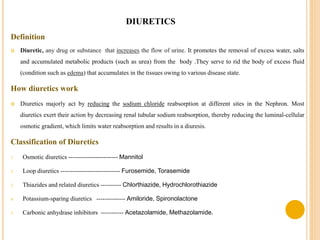
 Diuretic, any drug or substance that increases the flow of urine. It promotes the removal of excess water, salts
and accumulated metabolic products (such as urea) from the body .They serve to rid the body of excess fluid
(condition such as edema) that accumulates in the tissues owing to various disease state.
How diuretics work
 Diuretics majorly act by reducing the sodium chloride reabsorption at different sites in the Nephron. Most
diuretics exert their action by decreasing renal tubular sodium reabsorption, thereby reducing the luminal-cellular
osmotic gradient, which limits water reabsorption and results in a diuresis.
Classification of Diuretics
1. Osmotic diuretics ------------------------ Mannitol
2. Loop diuretics ----------------------------- Furosemide, Torasemide
3. Thiazides and related diuretics ---------- Chlorthiazide, Hydrochlorothiazide
4. Potassium-sparing diuretics -------------- Amiloride, Spironolactone
5. Carbonic anhydrase inhibitors ----------- Acetazolamide, Methazolamide.
Osmotic Diuretics
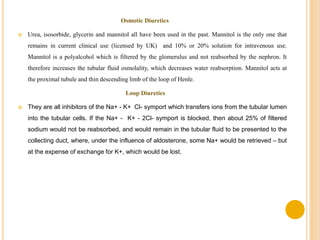
 Urea, isosorbide, glycerin and mannitol all have been used in the past. Mannitol is the only one that
remains in current clinical use (licensed by UK) and 10% or 20% solution for intravenous use.
Mannitol is a polyalcohol which is filtered by the glomerulus and not reabsorbed by the nephron. It
therefore increases the tubular fluid osmolality, which decreases water reabsorption. Mannitol acts at
the proximal tubule and thin descending limb of the loop of Henle.
Loop Diuretics
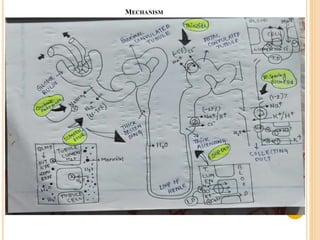
 They are all inhibitors of the Na+ - K+ Cl- symport which transfers ions from the tubular lumen
into the tubular cells. If the Na+ - K+ - 2Cl- symport is blocked, then about 25% of filtered
sodium would not be reabsorbed, and would remain in the tubular fluid to be presented to the
collecting duct, where, under the influence of aldosterone, some Na+ would be retrieved – but
at the expense of exchange for K+, which would be lost.
Thiazide Diuretics
 Their site of action is the cortical portion of the ascending loop of Henle´ and the distal convoluted tubule
where they inhibit sodium and chloride reabsorption by inhibiting the electro neutral Na+ Cl- symport
located there. Thiazides are believed to inhibit the Na+ Cl- symporter by binding competitively to the
chloride binding site.
Potassium-sparing diuretics
 A potassium-sparing diuretic that interferes with sodium reabsorption by competitively inhibiting
the action of aldosterone in the distal tubule, thus promoting sodium and water excretion and
increasing potassium retention. Potassium sparing diuretics (such as amiloride) produce a
mild diuretic effect by blocking the sodium/potassium exchange pump in the distal tubule.
As potassium sparing diuretics tend to have a weak diuretic effect, they are mainly used in
combination with thiazide or loop diuretics to prevent hypokalemia.
Carbonic anhydrase inhibitors
 Acetazolamide, the prototype Carbonic Anhydrase Inhibitors, inhibits carbonic anhydrase and in doing so
reduces renal bicarbonate resorption in the proximal tubule. This leads to a direct increase in urinary
bicarbonate excretion and secondarily to mild increases in sodium and potassium excretion.
Reaction involved : H2O + CO2 = H2CO3 = H+ HCO3-
What diuretics help treat
 The most common condition treated with diuretics is high blood pressure. The drugs reduce the amount of fluid
in blood vessels, and this helps lower blood pressure. Other conditions are also treated with diuretics such as
Congestive heart failure, for instance, keeps heart from pumping blood effectively throughout body. This leads
to a buildup of fluids in body, which is called edema. Diuretics can help reduce this fluid buildup. Potassium-
sparing diuretics don’t reduce blood pressure as well as the other types of diuretics do. Therefore, your doctor
may prescribe a potassium-sparing diuretic with another medication that also lowers blood pressure.
 Side effects of diuretics
 low sodium levels
 Headache, dizziness , skin rash
 Muscle cramp, thirst.
SAR (STRUCTURE–ACTIVITY RELATIONSHIP)
 The structure–activity relationship is the relationship between the chemical or 3D structure of a molecule
and its biological activity. The analysis of SAR enables the determination of the chemical groups responsible
for evoking a target biological effect in the organism.
QSAR
 Structure-activity relationship (SAR) and quantitative structure-activity relationship (QSAR) models -
collectively referred to as (Q)SARs - are mathematical models that can be used to predict the
physicochemical, biological and environmental fate properties of compounds from the knowledge of their
chemical structure.
Rationality
 Structure Activity Relationships (SAR) can be used to predict biological activity from molecular structure.
This powerful technology is used in drug discovery to guide the acquisition or synthesis of desirable new
compounds, as well as to further characterize existing molecules.
SAR OF THIAZIDES
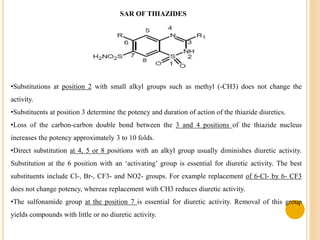
•Substitutions at position 2 with small alkyl groups such as methyl (-CH3) does not change the
activity.
•Substituents at position 3 determine the potency and duration of action of the thiazide diuretics.
•Loss of the carbon-carbon double bond between the 3 and 4 positions of the thiazide nucleus
increases the potency approximately 3 to 10 folds.
•Direct substitution at 4, 5 or 8 positions with an alkyl group usually diminishes diuretic activity.
Substitution at the 6 position with an ‘activating’ group is essential for diuretic activity. The best
substituents include Cl-, Br-, CF3- and NO2- groups. For example replacement of 6-Cl- by 6- CF3
does not change potency, whereas replacement with CH3 reduces diuretic activity.
•The sulfonamide group at the position 7 is essential for diuretic activity. Removal of this group
yields compounds with little or no diuretic activity.
LOOP DIURETICS
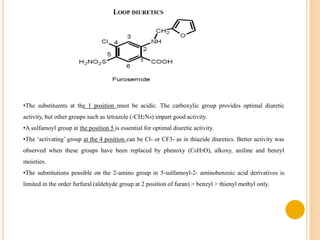
•The substituents at the 1 position must be acidic. The carboxylic group provides optimal diuretic
activity, but other groups such as tetrazole (-CH2N4) impart good activity.
•A sulfamoyl group at the position 5 is essential for optimal diuretic activity.
•The ‘activating’ group at the 4 position can be Cl- or CF3- as in thiazide diuretics. Better activity was
observed when these groups have been replaced by phenoxy (C6H5O), alkoxy, aniline and benzyl
moieties.
•The substitutions possible on the 2-amino group in 5-sulfamoyl-2- aminobenzoic acid derivatives is
limited in the order furfural (aldehyde group at 2 position of furan) > benzyl > thienyl methyl only.
MECHANISM
REFERENCE
 Roush GC, Kaur R, Ernst ME. Diuretics: a review and update. Journal of cardiovascular pharmacology and
therapeutics. 2014 Jan;19(1):5-13.
 Wilson CO, Gisvold O, Block JH, Beale JM. Wilson and Gisvold's textbook of organic medicinal and
pharmaceutical chemistry/edited by John H. Block, John M. Beale Jr. Philadelphia: Lippincott Williams &
Wilkins,; 2004.
Thank You.

Diuretics by sumel ashique

  • 1.
    TOPIC- AN INSIGHTTO DIURETICS (MEDICINAL CHEMISTRY) B.PHARM SEM-5TH Sumel Ashique Department- Pharmaceutics Mail id- ashiquesumel007@gmail.com
  • 2.
    INDEX  Diuretics  Classificationof Diuretics  Mechanism Involved  SAR of Diuretics  Reference
  • 3.
    DIURETICS Definition  Diuretic, anydrug or substance that increases the flow of urine. It promotes the removal of excess water, salts and accumulated metabolic products (such as urea) from the body .They serve to rid the body of excess fluid (condition such as edema) that accumulates in the tissues owing to various disease state. How diuretics work  Diuretics majorly act by reducing the sodium chloride reabsorption at different sites in the Nephron. Most diuretics exert their action by decreasing renal tubular sodium reabsorption, thereby reducing the luminal-cellular osmotic gradient, which limits water reabsorption and results in a diuresis. Classification of Diuretics 1. Osmotic diuretics ------------------------ Mannitol 2. Loop diuretics ----------------------------- Furosemide, Torasemide 3. Thiazides and related diuretics ---------- Chlorthiazide, Hydrochlorothiazide 4. Potassium-sparing diuretics -------------- Amiloride, Spironolactone 5. Carbonic anhydrase inhibitors ----------- Acetazolamide, Methazolamide.
  • 4.
    Osmotic Diuretics  Urea,isosorbide, glycerin and mannitol all have been used in the past. Mannitol is the only one that remains in current clinical use (licensed by UK) and 10% or 20% solution for intravenous use. Mannitol is a polyalcohol which is filtered by the glomerulus and not reabsorbed by the nephron. It therefore increases the tubular fluid osmolality, which decreases water reabsorption. Mannitol acts at the proximal tubule and thin descending limb of the loop of Henle. Loop Diuretics  They are all inhibitors of the Na+ - K+ Cl- symport which transfers ions from the tubular lumen into the tubular cells. If the Na+ - K+ - 2Cl- symport is blocked, then about 25% of filtered sodium would not be reabsorbed, and would remain in the tubular fluid to be presented to the collecting duct, where, under the influence of aldosterone, some Na+ would be retrieved – but at the expense of exchange for K+, which would be lost.
  • 5.
    Thiazide Diuretics  Theirsite of action is the cortical portion of the ascending loop of Henle´ and the distal convoluted tubule where they inhibit sodium and chloride reabsorption by inhibiting the electro neutral Na+ Cl- symport located there. Thiazides are believed to inhibit the Na+ Cl- symporter by binding competitively to the chloride binding site. Potassium-sparing diuretics  A potassium-sparing diuretic that interferes with sodium reabsorption by competitively inhibiting the action of aldosterone in the distal tubule, thus promoting sodium and water excretion and increasing potassium retention. Potassium sparing diuretics (such as amiloride) produce a mild diuretic effect by blocking the sodium/potassium exchange pump in the distal tubule. As potassium sparing diuretics tend to have a weak diuretic effect, they are mainly used in combination with thiazide or loop diuretics to prevent hypokalemia.
  • 6.
    Carbonic anhydrase inhibitors Acetazolamide, the prototype Carbonic Anhydrase Inhibitors, inhibits carbonic anhydrase and in doing so reduces renal bicarbonate resorption in the proximal tubule. This leads to a direct increase in urinary bicarbonate excretion and secondarily to mild increases in sodium and potassium excretion. Reaction involved : H2O + CO2 = H2CO3 = H+ HCO3- What diuretics help treat  The most common condition treated with diuretics is high blood pressure. The drugs reduce the amount of fluid in blood vessels, and this helps lower blood pressure. Other conditions are also treated with diuretics such as Congestive heart failure, for instance, keeps heart from pumping blood effectively throughout body. This leads to a buildup of fluids in body, which is called edema. Diuretics can help reduce this fluid buildup. Potassium- sparing diuretics don’t reduce blood pressure as well as the other types of diuretics do. Therefore, your doctor may prescribe a potassium-sparing diuretic with another medication that also lowers blood pressure.  Side effects of diuretics  low sodium levels  Headache, dizziness , skin rash  Muscle cramp, thirst.
  • 7.
    SAR (STRUCTURE–ACTIVITY RELATIONSHIP) The structure–activity relationship is the relationship between the chemical or 3D structure of a molecule and its biological activity. The analysis of SAR enables the determination of the chemical groups responsible for evoking a target biological effect in the organism. QSAR  Structure-activity relationship (SAR) and quantitative structure-activity relationship (QSAR) models - collectively referred to as (Q)SARs - are mathematical models that can be used to predict the physicochemical, biological and environmental fate properties of compounds from the knowledge of their chemical structure. Rationality  Structure Activity Relationships (SAR) can be used to predict biological activity from molecular structure. This powerful technology is used in drug discovery to guide the acquisition or synthesis of desirable new compounds, as well as to further characterize existing molecules.
  • 8.
    SAR OF THIAZIDES •Substitutionsat position 2 with small alkyl groups such as methyl (-CH3) does not change the activity. •Substituents at position 3 determine the potency and duration of action of the thiazide diuretics. •Loss of the carbon-carbon double bond between the 3 and 4 positions of the thiazide nucleus increases the potency approximately 3 to 10 folds. •Direct substitution at 4, 5 or 8 positions with an alkyl group usually diminishes diuretic activity. Substitution at the 6 position with an ‘activating’ group is essential for diuretic activity. The best substituents include Cl-, Br-, CF3- and NO2- groups. For example replacement of 6-Cl- by 6- CF3 does not change potency, whereas replacement with CH3 reduces diuretic activity. •The sulfonamide group at the position 7 is essential for diuretic activity. Removal of this group yields compounds with little or no diuretic activity.
  • 9.
    LOOP DIURETICS •The substituentsat the 1 position must be acidic. The carboxylic group provides optimal diuretic activity, but other groups such as tetrazole (-CH2N4) impart good activity. •A sulfamoyl group at the position 5 is essential for optimal diuretic activity. •The ‘activating’ group at the 4 position can be Cl- or CF3- as in thiazide diuretics. Better activity was observed when these groups have been replaced by phenoxy (C6H5O), alkoxy, aniline and benzyl moieties. •The substitutions possible on the 2-amino group in 5-sulfamoyl-2- aminobenzoic acid derivatives is limited in the order furfural (aldehyde group at 2 position of furan) > benzyl > thienyl methyl only.
  • 10.
  • 11.
    REFERENCE  Roush GC,Kaur R, Ernst ME. Diuretics: a review and update. Journal of cardiovascular pharmacology and therapeutics. 2014 Jan;19(1):5-13.  Wilson CO, Gisvold O, Block JH, Beale JM. Wilson and Gisvold's textbook of organic medicinal and pharmaceutical chemistry/edited by John H. Block, John M. Beale Jr. Philadelphia: Lippincott Williams & Wilkins,; 2004. Thank You.