WHAT IS AN INNOVATION?
 Innovation is profitable implementation of Ideas.
 It is an idea, practice or object that is perceived as new by
an individual or other unit of adoption.
 It is a use of new knowledge to offer a new product or
service that customers want. Thus, it is
Invention + Commercialization.
“Innovation is the search for and the discovery,
developed, improvement, adoption and commercialization
of new processes, new products and new organization
structures and procedures.”
GOALS OF INNOVATION
 Improving quality
 Creation of new markets
 Extension of the product range
 Reducing labor cost
 Improving production process
 Reducing materials
 Reducing environmental damage
 Replacement of products/services
 Reducing energy consumption
 Conformance to regulations
CHARACTERISTICS OF INNOVATION
 There is an object or target which is being changed.
 It can be a product, a process, an individual’s lifestyle,
an organization's strategy, a society culture.
 Innovation vary in extent or magnitude i.e. degree to
which one deviates from the past.
 It is closely related to problem solving since generation
& implementation of ideas for change never transpire
without difficulty.
 A final characteristic is the impact of the change, the
significance or range of its effects.
Difference between Innovation & Invention
Invention Innovation
1. It’s creation of new product, service
or process.
2. May not be commercialized
3. It can be autonomous or induced
4. Can be for economic or non-
economic motive
5. Usually restricted to R&D centre
6. May bring few changes in
organization
7. Precedes innovation
1. It is the introduction of new product,
service or process into the
marketplace.
2. Results into commercialization
3. Usually induced
4. Economic motive
5.Spread across the organization
6. Brings organizational change
7.Succeeds invention
WHY INNOVATE ???
OTHERWISE THEIR
SURVIVAL CHANCES
ARE SERIOUSLY
THREATENED
ORGANIZATION
PREPARE
THEMSELVES TO
INNOVATE ON A
CONTINUING BASIS
TURBULENT AND
RAPIDLY CHANGING
ECONOMY
SOURCES OF INNOVATION
 Organizational Structure.
- Organic structures positively influence innovation. As there is lower
vertical differentiation, formalization, centralization. Organic
organizations facilitate the flexibility, adaptation & cross-fertilization.
 Long tenure in Management
- Managerial tenure apparently provides legitimacy & knowledge of how
to accomplish a task and obtain desired outcomes.
 Slack Resources
- Having an abundance of resources allows an organization to afford to
purchase innovations, bear the cost of instituting innovations & absorb
failures.
 Interunit Communications
- Innovative organizations are high users of committees, task forces,
cross-functional teams that facilitate interaction across departmental
lines.
TYPES OF INNOVATION
 Product & Process Innovation
 Open & Closed Innovation
 Incremental & Radical Innovation
 Modular and Architectural Innovation
PRODUCT & PROCESS
INNOVATION
Open & Closed Innovation
Concept
Development
Implementation
PROJECT
START
CONCEPT
FROZEN
MARKET
INTRODUCTION
Concept
Development
Implementation
PROJECT
START
CONCEPT
FROZEN
MARKET
INTRODUCTION
Open Model For Innovation
Closed Model For Innovation
INCREMENTAL INNOVATION
Improving Inherent
Processes/Inputs to achieve
Higher Output
RADICAL INNOVATION
Displacing Existing Technology
Architectural
Innovation
Change in
Product Structure
Modular
Innovation
Change in
Component
Technology
Steam Engine
of Car
Fuel Engine
of Car
 Recognizing or scanning the environment.
 Aligning the overall business strategy & proposed
innovation.
 Acquiring technology from outside.
 Generating technology in-house.
 Exploring & selecting the most suitable response to the
environment.
 Executing & implementing innovation.
 Learning lessons for improvement.
 Developing the organization.
INNOVATION PROCESS
INNOVATION OCCURS AT
THREE LEVELS
NATIONAL LEVEL
ENTERPRISE
LEVEL
INDIVIDUAL LEVEL
GOVT. POLICIES &
SUPPORT
ENTERPRISE
POLICIES,
SUPPORT &
INITIATIVES
INDIVIDUAL &
GROUP
INNOVATION
ACTIVITIES
SEARCH SELECT IMPLEMENT
LEARN
T I M E
INNOVATION MANAGEMENT
 Innovation management is all about
- learning to find the most appropriate solution
- to the problem of consistently managing
aforestated process
- doing so in the ways best suited to the particular
circumstances in which the organization finds
itself.
 It is the search of effective routines.
 It is about managing the learning process to deal
with the challenge of the innovation process.
Innovation Management
Management of Innovation comprises three
things:
- linking of engineering,
- science &
- management disciplines
 to plan, develop & implement technological
capabilities to shape & accomplish the strategic
& operational objectives of an organization.
Need/Objectives of Innovation Management
 To reap in the economic benefits of new technological
inventions by commercializing them on time
 To integrate technology into overall strategic objective of
the organization.
 To get into and out of the technologies faster and more
efficiently.
 To accomplish technology transfer.
 To reduce new product development time.
 To manage large ,complex & interdisciplinary projects
and systems.
Organizational Process for Innovation
Management
Market
Learning
Effectively
Building
Business
Models
Creating a
Cause &
not a
business
Designing
an open
market for
:Ideas,
Capital,
Talent
Listening
to New
Voices
Setting
Unreasonable
Expectations
& Stretching
the Business
Definition
Building
Partnership
and
Alliances
Lowering the
risks of
experimentation
Paying the
Innovators
Well
VALUE INNOVATION(VI)
 One of the most prominent programmatic approaches to
innovation currently in use.
 It is different from building layers of competitive
advantages & does not means segmenting market &
accommodating customer needs.
 It’s main focus is on offering those products & services
which creates a superior buyer value in existing markets &
enables a quantum leap for the firm to create new
markets.
 Value Innovation also differs from technology innovation.
New technology developed does not becomes a value
innovation unless it is cheap enough for MASS BUYERS.
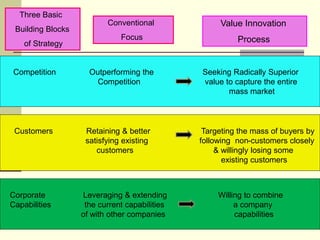
Three Basic
Building Blocks
of Strategy
Conventional
Focus
Value Innovation
Process
Competition Outperforming the Seeking Radically Superior
Competition value to capture the entire
mass market
Customers Retaining & better Targeting the mass of buyers by
satisfying existing following non-customers closely
customers & willingly losing some
existing customers
Corporate Leveraging & extending Willing to combine
Capabilities the current capabilities a company
of with other companies capabilities
1. Why Change?
- Only innovation matters.
2. What to Change?
- Ranging from changes in product & service to the
ways(i.e. process innovation).
3. Understanding Innovation.
- Understanding common problems associated with partial
views of innovation.
4. Building an Innovation Culture.
- Managing Innovation is all about creating firm specific
routines(i.e. repeated, reinforced patterns of behavior)
which define its particular approach to the problem.
CHALLENGES FACED WHILE
MANAGING INNOVATION
5. Continuous Learning
- Firms constantly needs to develop their routines to
deal with the environmental challenges.
6. High Involvement Innovation
- Higher level of participations in innovation represents
a competitive advantage.
7. Managing Connections
- In current scenario business organizations are required
to operate in relationship with others rather than in
splendid isolation.
CONTD……….
 External Barriers
- Market-Related Barrier
- Government & its Policies
- Others (Technical, Societal, & Inter
Organizational Barriers)
 Internal Barriers
- People Related
- Structural
- Strategy Related
BARRIERS TO INNOVATION
• Clearly articulated &
shared sense of purpose
• Stretching strategic intent
• Top management
commitment.
SHARED
VISION,
LEADERSHIP &
THE WILL TO
INNOVATE.
• Encouraging creativity
• Enabling learning &
interaction
• Balancing between ‘organic
& mechanistic’
APPROPRIATE
CULTURE
HOW TO OVERCOME THESE BARRIERS
LEARNING TO MANAGE INNOVATION
CONTD.
• Promoters, champions &
other roles which facilitate
innovation
KEY
INDIVIDUALS
• Use of teams at cross-
functional & inter-
organizational level
• Investment in team
selection & building
EFFECTIVE
TEAM
WORKING
• Education & training of
employees to ensure high
level of skills &
competence
CONTINUING &
STRETCHING
INDIVIDUAL
DEVELOPMENT
• Within & between the
organization and
outside
EXTENSIVE
COMMUNICATION
• Positive approach to
creative ideas,
supported by relevant
motivation systems
CREATIVE CLIMATE
• High level of
involvement within &
outside the firm in
proactive
experimentation
• Knowledge capture &
dissemination
LEARNING
ORGANISATION
CONCLUSION
Enterprises should emphasize
Planning &
Controlling
Systems
With high
degree of
Flexibility
Respect for
Individual
Initiative
And
Personal
Growth
Tolerance for
mistakes
And
Allowing
Room for
Failure
Past of Innovation
 Developed to Developing world
Developed
World
Developing
World
Future of Innovation
 Developing to Developed world
Developed
World
Developing
World
Why
 Population
 85% of the people (5.8 billion) live in poor
countries
 Total GDP
 In total GDP China is No. 2; India – No. 4
 Total GDP of poor countries is roughly $35 Trillion
(half of World GDP)
Why
 Projected GDP Growth rates
 China and India (Double as compared to Rich
countries)
 GDP per capita
 US – 6th; China – 94; India - 128
 Point is simple
 In rich countries there are few people who each
spend a lot
 In Developing world there are a lot of people who
each spend a little.
Either way, total spending is vast
The business challenge
 One person with 10 Dollars
 10 persons with 1 Dollar each
It requires innovation
Reverse innovation
Do you know him ?
WHAT IS REVERSE INNOVATION?
 Reverse Innovation is the strategy of innovating in
emerging (or developing) markets and then
distributing/marketing these innovations in developed
markets. Many companies are developing products in
emerging countries like China and India and then
distributing them globally.
 It is the reverse process of innovation.
 Developing country don’t need innovation that is why
glocalization strategy makes the perfect sense.
Key ideas for Reverse innovation
• Move People , Power and money to where the
growth is the developing countries.
• Create a reverse innovation mind set throughout
the corporation.
• Create separate business scorecards for
developing nations with full income statements and
an emphasis on growth metrics.
GE Healthcare – Technology In
Doctor’s Bag
• GE started developing 2001
• Traditional ECG machine costing $
50,000
• GE – Dominant manufacturers of
medical-imaging, diagnostics and
health-information technologies
• High-end devices are typically heavy
and cumbersome to carry
INDIAN SCENARIO
 Both patients and clinics has far less to spend than
their western counter parts
 The problem of the Indian market
 Low cost to patients
 Low capital cost
 Portability
 Battery power
 Ease of use
 Ease of maintenance and repairs
ADVANTAGE INDIA –
MACINDIA
 Development of MacIndia, a portable ECG
machine costing only $500
 Easy to operate with only two buttons
 Battery operated, No external power source
required
 Easy to carry in Doctor’s bag
 Open heart surgery for just $3,000
 US price - $ 150,000
 Despite the ultra-low price, NH hospital’s new
profit margins are slightly higher than USA
 Quality: its mortality rates within 30 days of
bypass surgery is 1.4% as compared to US
average of 1.9%
 The real magic lies in process innovation
 Standardization, specialization of labour,
economies of scale, and assembly line
production (just Like Henry Ford)
 Extensive resource utilization – expensive
equipments are used five times more as
compared to USA.
 Specialization of doctors in specific type of
surgery.
 Surgeons perform two to three times more
procedures.
 This accelerates learning, improves skills,
and increases quality.
 Now they are building a large 2000 bed
hospital in the Cayman islands (close to USA)
– an hour’s flight from Miami
 Reverse Innovation
Artificial Legs
IN USA APPROX CHARGES FOR ARTIFICIAL LEG- $20,000
PK SETHI JAIPURI FOOT
SUDHA CHANDRAN
Dr. Therdchai Jivacate
Artificial Leg
BABY MOSHA
Innovation-Reverse innovation by Roy

Innovation-Reverse innovation by Roy

  • 3.
    WHAT IS ANINNOVATION?  Innovation is profitable implementation of Ideas.  It is an idea, practice or object that is perceived as new by an individual or other unit of adoption.  It is a use of new knowledge to offer a new product or service that customers want. Thus, it is Invention + Commercialization. “Innovation is the search for and the discovery, developed, improvement, adoption and commercialization of new processes, new products and new organization structures and procedures.”
  • 4.
    GOALS OF INNOVATION Improving quality  Creation of new markets  Extension of the product range  Reducing labor cost  Improving production process  Reducing materials  Reducing environmental damage  Replacement of products/services  Reducing energy consumption  Conformance to regulations
  • 6.
    CHARACTERISTICS OF INNOVATION There is an object or target which is being changed.  It can be a product, a process, an individual’s lifestyle, an organization's strategy, a society culture.  Innovation vary in extent or magnitude i.e. degree to which one deviates from the past.  It is closely related to problem solving since generation & implementation of ideas for change never transpire without difficulty.  A final characteristic is the impact of the change, the significance or range of its effects.
  • 7.
    Difference between Innovation& Invention Invention Innovation 1. It’s creation of new product, service or process. 2. May not be commercialized 3. It can be autonomous or induced 4. Can be for economic or non- economic motive 5. Usually restricted to R&D centre 6. May bring few changes in organization 7. Precedes innovation 1. It is the introduction of new product, service or process into the marketplace. 2. Results into commercialization 3. Usually induced 4. Economic motive 5.Spread across the organization 6. Brings organizational change 7.Succeeds invention
  • 8.
    WHY INNOVATE ??? OTHERWISETHEIR SURVIVAL CHANCES ARE SERIOUSLY THREATENED ORGANIZATION PREPARE THEMSELVES TO INNOVATE ON A CONTINUING BASIS TURBULENT AND RAPIDLY CHANGING ECONOMY
  • 9.
    SOURCES OF INNOVATION Organizational Structure. - Organic structures positively influence innovation. As there is lower vertical differentiation, formalization, centralization. Organic organizations facilitate the flexibility, adaptation & cross-fertilization.  Long tenure in Management - Managerial tenure apparently provides legitimacy & knowledge of how to accomplish a task and obtain desired outcomes.  Slack Resources - Having an abundance of resources allows an organization to afford to purchase innovations, bear the cost of instituting innovations & absorb failures.  Interunit Communications - Innovative organizations are high users of committees, task forces, cross-functional teams that facilitate interaction across departmental lines.
  • 10.
    TYPES OF INNOVATION Product & Process Innovation  Open & Closed Innovation  Incremental & Radical Innovation  Modular and Architectural Innovation
  • 11.
  • 12.
    Open & ClosedInnovation Concept Development Implementation PROJECT START CONCEPT FROZEN MARKET INTRODUCTION Concept Development Implementation PROJECT START CONCEPT FROZEN MARKET INTRODUCTION Open Model For Innovation Closed Model For Innovation
  • 13.
  • 14.
  • 15.
    Architectural Innovation Change in Product Structure Modular Innovation Changein Component Technology Steam Engine of Car Fuel Engine of Car
  • 16.
     Recognizing orscanning the environment.  Aligning the overall business strategy & proposed innovation.  Acquiring technology from outside.  Generating technology in-house.  Exploring & selecting the most suitable response to the environment.  Executing & implementing innovation.  Learning lessons for improvement.  Developing the organization. INNOVATION PROCESS
  • 17.
    INNOVATION OCCURS AT THREELEVELS NATIONAL LEVEL ENTERPRISE LEVEL INDIVIDUAL LEVEL GOVT. POLICIES & SUPPORT ENTERPRISE POLICIES, SUPPORT & INITIATIVES INDIVIDUAL & GROUP INNOVATION ACTIVITIES
  • 18.
  • 19.
    INNOVATION MANAGEMENT  Innovationmanagement is all about - learning to find the most appropriate solution - to the problem of consistently managing aforestated process - doing so in the ways best suited to the particular circumstances in which the organization finds itself.  It is the search of effective routines.  It is about managing the learning process to deal with the challenge of the innovation process.
  • 20.
    Innovation Management Management ofInnovation comprises three things: - linking of engineering, - science & - management disciplines  to plan, develop & implement technological capabilities to shape & accomplish the strategic & operational objectives of an organization.
  • 21.
    Need/Objectives of InnovationManagement  To reap in the economic benefits of new technological inventions by commercializing them on time  To integrate technology into overall strategic objective of the organization.  To get into and out of the technologies faster and more efficiently.  To accomplish technology transfer.  To reduce new product development time.  To manage large ,complex & interdisciplinary projects and systems.
  • 22.
    Organizational Process forInnovation Management Market Learning Effectively Building Business Models Creating a Cause & not a business Designing an open market for :Ideas, Capital, Talent Listening to New Voices Setting Unreasonable Expectations & Stretching the Business Definition Building Partnership and Alliances Lowering the risks of experimentation Paying the Innovators Well
  • 23.
    VALUE INNOVATION(VI)  Oneof the most prominent programmatic approaches to innovation currently in use.  It is different from building layers of competitive advantages & does not means segmenting market & accommodating customer needs.  It’s main focus is on offering those products & services which creates a superior buyer value in existing markets & enables a quantum leap for the firm to create new markets.  Value Innovation also differs from technology innovation. New technology developed does not becomes a value innovation unless it is cheap enough for MASS BUYERS.
  • 24.
    Three Basic Building Blocks ofStrategy Conventional Focus Value Innovation Process Competition Outperforming the Seeking Radically Superior Competition value to capture the entire mass market Customers Retaining & better Targeting the mass of buyers by satisfying existing following non-customers closely customers & willingly losing some existing customers Corporate Leveraging & extending Willing to combine Capabilities the current capabilities a company of with other companies capabilities
  • 25.
    1. Why Change? -Only innovation matters. 2. What to Change? - Ranging from changes in product & service to the ways(i.e. process innovation). 3. Understanding Innovation. - Understanding common problems associated with partial views of innovation. 4. Building an Innovation Culture. - Managing Innovation is all about creating firm specific routines(i.e. repeated, reinforced patterns of behavior) which define its particular approach to the problem. CHALLENGES FACED WHILE MANAGING INNOVATION
  • 26.
    5. Continuous Learning -Firms constantly needs to develop their routines to deal with the environmental challenges. 6. High Involvement Innovation - Higher level of participations in innovation represents a competitive advantage. 7. Managing Connections - In current scenario business organizations are required to operate in relationship with others rather than in splendid isolation. CONTD……….
  • 27.
     External Barriers -Market-Related Barrier - Government & its Policies - Others (Technical, Societal, & Inter Organizational Barriers)  Internal Barriers - People Related - Structural - Strategy Related BARRIERS TO INNOVATION
  • 28.
    • Clearly articulated& shared sense of purpose • Stretching strategic intent • Top management commitment. SHARED VISION, LEADERSHIP & THE WILL TO INNOVATE. • Encouraging creativity • Enabling learning & interaction • Balancing between ‘organic & mechanistic’ APPROPRIATE CULTURE HOW TO OVERCOME THESE BARRIERS LEARNING TO MANAGE INNOVATION
  • 29.
    CONTD. • Promoters, champions& other roles which facilitate innovation KEY INDIVIDUALS • Use of teams at cross- functional & inter- organizational level • Investment in team selection & building EFFECTIVE TEAM WORKING • Education & training of employees to ensure high level of skills & competence CONTINUING & STRETCHING INDIVIDUAL DEVELOPMENT
  • 30.
    • Within &between the organization and outside EXTENSIVE COMMUNICATION • Positive approach to creative ideas, supported by relevant motivation systems CREATIVE CLIMATE • High level of involvement within & outside the firm in proactive experimentation • Knowledge capture & dissemination LEARNING ORGANISATION
  • 31.
    CONCLUSION Enterprises should emphasize Planning& Controlling Systems With high degree of Flexibility Respect for Individual Initiative And Personal Growth Tolerance for mistakes And Allowing Room for Failure
  • 32.
    Past of Innovation Developed to Developing world Developed World Developing World
  • 33.
    Future of Innovation Developing to Developed world Developed World Developing World
  • 34.
    Why  Population  85%of the people (5.8 billion) live in poor countries  Total GDP  In total GDP China is No. 2; India – No. 4  Total GDP of poor countries is roughly $35 Trillion (half of World GDP)
  • 35.
    Why  Projected GDPGrowth rates  China and India (Double as compared to Rich countries)  GDP per capita  US – 6th; China – 94; India - 128  Point is simple  In rich countries there are few people who each spend a lot  In Developing world there are a lot of people who each spend a little. Either way, total spending is vast
  • 36.
    The business challenge One person with 10 Dollars  10 persons with 1 Dollar each It requires innovation Reverse innovation
  • 37.
  • 38.
    WHAT IS REVERSEINNOVATION?  Reverse Innovation is the strategy of innovating in emerging (or developing) markets and then distributing/marketing these innovations in developed markets. Many companies are developing products in emerging countries like China and India and then distributing them globally.  It is the reverse process of innovation.  Developing country don’t need innovation that is why glocalization strategy makes the perfect sense.
  • 40.
    Key ideas forReverse innovation • Move People , Power and money to where the growth is the developing countries. • Create a reverse innovation mind set throughout the corporation. • Create separate business scorecards for developing nations with full income statements and an emphasis on growth metrics.
  • 42.
    GE Healthcare –Technology In Doctor’s Bag • GE started developing 2001 • Traditional ECG machine costing $ 50,000 • GE – Dominant manufacturers of medical-imaging, diagnostics and health-information technologies • High-end devices are typically heavy and cumbersome to carry
  • 43.
    INDIAN SCENARIO  Bothpatients and clinics has far less to spend than their western counter parts  The problem of the Indian market  Low cost to patients  Low capital cost  Portability  Battery power  Ease of use  Ease of maintenance and repairs
  • 44.
    ADVANTAGE INDIA – MACINDIA Development of MacIndia, a portable ECG machine costing only $500  Easy to operate with only two buttons  Battery operated, No external power source required  Easy to carry in Doctor’s bag
  • 46.
     Open heartsurgery for just $3,000  US price - $ 150,000  Despite the ultra-low price, NH hospital’s new profit margins are slightly higher than USA  Quality: its mortality rates within 30 days of bypass surgery is 1.4% as compared to US average of 1.9%  The real magic lies in process innovation  Standardization, specialization of labour, economies of scale, and assembly line production (just Like Henry Ford)
  • 47.
     Extensive resourceutilization – expensive equipments are used five times more as compared to USA.  Specialization of doctors in specific type of surgery.  Surgeons perform two to three times more procedures.  This accelerates learning, improves skills, and increases quality.
  • 48.
     Now theyare building a large 2000 bed hospital in the Cayman islands (close to USA) – an hour’s flight from Miami  Reverse Innovation
  • 49.
    Artificial Legs IN USAAPPROX CHARGES FOR ARTIFICIAL LEG- $20,000
  • 50.
    PK SETHI JAIPURIFOOT SUDHA CHANDRAN
  • 51.
  • 53.