
Ashima Wadhwa
Assistant Professor (IT)
Amity University, Noida
Topic Outline
Definition(SEO)
How Search Engines Work
SEO Building Blocks
Keywords
Crawler
Links
SEO Tools
SEO Techniques
Summary and Conclusion
2
3
Definition of Search Engine
Optimization (SEO)
SEO is Search Engine is the process of making a site and its
content highly relevant for both search engines and
searchers.
OR
SEO is the act of modifying a website to increase its ranking
in organic (vs paid), crawler-based listings of search engines
4
How Search Engines Works
How do organic search listings work?
A spider or crawler which is a component of a SE gathers
listings by automatically "crawling" the web
The spider follows links to web pages, makes copies of
the pages and stores them in the SE’s index
Based on this data, the SE then indexes the pages and
ranks the websites
Major SEs that index pages using spiders: Google,
Altavista, Msn, Aol, lycos
“Spiders read only text, nothing else”
Search Engine Operations
1. Gather Content
 Crawler or spider moves recursively downloading
content
1. Builds sophisticate index
2. Individual web searches run against index
 Results are retrieved and ordered
6
7
SEO Techniques
SEO strategies/techniques
1. Domain name strategies
- domain names are traffic magnets
> 63 million domain names registered
> 4.7 million domain names registered 1st quarter
2004
- choose a domain name that will increase your
search engine ranking. How?
- use keywords, location, advertising terms, product
names
- choose a keyword that is important for your
business
SEO strategies/techniques
2. Linking strategies
- the text in the links should include keywords
- the more inbound links the higher the SE ranking
- links for the sake of links can damage your search rankings
Search engine optimization/cont’d
3. Keywords
- keywords are words that appear the most in a
page.
- the spider chooses the appropriate keywords for
each page, then sends them back to its SE .
- your web site will then be indexed based on your
keywords .
- do not use common words eg ‘the’ ‘and’ ‘of’:
spiders ignore them.
- write keyword-rich text
- balance keyword-rich and readability
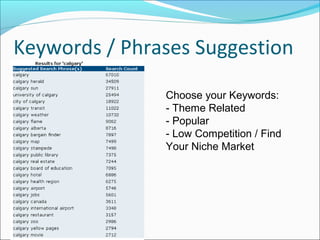
Keywords / Phrases Suggestion
Choose your Keywords:
- Theme Related
- Popular
- Low Competition / Find
Your Niche Market
SEO strategies/techniques
4. Title tags
- important in optimizing rankings
- the first thing that a search engine displays on a
search return
- should have the exact keyword you use for the page
- every single web page must have its own title tag
- you can use up to 65 characters - example
http://www.ebay.com/ (title is littered with keywords)
SEO strategies/techniques
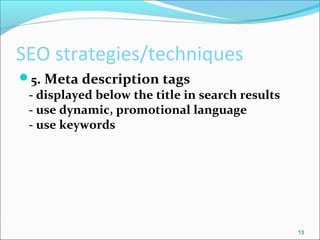
5. Meta description tags
- displayed below the title in search results
- use dynamic, promotional language
- use keywords
13
14
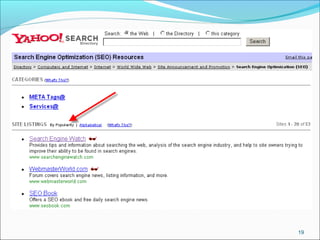
SEO Tools
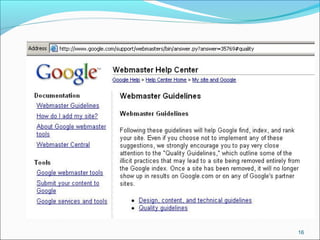
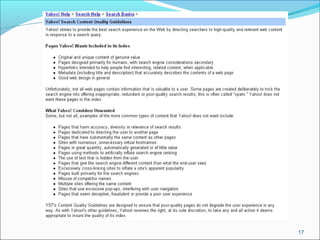
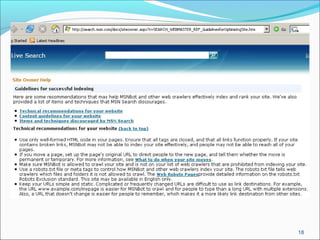
Search Engine Term and Conditions
Google
Yahoo
MSN Search
15
16
17
18
19
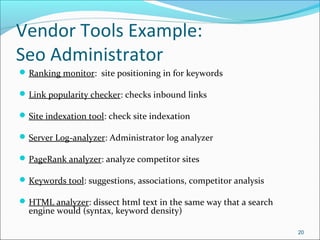
Vendor Tools Example:
Seo Administrator
Ranking monitor: site positioning in for keywords
Link popularity checker: checks inbound links
Site indexation tool: check site indexation
Server Log-analyzer: Administrator log analyzer
PageRank analyzer: analyze competitor sites
Keywords tool: suggestions, associations, competitor analysis
HTML analyzer: dissect html text in the same way that a search
engine would (syntax, keyword density)
20
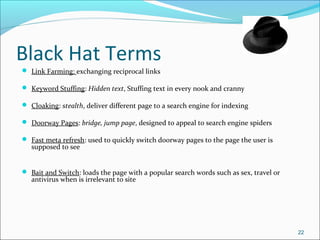
Black Hat Terms
 Link Farming: exchanging reciprocal links
 Keyword Stuffing: Hidden text, Stuffing text in every nook and cranny
 Cloaking: stealth, deliver different page to a search engine for indexing
 Doorway Pages: bridge, jump page, designed to appeal to search engine spiders
 Fast meta refresh: used to quickly switch doorway pages to the page the user is
supposed to see
 Bait and Switch: loads the page with a popular search words such as sex, travel or
antivirus when is irrelevant to site
22
SEO - what is NOT recommended
Flash and shockwave – s piders do not pick up these files.
Image only sites - spiders do not pick up images.
Image maps - spiders cannot read image maps.
Do not use them on your home page or critical pages.
Frames - - Some spiders may not even read a frames web site.
Password protected pages – spiders cannot enter password protected
pages
SEO - what is NOT recommended
PDF files - can be problematic for spiders. Although some search
engines can index them, the pages must be interpreted into HTML
and can lose much of their content.
- place PDFs lower down in your site
Dynamic pages - spiders cannot index some content on pages using
ASP, CGI or other dynamic languages.
- Make sure important pages are HTML, no dynamically generated
content.
Drop down menus – spiders cannot read them
25

Search engine optimization

  • 1.
    Ashima Wadhwa Assistant Professor(IT) Amity University, Noida
  • 2.
    Topic Outline Definition(SEO) How SearchEngines Work SEO Building Blocks Keywords Crawler Links SEO Tools SEO Techniques Summary and Conclusion 2
  • 3.
    3 Definition of SearchEngine Optimization (SEO) SEO is Search Engine is the process of making a site and its content highly relevant for both search engines and searchers. OR SEO is the act of modifying a website to increase its ranking in organic (vs paid), crawler-based listings of search engines
  • 4.
  • 5.
    How do organicsearch listings work? A spider or crawler which is a component of a SE gathers listings by automatically "crawling" the web The spider follows links to web pages, makes copies of the pages and stores them in the SE’s index Based on this data, the SE then indexes the pages and ranks the websites Major SEs that index pages using spiders: Google, Altavista, Msn, Aol, lycos “Spiders read only text, nothing else”
  • 6.
    Search Engine Operations 1.Gather Content  Crawler or spider moves recursively downloading content 1. Builds sophisticate index 2. Individual web searches run against index  Results are retrieved and ordered 6
  • 7.
  • 8.
    SEO strategies/techniques 1. Domainname strategies - domain names are traffic magnets > 63 million domain names registered > 4.7 million domain names registered 1st quarter 2004 - choose a domain name that will increase your search engine ranking. How? - use keywords, location, advertising terms, product names - choose a keyword that is important for your business
  • 9.
    SEO strategies/techniques 2. Linkingstrategies - the text in the links should include keywords - the more inbound links the higher the SE ranking - links for the sake of links can damage your search rankings
  • 10.
    Search engine optimization/cont’d 3.Keywords - keywords are words that appear the most in a page. - the spider chooses the appropriate keywords for each page, then sends them back to its SE . - your web site will then be indexed based on your keywords . - do not use common words eg ‘the’ ‘and’ ‘of’: spiders ignore them. - write keyword-rich text - balance keyword-rich and readability
  • 11.
    Keywords / PhrasesSuggestion Choose your Keywords: - Theme Related - Popular - Low Competition / Find Your Niche Market
  • 12.
    SEO strategies/techniques 4. Titletags - important in optimizing rankings - the first thing that a search engine displays on a search return - should have the exact keyword you use for the page - every single web page must have its own title tag - you can use up to 65 characters - example http://www.ebay.com/ (title is littered with keywords)
  • 13.
    SEO strategies/techniques 5. Metadescription tags - displayed below the title in search results - use dynamic, promotional language - use keywords 13
  • 14.
  • 15.
    Search Engine Termand Conditions Google Yahoo MSN Search 15
  • 16.
  • 17.
  • 18.
  • 19.
  • 20.
    Vendor Tools Example: SeoAdministrator Ranking monitor: site positioning in for keywords Link popularity checker: checks inbound links Site indexation tool: check site indexation Server Log-analyzer: Administrator log analyzer PageRank analyzer: analyze competitor sites Keywords tool: suggestions, associations, competitor analysis HTML analyzer: dissect html text in the same way that a search engine would (syntax, keyword density) 20
  • 22.
    Black Hat Terms Link Farming: exchanging reciprocal links  Keyword Stuffing: Hidden text, Stuffing text in every nook and cranny  Cloaking: stealth, deliver different page to a search engine for indexing  Doorway Pages: bridge, jump page, designed to appeal to search engine spiders  Fast meta refresh: used to quickly switch doorway pages to the page the user is supposed to see  Bait and Switch: loads the page with a popular search words such as sex, travel or antivirus when is irrelevant to site 22
  • 23.
    SEO - whatis NOT recommended Flash and shockwave – s piders do not pick up these files. Image only sites - spiders do not pick up images. Image maps - spiders cannot read image maps. Do not use them on your home page or critical pages. Frames - - Some spiders may not even read a frames web site. Password protected pages – spiders cannot enter password protected pages
  • 24.
    SEO - whatis NOT recommended PDF files - can be problematic for spiders. Although some search engines can index them, the pages must be interpreted into HTML and can lose much of their content. - place PDFs lower down in your site Dynamic pages - spiders cannot index some content on pages using ASP, CGI or other dynamic languages. - Make sure important pages are HTML, no dynamically generated content. Drop down menus – spiders cannot read them
  • 25.