Disruptive Technologies
Marius Keown – Systems Engineer @ Arista Networks
Moore’s Law
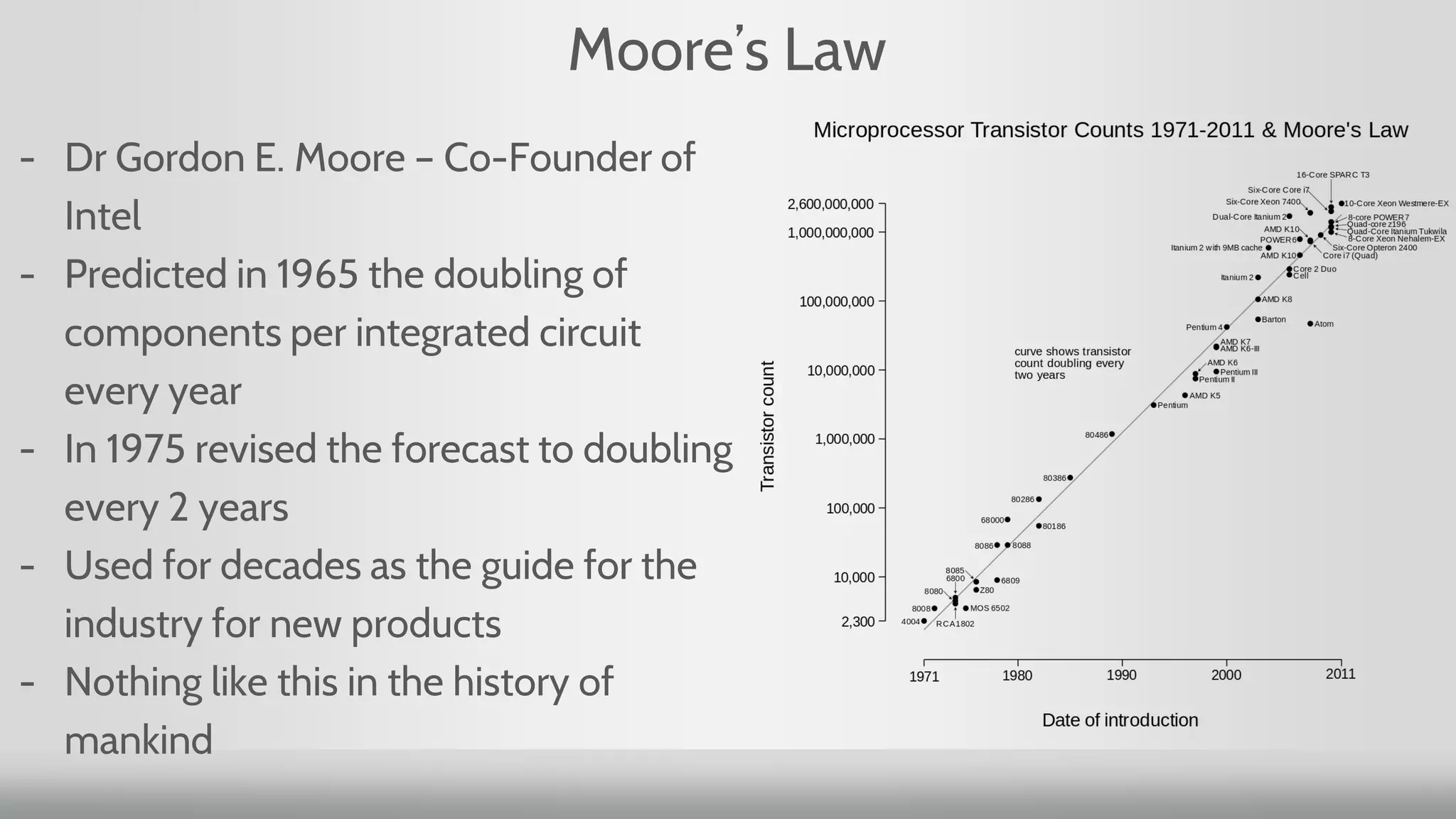
- Dr Gordon E. Moore – Co-Founder of
Intel
- Predicted in 1965 the doubling of
components per integrated circuit
every year
- In 1975 revised the forecast to doubling
every 2 years
- Used for decades as the guide for the
industry for new products
- Nothing like this in the history of
mankind
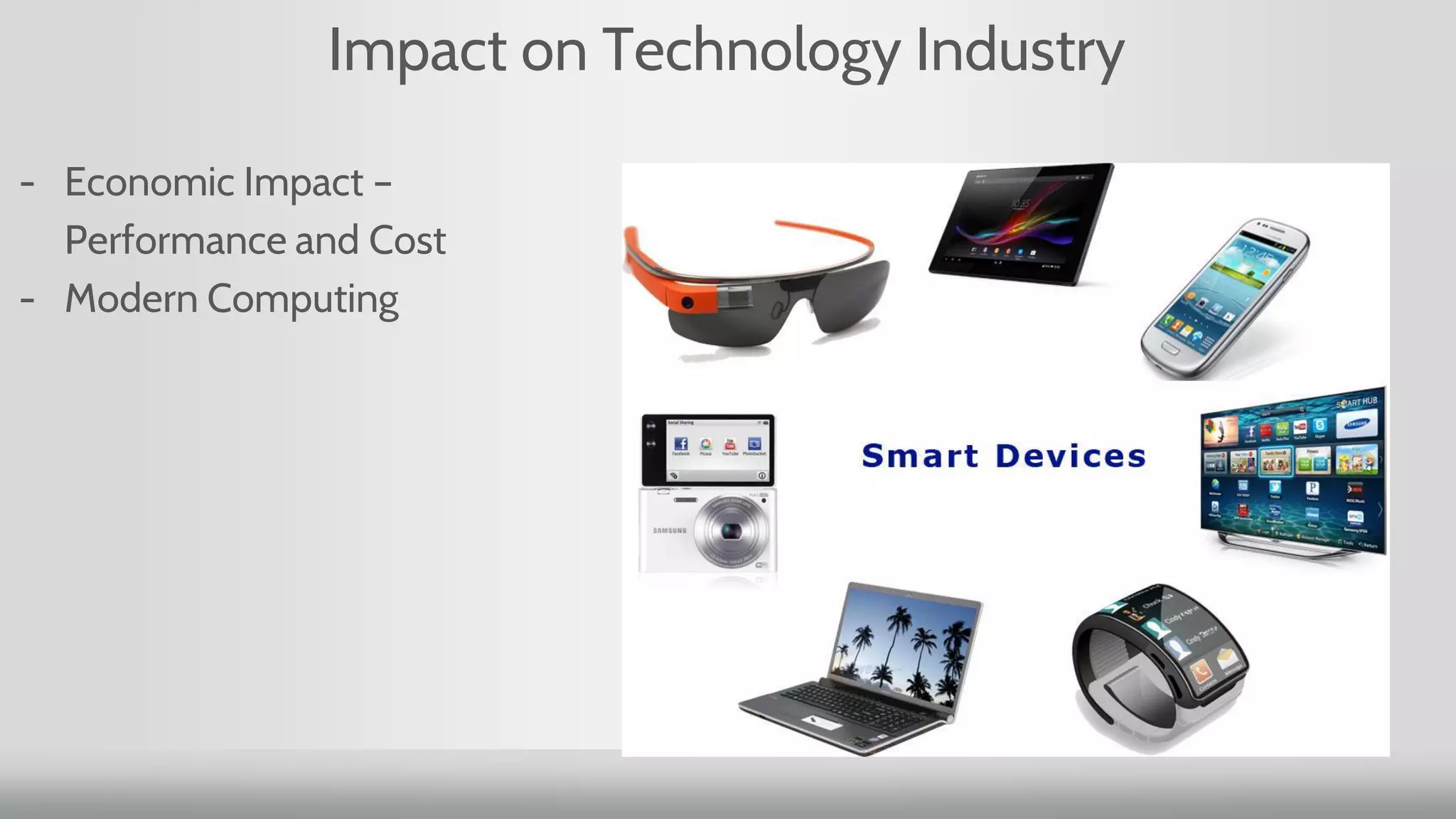
Impact on Technology Industry
- Economic Impact –
Performance and Cost
- Modern Computing
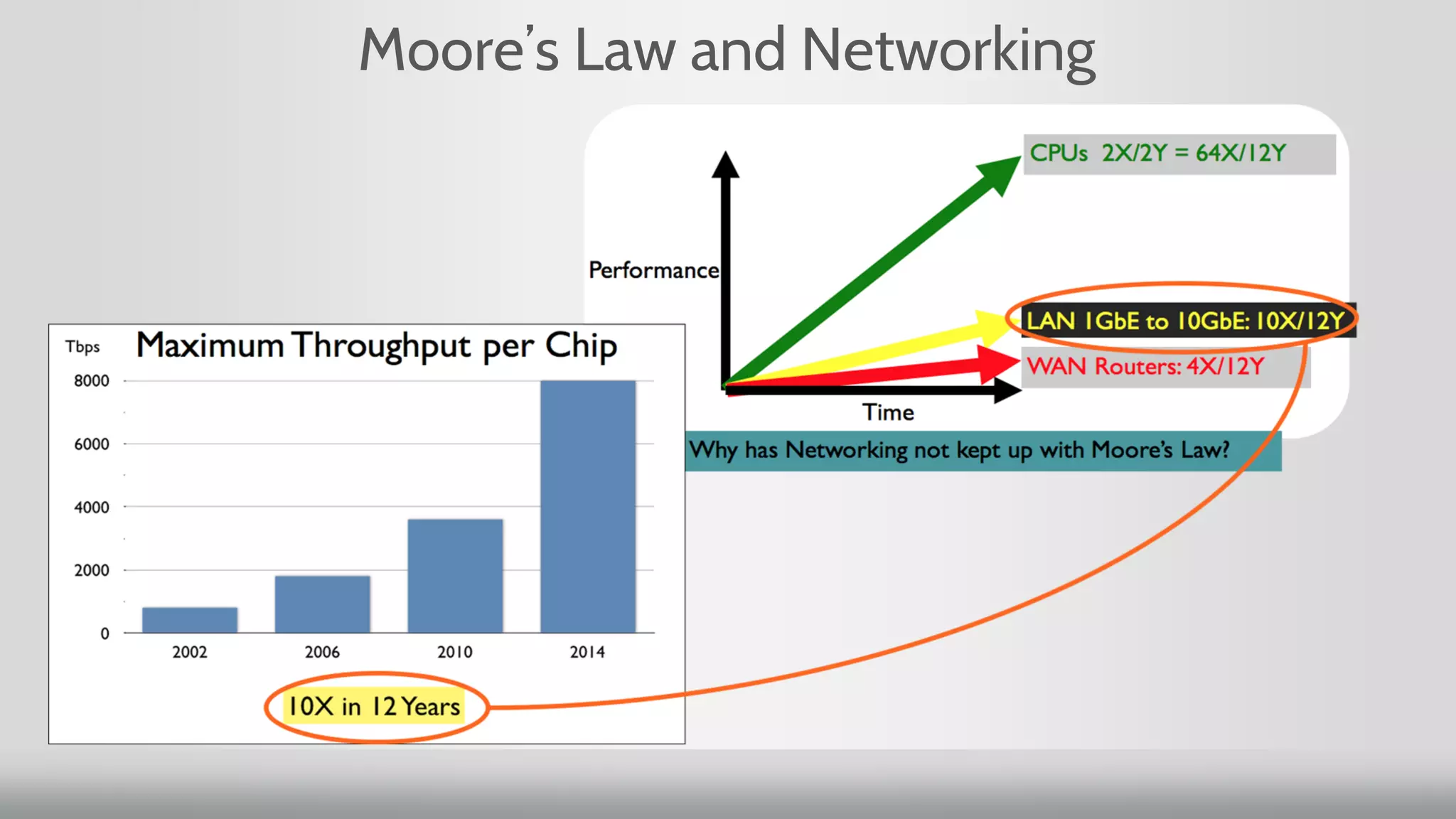
Moore’s Law and Networking
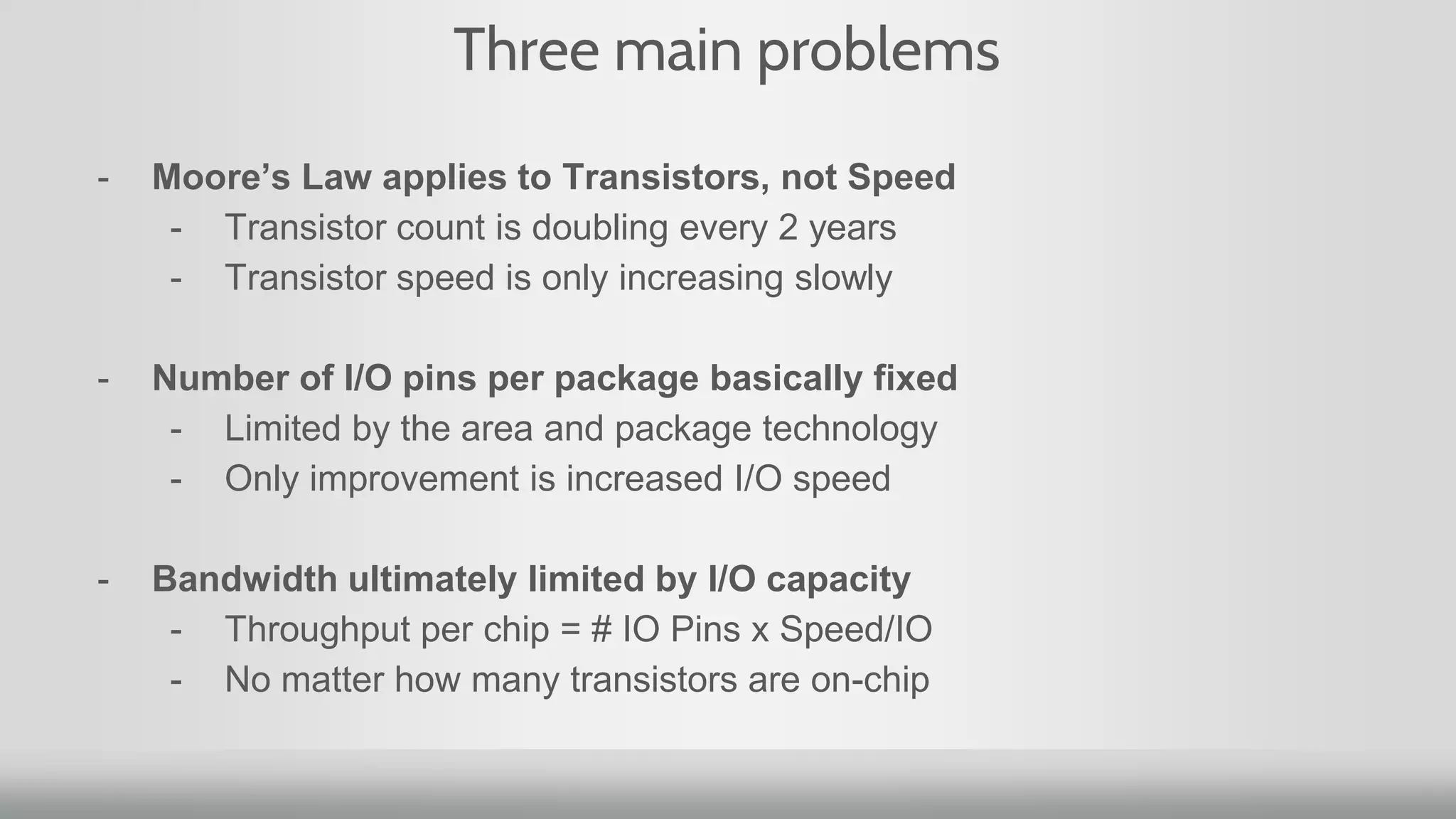
Three main problems
- Moore’s Law applies to Transistors, not Speed
- Transistor count is doubling every 2 years
- Transistor speed is only increasing slowly
- Number of I/O pins per package basically fixed
- Limited by the area and package technology
- Only improvement is increased I/O speed
- Bandwidth ultimately limited by I/O capacity
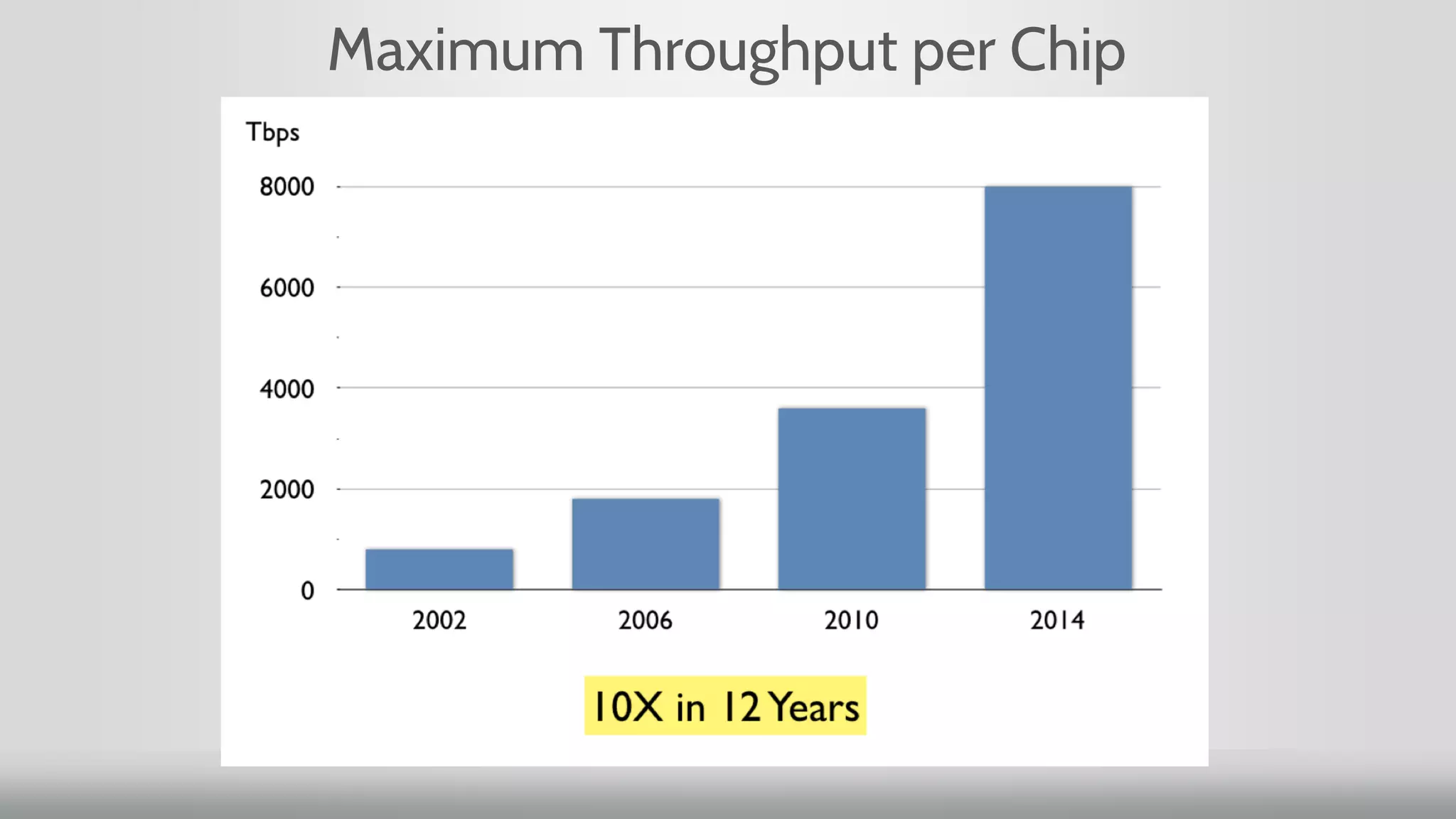
- Throughput per chip = # IO Pins x Speed/IO
- No matter how many transistors are on-chip
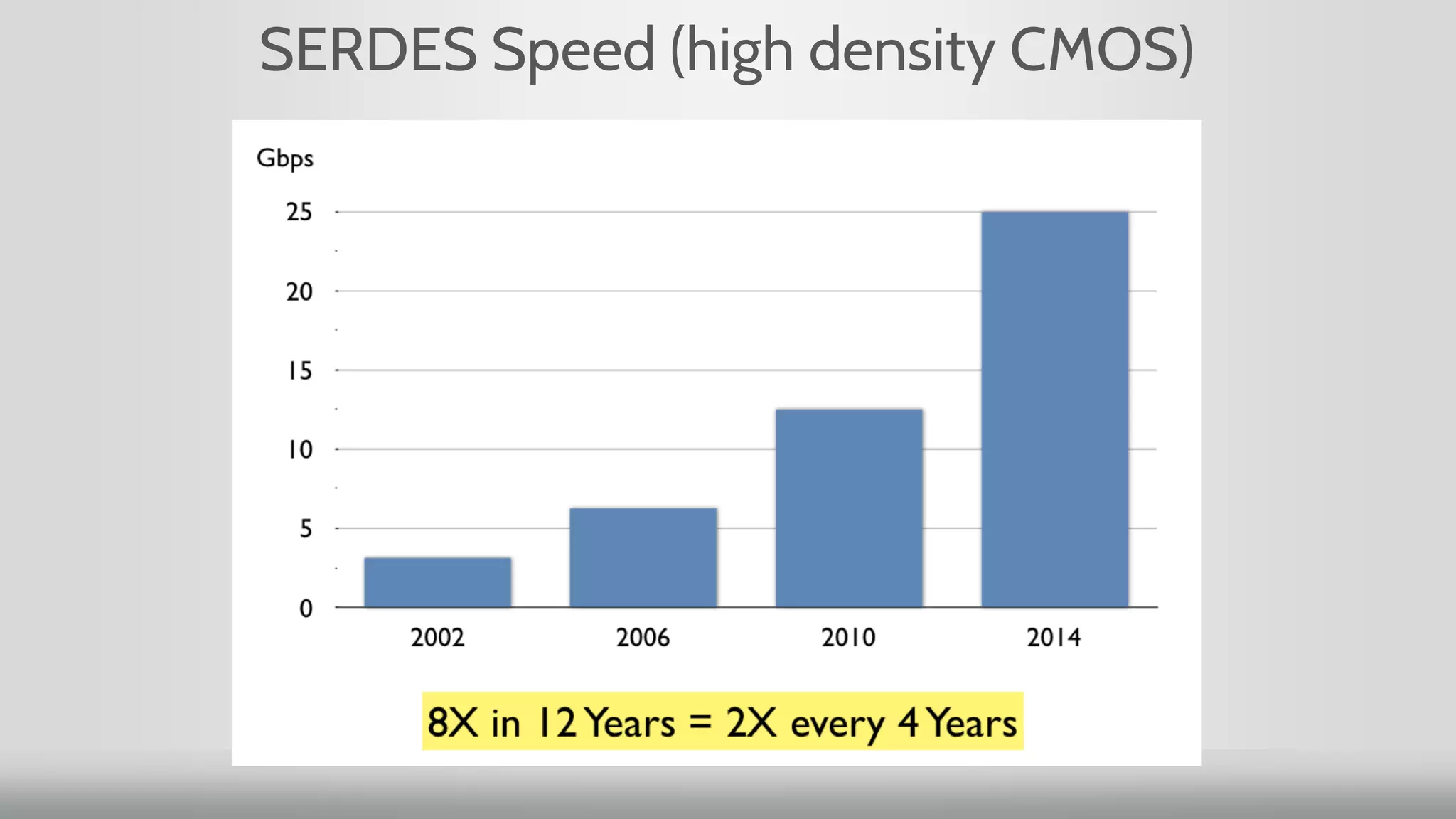
SERDES Speed (high density CMOS)
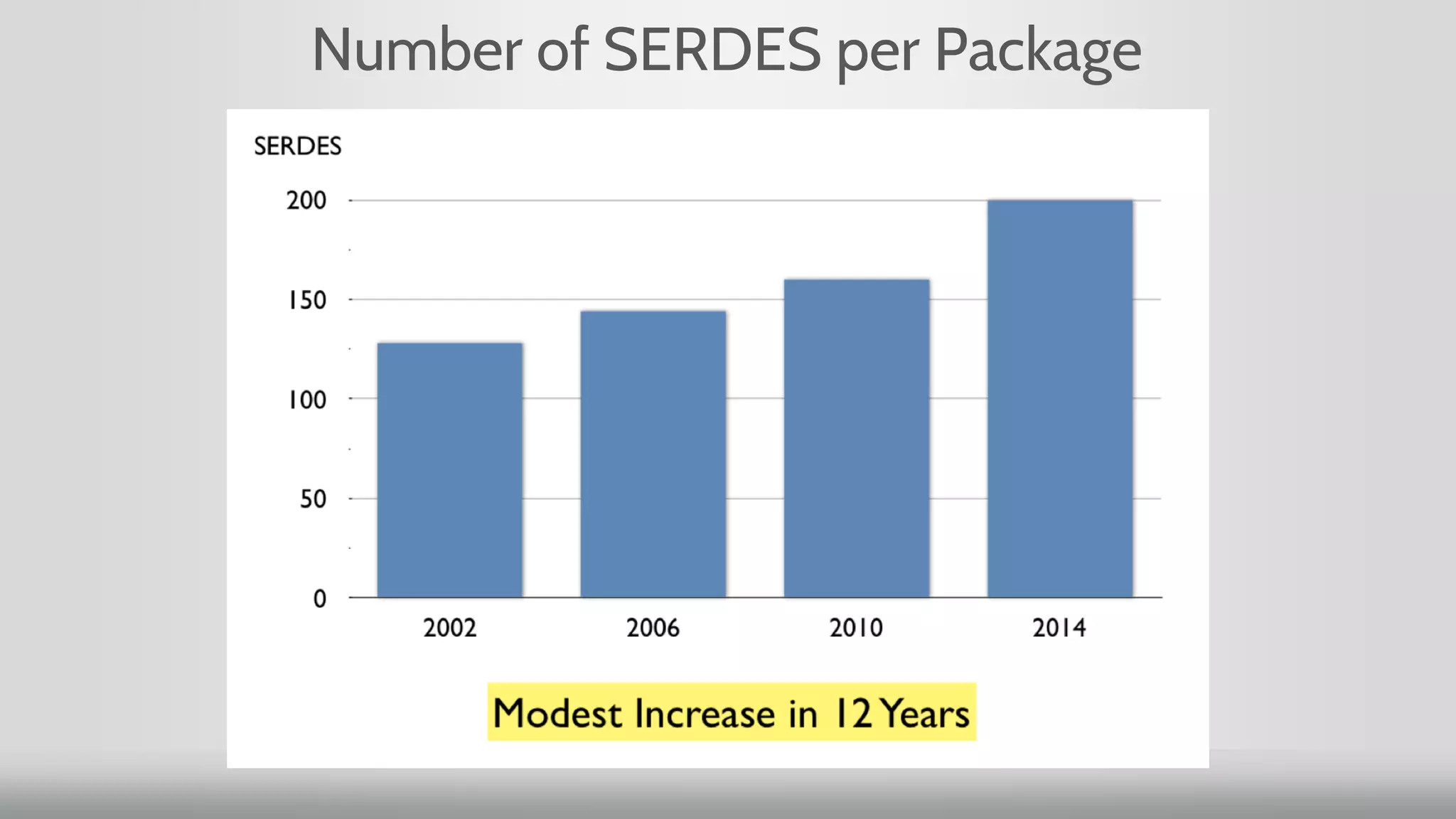
Number of SERDES per Package
Maximum Throughput per Chip
Moore’s Law and Networking
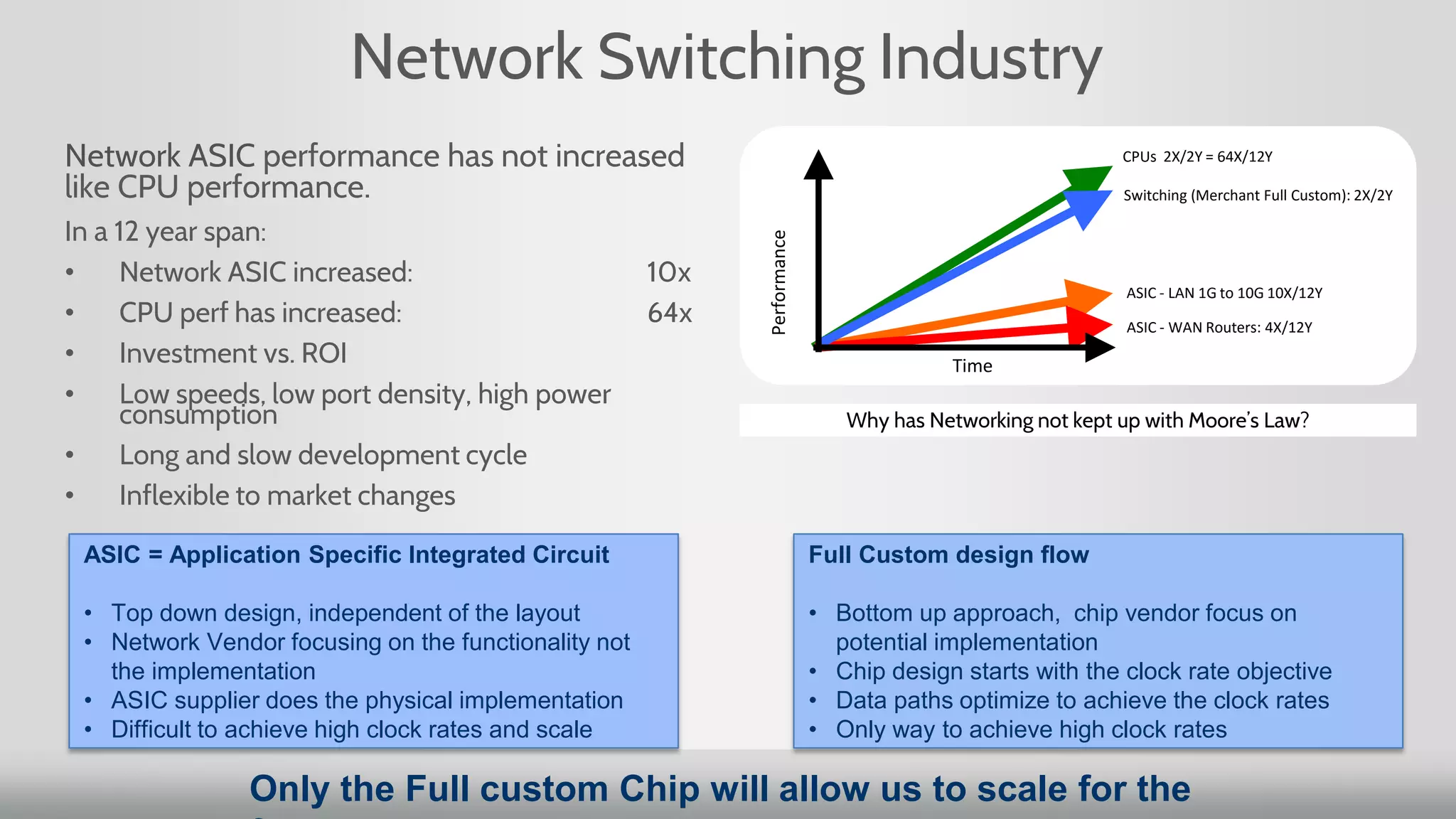
Network Switching Industry
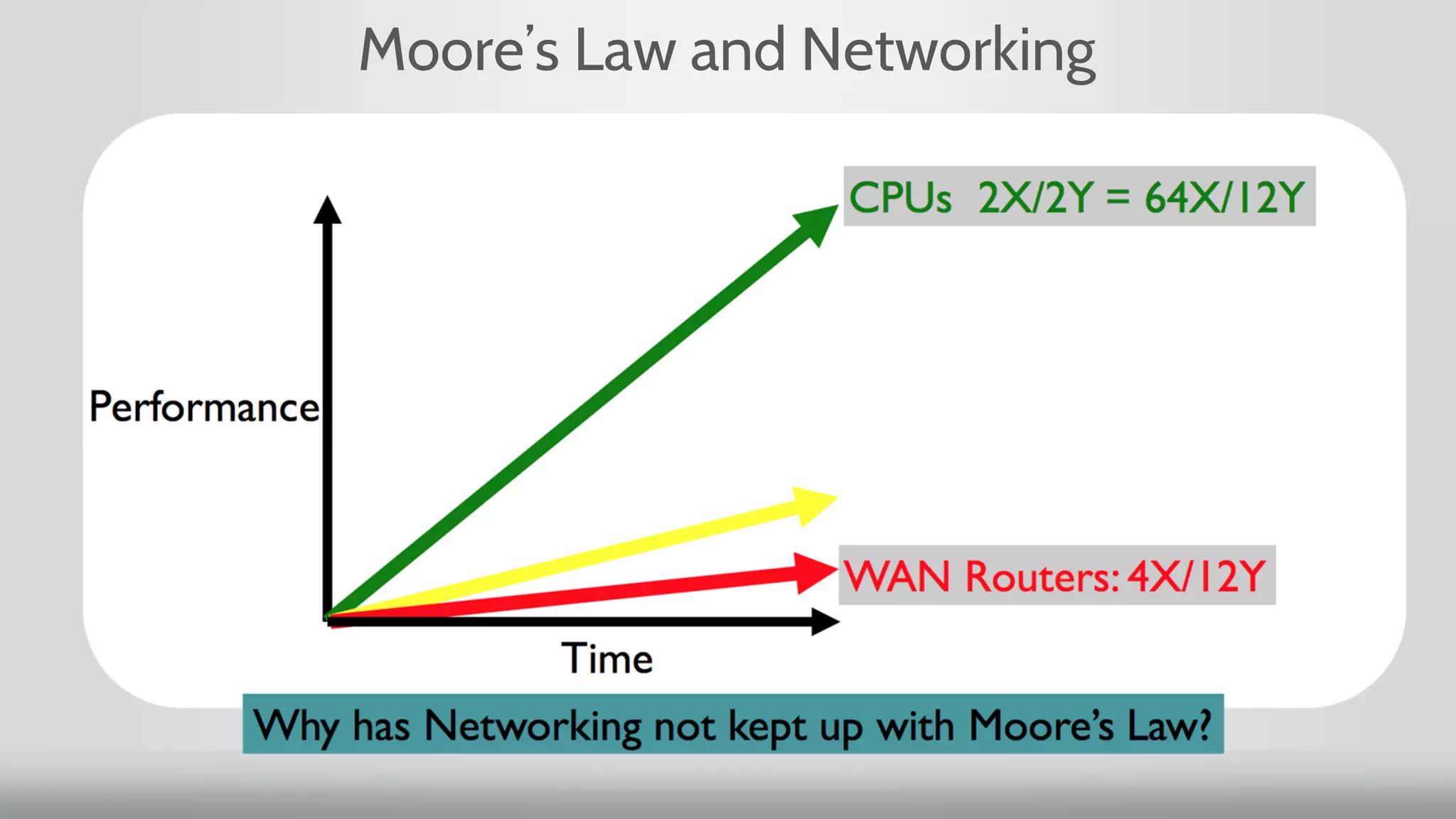
Network ASIC performance has not increased
like CPU performance.
In a 12 year span:
• Network ASIC increased: 10x
• CPU perf has increased: 64x
• Investment vs. ROI
• Low speeds, low port density, high power
consumption
• Long and slow development cycle
• Inflexible to market changes
ASIC = Application Specific Integrated Circuit
• Top down design, independent of the layout
• Network Vendor focusing on the functionality not
the implementation
• ASIC supplier does the physical implementation
• Difficult to achieve high clock rates and scale
Full Custom design flow
• Bottom up approach, chip vendor focus on
potential implementation
• Chip design starts with the clock rate objective
• Data paths optimize to achieve the clock rates
• Only way to achieve high clock rates
Only the Full custom Chip will allow us to scale for thePerformance
Time
CPUs 2X/2Y = 64X/12Y
ASIC - LAN 1G to 10G 10X/12Y
ASIC - WAN Routers: 4X/12Y
Why has Networking not kept up with Moore’s Law?
Switching (Merchant Full Custom): 2X/2Y
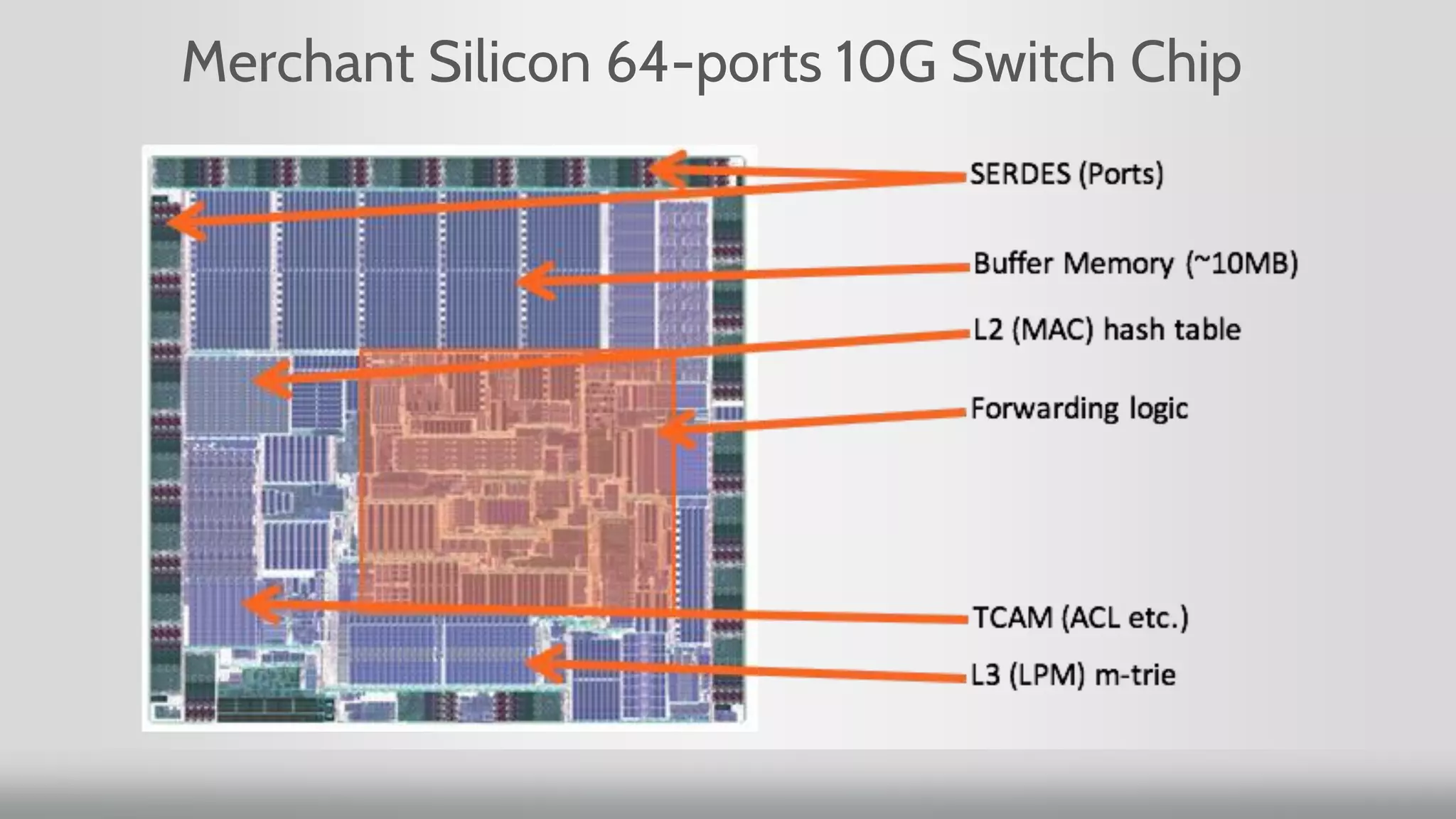
Merchant Silicon 64-ports 10G Switch Chip
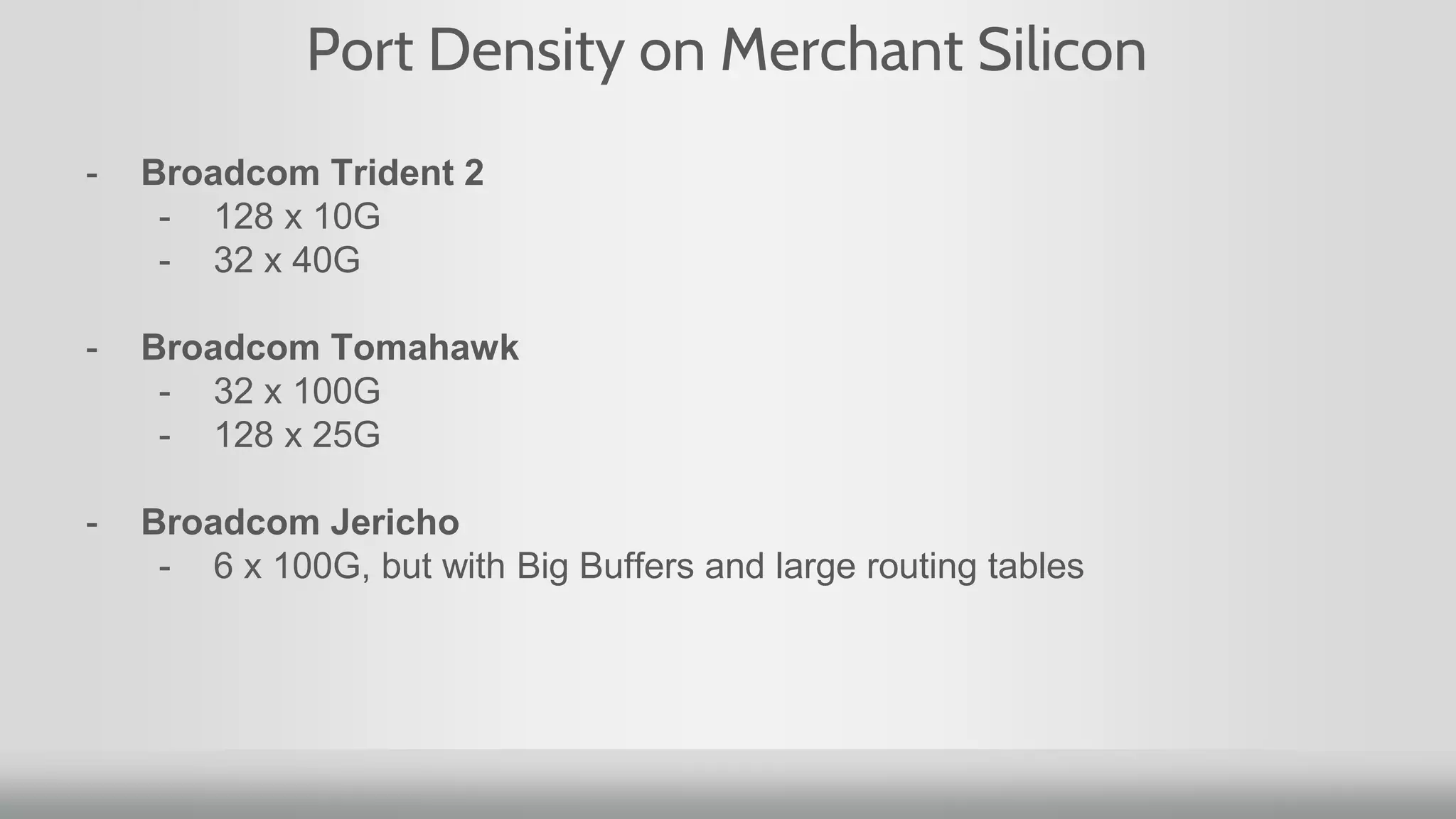
Port Density on Merchant Silicon
- Broadcom Trident 2
- 128 x 10G
- 32 x 40G
- Broadcom Tomahawk
- 32 x 100G
- 128 x 25G
- Broadcom Jericho
- 6 x 100G, but with Big Buffers and large routing tables
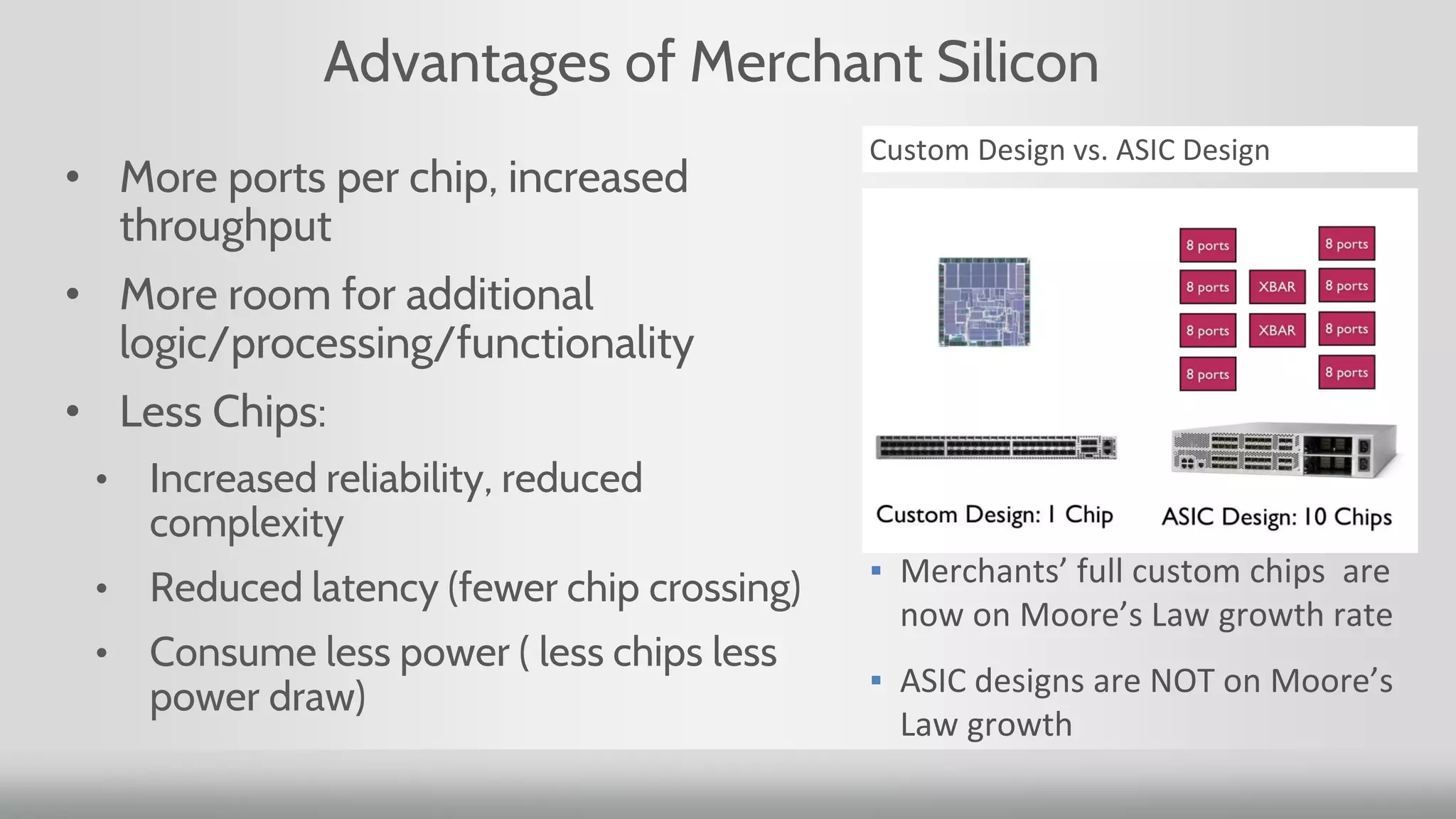
Advantages of Merchant Silicon
• More ports per chip, increased
throughput
• More room for additional
logic/processing/functionality
• Less Chips:
• Increased reliability, reduced
complexity
• Reduced latency (fewer chip crossing)
• Consume less power ( less chips less
power draw)
▪ Merchants’ full custom chips are
now on Moore’s Law growth rate
▪ ASIC designs are NOT on Moore’s
Law growth
Custom Design vs. ASIC Design
Merchant Silicon for SP
15
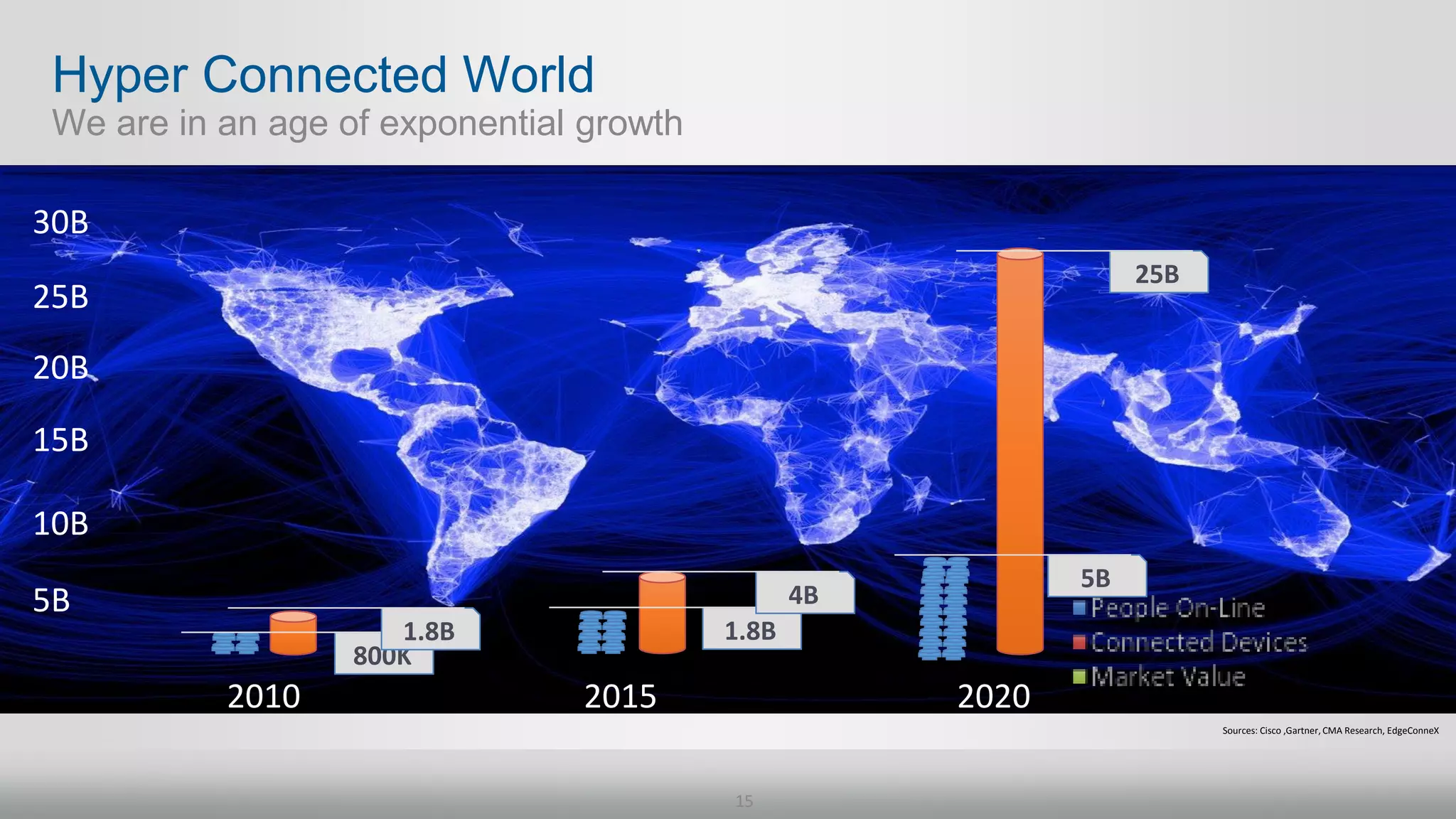
Hyper Connected World
We are in an age of exponential growth
2010 2015 2020
30B
25B
20B
15B
10B
5B
25B
800K
1.8B 1.8B
4B
5B
Sources: Cisco ,Gartner, CMA Research, EdgeConneX
1
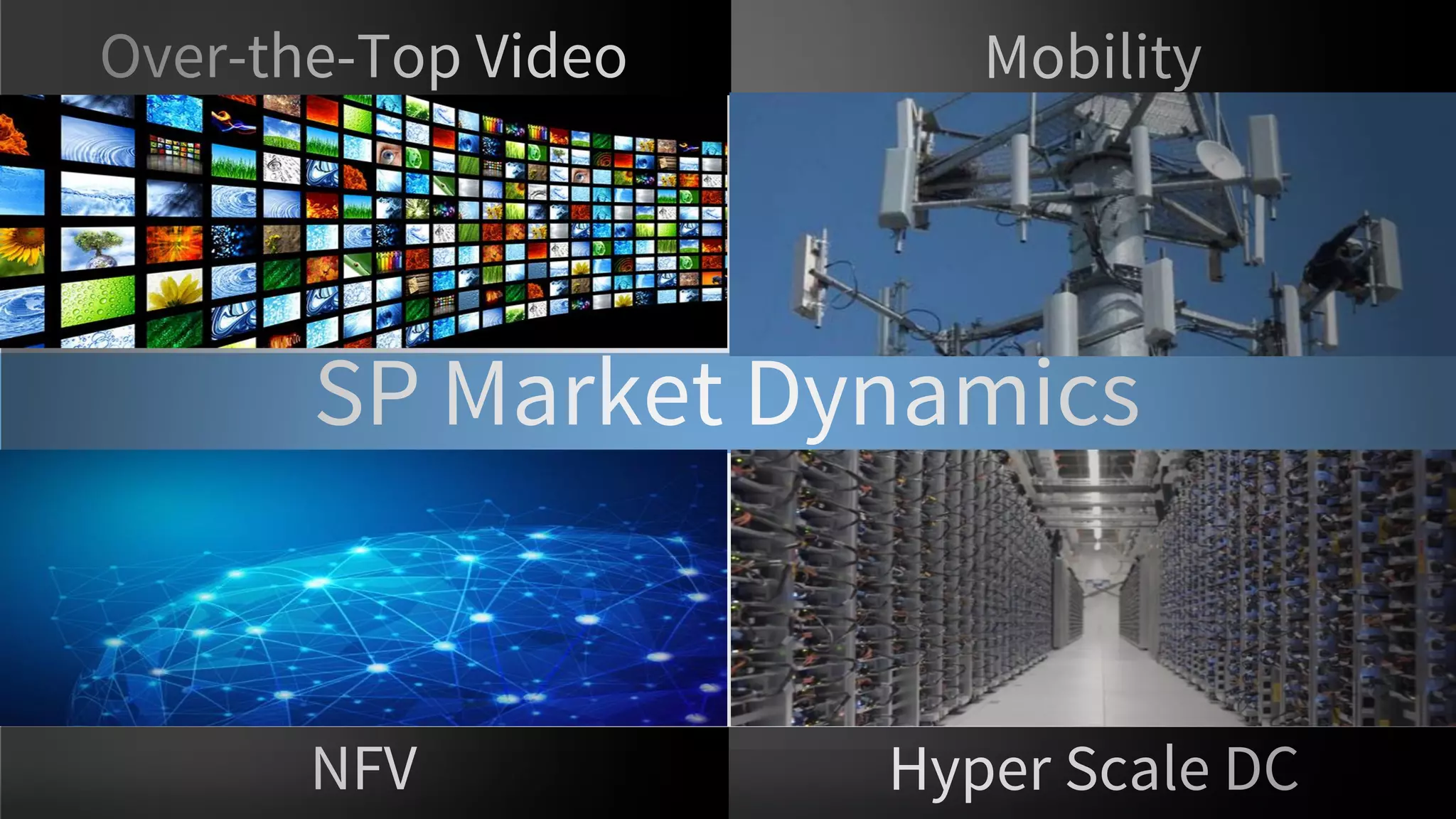
Over-the-Top Video Mobility
NFV Hyper Scale DC
SP Market Dynamics
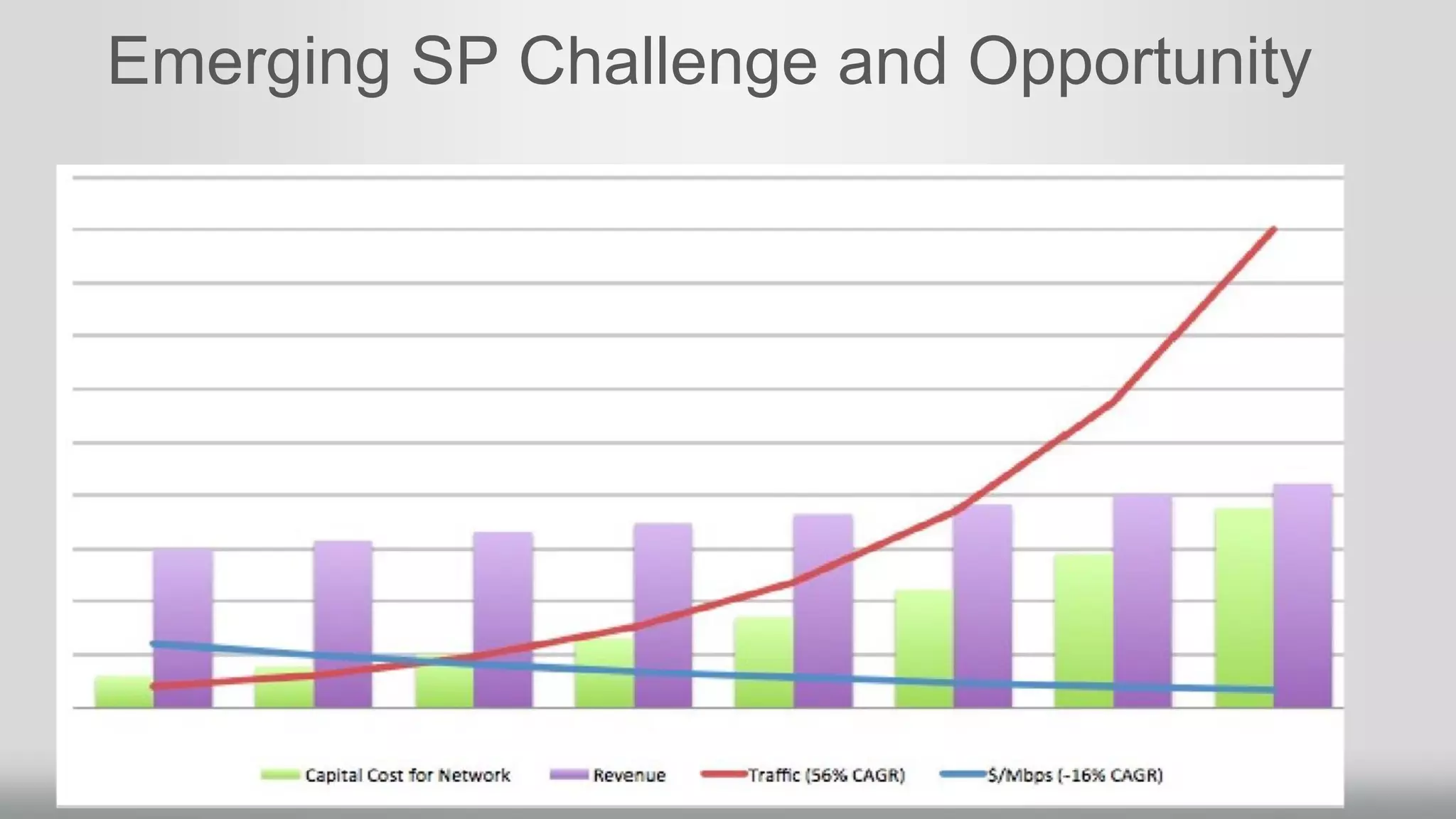
Emerging SP Challenge and Opportunity
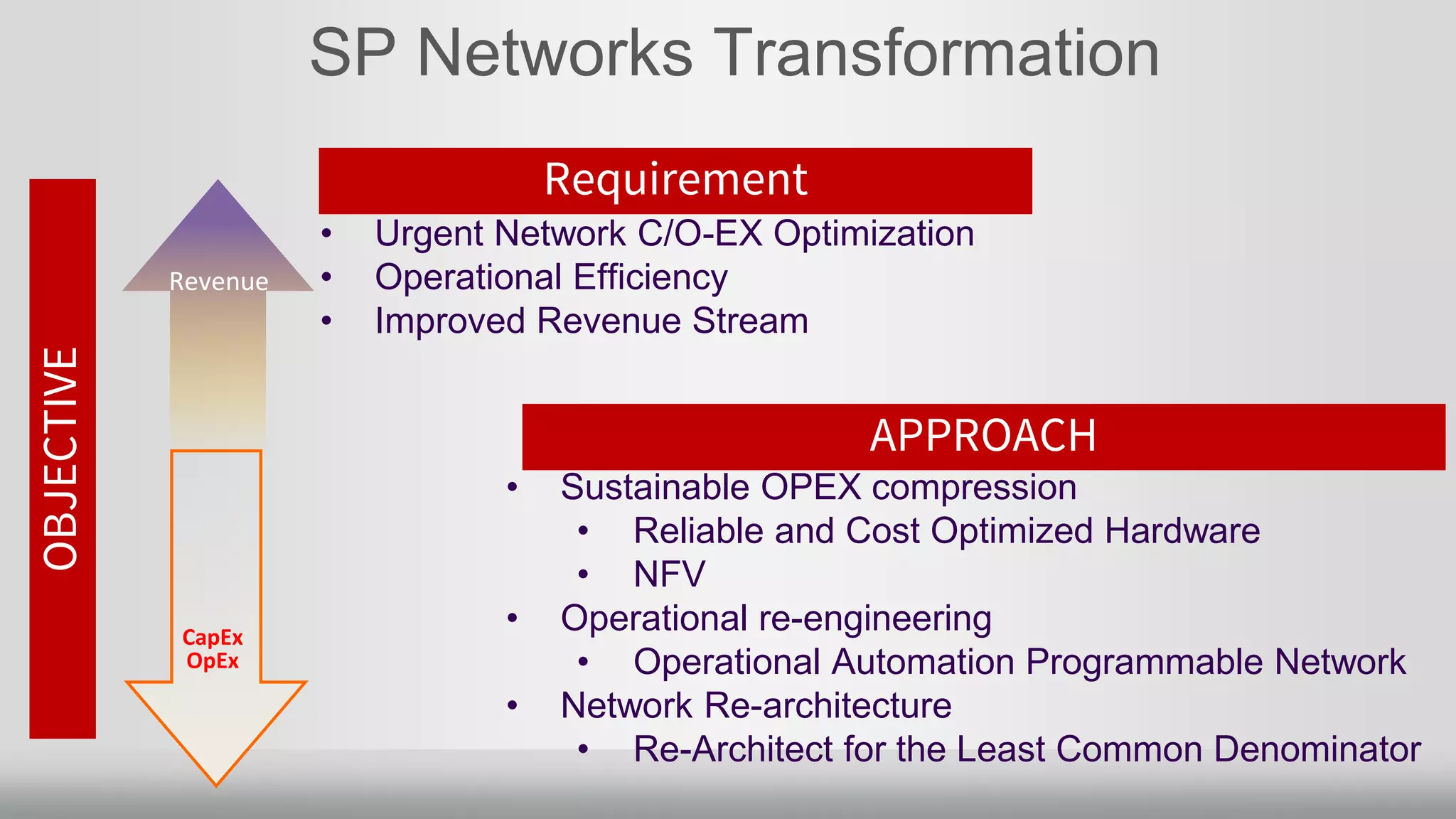
SP Networks TransformationOBJECTIVE
Revenue
CapEx
OpEx
Requirement
• Urgent Network C/O-EX Optimization
• Operational Efficiency
• Improved Revenue Stream
• Sustainable OPEX compression
• Reliable and Cost Optimized Hardware
• NFV
• Operational re-engineering
• Operational Automation Programmable Network
• Network Re-architecture
• Re-Architect for the Least Common Denominator
APPROACH
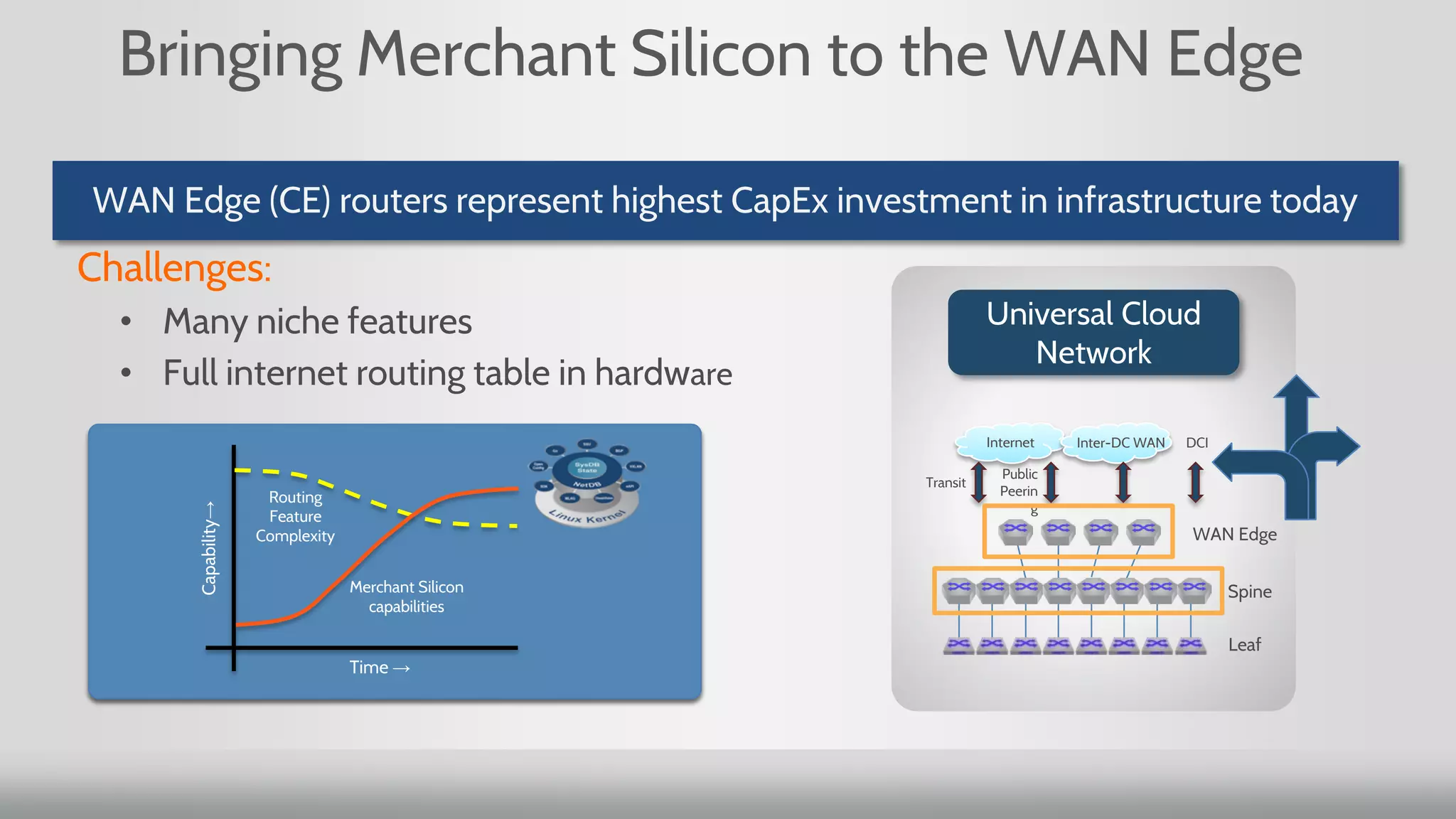
Bringing Merchant Silicon to the WAN Edge
Time →
Capability→
Merchant Silicon
capabilities
Routing
Feature
Complexity
Universal Cloud
Network
DCI
Transit
Public
Peerin
g
Internet Inter-DC WAN
WAN Edge
Spine
Leaf
WAN Edge (CE) routers represent highest CapEx investment in infrastructure today
Challenges:
• Many niche features
• Full internet routing table in hardware
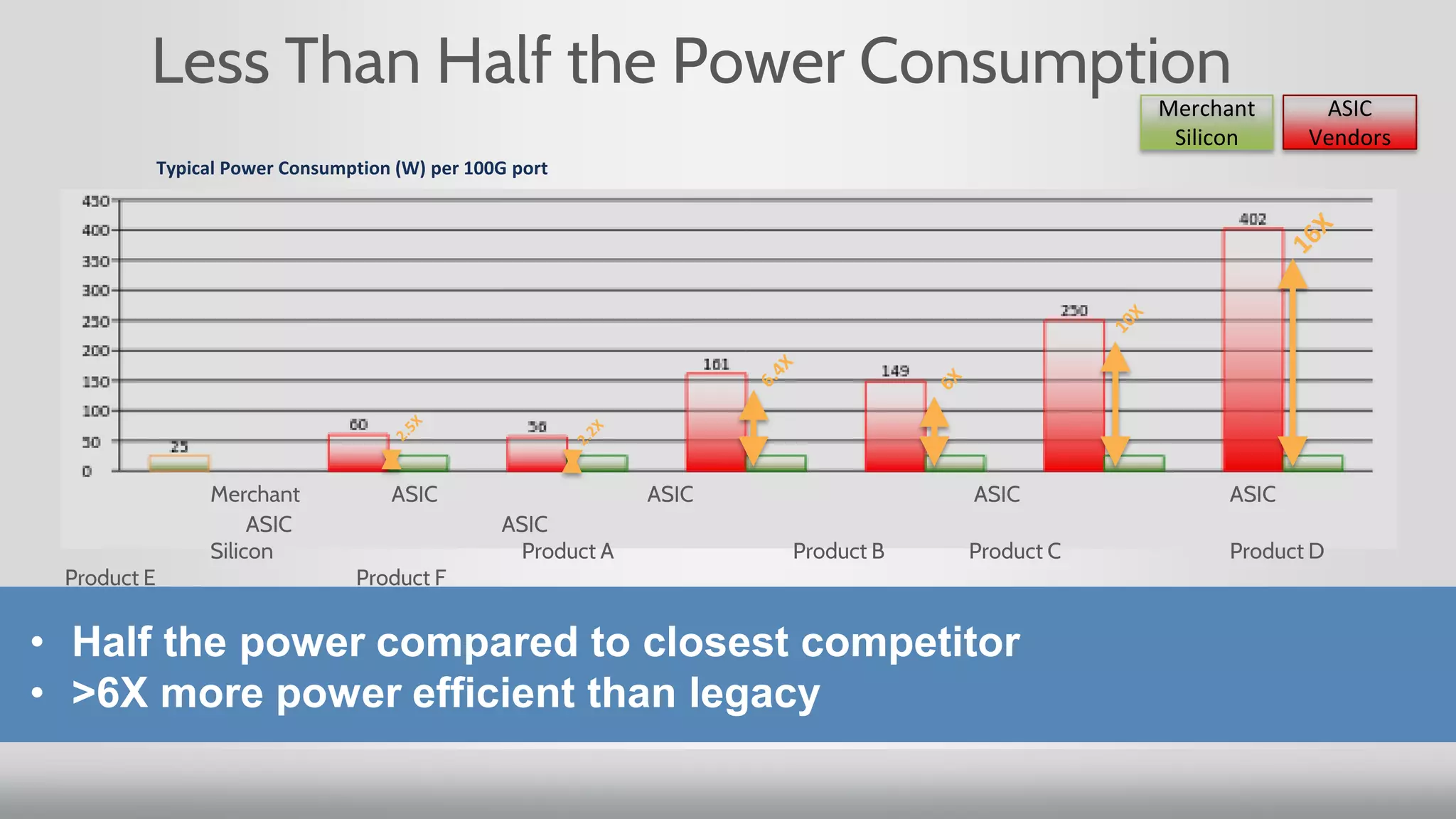
Less Than Half the Power Consumption
Typical Power Consumption (W) per 100G port
• Half the power compared to closest competitor
• >6X more power efficient than legacy
Merchant
Silicon
ASIC
Vendors
Merchant ASIC ASIC ASIC ASIC
ASIC ASIC
Silicon Product A Product B Product C Product D
Product E Product F
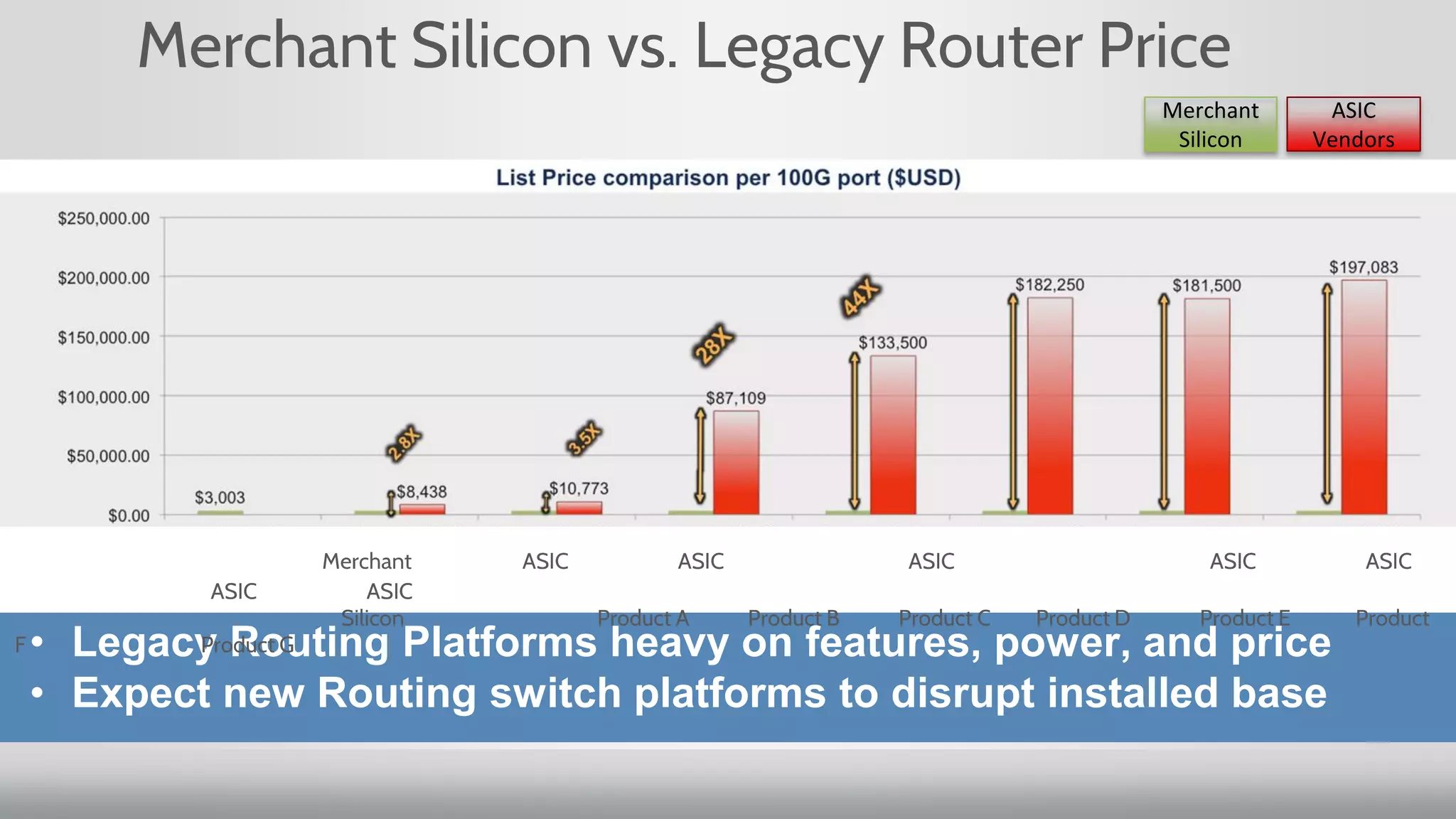
Merchant Silicon vs. Legacy Router Price
• Legacy Routing Platforms heavy on features, power, and price
• Expect new Routing switch platforms to disrupt installed base
Merchant
Silicon
ASIC
Vendors
Merchant ASIC ASIC ASIC ASIC ASIC
ASIC ASIC
Silicon Product A Product B Product C Product D Product E Product
F Product G
Merchant Silicon for SP
Use Cases
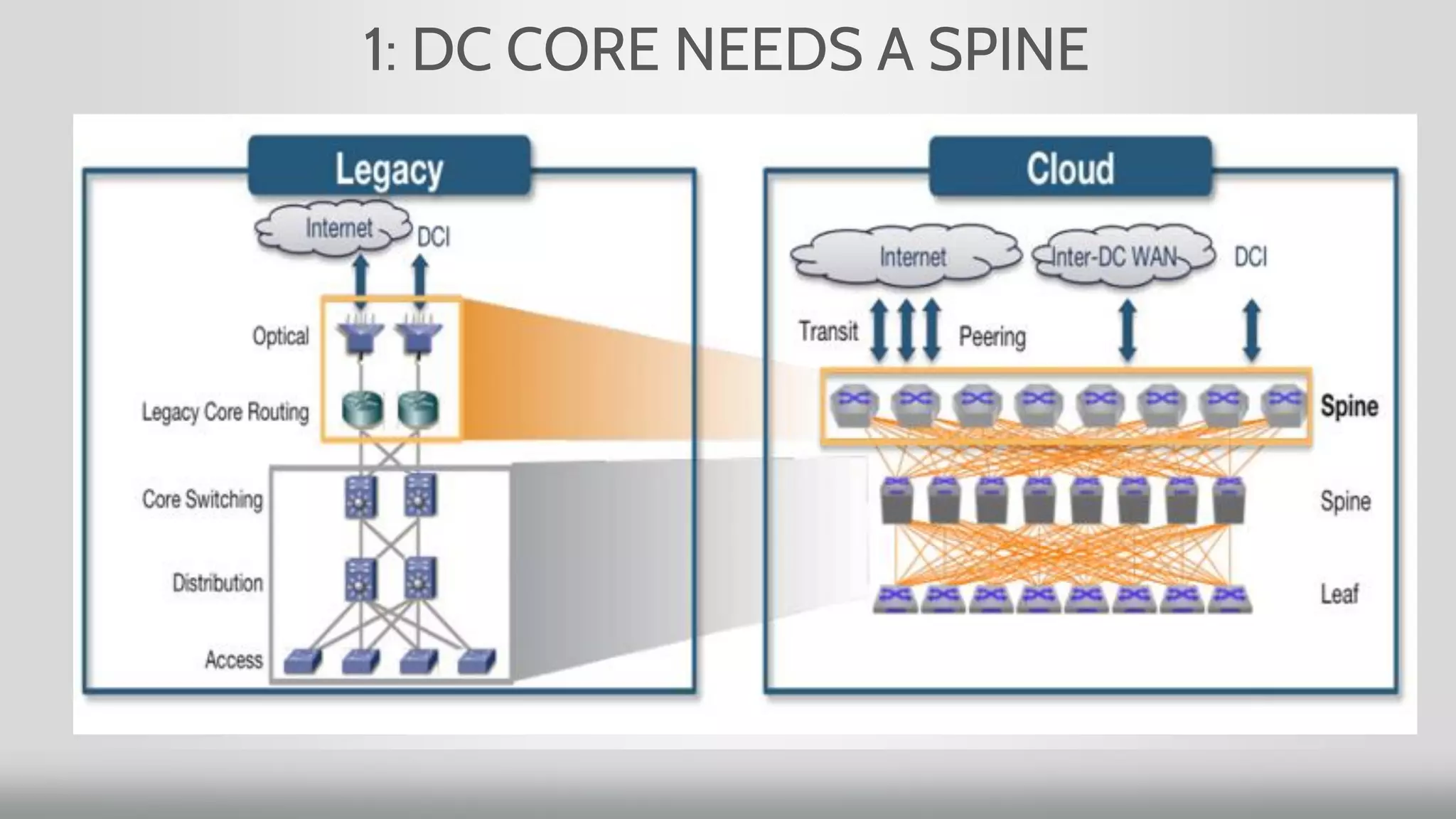
1: DC CORE NEEDS A SPINE
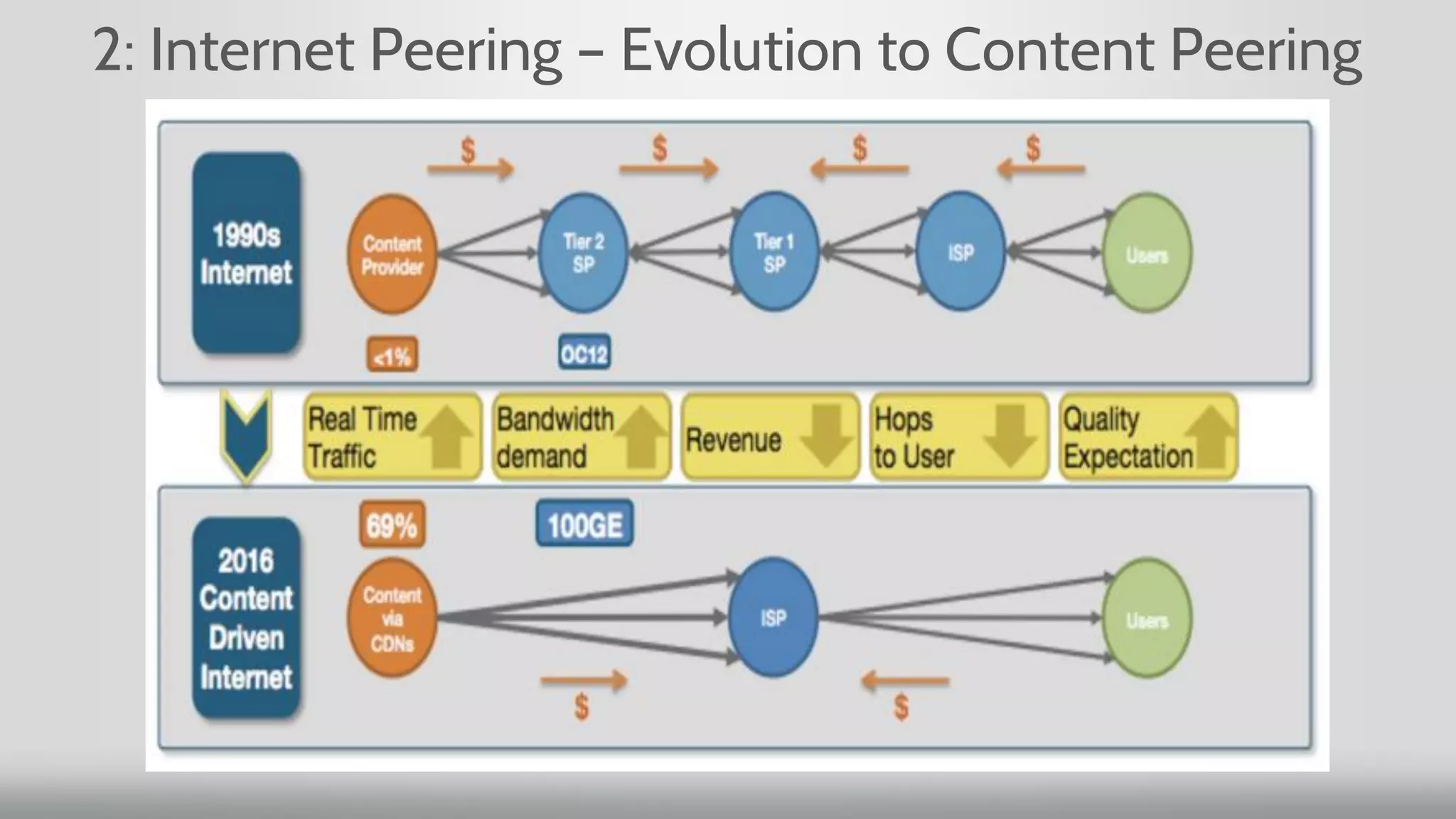
2: Internet Peering – Evolution to Content Peering
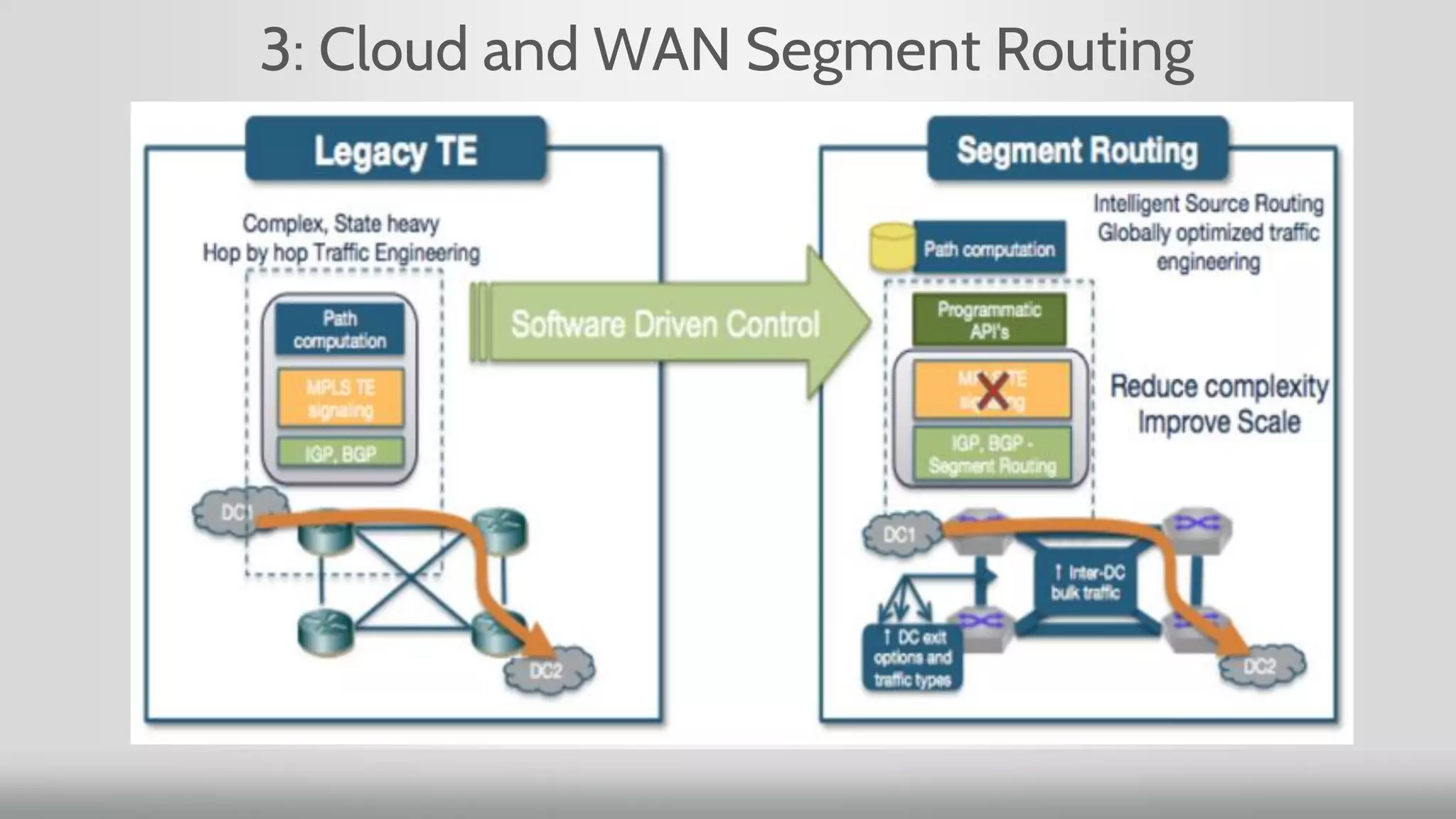
3: Cloud and WAN Segment Routing
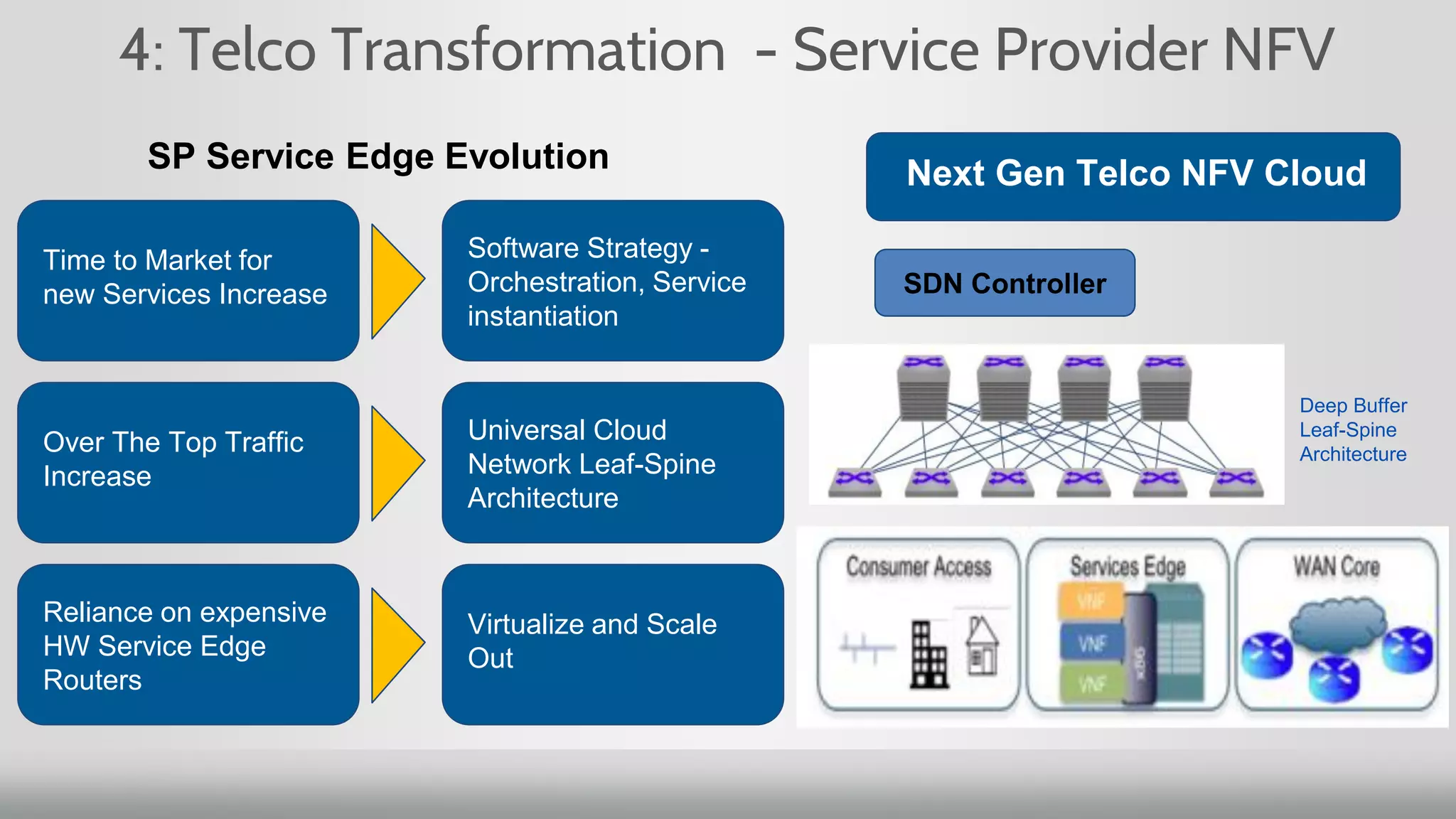
4: Telco Transformation - Service Provider NFV
Next Gen Telco NFV Cloud
Time to Market for
new Services Increase
Over The Top Traffic
Increase
Reliance on expensive
HW Service Edge
Routers
Software Strategy -
Orchestration, Service
instantiation
Universal Cloud
Network Leaf-Spine
Architecture
Virtualize and Scale
Out
SP Service Edge Evolution
SDN Controller
Deep Buffer
Leaf-Spine
Architecture
Summary
- Following Moore’s Law
- Higher Port Density
- Lower Price per Port
- Lower Power Consumption
Thank You

Disruptive Technologies

  • 1.
    Disruptive Technologies Marius Keown– Systems Engineer @ Arista Networks
  • 2.
    Moore’s Law - DrGordon E. Moore – Co-Founder of Intel - Predicted in 1965 the doubling of components per integrated circuit every year - In 1975 revised the forecast to doubling every 2 years - Used for decades as the guide for the industry for new products - Nothing like this in the history of mankind
  • 3.
    Impact on TechnologyIndustry - Economic Impact – Performance and Cost - Modern Computing
  • 4.
  • 5.
    Three main problems -Moore’s Law applies to Transistors, not Speed - Transistor count is doubling every 2 years - Transistor speed is only increasing slowly - Number of I/O pins per package basically fixed - Limited by the area and package technology - Only improvement is increased I/O speed - Bandwidth ultimately limited by I/O capacity - Throughput per chip = # IO Pins x Speed/IO - No matter how many transistors are on-chip
  • 6.
    SERDES Speed (highdensity CMOS)
  • 7.
    Number of SERDESper Package
  • 8.
  • 9.
  • 10.
    Network Switching Industry NetworkASIC performance has not increased like CPU performance. In a 12 year span: • Network ASIC increased: 10x • CPU perf has increased: 64x • Investment vs. ROI • Low speeds, low port density, high power consumption • Long and slow development cycle • Inflexible to market changes ASIC = Application Specific Integrated Circuit • Top down design, independent of the layout • Network Vendor focusing on the functionality not the implementation • ASIC supplier does the physical implementation • Difficult to achieve high clock rates and scale Full Custom design flow • Bottom up approach, chip vendor focus on potential implementation • Chip design starts with the clock rate objective • Data paths optimize to achieve the clock rates • Only way to achieve high clock rates Only the Full custom Chip will allow us to scale for thePerformance Time CPUs 2X/2Y = 64X/12Y ASIC - LAN 1G to 10G 10X/12Y ASIC - WAN Routers: 4X/12Y Why has Networking not kept up with Moore’s Law? Switching (Merchant Full Custom): 2X/2Y
  • 11.
  • 12.
    Port Density onMerchant Silicon - Broadcom Trident 2 - 128 x 10G - 32 x 40G - Broadcom Tomahawk - 32 x 100G - 128 x 25G - Broadcom Jericho - 6 x 100G, but with Big Buffers and large routing tables
  • 13.
    Advantages of MerchantSilicon • More ports per chip, increased throughput • More room for additional logic/processing/functionality • Less Chips: • Increased reliability, reduced complexity • Reduced latency (fewer chip crossing) • Consume less power ( less chips less power draw) ▪ Merchants’ full custom chips are now on Moore’s Law growth rate ▪ ASIC designs are NOT on Moore’s Law growth Custom Design vs. ASIC Design
  • 14.
  • 15.
    15 Hyper Connected World Weare in an age of exponential growth 2010 2015 2020 30B 25B 20B 15B 10B 5B 25B 800K 1.8B 1.8B 4B 5B Sources: Cisco ,Gartner, CMA Research, EdgeConneX
  • 16.
    1 Over-the-Top Video Mobility NFVHyper Scale DC SP Market Dynamics
  • 17.
    Emerging SP Challengeand Opportunity
  • 18.
    SP Networks TransformationOBJECTIVE Revenue CapEx OpEx Requirement •Urgent Network C/O-EX Optimization • Operational Efficiency • Improved Revenue Stream • Sustainable OPEX compression • Reliable and Cost Optimized Hardware • NFV • Operational re-engineering • Operational Automation Programmable Network • Network Re-architecture • Re-Architect for the Least Common Denominator APPROACH
  • 19.
    Bringing Merchant Siliconto the WAN Edge Time → Capability→ Merchant Silicon capabilities Routing Feature Complexity Universal Cloud Network DCI Transit Public Peerin g Internet Inter-DC WAN WAN Edge Spine Leaf WAN Edge (CE) routers represent highest CapEx investment in infrastructure today Challenges: • Many niche features • Full internet routing table in hardware
  • 20.
    Less Than Halfthe Power Consumption Typical Power Consumption (W) per 100G port • Half the power compared to closest competitor • >6X more power efficient than legacy Merchant Silicon ASIC Vendors Merchant ASIC ASIC ASIC ASIC ASIC ASIC Silicon Product A Product B Product C Product D Product E Product F
  • 21.
    Merchant Silicon vs.Legacy Router Price • Legacy Routing Platforms heavy on features, power, and price • Expect new Routing switch platforms to disrupt installed base Merchant Silicon ASIC Vendors Merchant ASIC ASIC ASIC ASIC ASIC ASIC ASIC Silicon Product A Product B Product C Product D Product E Product F Product G
  • 22.
  • 23.
    1: DC CORENEEDS A SPINE
  • 24.
    2: Internet Peering– Evolution to Content Peering
  • 25.
    3: Cloud andWAN Segment Routing
  • 26.
    4: Telco Transformation- Service Provider NFV Next Gen Telco NFV Cloud Time to Market for new Services Increase Over The Top Traffic Increase Reliance on expensive HW Service Edge Routers Software Strategy - Orchestration, Service instantiation Universal Cloud Network Leaf-Spine Architecture Virtualize and Scale Out SP Service Edge Evolution SDN Controller Deep Buffer Leaf-Spine Architecture
  • 27.
    Summary - Following Moore’sLaw - Higher Port Density - Lower Price per Port - Lower Power Consumption
  • 28.