The End of Moore’s Law
Or, “Peak Oil Transistors”
Semiconductor Business Basics
Hi, I’m Ron and I’m a CMOS-aholic
Semiconductors 101
 In 2013 the entire, worldwide semiconductor industry achieved about
$300B in revenues and ~4% growth
 Walmart achieved $466B, or 50% more
 Semi OI = 10-15%; Walmart OI = 3-4%
 China had twice the growth rate
 Oil industry was about $10T
 New fabrication plants, “fabs,” cost about $5B and only a handful of
companies can even consider owning one
 In 1973, a new mask aligner cost about 1 MY (~$35k)
 Today, an EUV stepper costs about 1,000 MY (~$100M)
 State-of-art chips using these technologies require thousands of design
engineers
 And about 2X as many software engineers
 A modern chip costs about $100M to develop, plus ramp-up costs
3
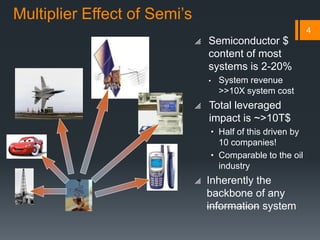
Multiplier Effect of Semi’s
 Semiconductor $
content of most
systems is 2-20%
• System revenue
>>10X system cost
 Total leveraged
impact is ~>10T$
 Half of this driven by
10 companies!
 Comparable to the oil
industry
 Inherently the
backbone of any
information system
4
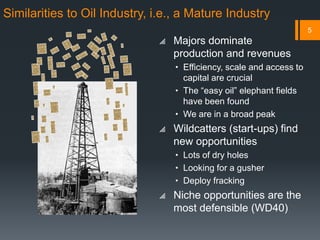
Similarities to Oil Industry, i.e., a Mature Industry
 Majors dominate
production and revenues
 Efficiency, scale and access to
capital are crucial
 The “easy oil” elephant fields
have been found
 We are in a broad peak
 Wildcatters (start-ups) find
new opportunities
 Lots of dry holes
 Looking for a gusher
 Deploy fracking
 Niche opportunities are the
most defensible (WD40)
5
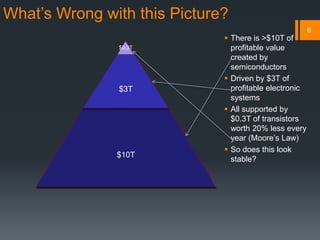
What’s Wrong with this Picture?
 There is >$10T of
profitable value
created by
semiconductors
 Driven by $3T of
profitable electronic
systems
 All supported by
$0.3T of transistors
worth 20% less every
year (Moore’s Law)
 So does this look
stable?
$10T
$3T
$0.3T
6
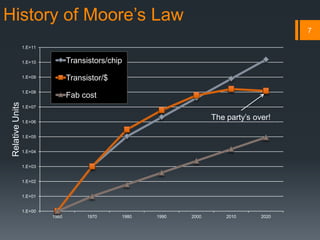
History of Moore’s Law
1.E+00
1.E+01
1.E+02
1.E+03
1.E+04
1.E+05
1.E+06
1.E+07
1.E+08
1.E+09
1.E+10
1.E+11
1960 1970 1980 1990 2000 2010 2020
RelativeUnits
Transistors/chip
Transistor/$
Fab cost
The party’s over!
7
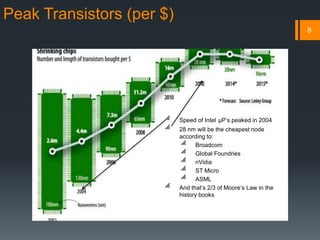
Peak Transistors (per $)
 Speed of Intel μP’s peaked in 2004
 28 nm will be the cheapest node
according to:
 Broadcom
 Global Foundries
 nVidia
 ST Micro
 ASML
 And that’s 2/3 of Moore’s Law in the
history books
8
What Moore’s Law Really Says
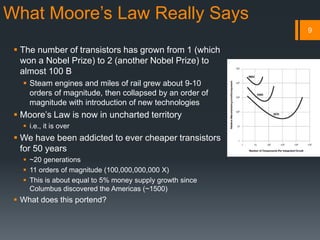
 The number of transistors has grown from 1 (which
won a Nobel Prize) to 2 (another Nobel Prize) to
almost 100 B
 Steam engines and miles of rail grew about 9-10
orders of magnitude, then collapsed by an order of
magnitude with introduction of new technologies
 Moore’s Law is now in uncharted territory
 i.e., it is over
 We have been addicted to ever cheaper transistors
for 50 years
 ~20 generations
 11 orders of magnitude (100,000,000,000 X)
 This is about equal to 5% money supply growth since
Columbus discovered the Americas (~1500)
 What does this portend?
9
Crossing the Rubicon: Transistor Costs
are Rising
 So what is the impact of each successive node increasing in
cost by 10-30%?
 Compare this to the original 4X cost reduction per node (~3Y)
 It will require “EUV,” a euphemism for soft XRAY, lithography
 The difficulty and cost of this development is why Cymer was acquired
 The electronics industry is addicted to rapid declines in
transistor costs and short replacement cycles
 “Have you seen the new whizbangmatron at Fry’s?,” followed by
 “I can’t wait ‘til those are less than $1,000”
 Combined, these market responses create a volume-driven
virtuous cycle, all of which is based on declining transistor costs
 IC cost has overwhelmed other inflationary pressures
10
Potential Implications
 World GDP
 If electronics systems drive $10T/Y in total turnover, or about 20% of
world GDP, then flat IC-derived revenues causes 1% lower GDP
growth
 About 50% of all IC’s are shipped into China for product assembly,
so half of the total $ impact will fall on China
 Could reduce China’s GDP growth to that of a developed country
 Geopolitical
 America won the Cold War and the post-Soviet competition largely
with Si-based technology (GPS, smart weapons, consumerism, etc.)
 What if our lead stagnates, or even shrinks? (Satchel Paige: “Don’t look
back; something might be gaining on you”)
 What else changes now that we cannot rely on cheaper transistors?
 Is this the equivalent of the “peak oil” concept?
 We’ve seen massive changes in world economics as the “easy oil”
era passed into history ($2.50/bbl, before the ‘72 oil embargo)
 Is there an equivalent to fracking that changes things (for a while)?
11
Potential Implications, II
 Entrepreneurism
 Gotta love it! All problems are opportunities
 Entrepreneurs require dislocations (ask the mammals, or Gordon Moore
himself)
 Research & Development
 New ways to deliver enhanced performance per transistor
 “The Cloud” reuses centralized computer assets instead of billions of
discrete platforms
 “The network is the computer,” Sun Micro
 More efficient use of transistors
 Cell phones subsumed the following:
 GPS, MP3/DVD player, still camera, movie camera, calculator,
dictaphone, landline, encyclopedia, wristwatch, alarm clock, timer,
personal computer, flashlight, routers, etc
 Is there any new technology that can extend the Si growth curve?
12
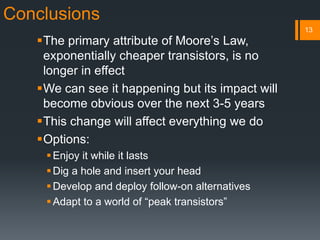
Conclusions
The primary attribute of Moore’s Law,
exponentially cheaper transistors, is no
longer in effect
We can see it happening but its impact will
become obvious over the next 3-5 years
This change will affect everything we do
Options:
Enjoy it while it lasts
Dig a hole and insert your head
Develop and deploy follow-on alternatives
Adapt to a world of “peak transistors”
13
Thank You
 Ron Reedy
 A personal perspective

Venture Summit 2014, Ron Reedy

  • 1.
    The End ofMoore’s Law Or, “Peak Oil Transistors”
  • 2.
    Semiconductor Business Basics Hi,I’m Ron and I’m a CMOS-aholic
  • 3.
    Semiconductors 101  In2013 the entire, worldwide semiconductor industry achieved about $300B in revenues and ~4% growth  Walmart achieved $466B, or 50% more  Semi OI = 10-15%; Walmart OI = 3-4%  China had twice the growth rate  Oil industry was about $10T  New fabrication plants, “fabs,” cost about $5B and only a handful of companies can even consider owning one  In 1973, a new mask aligner cost about 1 MY (~$35k)  Today, an EUV stepper costs about 1,000 MY (~$100M)  State-of-art chips using these technologies require thousands of design engineers  And about 2X as many software engineers  A modern chip costs about $100M to develop, plus ramp-up costs 3
  • 4.
    Multiplier Effect ofSemi’s  Semiconductor $ content of most systems is 2-20% • System revenue >>10X system cost  Total leveraged impact is ~>10T$  Half of this driven by 10 companies!  Comparable to the oil industry  Inherently the backbone of any information system 4
  • 5.
    Similarities to OilIndustry, i.e., a Mature Industry  Majors dominate production and revenues  Efficiency, scale and access to capital are crucial  The “easy oil” elephant fields have been found  We are in a broad peak  Wildcatters (start-ups) find new opportunities  Lots of dry holes  Looking for a gusher  Deploy fracking  Niche opportunities are the most defensible (WD40) 5
  • 6.
    What’s Wrong withthis Picture?  There is >$10T of profitable value created by semiconductors  Driven by $3T of profitable electronic systems  All supported by $0.3T of transistors worth 20% less every year (Moore’s Law)  So does this look stable? $10T $3T $0.3T 6
  • 7.
    History of Moore’sLaw 1.E+00 1.E+01 1.E+02 1.E+03 1.E+04 1.E+05 1.E+06 1.E+07 1.E+08 1.E+09 1.E+10 1.E+11 1960 1970 1980 1990 2000 2010 2020 RelativeUnits Transistors/chip Transistor/$ Fab cost The party’s over! 7
  • 8.
    Peak Transistors (per$)  Speed of Intel μP’s peaked in 2004  28 nm will be the cheapest node according to:  Broadcom  Global Foundries  nVidia  ST Micro  ASML  And that’s 2/3 of Moore’s Law in the history books 8
  • 9.
    What Moore’s LawReally Says  The number of transistors has grown from 1 (which won a Nobel Prize) to 2 (another Nobel Prize) to almost 100 B  Steam engines and miles of rail grew about 9-10 orders of magnitude, then collapsed by an order of magnitude with introduction of new technologies  Moore’s Law is now in uncharted territory  i.e., it is over  We have been addicted to ever cheaper transistors for 50 years  ~20 generations  11 orders of magnitude (100,000,000,000 X)  This is about equal to 5% money supply growth since Columbus discovered the Americas (~1500)  What does this portend? 9
  • 10.
    Crossing the Rubicon:Transistor Costs are Rising  So what is the impact of each successive node increasing in cost by 10-30%?  Compare this to the original 4X cost reduction per node (~3Y)  It will require “EUV,” a euphemism for soft XRAY, lithography  The difficulty and cost of this development is why Cymer was acquired  The electronics industry is addicted to rapid declines in transistor costs and short replacement cycles  “Have you seen the new whizbangmatron at Fry’s?,” followed by  “I can’t wait ‘til those are less than $1,000”  Combined, these market responses create a volume-driven virtuous cycle, all of which is based on declining transistor costs  IC cost has overwhelmed other inflationary pressures 10
  • 11.
    Potential Implications  WorldGDP  If electronics systems drive $10T/Y in total turnover, or about 20% of world GDP, then flat IC-derived revenues causes 1% lower GDP growth  About 50% of all IC’s are shipped into China for product assembly, so half of the total $ impact will fall on China  Could reduce China’s GDP growth to that of a developed country  Geopolitical  America won the Cold War and the post-Soviet competition largely with Si-based technology (GPS, smart weapons, consumerism, etc.)  What if our lead stagnates, or even shrinks? (Satchel Paige: “Don’t look back; something might be gaining on you”)  What else changes now that we cannot rely on cheaper transistors?  Is this the equivalent of the “peak oil” concept?  We’ve seen massive changes in world economics as the “easy oil” era passed into history ($2.50/bbl, before the ‘72 oil embargo)  Is there an equivalent to fracking that changes things (for a while)? 11
  • 12.
    Potential Implications, II Entrepreneurism  Gotta love it! All problems are opportunities  Entrepreneurs require dislocations (ask the mammals, or Gordon Moore himself)  Research & Development  New ways to deliver enhanced performance per transistor  “The Cloud” reuses centralized computer assets instead of billions of discrete platforms  “The network is the computer,” Sun Micro  More efficient use of transistors  Cell phones subsumed the following:  GPS, MP3/DVD player, still camera, movie camera, calculator, dictaphone, landline, encyclopedia, wristwatch, alarm clock, timer, personal computer, flashlight, routers, etc  Is there any new technology that can extend the Si growth curve? 12
  • 13.
    Conclusions The primary attributeof Moore’s Law, exponentially cheaper transistors, is no longer in effect We can see it happening but its impact will become obvious over the next 3-5 years This change will affect everything we do Options: Enjoy it while it lasts Dig a hole and insert your head Develop and deploy follow-on alternatives Adapt to a world of “peak transistors” 13
  • 14.
    Thank You  RonReedy  A personal perspective