Page 1
Metrology
The Science of
Measurement
By,
Afaqahmed M J
AIKTC
Slides are subjected to copyright©
Page 2
Syllabus TH + PR + OR
Module1
1.1 Introduction to Metrology, Fundamental principles and
definitions, measurement standards / primary and tertiary
standards, distinction between precision and accuracy.
1.2 Limits, fits and tolerances, Tolerance grades, Types of fits,
IS919, GO and NO GO gauges- Taylor’s principle, design of
GO and NO GO gauges, filler gauges, plug gauges and snap
gauges.
Module 2
2.1 Comparators: Constructional features and operation of
mechanical, optical, electrical/electronics and pneumatic
comparators, advantages, limitations and field of applications.
2.2 Principles of interference, concept of flatness, flatness
testing, optical flats, optical interferometer and laser
interferometer.
2.3 Surface texture measurement: importance of surface
conditions, roughness and waviness, surface roughness
standards specifying surface roughness parameters- Ra, Ry, Rz,
RMS value etc., surface roughness measuring instruments –
Tomlinson and Taylor Hobson versions, surface roughness
symbols.
Page 3
Module 3
3.1 Screw Thread measurement: Two wire and three wire
methods, floating carriage micrometer.
3.2 Gear measurement: Gear tooth comparator, Master gears,
measurement using rollers and Parkinson’s Tester.
3.3 Special measuring Equipments: Principles of measurement
using Tool Maker’s microscope, profile projector & 3D coordinate
measuring machine.
Module 4
Quality Control
Introduction, definition and concept of quality & quality control,
set up policy and objectives of quality control, quality of design
and quality of conformance, compromise between quality & cost,
quality cost and planning for quality.
Module 5
SQC and SQC tools
Importance statistical methods in QC, measurement of statistical
control variables and attributes, pie charts, bar charts/ histograms,
scatter diagrams, pareto chart, GANT charts, control charts, X
chart, X bar charts, R charts, P charts, np charts their preparation,
analysis and applications. Elementary treatment on modern SQC
tools.
Page 4
Module 6
Sampling Techniques
Sampling inspection and basic concepts, OC curves,
consumer & producer risk, single & double sampling plans
and use of sampling tables.
Page 5
Best
Better
Good
Page 6
Let‟s take a trip back in
time…
Page 7
Prehistoric people
didn‟t have time to measure
Page 8
But over time….
Page 9
People started growing
food
Page 10
And developing permanent
settlements
Page 11
So, they desired a
system of
measurement…
Page 12
Or there would be
pandemonium (chaos) !
Page 13
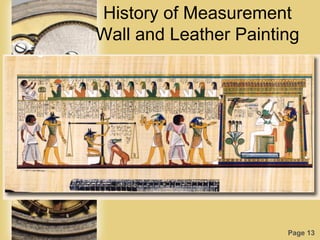
History of Measurement
Wall and Leather Painting
Page 14
Fast-forward 5000 years
to current measurement
systems
Page 15
METROLOGY?????
Metrology
Mechanical
Measurements
Page 16
METROLOGY????
Greek Word
Metro – Measurement
Logy - Science
Standardization
Page 17
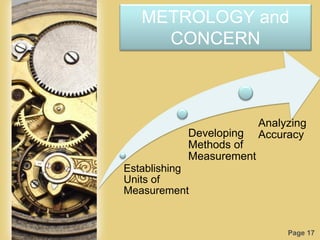
METROLOGY and
CONCERN
Establishing
Units of
Measurement
Developing
Methods of
Measurement
Analyzing
Accuracy
Page 18
What is metrology?
The science of measurement
(not weather!)
Metrology establishes the
international standards for
measurement used by all
countries in the world in both
science and industry.
Examples: distance, time, mass,
temperature, voltage, values of
physical and chemical constants
Page 19
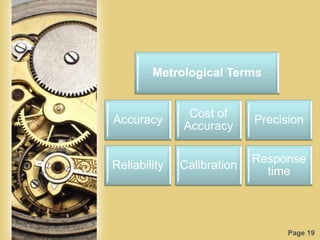
Accuracy
Cost of
Accuracy
Precision
Reliability Calibration
Response
time
Metrological Terms
Page 20
Career in Metrology
1.Scientific Metrology
– Organization and development of
measurement standards and their
maintenance (highest level)
– NIST Atomic Clock
Accurate up to 1s / 20
million years
National Institute
Standard &
Technology
Page 21
Industrial Metrology
– Adequate functioning of measurement
instruments used in industry as well as
production and testing processes
Page 22
Pharmaceutical
Industry
• Metrology laboratories test weights and
volume standards for pharmaceutical
companies
• Products include medicines like aspirin,
antibiotics, vaccines, insulin, & vitamins
Page 23
Defense Industry
• Metrology laboratories test standards for
many military and defense companies
• These companies make the guidance
systems for the Patriot missiles and other
things that aretop secret
Page 24
Space Station, Satellites….
• Metrology laboratories test standards for
many companies that provide parts of the
space shuttle
• These parts include the metal, heat shield,
electronics, fabrics, o-rings, optics, and
tires
Page 25
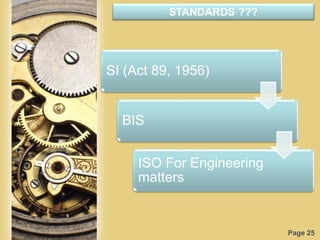
STANDARDS ???
SI (Act 89, 1956)
BIS
ISO For Engineering
matters
Page 26
BIS ???
1
• Formulation, Publication,
Promotion, Inspection for
Certification
2
• Establishment, Formulation,
coordination and
Maintenance
3
• Information, Documentation
and recognition
Page 27
Standards of Measurement
A standard is defined as “something
that is set up and established by an
authority as rule of the measure of
quantity, weight, extent, value or
quality”.
Page 28
1. Primary standards
 They are material standard preserved under most careful
conditions.
 These are not used for directly for measurements but are
used once in 10 or 20 years for calibrating secondary
standards.
 At the highest level, a primary reference standard is
assigned a value by direct comparison with the reference
base.
 Ex: International Prototype meter, Imperial Standard
yard.
Page 29
2. Secondary standards
 These are close copies of primary standards
w.r.t design, material & length.
 Any error existing in these standards is
recorded by comparison with primary standards
after long intervals.
 They are kept at a number of places under great
supervision and serve as reference for tertiary
standards.
 This also acts as safeguard against the loss or
destruction of primary standards.
Page 30
3. Tertiary standards
 The primary or secondary standards exist as the
ultimate controls for reference at rare intervals.
 Tertiary standards are the reference standards
employed by National Physical laboratory
(N.P.L) and are the first standards to be used
for reference in laboratories & workshops.
 They are made as close copies of secondary
standards & are kept as reference for
comparison with working standards.
Page 31
4. Working standards
These standards are similar in design to primary,
secondary & tertiary standards. But being less in
cost and are made of low grade materials, they are
used for general applications in metrology
laboratories.
Sometimes, standards are also classified as;
• Reference standards (used as reference
purposes)
• Calibration standards (used for calibration of
inspection & working standards)
• Inspection standards (used by inspectors)
• Working standards (used by operators)
Page 32
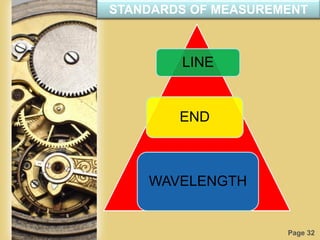
STANDARDS OF MEASUREMENT
LINE
END
WAVELENGTH
Page 33
LINE STANDARD
According to it, yard or metre is defined
as the distance between scribed lines on a
bar of metal under certain conditions of
temperature and support.
Yard  The Imperial Standard Yard is a
bronze bar of one inch square cross-section
and 38 inches long.
METRE  This is the distance between the
centre portions of two lines engraved on the
polished surface of a bar of pure platinum-
iridium alloy (90% platinum and 10% iridium).
Page 34
END STANDARDS
Is expressed as the distance between
two surfaces, this is referred to as end
standard.
For all the important works in the shop,
the users prefer end standards e.g. slip
gauges, length bars, the ends of
micrometre anvils, gap gauges, and so
on.
Dimensional tolerance as small as
0.0005 mm can be obtained.
They are not subjected to parallax effect
as their use depends on “feel”.
Well suited to measurements of close
tolerance.
Lethargic
Page 35
WAVELENGTH
A meter is defined as equal to
1670763.73 wavelength of red-
orange radiations of Krypton
isotope 86 gas .
Length of path travelled by light in
vacuum in 1/299792458 second.
Higher Accuracy
Environment-friendly
Reproducible
No Wear and Tear
Page 36
Seven base units
Length: meter (m)
Mass: kilogram (kg)
Time: second (s)
Electric current: ampere (A)
Thermodynamic temperature: Kelvin (K)
Amount of substance: mole (mol)
Luminous intensity: candela (cd)
Page 37
• Accuracy
– How close you are to the actual
value
– Depends on the person
measuring
– Calculated by the formula:
% Error = (YV – AV) x 100 ÷ AV
Where: YV is YOUR measured Value & AV is the
Accepted Value
Page 38
• Precision
– How finely tuned your
measurements are or how close
they can be to each other
– Depends on the measuring tool
– Determined by the number of
significant digits
Page 39
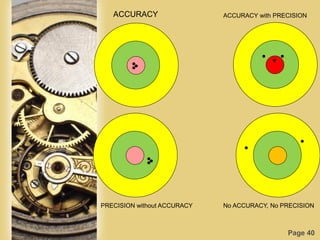
• Accuracy & Precision may be
demonstrated by shooting at a
target.
• Accuracy is represented by
hitting the bulls eye (the
accepted value)
• Precision is represented by a
tight grouping of shots (they are
finely tuned)
Page 40
ACCURACY ACCURACY with PRECISION
PRECISION without ACCURACY No ACCURACY, No PRECISION
Page 41
LIMITS, FITS &
TOLERANCES
Page 42
LIMITS
FITS
&
Toleranc
es
Based on Standards,
Sufficient in sizes
Both Uni and Bi lateral
Tolerances shd b accptbl
Carefully designed
Page 43
TERMINOLOGY
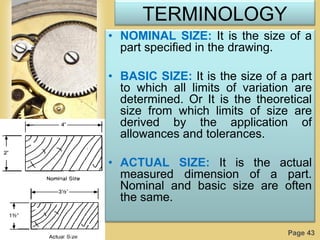
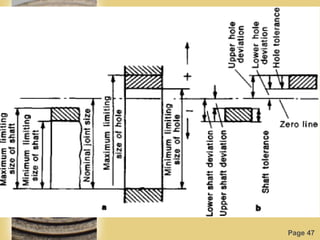
• NOMINAL SIZE: It is the size of a
part specified in the drawing.
• BASIC SIZE: It is the size of a part
to which all limits of variation are
determined. Or It is the theoretical
size from which limits of size are
derived by the application of
allowances and tolerances.
• ACTUAL SIZE: It is the actual
measured dimension of a part.
Nominal and basic size are often
the same.
Page 44
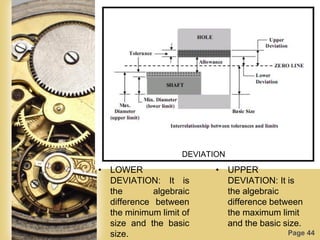
DEVIATION
• LOWER
DEVIATION: It is
the algebraic
difference between
the minimum limit of
size and the basic
size.
• UPPER
DEVIATION: It is
the algebraic
difference between
the maximum limit
and the basic size.
Page 45
LIMITS OF SIZE
Considerations for Deciding LIMITS
Functional
Req
Interchan
geability
Economi
cs
Page 46
LIMITS OF SIZE
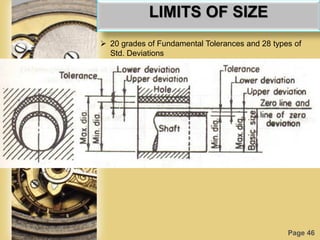
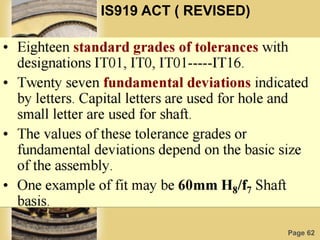
 20 grades of Fundamental Tolerances and 28 types of
Std. Deviations
Page 47
Page 48
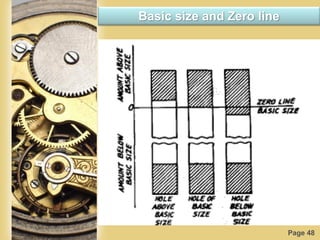
Basic size and Zero line
Page 49
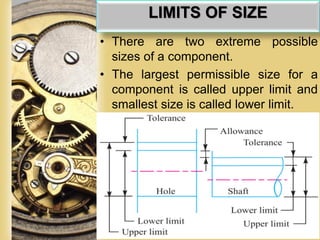
• There are two extreme possible
sizes of a component.
• The largest permissible size for a
component is called upper limit and
smallest size is called lower limit.
LIMITS OF SIZE
Page 50
BASIS OF LIMIT
SYSTEM
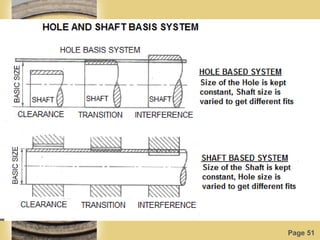
 SHAFT BASIS SYSTEM:
In this system, the shaft is kept as
constant member and different fits
are obtained by varying the hole
size.
 HOLE BASIS SYSTEM:
In this system, the hole is kept as
a constant member and
different fits are obtained by
varying the shaft size.
Page 51
Page 52
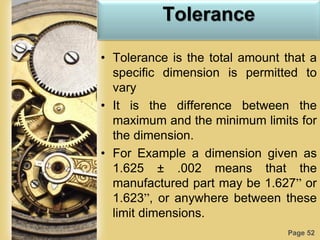
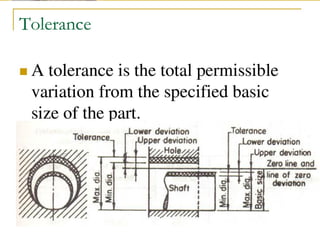
Tolerance
• Tolerance is the total amount that a
specific dimension is permitted to
vary
• It is the difference between the
maximum and the minimum limits for
the dimension.
• For Example a dimension given as
1.625 ± .002 means that the
manufactured part may be 1.627” or
1.623”, or anywhere between these
limit dimensions.
Page 53
Page 54
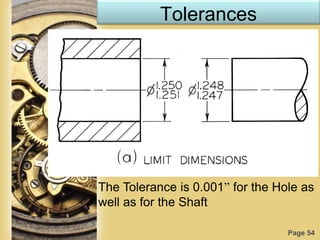
Tolerances
The Tolerance is 0.001” for the Hole as
well as for the Shaft
Page 55
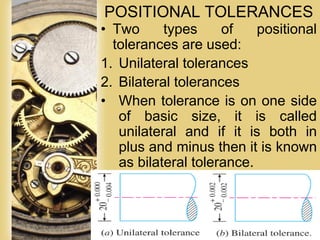
POSITIONAL TOLERANCES
• Two types of positional
tolerances are used:
1. Unilateral tolerances
2. Bilateral tolerances
• When tolerance is on one side
of basic size, it is called
unilateral and if it is both in
plus and minus then it is known
as bilateral tolerance.
Page 56
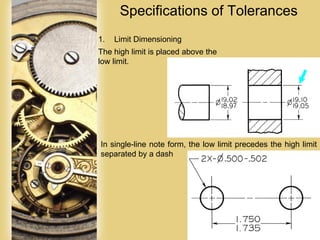
Specifications of Tolerances
1. Limit Dimensioning
The high limit is placed above the
low limit.
In single-line note form, the low limit precedes the high limit
separated by a dash
Page 57
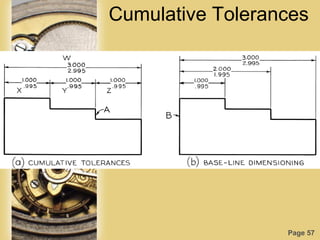
Cumulative Tolerances
Page 58
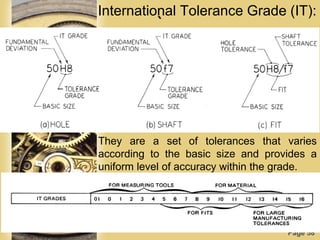
International Tolerance Grade (IT):
They are a set of tolerances that varies
according to the basic size and provides a
uniform level of accuracy within the grade.
`
Page 59
Numerical on
Tolerances
Page 60
Diameters specified by ISI
1-3, 3-6, 6-10, 10-18, 18-30, 30-50, 50-80, 80-120, 120-180,
180-250….. 2500-3000mm
D is Avg. Size
Question
Calculate the limits of tolerance and allowance for 25 H8d9.
Page 61
Page 62
IS919 ACT ( REVISED)
Page 63
FITS
Range of tightness or looseness
Page 64
Fits Between Mating Parts
Fit is the general term used to
signify the range of
tightness or looseness that
may result from the
application of a specific
combination of allowances
and tolerances in mating
parts.
Page 65
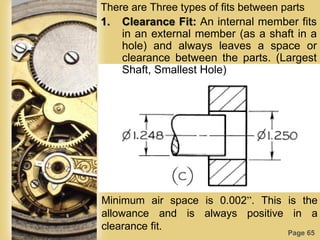
There are Three types of fits between parts
1. Clearance Fit: An internal member fits
in an external member (as a shaft in a
hole) and always leaves a space or
clearance between the parts. (Largest
Shaft, Smallest Hole)
Minimum air space is 0.002”. This is the
allowance and is always positive in a
clearance fit.
Page 66
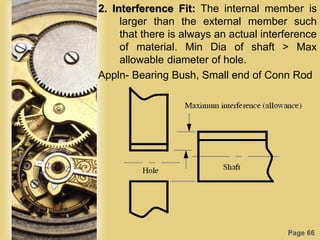
2. Interference Fit: The internal member is
larger than the external member such
that there is always an actual interference
of material. Min Dia of shaft > Max
allowable diameter of hole.
Appln- Bearing Bush, Small end of Conn Rod
Page 67
3. TRANSITION FIT:
In this type of fit, the limits for the
mating parts are so selected that either
a clearance or interference may occur
depending upon the actual size of the
mating parts. +ve and –ve clearance is
employable
Page 68
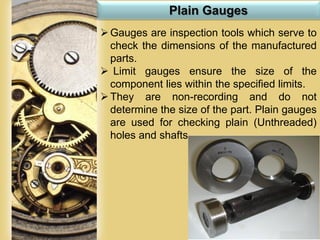
Plain Gauges
Gauges are inspection tools which serve to
check the dimensions of the manufactured
parts.
 Limit gauges ensure the size of the
component lies within the specified limits.
They are non-recording and do not
determine the size of the part. Plain gauges
are used for checking plain (Unthreaded)
holes and shafts.
Page 69
ADVANTAGES
Free from Errors
Portable and Independent on
Power
No auxiliary setup required
Check Combination in
Dimensions
Not expensive
Page 70
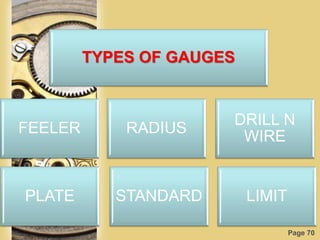
FEELER RADIUS
DRILL N
WIRE
PLATE STANDARD LIMIT
TYPES OF GAUGES
Page 71
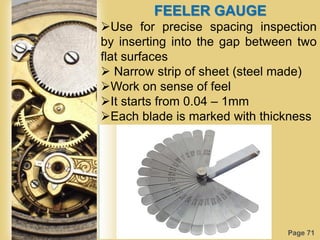
FEELER GAUGE
Use for precise spacing inspection
by inserting into the gap between two
flat surfaces
 Narrow strip of sheet (steel made)
Work on sense of feel
It starts from 0.04 – 1mm
Each blade is marked with thickness
Page 72
1.
2.
3.
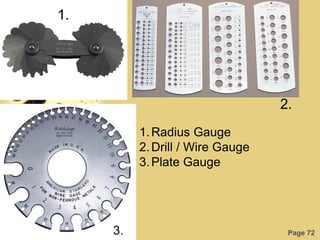
1.Radius Gauge
2.Drill / Wire Gauge
3.Plate Gauge
Page 73
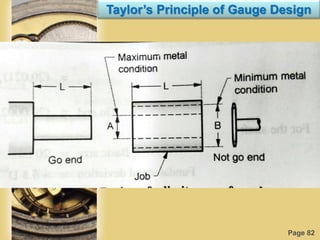
LIMIT GAUGING
Limit gauging is adopted for checking parts
produced by mass production.
It has the advantage that they can be used
by unskilled persons. Instead of measuring
actual dimensions, the conformance of
product with tolerance specifications can be
checked by a „GO‟ and „NO GO‟ gauges.
 A „GO‟ gauge represents the maximum
material condition of the product (i.e.
minimum hole size or maximum shaft size)
and conversely a „NO GO‟ represents the
minimum material condition (i.e. maximum
hole size or minimum shaft size)
Page 74
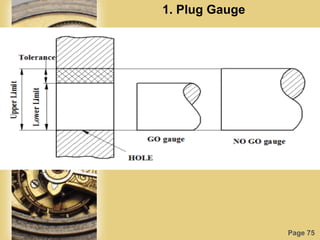
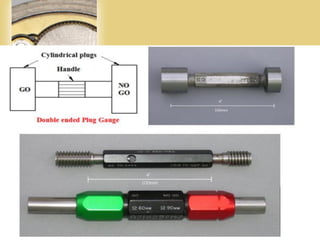
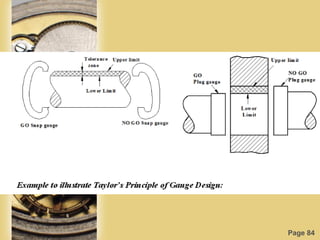
1.Plug Gauge
Plug gauges are the limit gauges used
for checking holes and consist of two
cylindrical wear resistant plugs.
The plug made to the lower limit of the
hole is known as „GO‟ end and this will
enter any hole which is not smaller than
the lower limit allowed.
 The plug made to the upper limit of the
hole is known as „NO GO‟ end and this will
not enter any hole which is smaller than
the upper limit allowed.
Page 75
1. Plug Gauge
Page 76
Page 77
Page 78
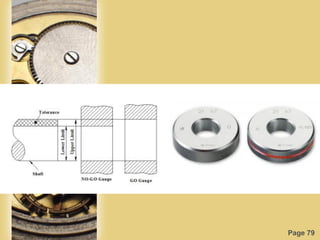
2. Ring Gauge
Ring gauges are used for gauging
shafts.
They are used in a similar manner to
that of GO & NO GO plug gauges.
A ring gauge consists of a piece of
metal in which a hole of required size
is bored.
Page 79
Page 80
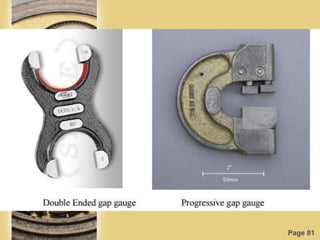
SNAP (or) GAP GAUGES:
 A snap gauge usually consists of a plate or
frame with a parallel faced gap of the
required dimension.
Snap gauges can be used for both
cylindrical as well as non cylindrical work as
compared to ring gauges which are
conveniently used only for cylindrical work.
Double ended snap gauges can be used for
sizes ranging from 3 to 100 mm.
For sizes above 100 mm upto 250 mm a
single ended progressive gauge may be
used.
Page 81
Page 82
Taylor’s Principle of Gauge Design
Page 83
Taylor’s Principle of Gauge Design
Page 84
Page 85
No Go Limit:
This designation is applied to that limit of the
two limits of size which corresponds to the
minimum material condition. i.e. the lower limit
of a shaft and the upper limit of a hole.
 „No Go‟ gauge should check only one part
or feature of the component at a time, so that
specific discrepancies in shape or size can be
detected.
Thus a separate „No Go‟ gauge is required
for each different individual dimension.
Page 86
Wear Allowance:
The GO gauges only are subjected to wear
due to rubbing against the parts during
inspection and hence a provision has to be
made for the wear allowance. Wear
allowance is taken as 10% of gauge
tolerance and is allowed between the
tolerance zone of the gauge and the
maximum material condition.
Page 87

Introduction to Metrology

  • 1.
    Page 1 Metrology The Scienceof Measurement By, Afaqahmed M J AIKTC Slides are subjected to copyright©
  • 2.
    Page 2 Syllabus TH+ PR + OR Module1 1.1 Introduction to Metrology, Fundamental principles and definitions, measurement standards / primary and tertiary standards, distinction between precision and accuracy. 1.2 Limits, fits and tolerances, Tolerance grades, Types of fits, IS919, GO and NO GO gauges- Taylor’s principle, design of GO and NO GO gauges, filler gauges, plug gauges and snap gauges. Module 2 2.1 Comparators: Constructional features and operation of mechanical, optical, electrical/electronics and pneumatic comparators, advantages, limitations and field of applications. 2.2 Principles of interference, concept of flatness, flatness testing, optical flats, optical interferometer and laser interferometer. 2.3 Surface texture measurement: importance of surface conditions, roughness and waviness, surface roughness standards specifying surface roughness parameters- Ra, Ry, Rz, RMS value etc., surface roughness measuring instruments – Tomlinson and Taylor Hobson versions, surface roughness symbols.
  • 3.
    Page 3 Module 3 3.1Screw Thread measurement: Two wire and three wire methods, floating carriage micrometer. 3.2 Gear measurement: Gear tooth comparator, Master gears, measurement using rollers and Parkinson’s Tester. 3.3 Special measuring Equipments: Principles of measurement using Tool Maker’s microscope, profile projector & 3D coordinate measuring machine. Module 4 Quality Control Introduction, definition and concept of quality & quality control, set up policy and objectives of quality control, quality of design and quality of conformance, compromise between quality & cost, quality cost and planning for quality. Module 5 SQC and SQC tools Importance statistical methods in QC, measurement of statistical control variables and attributes, pie charts, bar charts/ histograms, scatter diagrams, pareto chart, GANT charts, control charts, X chart, X bar charts, R charts, P charts, np charts their preparation, analysis and applications. Elementary treatment on modern SQC tools.
  • 4.
    Page 4 Module 6 SamplingTechniques Sampling inspection and basic concepts, OC curves, consumer & producer risk, single & double sampling plans and use of sampling tables.
  • 5.
  • 6.
    Page 6 Let‟s takea trip back in time…
  • 7.
  • 8.
  • 9.
  • 10.
    Page 10 And developingpermanent settlements
  • 11.
    Page 11 So, theydesired a system of measurement…
  • 12.
    Page 12 Or therewould be pandemonium (chaos) !
  • 13.
    Page 13 History ofMeasurement Wall and Leather Painting
  • 14.
    Page 14 Fast-forward 5000years to current measurement systems
  • 15.
  • 16.
    Page 16 METROLOGY???? Greek Word Metro– Measurement Logy - Science Standardization
  • 17.
    Page 17 METROLOGY and CONCERN Establishing Unitsof Measurement Developing Methods of Measurement Analyzing Accuracy
  • 18.
    Page 18 What ismetrology? The science of measurement (not weather!) Metrology establishes the international standards for measurement used by all countries in the world in both science and industry. Examples: distance, time, mass, temperature, voltage, values of physical and chemical constants
  • 19.
    Page 19 Accuracy Cost of Accuracy Precision ReliabilityCalibration Response time Metrological Terms
  • 20.
    Page 20 Career inMetrology 1.Scientific Metrology – Organization and development of measurement standards and their maintenance (highest level) – NIST Atomic Clock Accurate up to 1s / 20 million years National Institute Standard & Technology
  • 21.
    Page 21 Industrial Metrology –Adequate functioning of measurement instruments used in industry as well as production and testing processes
  • 22.
    Page 22 Pharmaceutical Industry • Metrologylaboratories test weights and volume standards for pharmaceutical companies • Products include medicines like aspirin, antibiotics, vaccines, insulin, & vitamins
  • 23.
    Page 23 Defense Industry •Metrology laboratories test standards for many military and defense companies • These companies make the guidance systems for the Patriot missiles and other things that aretop secret
  • 24.
    Page 24 Space Station,Satellites…. • Metrology laboratories test standards for many companies that provide parts of the space shuttle • These parts include the metal, heat shield, electronics, fabrics, o-rings, optics, and tires
  • 25.
    Page 25 STANDARDS ??? SI(Act 89, 1956) BIS ISO For Engineering matters
  • 26.
    Page 26 BIS ??? 1 •Formulation, Publication, Promotion, Inspection for Certification 2 • Establishment, Formulation, coordination and Maintenance 3 • Information, Documentation and recognition
  • 27.
    Page 27 Standards ofMeasurement A standard is defined as “something that is set up and established by an authority as rule of the measure of quantity, weight, extent, value or quality”.
  • 28.
    Page 28 1. Primarystandards  They are material standard preserved under most careful conditions.  These are not used for directly for measurements but are used once in 10 or 20 years for calibrating secondary standards.  At the highest level, a primary reference standard is assigned a value by direct comparison with the reference base.  Ex: International Prototype meter, Imperial Standard yard.
  • 29.
    Page 29 2. Secondarystandards  These are close copies of primary standards w.r.t design, material & length.  Any error existing in these standards is recorded by comparison with primary standards after long intervals.  They are kept at a number of places under great supervision and serve as reference for tertiary standards.  This also acts as safeguard against the loss or destruction of primary standards.
  • 30.
    Page 30 3. Tertiarystandards  The primary or secondary standards exist as the ultimate controls for reference at rare intervals.  Tertiary standards are the reference standards employed by National Physical laboratory (N.P.L) and are the first standards to be used for reference in laboratories & workshops.  They are made as close copies of secondary standards & are kept as reference for comparison with working standards.
  • 31.
    Page 31 4. Workingstandards These standards are similar in design to primary, secondary & tertiary standards. But being less in cost and are made of low grade materials, they are used for general applications in metrology laboratories. Sometimes, standards are also classified as; • Reference standards (used as reference purposes) • Calibration standards (used for calibration of inspection & working standards) • Inspection standards (used by inspectors) • Working standards (used by operators)
  • 32.
    Page 32 STANDARDS OFMEASUREMENT LINE END WAVELENGTH
  • 33.
    Page 33 LINE STANDARD Accordingto it, yard or metre is defined as the distance between scribed lines on a bar of metal under certain conditions of temperature and support. Yard  The Imperial Standard Yard is a bronze bar of one inch square cross-section and 38 inches long. METRE  This is the distance between the centre portions of two lines engraved on the polished surface of a bar of pure platinum- iridium alloy (90% platinum and 10% iridium).
  • 34.
    Page 34 END STANDARDS Isexpressed as the distance between two surfaces, this is referred to as end standard. For all the important works in the shop, the users prefer end standards e.g. slip gauges, length bars, the ends of micrometre anvils, gap gauges, and so on. Dimensional tolerance as small as 0.0005 mm can be obtained. They are not subjected to parallax effect as their use depends on “feel”. Well suited to measurements of close tolerance. Lethargic
  • 35.
    Page 35 WAVELENGTH A meteris defined as equal to 1670763.73 wavelength of red- orange radiations of Krypton isotope 86 gas . Length of path travelled by light in vacuum in 1/299792458 second. Higher Accuracy Environment-friendly Reproducible No Wear and Tear
  • 36.
    Page 36 Seven baseunits Length: meter (m) Mass: kilogram (kg) Time: second (s) Electric current: ampere (A) Thermodynamic temperature: Kelvin (K) Amount of substance: mole (mol) Luminous intensity: candela (cd)
  • 37.
    Page 37 • Accuracy –How close you are to the actual value – Depends on the person measuring – Calculated by the formula: % Error = (YV – AV) x 100 ÷ AV Where: YV is YOUR measured Value & AV is the Accepted Value
  • 38.
    Page 38 • Precision –How finely tuned your measurements are or how close they can be to each other – Depends on the measuring tool – Determined by the number of significant digits
  • 39.
    Page 39 • Accuracy& Precision may be demonstrated by shooting at a target. • Accuracy is represented by hitting the bulls eye (the accepted value) • Precision is represented by a tight grouping of shots (they are finely tuned)
  • 40.
    Page 40 ACCURACY ACCURACYwith PRECISION PRECISION without ACCURACY No ACCURACY, No PRECISION
  • 41.
  • 42.
    Page 42 LIMITS FITS & Toleranc es Based onStandards, Sufficient in sizes Both Uni and Bi lateral Tolerances shd b accptbl Carefully designed
  • 43.
    Page 43 TERMINOLOGY • NOMINALSIZE: It is the size of a part specified in the drawing. • BASIC SIZE: It is the size of a part to which all limits of variation are determined. Or It is the theoretical size from which limits of size are derived by the application of allowances and tolerances. • ACTUAL SIZE: It is the actual measured dimension of a part. Nominal and basic size are often the same.
  • 44.
    Page 44 DEVIATION • LOWER DEVIATION:It is the algebraic difference between the minimum limit of size and the basic size. • UPPER DEVIATION: It is the algebraic difference between the maximum limit and the basic size.
  • 45.
    Page 45 LIMITS OFSIZE Considerations for Deciding LIMITS Functional Req Interchan geability Economi cs
  • 46.
    Page 46 LIMITS OFSIZE  20 grades of Fundamental Tolerances and 28 types of Std. Deviations
  • 47.
  • 48.
    Page 48 Basic sizeand Zero line
  • 49.
    Page 49 • Thereare two extreme possible sizes of a component. • The largest permissible size for a component is called upper limit and smallest size is called lower limit. LIMITS OF SIZE
  • 50.
    Page 50 BASIS OFLIMIT SYSTEM  SHAFT BASIS SYSTEM: In this system, the shaft is kept as constant member and different fits are obtained by varying the hole size.  HOLE BASIS SYSTEM: In this system, the hole is kept as a constant member and different fits are obtained by varying the shaft size.
  • 51.
  • 52.
    Page 52 Tolerance • Toleranceis the total amount that a specific dimension is permitted to vary • It is the difference between the maximum and the minimum limits for the dimension. • For Example a dimension given as 1.625 ± .002 means that the manufactured part may be 1.627” or 1.623”, or anywhere between these limit dimensions.
  • 53.
  • 54.
    Page 54 Tolerances The Toleranceis 0.001” for the Hole as well as for the Shaft
  • 55.
    Page 55 POSITIONAL TOLERANCES •Two types of positional tolerances are used: 1. Unilateral tolerances 2. Bilateral tolerances • When tolerance is on one side of basic size, it is called unilateral and if it is both in plus and minus then it is known as bilateral tolerance.
  • 56.
    Page 56 Specifications ofTolerances 1. Limit Dimensioning The high limit is placed above the low limit. In single-line note form, the low limit precedes the high limit separated by a dash
  • 57.
  • 58.
    Page 58 International ToleranceGrade (IT): They are a set of tolerances that varies according to the basic size and provides a uniform level of accuracy within the grade. `
  • 59.
  • 60.
    Page 60 Diameters specifiedby ISI 1-3, 3-6, 6-10, 10-18, 18-30, 30-50, 50-80, 80-120, 120-180, 180-250….. 2500-3000mm D is Avg. Size Question Calculate the limits of tolerance and allowance for 25 H8d9.
  • 61.
  • 62.
  • 63.
    Page 63 FITS Range oftightness or looseness
  • 64.
    Page 64 Fits BetweenMating Parts Fit is the general term used to signify the range of tightness or looseness that may result from the application of a specific combination of allowances and tolerances in mating parts.
  • 65.
    Page 65 There areThree types of fits between parts 1. Clearance Fit: An internal member fits in an external member (as a shaft in a hole) and always leaves a space or clearance between the parts. (Largest Shaft, Smallest Hole) Minimum air space is 0.002”. This is the allowance and is always positive in a clearance fit.
  • 66.
    Page 66 2. InterferenceFit: The internal member is larger than the external member such that there is always an actual interference of material. Min Dia of shaft > Max allowable diameter of hole. Appln- Bearing Bush, Small end of Conn Rod
  • 67.
    Page 67 3. TRANSITIONFIT: In this type of fit, the limits for the mating parts are so selected that either a clearance or interference may occur depending upon the actual size of the mating parts. +ve and –ve clearance is employable
  • 68.
    Page 68 Plain Gauges Gaugesare inspection tools which serve to check the dimensions of the manufactured parts.  Limit gauges ensure the size of the component lies within the specified limits. They are non-recording and do not determine the size of the part. Plain gauges are used for checking plain (Unthreaded) holes and shafts.
  • 69.
    Page 69 ADVANTAGES Free fromErrors Portable and Independent on Power No auxiliary setup required Check Combination in Dimensions Not expensive
  • 70.
    Page 70 FEELER RADIUS DRILLN WIRE PLATE STANDARD LIMIT TYPES OF GAUGES
  • 71.
    Page 71 FEELER GAUGE Usefor precise spacing inspection by inserting into the gap between two flat surfaces  Narrow strip of sheet (steel made) Work on sense of feel It starts from 0.04 – 1mm Each blade is marked with thickness
  • 72.
    Page 72 1. 2. 3. 1.Radius Gauge 2.Drill/ Wire Gauge 3.Plate Gauge
  • 73.
    Page 73 LIMIT GAUGING Limitgauging is adopted for checking parts produced by mass production. It has the advantage that they can be used by unskilled persons. Instead of measuring actual dimensions, the conformance of product with tolerance specifications can be checked by a „GO‟ and „NO GO‟ gauges.  A „GO‟ gauge represents the maximum material condition of the product (i.e. minimum hole size or maximum shaft size) and conversely a „NO GO‟ represents the minimum material condition (i.e. maximum hole size or minimum shaft size)
  • 74.
    Page 74 1.Plug Gauge Pluggauges are the limit gauges used for checking holes and consist of two cylindrical wear resistant plugs. The plug made to the lower limit of the hole is known as „GO‟ end and this will enter any hole which is not smaller than the lower limit allowed.  The plug made to the upper limit of the hole is known as „NO GO‟ end and this will not enter any hole which is smaller than the upper limit allowed.
  • 75.
  • 76.
  • 77.
  • 78.
    Page 78 2. RingGauge Ring gauges are used for gauging shafts. They are used in a similar manner to that of GO & NO GO plug gauges. A ring gauge consists of a piece of metal in which a hole of required size is bored.
  • 79.
  • 80.
    Page 80 SNAP (or)GAP GAUGES:  A snap gauge usually consists of a plate or frame with a parallel faced gap of the required dimension. Snap gauges can be used for both cylindrical as well as non cylindrical work as compared to ring gauges which are conveniently used only for cylindrical work. Double ended snap gauges can be used for sizes ranging from 3 to 100 mm. For sizes above 100 mm upto 250 mm a single ended progressive gauge may be used.
  • 81.
  • 82.
  • 83.
  • 84.
  • 85.
    Page 85 No GoLimit: This designation is applied to that limit of the two limits of size which corresponds to the minimum material condition. i.e. the lower limit of a shaft and the upper limit of a hole.  „No Go‟ gauge should check only one part or feature of the component at a time, so that specific discrepancies in shape or size can be detected. Thus a separate „No Go‟ gauge is required for each different individual dimension.
  • 86.
    Page 86 Wear Allowance: TheGO gauges only are subjected to wear due to rubbing against the parts during inspection and hence a provision has to be made for the wear allowance. Wear allowance is taken as 10% of gauge tolerance and is allowed between the tolerance zone of the gauge and the maximum material condition.
  • 87.