LVDT
Linear Variable DifferentialTransformer
LVDT is the most used inductive transducer for
converting translating linear motion into electrical
signal.
This transducer converts a mechanical displacement
proportionally into electrical signal.
Construction:
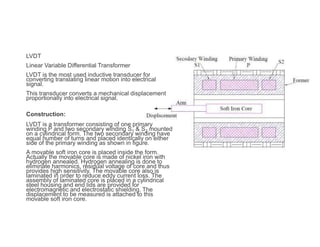
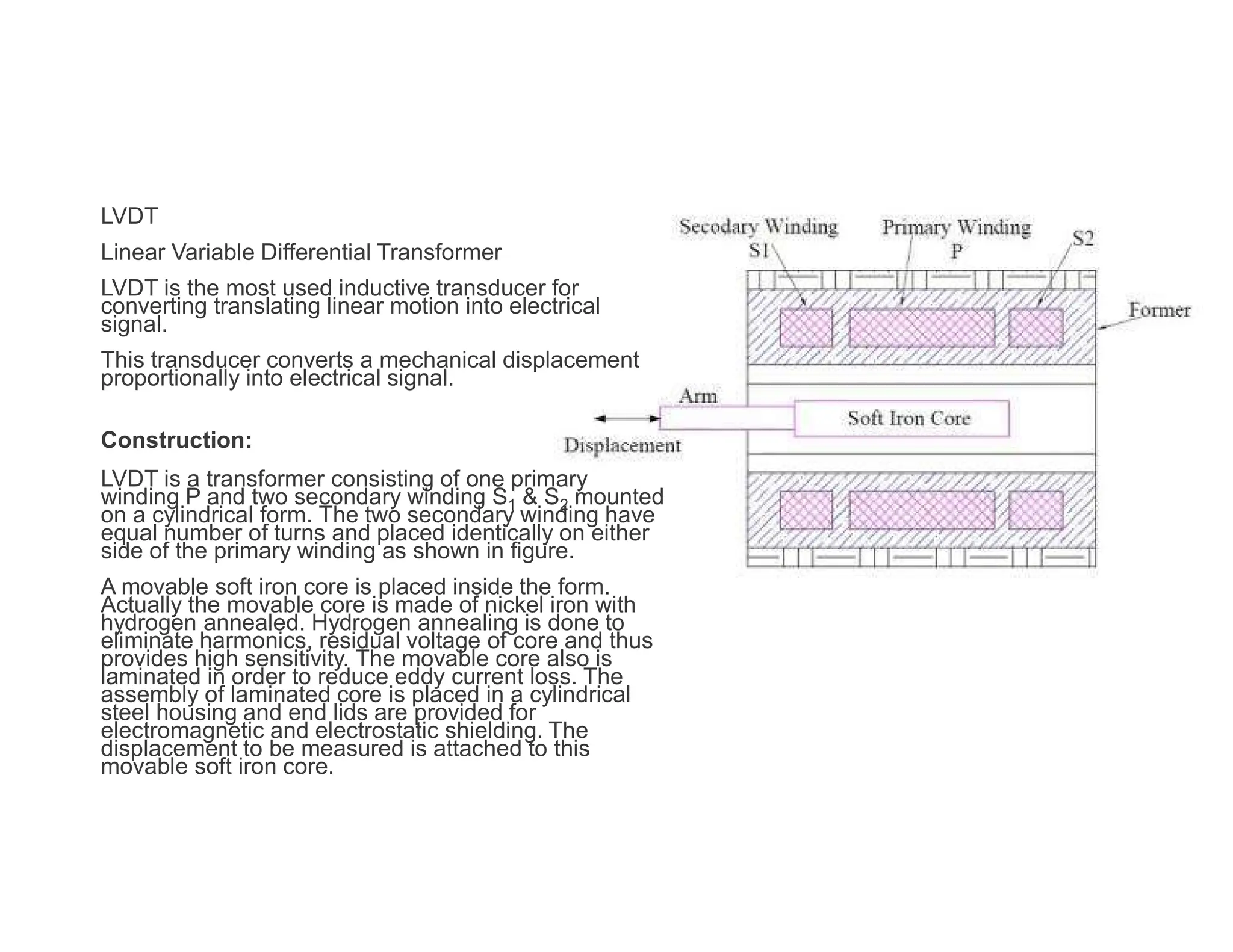
LVDT is a transformer consisting of one primary
winding P and two secondary winding S1 & S2 mounted
on a cylindrical form. The two secondary winding have
equal number of turns and placed identically on either
side of the primary winding as shown in figure.
A movable soft iron core is placed inside the form.
Actually the movable core is made of nickel iron with
hydrogen annealed. Hydrogen annealing is done to
eliminate harmonics, residual voltage of core and thus
provides high sensitivity. The movable core also is
laminated in order to reduce eddy current loss. The
assembly of laminated core is placed in a cylindrical
steel housing and end lids are provided for
electromagnetic and electrostatic shielding. The
displacement to be measured is attached to this
movable soft iron core.
2.
LVDT- Working Principle:
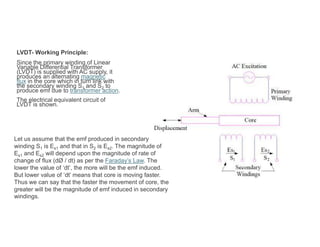
Sincethe primary winding of Linear
Variable Differential Transformer
(LVDT) is supplied with AC supply, it
produces an alternating magnetic
flux in the core which in turn link with
the secondary winding S1 and S2 to
produce emf due to transformer action.
The electrical equivalent circuit of
LVDT is shown.
Let us assume that the emf produced in secondary
winding S1 is Es1 and that in S2 is Es2. The magnitude of
Es1 and Es2 will depend upon the magnitude of rate of
change of flux (dØ / dt) as per the Faraday’s Law. The
lower the value of ‘dt’, the more will be the emf induced.
But lower value of ‘dt’ means that core is moving faster.
Thus we can say that the faster the movement of core, the
greater will be the magnitude of emf induced in secondary
windings.
3.
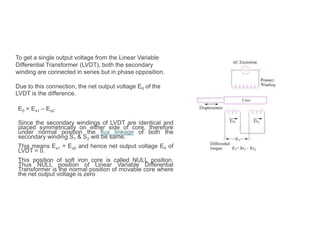
To get asingle output voltage from the Linear Variable
Differential Transformer (LVDT), both the secondary
winding are connected in series but in phase opposition.
Due to this connection, the net output voltage E0 of the
LVDT is the difference.
E0 = Es1 – Es2
Since the secondary windings of LVDT are identical and
placed symmetrically on either side of core, therefore
under normal position the flux linkage of both the
secondary winding S1 & S2 will be same.
This means Es1 = Es2 and hence net output voltage E0 of
LVDT = 0.
This position of soft iron core is called NULL position.
Thus NULL position of Linear Variable Differential
Transformer is the normal position of movable core where
the net output voltage is zero
4.
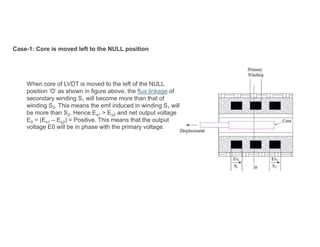
Case-1: Core ismoved left to the NULL position
When core of LVDT is moved to the left of the NULL
position ‘O’ as shown in figure above, the flux linkage of
secondary winding S1 will become more than that of
winding S2. This means the emf induced in winding S1 will
be more than S2. Hence Es1 > Es2 and net output voltage
E0 = (Es1 – Es2) = Positive. This means that the output
voltage E0 will be in phase with the primary voltage.
5.
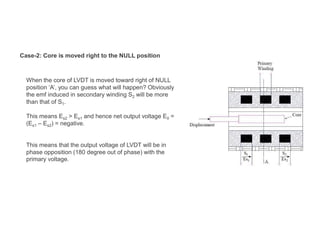
Case-2: Core ismoved right to the NULL position
When the core of LVDT is moved toward right of NULL
position ‘A’, you can guess what will happen? Obviously
the emf induced in secondary winding S2 will be more
than that of S1.
This means Es2 > Es1 and hence net output voltage E0 =
(Es1 – Es2) = negative.
This means that the output voltage of LVDT will be in
phase opposition (180 degree out of phase) with the
primary voltage.
6.
From the abovetwo cases, we can have the following conclusions:
1)The direction of movement of a physical quantity can be identified by the output voltage of
LVDT. If the output voltage E0 is positive, this means the physical quantity is moving toward
left.
2) If the output voltage E0 is negative, this will mean that the physical quantity is moving in the
right direction from the NULL position.
3) The amount / magnitude of displacement is proportional to the magnitude of output voltage.
The more the output voltage, the more will be displacement.
Application:
LVDT is used in those applications where displacement ranging from fraction of a mm to few
cm. As a primary transducer, it converts the mechanical displacement into electrical signal.
Acting as a secondary transducer, it is sued for measurement of force, pressure, weight etc.