Dr.S.Sundaresan
Tagore Medical College and Hospital
Learning Objectives
 At the end of this lecture, the student should be able
to
 Define disinfection and sterilisation
 Describe the common substances and processes used to
achieve these outcomes
Definitions
 Cleaning
 process which physically removes contamination but does not
necessarily destroy micro-organisms
 prerequisite before decontamination by disinfection or sterilisation
of instruments
 Disinfection
 using an agent that destroys germs or other harmful microbes or
inactivates them, usually referred to chemicals that kill the growing
forms (vegetative forms) but not the resistant spores of bacteria
Definitions
 Antisepsis
 destruction of pathogenic microorganisms existing in
their vegetative state on living tissue
 Sterilization
 any process, physical or chemical, that will destroy all
forms of life, including bacterial, fungi, spores, and
viruses
Methods of Microbial Control
 Physical Methods
 Chemical Methods
Physical Methods
 Dry Heat
 Oxidation
 Moist Heat
 Denatures microbial protein
 Radiation
 Damages cell enzyme systems and DNA
 Filtration
 Traps organisms that are too large to pass through the
filter
 Ultrasonic Vibration
 Coagulates proteins and damages cell walls
Physical Methods: Heat
 Dry heat (hot air oven)
 used on waxes, oils (wet heat usually preferred)
 Flaming , red heat.
 Incineration the ultimate sterilization
used for disposal of hospital waste
 Wet heat
 Below 1oo⁰C :Pasteurisation,First used with milk: 72°C for 20 seconds
 Boiling 1oo⁰C
 limited use as spores may be resistant, boilers may be misused
 Low temperature steam disinfection (75°C for 30 mins)
 Used for e.g. ventilator tubing
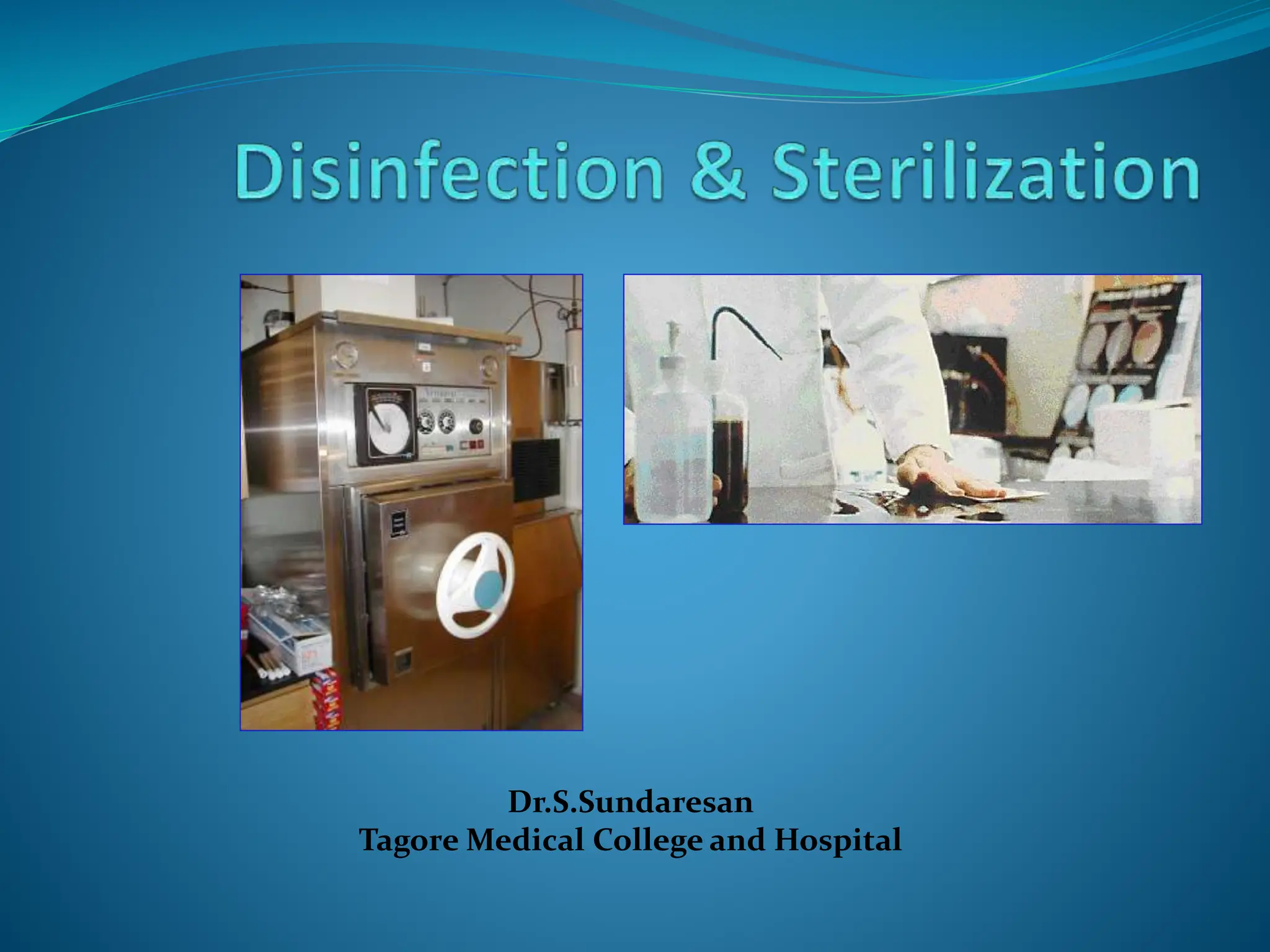
 Autoclaving
 High-temperature steam plus pressure (same principle as pressure
cooker)
Dry Heat
 Incineration
 Material or object is exposed to a hot fire
 Object must become red hot as in the inoculation loops
used in microbiology
 Used to dispose of tissue or carcasses
 Efficacy: complete sterilization
Dry Heat
 Hot Air Oven
 Sterility requires 1 hour of exposure @ 170° C(340° F)
 Powders and non-aqueous liquids like paraffin or
Vaseline
 Used in some animal care facilities and useful in
domestic applications (e.g. the kitchen oven)
 Efficacy: complete sterilization
Moist Heat
 Hot Water
 Used to clean and sanitize surfaces
 Addition of detergents increases efficacy by emulsifying
oils and suspending soils so they are rinsed away
 Efficacy: incomplete sterilization
Moist Heat
 Boiling
 Requires 3 hours of boiling to achieve complete
sterilization
 Boiling for 10 minutes will destroy vegetative bacteria
and viruses but not spores
 Addition of 2% calcium carbonate or sodium carbonate
will inhibit rust and increase efficacy
 Useful for field work
 Efficacy: may be complete sterilization
Moist Heat
 Steam
 Similar to boiling because the temperature is the same
 Exposure to steam for 90 minutes kills vegetative
bacteria but not spores
 Efficacy: incomplete sterilization
Moist Heat
 Steam under pressure
 Pressure increases the
boiling point such that the
temperature of the water
becomes much higher that
100° C (212° F)
 Typical settings: 121˚C @ 15
psi for 15 min. or 121˚C @ 30
psi for 3 min
 The autoclave utilizes steam
under pressure to achieve
sterilization
 This is the most efficient and
inexpensive method of
sterilization for routine use
 Efficacy: complete
sterilization
Physical Methods: Heat
 Advantages
 Non-toxic
 Quick
 Cheap
 Disadvantages
 Can only be used on heat-resistant materials
 No use for many plastics, electronics, tarnishes some metals
Physical Methods
 Filtration
 Used on labile fluids and on air supplies
 Gamma-Irradiation
 Used on disposable plastics, e.g. in sealed packs
 Only in specialised centres
Radiation
 Ultraviolet (UV)
 Low energy UV radiation is a sterilant when items are
placed at a close range
 UV radiation has no penetrating ability
 Used to sterilize rooms
 Very irritating to eyes
 Efficacy: may be complete sterilization
Radiation
 Gamma radiation
 Ionizing radiation produced from a Cobalt 60 source
 Good penetrating ability in solids and liquids
 Used extensively in commercial preparation of
pharmaceuticals, biological products and disposable
plastics
 Efficacy: complete sterilization
Filtration
 Fluid filtration
 Forced through a filter with either positive or negative
pressure
 Filter is most commonly a synthetic screen filter with
micropore openings
 Used to sterilize culture media, buffers and
pharmaceuticals
 Pore size of 0.45µm removes most bacteria
 Microplasmas and viruses require 0.01µm to 0.1µm
 May be used in conjunction with a pre-filter
 Efficacy: can be complete sterilization
Filtration
 Air filtration
 Examples of usage: surgical masks, laboratory animal
cages and air duct filters
 Fibrous filters made of various paper products are
effective for removing particles from air
 Efficacy is influenced by air velocity, relative humidity
and electrostatic charge
 Efficacy: can be complete sterilization
Ultrasonic Vibration
 Cavitation
 High frequency sound waves passed through a solution
create thousands of cavitation “bubbles”
 Bubbles contain a vacuum; as they implode or collapse,
debris is physically removed from objects
 Effective as an instrument cleaner
 Efficacy: incomplete sterility
Factors influencing ability to kill
microbes
 Strength of the killing agent
 Time that the agent has to act
 Temperature of environment
 rate of microbe death doubles with every 10˚C rise in
temp.
 Type of microbe
 Environment around the area to be decontaminated
 Number of microbes to be killed
Chemicals
 Use depends on spectrum
of antimicrobial activity
and compatibility with
materials
 Also limited by dangers of
chemicals themselves
 Examples
 Halogens
 Alcohols
 Alkylating agents
 Ethylene oxide
 Phenolics
 cetrimide (QAC)
 chlorhexidine (diguanide)
Halogens
 Hypochlorites (household
bleach) & chlorine
 Advantages
 active against viruses, spores,
fungi
 Disadvantages
 inactivated by organic matter,
freshness & pH critical (go off if
diluted), corrosive to metals
 Practical Uses
 0.1% hypochlorite used as general
disinfectant
 Strong hypochlorite (0.25%) used in
lab & on wounds
 Extra strong (1%) used on HBV
blood spills
 Chlorine used to treat drinking
water and control Legionella
Halogens
 Iodophors & iodine
 Advantages
 Some activity against viruses, spores, fungi
 Disadvantages
 inactivated by organic matter, can stain skin, irritant, expensive
 Practical Uses
 Pre-op skin disinfection
 Povidone iodine used as surgical scrub, as powder on ulcers
Alcohols
 Isopropanol & ethanol
 Advantages
 kill vegetative bacteria on clean surfaces in 30 seconds
 Disadvantages
 inactive against spores, fungi
 Inflammable
 Need to be at correct %age with water (65-80%)
 Practical uses
 Skin antisepsis before venepuncture
 Hand rubs
 Disinfection of e.g. trolley tops
Alkylating agents
 Glutaraldehyde and Formaldehyde
 Advantages
 Good activity against spores, virues, fungi
 Disdvantages
 Glutaraldehyde only moderately active against TB
 Need long exposure time for full effect (3 hours)
 freshness & pH critical
 TOXIC!
 Practical uses
 Disinfection of endoscopes
 Blood spills
 Fumigation
Ethylene oxide
 Highly toxic flammable gas, kills spores!
 Used for bulky items such as heart lung machines
 Can be used on glutaraldehyde-labile endoscopes
 Use limited by safety issues
Phenolics & QACs
 Clear soluble phenolics (e.g. Hycolin) used as
disinfectant on soiled surfaces, relatively inactive
against spores and viruses
 Hexachlorophane used as surgical scrub
 Quaternary ammonium compounds, e.g. cetrimide
usually only used in combination with other agents;
good detergent properties.
Chlorhexidine (a diguanide)
 Used as general purpose
antiseptic for skin and mucous
membranes in many
formulations, e.g. Hibiscrub,
Hibisol, Savlon
 Advantages: relatively non-toxic
and good against S. aureus
 Disadvantages: can support
growth of e.g. P. aeruginosa
Factors determining usefulness of
chemical disinfection
 Spectrum of antimicrobial activity
 is it the right agent for the job?
 Used at correct concentration
 concept of 'in use concentration’
 diluted down from high concentration
 stored for <24 hours
 no topping up of old solutions
Factors determining usefulness of
chemical disinfection
 Time of exposure
 You cannot disinfect an endoscope in 5 minutes
glutaraldehyde!
 Correct pH?
 Inactivating materials
 Pus, blood vomit, cork, soaps etc
 Is disinfectant sterile?
 Many cases of Gram-negatives living in disinfectants!
 Microbiological “in-use” testing
Quality Control
 The effectiveness of any method of microbial control
must be monitored regularly
 Verification of the effectiveness of microbial control
should be performed at least monthly
Quality Control
 Methods
 Recording thermometer
 Thermocouple
 Chemical indicator
 Biological testing
 Bowie Dick test
 Surface sampling
 Serology

Sterilization and disinfection .pptx.

  • 1.
  • 2.
    Learning Objectives  Atthe end of this lecture, the student should be able to  Define disinfection and sterilisation  Describe the common substances and processes used to achieve these outcomes
  • 3.
    Definitions  Cleaning  processwhich physically removes contamination but does not necessarily destroy micro-organisms  prerequisite before decontamination by disinfection or sterilisation of instruments  Disinfection  using an agent that destroys germs or other harmful microbes or inactivates them, usually referred to chemicals that kill the growing forms (vegetative forms) but not the resistant spores of bacteria
  • 4.
    Definitions  Antisepsis  destructionof pathogenic microorganisms existing in their vegetative state on living tissue  Sterilization  any process, physical or chemical, that will destroy all forms of life, including bacterial, fungi, spores, and viruses
  • 5.
    Methods of MicrobialControl  Physical Methods  Chemical Methods
  • 6.
    Physical Methods  DryHeat  Oxidation  Moist Heat  Denatures microbial protein  Radiation  Damages cell enzyme systems and DNA  Filtration  Traps organisms that are too large to pass through the filter  Ultrasonic Vibration  Coagulates proteins and damages cell walls
  • 7.
    Physical Methods: Heat Dry heat (hot air oven)  used on waxes, oils (wet heat usually preferred)  Flaming , red heat.  Incineration the ultimate sterilization used for disposal of hospital waste  Wet heat  Below 1oo⁰C :Pasteurisation,First used with milk: 72°C for 20 seconds  Boiling 1oo⁰C  limited use as spores may be resistant, boilers may be misused  Low temperature steam disinfection (75°C for 30 mins)  Used for e.g. ventilator tubing  Autoclaving  High-temperature steam plus pressure (same principle as pressure cooker)
  • 8.
    Dry Heat  Incineration Material or object is exposed to a hot fire  Object must become red hot as in the inoculation loops used in microbiology  Used to dispose of tissue or carcasses  Efficacy: complete sterilization
  • 9.
    Dry Heat  HotAir Oven  Sterility requires 1 hour of exposure @ 170° C(340° F)  Powders and non-aqueous liquids like paraffin or Vaseline  Used in some animal care facilities and useful in domestic applications (e.g. the kitchen oven)  Efficacy: complete sterilization
  • 10.
    Moist Heat  HotWater  Used to clean and sanitize surfaces  Addition of detergents increases efficacy by emulsifying oils and suspending soils so they are rinsed away  Efficacy: incomplete sterilization
  • 11.
    Moist Heat  Boiling Requires 3 hours of boiling to achieve complete sterilization  Boiling for 10 minutes will destroy vegetative bacteria and viruses but not spores  Addition of 2% calcium carbonate or sodium carbonate will inhibit rust and increase efficacy  Useful for field work  Efficacy: may be complete sterilization
  • 12.
    Moist Heat  Steam Similar to boiling because the temperature is the same  Exposure to steam for 90 minutes kills vegetative bacteria but not spores  Efficacy: incomplete sterilization
  • 13.
    Moist Heat  Steamunder pressure  Pressure increases the boiling point such that the temperature of the water becomes much higher that 100° C (212° F)  Typical settings: 121˚C @ 15 psi for 15 min. or 121˚C @ 30 psi for 3 min  The autoclave utilizes steam under pressure to achieve sterilization  This is the most efficient and inexpensive method of sterilization for routine use  Efficacy: complete sterilization
  • 14.
    Physical Methods: Heat Advantages  Non-toxic  Quick  Cheap  Disadvantages  Can only be used on heat-resistant materials  No use for many plastics, electronics, tarnishes some metals
  • 15.
    Physical Methods  Filtration Used on labile fluids and on air supplies  Gamma-Irradiation  Used on disposable plastics, e.g. in sealed packs  Only in specialised centres
  • 16.
    Radiation  Ultraviolet (UV) Low energy UV radiation is a sterilant when items are placed at a close range  UV radiation has no penetrating ability  Used to sterilize rooms  Very irritating to eyes  Efficacy: may be complete sterilization
  • 17.
    Radiation  Gamma radiation Ionizing radiation produced from a Cobalt 60 source  Good penetrating ability in solids and liquids  Used extensively in commercial preparation of pharmaceuticals, biological products and disposable plastics  Efficacy: complete sterilization
  • 19.
    Filtration  Fluid filtration Forced through a filter with either positive or negative pressure  Filter is most commonly a synthetic screen filter with micropore openings  Used to sterilize culture media, buffers and pharmaceuticals  Pore size of 0.45µm removes most bacteria  Microplasmas and viruses require 0.01µm to 0.1µm  May be used in conjunction with a pre-filter  Efficacy: can be complete sterilization
  • 20.
    Filtration  Air filtration Examples of usage: surgical masks, laboratory animal cages and air duct filters  Fibrous filters made of various paper products are effective for removing particles from air  Efficacy is influenced by air velocity, relative humidity and electrostatic charge  Efficacy: can be complete sterilization
  • 21.
    Ultrasonic Vibration  Cavitation High frequency sound waves passed through a solution create thousands of cavitation “bubbles”  Bubbles contain a vacuum; as they implode or collapse, debris is physically removed from objects  Effective as an instrument cleaner  Efficacy: incomplete sterility
  • 22.
    Factors influencing abilityto kill microbes  Strength of the killing agent  Time that the agent has to act  Temperature of environment  rate of microbe death doubles with every 10˚C rise in temp.  Type of microbe  Environment around the area to be decontaminated  Number of microbes to be killed
  • 23.
    Chemicals  Use dependson spectrum of antimicrobial activity and compatibility with materials  Also limited by dangers of chemicals themselves  Examples  Halogens  Alcohols  Alkylating agents  Ethylene oxide  Phenolics  cetrimide (QAC)  chlorhexidine (diguanide)
  • 24.
    Halogens  Hypochlorites (household bleach)& chlorine  Advantages  active against viruses, spores, fungi  Disadvantages  inactivated by organic matter, freshness & pH critical (go off if diluted), corrosive to metals  Practical Uses  0.1% hypochlorite used as general disinfectant  Strong hypochlorite (0.25%) used in lab & on wounds  Extra strong (1%) used on HBV blood spills  Chlorine used to treat drinking water and control Legionella
  • 25.
    Halogens  Iodophors &iodine  Advantages  Some activity against viruses, spores, fungi  Disadvantages  inactivated by organic matter, can stain skin, irritant, expensive  Practical Uses  Pre-op skin disinfection  Povidone iodine used as surgical scrub, as powder on ulcers
  • 26.
    Alcohols  Isopropanol &ethanol  Advantages  kill vegetative bacteria on clean surfaces in 30 seconds  Disadvantages  inactive against spores, fungi  Inflammable  Need to be at correct %age with water (65-80%)  Practical uses  Skin antisepsis before venepuncture  Hand rubs  Disinfection of e.g. trolley tops
  • 27.
    Alkylating agents  Glutaraldehydeand Formaldehyde  Advantages  Good activity against spores, virues, fungi  Disdvantages  Glutaraldehyde only moderately active against TB  Need long exposure time for full effect (3 hours)  freshness & pH critical  TOXIC!  Practical uses  Disinfection of endoscopes  Blood spills  Fumigation
  • 28.
    Ethylene oxide  Highlytoxic flammable gas, kills spores!  Used for bulky items such as heart lung machines  Can be used on glutaraldehyde-labile endoscopes  Use limited by safety issues
  • 29.
    Phenolics & QACs Clear soluble phenolics (e.g. Hycolin) used as disinfectant on soiled surfaces, relatively inactive against spores and viruses  Hexachlorophane used as surgical scrub  Quaternary ammonium compounds, e.g. cetrimide usually only used in combination with other agents; good detergent properties.
  • 30.
    Chlorhexidine (a diguanide) Used as general purpose antiseptic for skin and mucous membranes in many formulations, e.g. Hibiscrub, Hibisol, Savlon  Advantages: relatively non-toxic and good against S. aureus  Disadvantages: can support growth of e.g. P. aeruginosa
  • 31.
    Factors determining usefulnessof chemical disinfection  Spectrum of antimicrobial activity  is it the right agent for the job?  Used at correct concentration  concept of 'in use concentration’  diluted down from high concentration  stored for <24 hours  no topping up of old solutions
  • 32.
    Factors determining usefulnessof chemical disinfection  Time of exposure  You cannot disinfect an endoscope in 5 minutes glutaraldehyde!  Correct pH?  Inactivating materials  Pus, blood vomit, cork, soaps etc  Is disinfectant sterile?  Many cases of Gram-negatives living in disinfectants!  Microbiological “in-use” testing
  • 33.
    Quality Control  Theeffectiveness of any method of microbial control must be monitored regularly  Verification of the effectiveness of microbial control should be performed at least monthly
  • 34.
    Quality Control  Methods Recording thermometer  Thermocouple  Chemical indicator  Biological testing  Bowie Dick test  Surface sampling  Serology