ALL INDIA INSTITUTE OF LOCAL SELF GOVERNMENT
TOPIC- FIRST AID
Dr. Chhavi Bajaj
Faculty AIILSG
First Aid
PURPOSE- 3PS
• PRESERVE LIFE
• PROTECT CONDITION FROM GETTING WORSE
• PROMOTE RECOVERY
QUALITIES OF FIRST AIDER
• QUICK RESPONSE
• CALM AND GOOD APPROACH
• PRIORITY TO BASIC LIFE SUPPORT (BLS)
• WORK WITH PRESENCE OF MIND
• STUDY SURROUNDING
• MORALLY SUPPORT THE VICTIM
Golden Rules of First Aid
• Don’t Panic
• Artificial respiration if breathing has stopped
• Stop Bleeding (using pressure points)
• Guard against shock
• Do the minimum essential procedure
required
• Reassurance by reducing Anxiety
• Move to hospital asap
It is an Immediate and temporary care given to a victim of an accident or sudden
illness
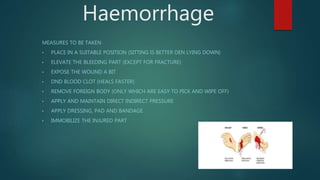
Haemorrhage
MEASURES TO BE TAKEN
• PLACE IN A SUITABLE POSITION (SITTING IS BETTER DEN LYING DOWN)
• ELEVATE THE BLEEDING PART (EXCEPT FOR FRACTURE)
• EXPOSE THE WOUND A BIT
• DND BLOOD CLOT (HEALS FASTER)
• REMOVE FOREIGN BODY (ONLY WHICH ARE EASY TO PICK AND WIPE OFF)
• APPLY AND MAINTAIN DIRECT INDIRECT PRESSURE
• APPLY DRESSING, PAD AND BANDAGE
• IMMOBILIZE THE INJURED PART
Procedures for control of haemorrhage by direct
pressure
APPLY DIRECT PRESSURE WITH THE THUMBS OR FINGERS OVER A PAD
BLEEDING POINT INVISIBLE- GRASP THE WHOLE WOUND AND SQUEEZE
TIGHTLY
• IF NO FOREIGN BODY APPLY DRESSING, MAINTAIN PRESSURE, BANDAGE
IT FIRMLY
• IF FOREIGN BODY CAN NOT BE REMOVED
Cover with dressing and do not apply pressure
Bandage the band firmly in position. Apply extra pads and
dressing is the bleeding doesn’t stop
Procedure of control of haemorrhage by
Indirect pressure
Methods
 By applying pressure on pressure points
A pressure point is one where an artery can be compressed against the underlying bone to
prevent the flow of blood beyond that point
 By use of constrictive bandage
Must be tight enough to control the flow of the blood
Best place to apply ---- middle of the upper arm and junction of the middle and upper third
of the thigh
Cautiously remove after 15 minutes, if the bleeding doesn’t stop, Re-tighten immediately
Constrictive
Bandage
Wounds with abdominal wall
1. When there is no protrusion of organ
 Keep the victim on his back and knees bent
 Apply general rules of wound treatment
2. When internal organs protrude
 Keep the victim on his back and knees bent
 Cover the area with clean towel
 Keep the victim war, don’t apply pressure or hot pack
 Do not give anything by mouth
 Remove the victim to hospital as speedily as possible
Wounds on the chest wall
• This may allow penetration of air in or out of the chest cavity as the patient breathes
• Serious condition, cover the wound with a dressing, pad and bandage firmly
Internal Haemorrhage
May result from injury, crush, blow, fracture, stab or bullet
May be visible or concealed
Signs and Symptoms
 Fainting
 Pallor of face and lips
 Cold clammy skin
 Severe thirst
 Restlessness
 Progressively weaker pulse
 Irregular breathing pattern
 Unconsciousness
Treatment includes moving the victim to the hospital, do not give anything by mouth
In case of bleeding from mouth (cheeks, tongue, gums, and socket of the tooth)
Plug with a clean cotton wool and ask the victim to bite on it
Bleeding from Nose
 Make the patient sit up right
 Loosen clothes around neck and chest
 Instruct to breath from nose
 Pinch the nose firmly just below the hard part
 Do not attempt to plug the nose
Bleeding from Ear
THIS INDICATE FRACTURE OF THE BASE OF THE SKULL
• Laying the causality down with the head slightly raised
• Do not plug the ear
• Incline the head to the affected part and give dressings
Bleeding from Varicose Veins
Bleeding from burst varicose veins in the leg is very severe and may be FATAL,
• Laying the casualty flat an raise the legs
• Apply clean pad and bandage
• Loosen constrictions
Normal
veins
Varicose veins
Bruises
Caused due to blow anywhere on the surface of the body leading to extensive capillary haemorrhage beneath
the skin
 Accompanied by discolouration and swelling
 Apply cold compress
Shock
 Severe depression of vital functions
 Severity depends upon the nature and extent of injury
 Common cause of Death following severe injuries
 Fainting
 Feeling of cold
 Nausea
 Pallor
 Cold and clammy skin
 Progressively changing pulse rate
 Vomiting
 Unconsciousness
 Treatment
 Reassure
 Lay him on his back, if airway is interfered Three quarters prone position
 Loosen clothing around neck
 Wrap him in a blanket or rug
 If thirsty, give a sip of water
 No heat therapy
Asphyxia
 Severely deficient supply of oxygen to the body that arises from abnormal
breathing like choking
 It leads to generalized hypoxia
 Can cause coma or death
Causes of Asphyxia
 Fluid in air passage
 Harmful gases
 Choking
 Compression of food pipe
 Swelling of tissues
 Pressure of crushing injuries
 Poisoning
 Electric shock
Signs & Symptoms
 Dizziness and weakness
 Shortness of breath
 Rapid pulse
 Partial loss of consciousness
 Swelling of veins of the neck
 Blueness of cheeks and lips
Treatment of Asphyxia
 Remove the cause
 Ensure free passage of air
Look for tongue, which may fall back and block the airway
 Apply artificial respiration
Drowning Artificial respiration, Remove wet clothes,
wrap in blanket
Strangulation Remove the band constricting the throat
Hanging Grasp the lower limb and raise the body
Chocking Heimlich Maneuvre
Smoke Wet towel over mouth and nose
Electric Injury
 Switch off the current
 Remove the casualty from contact with current by using dry insulating
material
 Give artificial respiration if necessary
 Treat for shock
 Treat for burns
 Transfer to hospital or call doctor
Fracture
 Discontinuation in the continuity of the bone is called a fracture usually occurs after
injury
Signs and symptoms
 Restriction of movement
 Deformity of the part
 Crepitus
 Pain
 Swelling
Treatment
• Do not move the casualty
• Treat for haemorrhage and severe wounds
• Immobilise the fractured part
Fracture of skull
 May injure brain and nervous system causing concussion and
compression. In these cases blood may ooze from the ear canal or from
nose or may be swallowed and afterwards vomited
 Treatment depends upon the type of breathing
 Not noisy Lay the casualty on his back with head and shoulder
raised
Turn the head on the affected side
 Noisy Lay the casualty in Three Quarter prone position
Knees should be bent
Check for air way obstruction
Turn the head on the affected side
Do not make unnecessary movements
Fracture of lower jaw
Signs and symptoms
 Difficulty in speaking
 Blood stained saliva
 Increasing pain on speaking and swallowing
 Irregular teeth
 Crepitus
 Tongue may fall back and obstruct airway
 Deformation of facial outline
Treatment
 Warn the casualty not to speak
 Lean forward
 Transport to hospital
Spinal injury
 Immediately warn the casualty to lie still
 If unconscious, check for airway obstruction
 Cover with a blanket
 Transport to hospital in supine position
Stretcher Methods
 Should be used in all serious cases like haemorrhage, shock, fractures
Rules
 Safety Stretcher should be inspected regularly
 Steady Great care must be taken to avoid jolting or jarring the patient
 Speed Must be quick
 Observe Watch for worsening in the condition
 Arrest severe blessing, bandage split fracture, and cover the wounds
Fracture of Ribs
Signs and Symptoms
 Pain at the site
 Casualty takes Deep breathing and coughing to restrict movements
 Internal haemorrhage may be seen
Complication An open wound may allow direct passage of air to lungs
Transport to hospital immediately
Fracture of Collar Bone
Signs and symptoms
Victim usually supports the injured side arm at the elbow from the other
hand and bends the head towards the injured side
Treatment
Support the arm
Place bandages
Support the upper limb in a triangular sling
Transport the casualty to hospital
Fracture of Pelvis
 This may be caused due to fall from height
 Pelvic organs may be injured
Signs and symptoms
 Pain
 Inability to stand
 Internal Haemorrhage may occur
 Desire to pass urine frequently
Treatment
 Laying comfortable position
 Warn not to urinate
 Transport on a stretcher as quickly as possible
Dislocation
 Displacement of one or more bones at the joint
 Frequently displaced joints are shoulder, elbow, thumb, fingers lower jaw
Sings and symptoms
 Severe pain near the joint
 Inability to move joint properly
 Change in shape of joint
 Swelling
Treatment
 Obtain medical help immediately
 In case of limbs give support
 In case of jaw- in spite of pushing the jaw backwards, pull it in front and
den it will go back on its own
Bandages
Types Triangular or Roller
 Triangular bandage is made from cutting 1 meter square diagonally
Ends are tied by Reef knots
May be used as an Arm Sling in case of ribs and forearm fractures
Can be used in case of scalp, elbow, palm, knee
Main uses are:
To retain dressing and immobilise fracture
To support injured part
Control bleeding
To reduce and prevent swelling
 Roller Bandage
Vary from 1’’ to 6’’ in width (for finger and truck respectively)
 Can be used in uniform parts
 Figure of 8 bandage is used at the point (when used n arms-chest and thigh-
hip aca Spika)
 Reversed spiral is used in tapering parts
Main uses are
Same as Triangular bandage
Counting Pulse
 The number of beats per minute is called as pulse rate
 It increase in case of-
Effort
Fever
Dehydration
Heart diseases
Mouth to Mouth Resuscitation
(Artificial Respiration)
 New Born baby
Clean mouth nose and throat to allow air passage
Lay the baby on his back and tilt the head
Cover mouth and nose with yours
Blow air gently
Belly is raised on blowing air, press from below to exhale the air
Continue till 15 minutes if the heat is still beating
 Adults
Same process
Blow air for 15-20 minutes with full pressure
Burns and Scalds
 Burn is an Injury caused by dry heat such as fire, piece of hot metal, electric shock, corrosive
chemicals like acids and alkaline
 A scald is an injury caused by moist heat such as boiling water, steam, hot oil or tar etc.
The effects are the same
Reddening of the skin
Blister formation
Destruction of the skin and deeper tissues
Severe pain and
Shock
Rules for treatment
• Wash hands before handling
• Do not apply any lotion
• Do not remove burst clothing or blister
• Cover with sterile dressing
• Immobilise
• Treat for shock
• In case of acidic solution use baking soda
• In case of alkaline solution use vinegar or diluted lemon juice
Unconsciousness
 F Fainting
 I Infantile convulsions
 S Shock
 H Heart Attack
 S stroke
 H Head Injury
 A Asphyxia
 P Poisoning
 E Epilepsy
 D Diabetes
Rules for treatment
 Ensure Fresh air
 Give Artificial respiration is required
 Check whether breathing is noisy or not
 Loosen tighten cloths
 Keep continuous watch on health
 Do not attempt to give food
Poisons
 A substance that is capable of causing illness or death of a living organism when introduced or absorbed
Signs and Symptoms
 Etching, vomiting, pain, diarrhoea
 Burning sensation
 Asphyxia
 Deep coma or fits
Rules for treatment
 Preserve the poison for better treatment, collect sample of vomit, if occurs
 Three quarter prone position and legs bent at hip and knees
 If conscious Try to make the patient vomit the poison
 Give antidote
 Dilute poison by giving water
 Give soothing drinks such as milk
Foreign Body in the Ear
 Remove the insect by filling olive oil
 For all other cases, refer to hospital
Foreign Body in the Nose
 Ask the patient to breath through the mouth
 Refer the case to hospital
Frost bite
 During severe cold exposure loss of sensation occurs and it is waxy white in appearance
 Treatment- gradually warm the body to bring down to room temperature
Heat Exhaustion
 Fainting on a hot day. Occurs due to dehydration, long standing position, unsuitable
clothing, or suffocation
 Symptoms- Giddiness, Pallor, and then fainting followed by cold & clammy skin and a
higher pulse rate
 Treatment- Consciousness is usually recovered instantly
Move the patient to a shady place
Make the patient lie down (increase blood flow to brain)
provide water, and make sure the patient breathes some
fresh air
Heat stroke
 It is a form of hyperthermia in which the body temperature is increased drastically
 It occurs due to elevation of body temperature followed by dehydration
 Symptoms
Fatigue
Weakness
Vomiting
Headache
Muscle cramps
dizziness
 First Aid Treatment
Move to a shady and open area
If he person is not breathing heavily, make them drink water
Monitor body temperature
Call emergency helpline
Dog Bite
 Needs medical attention
 To stop venom enter into general circulation use constructive bandages
 Constrictive bandage to be applied on the heart side of the effected part
 Loosen the bandage after half an hour for about a minute and then repeat
 Check for vital signs
 Seek medical help
Snake Bite
 Needs medical attention
 If skin is intact- wash with soap and water
 If skin is breached- wash with warm water and light soap
 If bleeding- apply clean cloth and press it to stop bleeding
 Look for signs of inflammation
 Seek medical help
Thank you

First aid

  • 1.
    ALL INDIA INSTITUTEOF LOCAL SELF GOVERNMENT TOPIC- FIRST AID Dr. Chhavi Bajaj Faculty AIILSG
  • 2.
    First Aid PURPOSE- 3PS •PRESERVE LIFE • PROTECT CONDITION FROM GETTING WORSE • PROMOTE RECOVERY QUALITIES OF FIRST AIDER • QUICK RESPONSE • CALM AND GOOD APPROACH • PRIORITY TO BASIC LIFE SUPPORT (BLS) • WORK WITH PRESENCE OF MIND • STUDY SURROUNDING • MORALLY SUPPORT THE VICTIM Golden Rules of First Aid • Don’t Panic • Artificial respiration if breathing has stopped • Stop Bleeding (using pressure points) • Guard against shock • Do the minimum essential procedure required • Reassurance by reducing Anxiety • Move to hospital asap It is an Immediate and temporary care given to a victim of an accident or sudden illness
  • 3.
    Haemorrhage MEASURES TO BETAKEN • PLACE IN A SUITABLE POSITION (SITTING IS BETTER DEN LYING DOWN) • ELEVATE THE BLEEDING PART (EXCEPT FOR FRACTURE) • EXPOSE THE WOUND A BIT • DND BLOOD CLOT (HEALS FASTER) • REMOVE FOREIGN BODY (ONLY WHICH ARE EASY TO PICK AND WIPE OFF) • APPLY AND MAINTAIN DIRECT INDIRECT PRESSURE • APPLY DRESSING, PAD AND BANDAGE • IMMOBILIZE THE INJURED PART
  • 4.
    Procedures for controlof haemorrhage by direct pressure APPLY DIRECT PRESSURE WITH THE THUMBS OR FINGERS OVER A PAD BLEEDING POINT INVISIBLE- GRASP THE WHOLE WOUND AND SQUEEZE TIGHTLY • IF NO FOREIGN BODY APPLY DRESSING, MAINTAIN PRESSURE, BANDAGE IT FIRMLY • IF FOREIGN BODY CAN NOT BE REMOVED Cover with dressing and do not apply pressure Bandage the band firmly in position. Apply extra pads and dressing is the bleeding doesn’t stop
  • 5.
    Procedure of controlof haemorrhage by Indirect pressure Methods  By applying pressure on pressure points A pressure point is one where an artery can be compressed against the underlying bone to prevent the flow of blood beyond that point  By use of constrictive bandage Must be tight enough to control the flow of the blood Best place to apply ---- middle of the upper arm and junction of the middle and upper third of the thigh Cautiously remove after 15 minutes, if the bleeding doesn’t stop, Re-tighten immediately
  • 6.
  • 7.
    Wounds with abdominalwall 1. When there is no protrusion of organ  Keep the victim on his back and knees bent  Apply general rules of wound treatment 2. When internal organs protrude  Keep the victim on his back and knees bent  Cover the area with clean towel  Keep the victim war, don’t apply pressure or hot pack  Do not give anything by mouth  Remove the victim to hospital as speedily as possible Wounds on the chest wall • This may allow penetration of air in or out of the chest cavity as the patient breathes • Serious condition, cover the wound with a dressing, pad and bandage firmly
  • 8.
    Internal Haemorrhage May resultfrom injury, crush, blow, fracture, stab or bullet May be visible or concealed Signs and Symptoms  Fainting  Pallor of face and lips  Cold clammy skin  Severe thirst  Restlessness  Progressively weaker pulse  Irregular breathing pattern  Unconsciousness Treatment includes moving the victim to the hospital, do not give anything by mouth In case of bleeding from mouth (cheeks, tongue, gums, and socket of the tooth) Plug with a clean cotton wool and ask the victim to bite on it
  • 9.
    Bleeding from Nose Make the patient sit up right  Loosen clothes around neck and chest  Instruct to breath from nose  Pinch the nose firmly just below the hard part  Do not attempt to plug the nose Bleeding from Ear THIS INDICATE FRACTURE OF THE BASE OF THE SKULL • Laying the causality down with the head slightly raised • Do not plug the ear • Incline the head to the affected part and give dressings Bleeding from Varicose Veins Bleeding from burst varicose veins in the leg is very severe and may be FATAL, • Laying the casualty flat an raise the legs • Apply clean pad and bandage • Loosen constrictions Normal veins Varicose veins
  • 10.
    Bruises Caused due toblow anywhere on the surface of the body leading to extensive capillary haemorrhage beneath the skin  Accompanied by discolouration and swelling  Apply cold compress
  • 11.
    Shock  Severe depressionof vital functions  Severity depends upon the nature and extent of injury  Common cause of Death following severe injuries  Fainting  Feeling of cold  Nausea  Pallor  Cold and clammy skin  Progressively changing pulse rate  Vomiting  Unconsciousness  Treatment  Reassure  Lay him on his back, if airway is interfered Three quarters prone position  Loosen clothing around neck  Wrap him in a blanket or rug  If thirsty, give a sip of water  No heat therapy
  • 12.
    Asphyxia  Severely deficientsupply of oxygen to the body that arises from abnormal breathing like choking  It leads to generalized hypoxia  Can cause coma or death Causes of Asphyxia  Fluid in air passage  Harmful gases  Choking  Compression of food pipe  Swelling of tissues  Pressure of crushing injuries  Poisoning  Electric shock Signs & Symptoms  Dizziness and weakness  Shortness of breath  Rapid pulse  Partial loss of consciousness  Swelling of veins of the neck  Blueness of cheeks and lips
  • 13.
    Treatment of Asphyxia Remove the cause  Ensure free passage of air Look for tongue, which may fall back and block the airway  Apply artificial respiration Drowning Artificial respiration, Remove wet clothes, wrap in blanket Strangulation Remove the band constricting the throat Hanging Grasp the lower limb and raise the body Chocking Heimlich Maneuvre Smoke Wet towel over mouth and nose
  • 14.
    Electric Injury  Switchoff the current  Remove the casualty from contact with current by using dry insulating material  Give artificial respiration if necessary  Treat for shock  Treat for burns  Transfer to hospital or call doctor
  • 15.
    Fracture  Discontinuation inthe continuity of the bone is called a fracture usually occurs after injury Signs and symptoms  Restriction of movement  Deformity of the part  Crepitus  Pain  Swelling
  • 16.
    Treatment • Do notmove the casualty • Treat for haemorrhage and severe wounds • Immobilise the fractured part
  • 17.
    Fracture of skull May injure brain and nervous system causing concussion and compression. In these cases blood may ooze from the ear canal or from nose or may be swallowed and afterwards vomited  Treatment depends upon the type of breathing  Not noisy Lay the casualty on his back with head and shoulder raised Turn the head on the affected side  Noisy Lay the casualty in Three Quarter prone position Knees should be bent Check for air way obstruction Turn the head on the affected side Do not make unnecessary movements
  • 18.
    Fracture of lowerjaw Signs and symptoms  Difficulty in speaking  Blood stained saliva  Increasing pain on speaking and swallowing  Irregular teeth  Crepitus  Tongue may fall back and obstruct airway  Deformation of facial outline Treatment  Warn the casualty not to speak  Lean forward  Transport to hospital
  • 19.
    Spinal injury  Immediatelywarn the casualty to lie still  If unconscious, check for airway obstruction  Cover with a blanket  Transport to hospital in supine position
  • 20.
    Stretcher Methods  Shouldbe used in all serious cases like haemorrhage, shock, fractures Rules  Safety Stretcher should be inspected regularly  Steady Great care must be taken to avoid jolting or jarring the patient  Speed Must be quick  Observe Watch for worsening in the condition  Arrest severe blessing, bandage split fracture, and cover the wounds
  • 21.
    Fracture of Ribs Signsand Symptoms  Pain at the site  Casualty takes Deep breathing and coughing to restrict movements  Internal haemorrhage may be seen Complication An open wound may allow direct passage of air to lungs Transport to hospital immediately Fracture of Collar Bone Signs and symptoms Victim usually supports the injured side arm at the elbow from the other hand and bends the head towards the injured side Treatment Support the arm Place bandages Support the upper limb in a triangular sling Transport the casualty to hospital
  • 22.
    Fracture of Pelvis This may be caused due to fall from height  Pelvic organs may be injured Signs and symptoms  Pain  Inability to stand  Internal Haemorrhage may occur  Desire to pass urine frequently Treatment  Laying comfortable position  Warn not to urinate  Transport on a stretcher as quickly as possible
  • 23.
    Dislocation  Displacement ofone or more bones at the joint  Frequently displaced joints are shoulder, elbow, thumb, fingers lower jaw Sings and symptoms  Severe pain near the joint  Inability to move joint properly  Change in shape of joint  Swelling Treatment  Obtain medical help immediately  In case of limbs give support  In case of jaw- in spite of pushing the jaw backwards, pull it in front and den it will go back on its own
  • 24.
    Bandages Types Triangular orRoller  Triangular bandage is made from cutting 1 meter square diagonally Ends are tied by Reef knots May be used as an Arm Sling in case of ribs and forearm fractures Can be used in case of scalp, elbow, palm, knee Main uses are: To retain dressing and immobilise fracture To support injured part Control bleeding To reduce and prevent swelling
  • 25.
     Roller Bandage Varyfrom 1’’ to 6’’ in width (for finger and truck respectively)  Can be used in uniform parts  Figure of 8 bandage is used at the point (when used n arms-chest and thigh- hip aca Spika)  Reversed spiral is used in tapering parts Main uses are Same as Triangular bandage
  • 26.
    Counting Pulse  Thenumber of beats per minute is called as pulse rate  It increase in case of- Effort Fever Dehydration Heart diseases
  • 27.
    Mouth to MouthResuscitation (Artificial Respiration)  New Born baby Clean mouth nose and throat to allow air passage Lay the baby on his back and tilt the head Cover mouth and nose with yours Blow air gently Belly is raised on blowing air, press from below to exhale the air Continue till 15 minutes if the heat is still beating  Adults Same process Blow air for 15-20 minutes with full pressure
  • 29.
    Burns and Scalds Burn is an Injury caused by dry heat such as fire, piece of hot metal, electric shock, corrosive chemicals like acids and alkaline  A scald is an injury caused by moist heat such as boiling water, steam, hot oil or tar etc. The effects are the same Reddening of the skin Blister formation Destruction of the skin and deeper tissues Severe pain and Shock
  • 30.
    Rules for treatment •Wash hands before handling • Do not apply any lotion • Do not remove burst clothing or blister • Cover with sterile dressing • Immobilise • Treat for shock • In case of acidic solution use baking soda • In case of alkaline solution use vinegar or diluted lemon juice
  • 31.
    Unconsciousness  F Fainting I Infantile convulsions  S Shock  H Heart Attack  S stroke  H Head Injury  A Asphyxia  P Poisoning  E Epilepsy  D Diabetes
  • 32.
    Rules for treatment Ensure Fresh air  Give Artificial respiration is required  Check whether breathing is noisy or not  Loosen tighten cloths  Keep continuous watch on health  Do not attempt to give food
  • 33.
    Poisons  A substancethat is capable of causing illness or death of a living organism when introduced or absorbed Signs and Symptoms  Etching, vomiting, pain, diarrhoea  Burning sensation  Asphyxia  Deep coma or fits Rules for treatment  Preserve the poison for better treatment, collect sample of vomit, if occurs  Three quarter prone position and legs bent at hip and knees  If conscious Try to make the patient vomit the poison  Give antidote  Dilute poison by giving water  Give soothing drinks such as milk
  • 34.
    Foreign Body inthe Ear  Remove the insect by filling olive oil  For all other cases, refer to hospital Foreign Body in the Nose  Ask the patient to breath through the mouth  Refer the case to hospital
  • 35.
    Frost bite  Duringsevere cold exposure loss of sensation occurs and it is waxy white in appearance  Treatment- gradually warm the body to bring down to room temperature Heat Exhaustion  Fainting on a hot day. Occurs due to dehydration, long standing position, unsuitable clothing, or suffocation  Symptoms- Giddiness, Pallor, and then fainting followed by cold & clammy skin and a higher pulse rate  Treatment- Consciousness is usually recovered instantly Move the patient to a shady place Make the patient lie down (increase blood flow to brain) provide water, and make sure the patient breathes some fresh air
  • 36.
    Heat stroke  Itis a form of hyperthermia in which the body temperature is increased drastically  It occurs due to elevation of body temperature followed by dehydration  Symptoms Fatigue Weakness Vomiting Headache Muscle cramps dizziness  First Aid Treatment Move to a shady and open area If he person is not breathing heavily, make them drink water Monitor body temperature Call emergency helpline
  • 38.
    Dog Bite  Needsmedical attention  To stop venom enter into general circulation use constructive bandages  Constrictive bandage to be applied on the heart side of the effected part  Loosen the bandage after half an hour for about a minute and then repeat  Check for vital signs  Seek medical help Snake Bite  Needs medical attention  If skin is intact- wash with soap and water  If skin is breached- wash with warm water and light soap  If bleeding- apply clean cloth and press it to stop bleeding  Look for signs of inflammation  Seek medical help
  • 39.