BY
M.LAVANYA,M.Sc(cs)
NADAR SARASWATHI COLLEGE OF
ARTS & SCIENCE THENI
DDL(Data Definition Language)
 DDL is short name of Data Definition Language, which deals
with database schemas and descriptions, of how the data should
reside in the database.
 CREATE- to create a database and its objects like (table, index,
views, store procedure, function, and triggers)
 ALTER - alters the structure of the existing database
 DROP - delete objects from the database
 TRUNCATE - remove all records from a table, including all
spaces allocated for the records are removed
 COMMENT - add comments to the data dictionary
 RENAME - rename an object
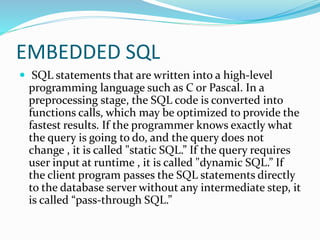
EMBEDDED SQL
 SQL statements that are written into a high-level
programming language such as C or Pascal. In a
preprocessing stage, the SQL code is converted into
functions calls, which may be optimized to provide the
fastest results. If the programmer knows exactly what
the query is going to do, and the query does not
change , it is called "static SQL.” If the query requires
user input at runtime , it is called "dynamic SQL.” If
the client program passes the SQL statements directly
to the database server without any intermediate step, it
is called “pass-through SQL.”
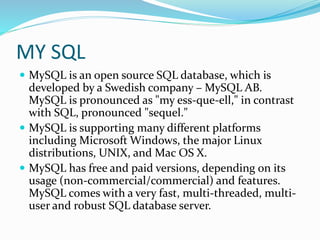
MY SQL
 MySQL is an open source SQL database, which is
developed by a Swedish company – MySQL AB.
MySQL is pronounced as "my ess-que-ell," in contrast
with SQL, pronounced "sequel."
 MySQL is supporting many different platforms
including Microsoft Windows, the major Linux
distributions, UNIX, and Mac OS X.
 MySQL has free and paid versions, depending on its
usage (non-commercial/commercial) and features.
MySQL comes with a very fast, multi-threaded, multi-
user and robust SQL database server.
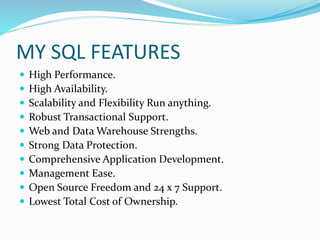
MY SQL FEATURES
 High Performance.
 High Availability.
 Scalability and Flexibility Run anything.
 Robust Transactional Support.
 Web and Data Warehouse Strengths.
 Strong Data Protection.
 Comprehensive Application Development.
 Management Ease.
 Open Source Freedom and 24 x 7 Support.
 Lowest Total Cost of Ownership.
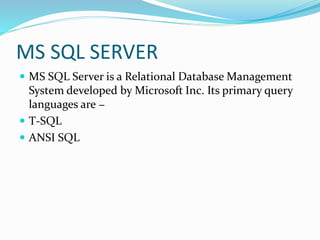
MS SQL SERVER
 MS SQL Server is a Relational Database Management
System developed by Microsoft Inc. Its primary query
languages are −
 T-SQL
 ANSI SQL
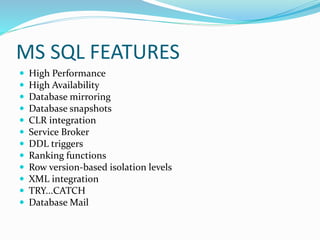
MS SQL FEATURES
 High Performance
 High Availability
 Database mirroring
 Database snapshots
 CLR integration
 Service Broker
 DDL triggers
 Ranking functions
 Row version-based isolation levels
 XML integration
 TRY...CATCH
 Database Mail
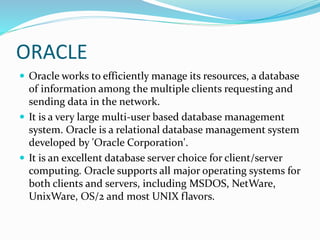
ORACLE
 Oracle works to efficiently manage its resources, a database
of information among the multiple clients requesting and
sending data in the network.
 It is a very large multi-user based database management
system. Oracle is a relational database management system
developed by 'Oracle Corporation'.
 It is an excellent database server choice for client/server
computing. Oracle supports all major operating systems for
both clients and servers, including MSDOS, NetWare,
UnixWare, OS/2 and most UNIX flavors.
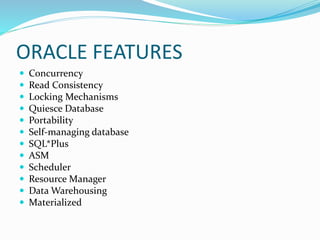
ORACLE FEATURES
 Concurrency
 Read Consistency
 Locking Mechanisms
 Quiesce Database
 Portability
 Self-managing database
 SQL*Plus
 ASM
 Scheduler
 Resource Manager
 Data Warehousing
 Materialized
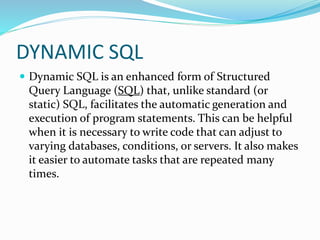
DYNAMIC SQL
 Dynamic SQL is an enhanced form of Structured
Query Language (SQL) that, unlike standard (or
static) SQL, facilitates the automatic generation and
execution of program statements. This can be helpful
when it is necessary to write code that can adjust to
varying databases, conditions, or servers. It also makes
it easier to automate tasks that are repeated many
times.

Sql

  • 1.
  • 2.
    DDL(Data Definition Language) DDL is short name of Data Definition Language, which deals with database schemas and descriptions, of how the data should reside in the database.  CREATE- to create a database and its objects like (table, index, views, store procedure, function, and triggers)  ALTER - alters the structure of the existing database  DROP - delete objects from the database  TRUNCATE - remove all records from a table, including all spaces allocated for the records are removed  COMMENT - add comments to the data dictionary  RENAME - rename an object
  • 3.
    EMBEDDED SQL  SQLstatements that are written into a high-level programming language such as C or Pascal. In a preprocessing stage, the SQL code is converted into functions calls, which may be optimized to provide the fastest results. If the programmer knows exactly what the query is going to do, and the query does not change , it is called "static SQL.” If the query requires user input at runtime , it is called "dynamic SQL.” If the client program passes the SQL statements directly to the database server without any intermediate step, it is called “pass-through SQL.”
  • 4.
    MY SQL  MySQLis an open source SQL database, which is developed by a Swedish company – MySQL AB. MySQL is pronounced as "my ess-que-ell," in contrast with SQL, pronounced "sequel."  MySQL is supporting many different platforms including Microsoft Windows, the major Linux distributions, UNIX, and Mac OS X.  MySQL has free and paid versions, depending on its usage (non-commercial/commercial) and features. MySQL comes with a very fast, multi-threaded, multi- user and robust SQL database server.
  • 5.
    MY SQL FEATURES High Performance.  High Availability.  Scalability and Flexibility Run anything.  Robust Transactional Support.  Web and Data Warehouse Strengths.  Strong Data Protection.  Comprehensive Application Development.  Management Ease.  Open Source Freedom and 24 x 7 Support.  Lowest Total Cost of Ownership.
  • 6.
    MS SQL SERVER MS SQL Server is a Relational Database Management System developed by Microsoft Inc. Its primary query languages are −  T-SQL  ANSI SQL
  • 7.
    MS SQL FEATURES High Performance  High Availability  Database mirroring  Database snapshots  CLR integration  Service Broker  DDL triggers  Ranking functions  Row version-based isolation levels  XML integration  TRY...CATCH  Database Mail
  • 8.
    ORACLE  Oracle worksto efficiently manage its resources, a database of information among the multiple clients requesting and sending data in the network.  It is a very large multi-user based database management system. Oracle is a relational database management system developed by 'Oracle Corporation'.  It is an excellent database server choice for client/server computing. Oracle supports all major operating systems for both clients and servers, including MSDOS, NetWare, UnixWare, OS/2 and most UNIX flavors.
  • 9.
    ORACLE FEATURES  Concurrency Read Consistency  Locking Mechanisms  Quiesce Database  Portability  Self-managing database  SQL*Plus  ASM  Scheduler  Resource Manager  Data Warehousing  Materialized
  • 10.
    DYNAMIC SQL  DynamicSQL is an enhanced form of Structured Query Language (SQL) that, unlike standard (or static) SQL, facilitates the automatic generation and execution of program statements. This can be helpful when it is necessary to write code that can adjust to varying databases, conditions, or servers. It also makes it easier to automate tasks that are repeated many times.