By
T.Manikandan


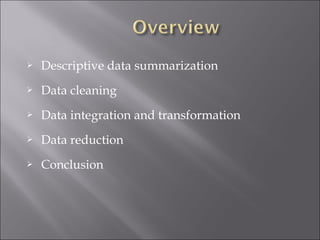
Descriptive data summarization



Data cleaning



Data integration and transformation



Data reduction



Conclusion


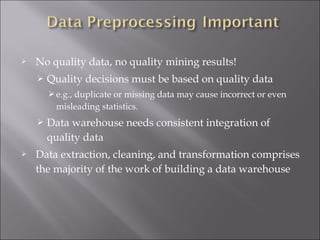
No quality data, no quality mining results!


Quality decisions must be based on quality data
 e.g., duplicate or missing data may cause incorrect or even

misleading statistics.




Data warehouse needs consistent integration of
quality data

Data extraction, cleaning, and transformation comprises
the majority of the work of building a data warehouse




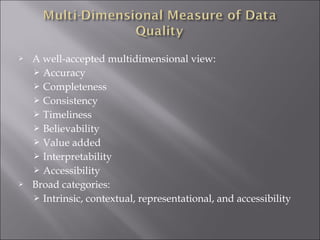
A well-accepted multidimensional view:
 Accuracy
 Completeness
 Consistency
 Timeliness
 Believability
 Value added
 Interpretability
 Accessibility
Broad categories:
 Intrinsic, contextual, representational, and accessibility


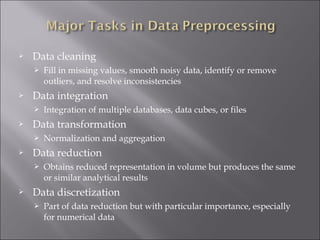
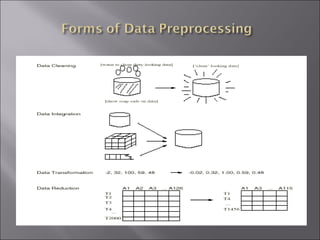
Data cleaning




Data integration




Normalization and aggregation

Data reduction




Integration of multiple databases, data cubes, or files

Data transformation




Fill in missing values, smooth noisy data, identify or remove
outliers, and resolve inconsistencies

Obtains reduced representation in volume but produces the same
or similar analytical results

Data discretization


Part of data reduction but with particular importance, especially
for numerical data


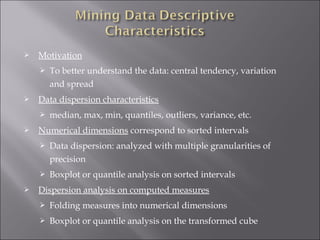
Motivation




Data dispersion characteristics




To better understand the data: central tendency, variation
and spread
median, max, min, quantiles, outliers, variance, etc.

Numerical dimensions correspond to sorted intervals





Data dispersion: analyzed with multiple granularities of
precision
Boxplot or quantile analysis on sorted intervals

Dispersion analysis on computed measures


Folding measures into numerical dimensions



Boxplot or quantile analysis on the transformed cube


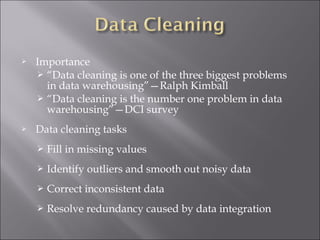
Importance
 “Data cleaning is one of the three biggest problems
in data warehousing”—Ralph Kimball
 “Data cleaning is the number one problem in data
warehousing”—DCI survey



Data cleaning tasks


Fill in missing values



Identify outliers and smooth out noisy data



Correct inconsistent data



Resolve redundancy caused by data integration


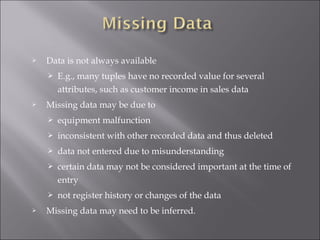
Data is not always available




E.g., many tuples have no recorded value for several
attributes, such as customer income in sales data

Missing data may be due to



inconsistent with other recorded data and thus deleted



data not entered due to misunderstanding



certain data may not be considered important at the time of
entry




equipment malfunction

not register history or changes of the data

Missing data may need to be inferred.


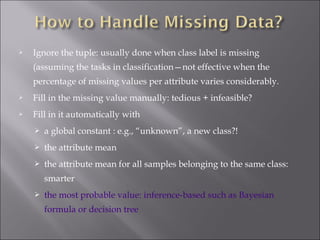
Ignore the tuple: usually done when class label is missing
(assuming the tasks in classification—not effective when the
percentage of missing values per attribute varies considerably.



Fill in the missing value manually: tedious + infeasible?



Fill in it automatically with


a global constant : e.g., “unknown”, a new class?!



the attribute mean



the attribute mean for all samples belonging to the same class:
smarter



the most probable value: inference-based such as Bayesian
formula or decision tree





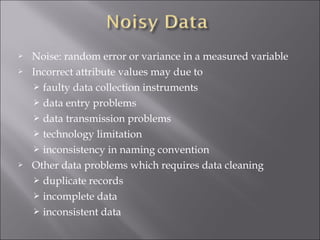
Noise: random error or variance in a measured variable
Incorrect attribute values may due to
 faulty data collection instruments
 data entry problems
 data transmission problems
 technology limitation
 inconsistency in naming convention
Other data problems which requires data cleaning
 duplicate records
 incomplete data
 inconsistent data








Binning
 first sort data and partition into (equal-frequency)
bins
 then one can smooth by bin means, smooth by bin
median, smooth by bin boundaries, etc.
Regression
 smooth by fitting the data into regression functions
Clustering
 detect and remove outliers
Combined computer and human inspection
 detect suspicious values and check by human (e.g.,
deal with possible outliers)


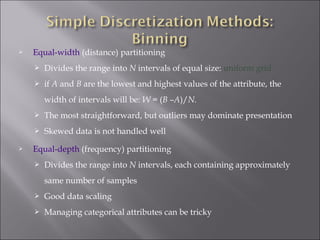
Equal-width (distance) partitioning


Divides the range into N intervals of equal size: uniform grid



if A and B are the lowest and highest values of the attribute, the
width of intervals will be: W = (B –A)/N.





The most straightforward, but outliers may dominate presentation
Skewed data is not handled well

Equal-depth (frequency) partitioning


Divides the range into N intervals, each containing approximately
same number of samples



Good data scaling



Managing categorical attributes can be tricky
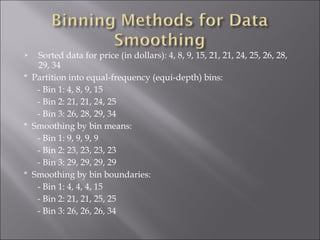
Sorted data for price (in dollars): 4, 8, 9, 15, 21, 21, 24, 25, 26, 28,
29, 34
* Partition into equal-frequency (equi-depth) bins:
- Bin 1: 4, 8, 9, 15
- Bin 2: 21, 21, 24, 25
- Bin 3: 26, 28, 29, 34
* Smoothing by bin means:
- Bin 1: 9, 9, 9, 9
- Bin 2: 23, 23, 23, 23
- Bin 3: 29, 29, 29, 29
* Smoothing by bin boundaries:
- Bin 1: 4, 4, 4, 15
- Bin 2: 21, 21, 25, 25
- Bin 3: 26, 26, 26, 34









Data integration:
 Combines data from multiple sources into a coherent
store
Schema integration: e.g., A.cust-id ≡ B.cust-#
 Integrate metadata from different sources
Entity identification problem:
 Identify real world entities from multiple data sources,
e.g., Bill Clinton = William Clinton
Detecting and resolving data value conflicts
 For the same real world entity, attribute values from
different sources are different
 Possible reasons: different representations, different
scales, e.g., metric vs. British units


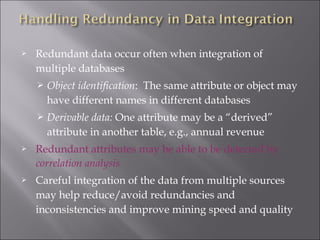
Redundant data occur often when integration of
multiple databases


Object identification: The same attribute or object may
have different names in different databases



Derivable data: One attribute may be a “derived”
attribute in another table, e.g., annual revenue



Redundant attributes may be able to be detected by
correlation analysis



Careful integration of the data from multiple sources
may help reduce/avoid redundancies and
inconsistencies and improve mining speed and quality


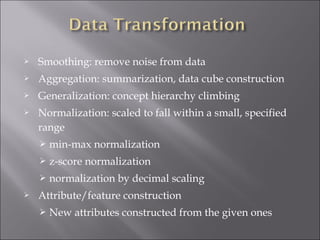
Smoothing: remove noise from data



Aggregation: summarization, data cube construction



Generalization: concept hierarchy climbing



Normalization: scaled to fall within a small, specified
range



z-score normalization




min-max normalization
normalization by decimal scaling

Attribute/feature construction


New attributes constructed from the given ones






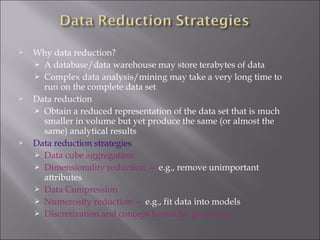
Why data reduction?
 A database/data warehouse may store terabytes of data
 Complex data analysis/mining may take a very long time to
run on the complete data set
Data reduction
 Obtain a reduced representation of the data set that is much
smaller in volume but yet produce the same (or almost the
same) analytical results
Data reduction strategies
 Data cube aggregation:
 Dimensionality reduction — e.g., remove unimportant
attributes
 Data Compression
 Numerosity reduction — e.g., fit data into models
 Discretization and concept hierarchy generation


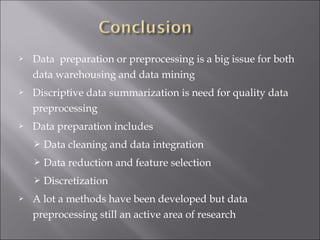
Data preparation or preprocessing is a big issue for both
data warehousing and data mining



Discriptive data summarization is need for quality data
preprocessing



Data preparation includes



Data reduction and feature selection




Data cleaning and data integration
Discretization

A lot a methods have been developed but data
preprocessing still an active area of research

Data preprocessing

  • 1.
  • 2.
     Descriptive data summarization  Datacleaning  Data integration and transformation  Data reduction  Conclusion
  • 3.
     No quality data,no quality mining results!  Quality decisions must be based on quality data  e.g., duplicate or missing data may cause incorrect or even misleading statistics.   Data warehouse needs consistent integration of quality data Data extraction, cleaning, and transformation comprises the majority of the work of building a data warehouse
  • 4.
      A well-accepted multidimensionalview:  Accuracy  Completeness  Consistency  Timeliness  Believability  Value added  Interpretability  Accessibility Broad categories:  Intrinsic, contextual, representational, and accessibility
  • 5.
     Data cleaning   Data integration   Normalizationand aggregation Data reduction   Integration of multiple databases, data cubes, or files Data transformation   Fill in missing values, smooth noisy data, identify or remove outliers, and resolve inconsistencies Obtains reduced representation in volume but produces the same or similar analytical results Data discretization  Part of data reduction but with particular importance, especially for numerical data
  • 7.
     Motivation   Data dispersion characteristics   Tobetter understand the data: central tendency, variation and spread median, max, min, quantiles, outliers, variance, etc. Numerical dimensions correspond to sorted intervals    Data dispersion: analyzed with multiple granularities of precision Boxplot or quantile analysis on sorted intervals Dispersion analysis on computed measures  Folding measures into numerical dimensions  Boxplot or quantile analysis on the transformed cube
  • 8.
     Importance  “Data cleaningis one of the three biggest problems in data warehousing”—Ralph Kimball  “Data cleaning is the number one problem in data warehousing”—DCI survey  Data cleaning tasks  Fill in missing values  Identify outliers and smooth out noisy data  Correct inconsistent data  Resolve redundancy caused by data integration
  • 9.
     Data is notalways available   E.g., many tuples have no recorded value for several attributes, such as customer income in sales data Missing data may be due to   inconsistent with other recorded data and thus deleted  data not entered due to misunderstanding  certain data may not be considered important at the time of entry   equipment malfunction not register history or changes of the data Missing data may need to be inferred.
  • 10.
     Ignore the tuple:usually done when class label is missing (assuming the tasks in classification—not effective when the percentage of missing values per attribute varies considerably.  Fill in the missing value manually: tedious + infeasible?  Fill in it automatically with  a global constant : e.g., “unknown”, a new class?!  the attribute mean  the attribute mean for all samples belonging to the same class: smarter  the most probable value: inference-based such as Bayesian formula or decision tree
  • 11.
       Noise: random erroror variance in a measured variable Incorrect attribute values may due to  faulty data collection instruments  data entry problems  data transmission problems  technology limitation  inconsistency in naming convention Other data problems which requires data cleaning  duplicate records  incomplete data  inconsistent data
  • 12.
        Binning  first sortdata and partition into (equal-frequency) bins  then one can smooth by bin means, smooth by bin median, smooth by bin boundaries, etc. Regression  smooth by fitting the data into regression functions Clustering  detect and remove outliers Combined computer and human inspection  detect suspicious values and check by human (e.g., deal with possible outliers)
  • 13.
     Equal-width (distance) partitioning  Dividesthe range into N intervals of equal size: uniform grid  if A and B are the lowest and highest values of the attribute, the width of intervals will be: W = (B –A)/N.    The most straightforward, but outliers may dominate presentation Skewed data is not handled well Equal-depth (frequency) partitioning  Divides the range into N intervals, each containing approximately same number of samples  Good data scaling  Managing categorical attributes can be tricky
  • 14.
    Sorted data forprice (in dollars): 4, 8, 9, 15, 21, 21, 24, 25, 26, 28, 29, 34 * Partition into equal-frequency (equi-depth) bins: - Bin 1: 4, 8, 9, 15 - Bin 2: 21, 21, 24, 25 - Bin 3: 26, 28, 29, 34 * Smoothing by bin means: - Bin 1: 9, 9, 9, 9 - Bin 2: 23, 23, 23, 23 - Bin 3: 29, 29, 29, 29 * Smoothing by bin boundaries: - Bin 1: 4, 4, 4, 15 - Bin 2: 21, 21, 25, 25 - Bin 3: 26, 26, 26, 34 
  • 15.
        Data integration:  Combinesdata from multiple sources into a coherent store Schema integration: e.g., A.cust-id ≡ B.cust-#  Integrate metadata from different sources Entity identification problem:  Identify real world entities from multiple data sources, e.g., Bill Clinton = William Clinton Detecting and resolving data value conflicts  For the same real world entity, attribute values from different sources are different  Possible reasons: different representations, different scales, e.g., metric vs. British units
  • 16.
     Redundant data occuroften when integration of multiple databases  Object identification: The same attribute or object may have different names in different databases  Derivable data: One attribute may be a “derived” attribute in another table, e.g., annual revenue  Redundant attributes may be able to be detected by correlation analysis  Careful integration of the data from multiple sources may help reduce/avoid redundancies and inconsistencies and improve mining speed and quality
  • 17.
     Smoothing: remove noisefrom data  Aggregation: summarization, data cube construction  Generalization: concept hierarchy climbing  Normalization: scaled to fall within a small, specified range   z-score normalization   min-max normalization normalization by decimal scaling Attribute/feature construction  New attributes constructed from the given ones
  • 18.
       Why data reduction? A database/data warehouse may store terabytes of data  Complex data analysis/mining may take a very long time to run on the complete data set Data reduction  Obtain a reduced representation of the data set that is much smaller in volume but yet produce the same (or almost the same) analytical results Data reduction strategies  Data cube aggregation:  Dimensionality reduction — e.g., remove unimportant attributes  Data Compression  Numerosity reduction — e.g., fit data into models  Discretization and concept hierarchy generation
  • 19.
     Data preparation orpreprocessing is a big issue for both data warehousing and data mining  Discriptive data summarization is need for quality data preprocessing  Data preparation includes   Data reduction and feature selection   Data cleaning and data integration Discretization A lot a methods have been developed but data preprocessing still an active area of research