PROCESS
IMPROVEMENT
By,
K.B.SNEGA.,M.SC(CS).,
NADAR SARASWATHI COLLEGE OF ARTS
AND SCIENCE,THENI.
WHAT IS SPI ?
 Understanding existing processes.
 Introducing process changes to achieve
organisational objectives which are usually
focused on quality improvement, cost
reduction and schedule acceleration Most
process improvement work so far has focused
on defect reduction. This reflects the
increasing attention paid by industry to quality.
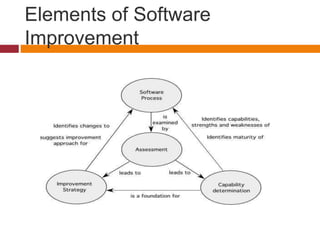
Software Improvement Cycle
Elements of Software
Improvement
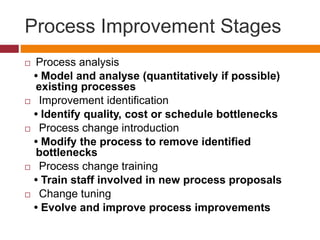
Process Improvement Stages
 Process analysis
• Model and analyse (quantitatively if possible)
existing processes
 Improvement identification
• Identify quality, cost or schedule bottlenecks
 Process change introduction
• Modify the process to remove identified
bottlenecks
 Process change training
• Train staff involved in new process proposals
 Change tuning
• Evolve and improve process improvements
Process and Product Quality
 Process quality and product quality are closely
related.
 A good process is usually required to produce
a good product.
 For manufactured goods, process is the
principal quality determinant.
 For design-based activity, other factors are
also involved especially the capabilities of the
designers.
Quality Factor
 For large projects with ‘average’ capabilities,
the development process determines product
quality.
 For small projects, the capabilities of the
developers is the main determinant.
 The development technology is particularly
significant for small projects.
 In all cases, if an unrealistic schedule is
imposed
then product quality will suffer.
Process Analysis Techniques
 Published process models and process
standards--
• It is always best to start process analysis with
an existing model. People then may extend and
change this.
 Questionnaires and interviews--
• Must be carefully designed. Participants may
tell you what they think you want to hear
 Ethnographic analysis--
• Involves assimilating process knowledge by
observation
Improvement Model Problem
 It focuses on project management rather than
product development.
 It ignores the use of technologies such as
rapid prototyping.
 It does not incorporate risk analysis as a key
process area.
 It does not define its domain of applicability.
Process improvement

Process improvement

  • 1.
  • 2.
    WHAT IS SPI?  Understanding existing processes.  Introducing process changes to achieve organisational objectives which are usually focused on quality improvement, cost reduction and schedule acceleration Most process improvement work so far has focused on defect reduction. This reflects the increasing attention paid by industry to quality.
  • 3.
  • 4.
  • 5.
    Process Improvement Stages Process analysis • Model and analyse (quantitatively if possible) existing processes  Improvement identification • Identify quality, cost or schedule bottlenecks  Process change introduction • Modify the process to remove identified bottlenecks  Process change training • Train staff involved in new process proposals  Change tuning • Evolve and improve process improvements
  • 6.
    Process and ProductQuality  Process quality and product quality are closely related.  A good process is usually required to produce a good product.  For manufactured goods, process is the principal quality determinant.  For design-based activity, other factors are also involved especially the capabilities of the designers.
  • 7.
    Quality Factor  Forlarge projects with ‘average’ capabilities, the development process determines product quality.  For small projects, the capabilities of the developers is the main determinant.  The development technology is particularly significant for small projects.  In all cases, if an unrealistic schedule is imposed then product quality will suffer.
  • 8.
    Process Analysis Techniques Published process models and process standards-- • It is always best to start process analysis with an existing model. People then may extend and change this.  Questionnaires and interviews-- • Must be carefully designed. Participants may tell you what they think you want to hear  Ethnographic analysis-- • Involves assimilating process knowledge by observation
  • 9.
    Improvement Model Problem It focuses on project management rather than product development.  It ignores the use of technologies such as rapid prototyping.  It does not incorporate risk analysis as a key process area.  It does not define its domain of applicability.