Lecture 2
Chapter-01
Discrete-Event System Simulation
-Jerry Banks
System, model & simulation
1
Systems and System Environment
System
 defined as a group of objects that are joined together in
some regular interaction or interdependence toward the
accomplishment of some purpose.
System Environment
 changes occurring outside the system.
The decision on the boundary between the system and its
environment may depend on the purpose of the study.
2
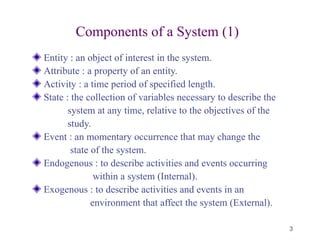
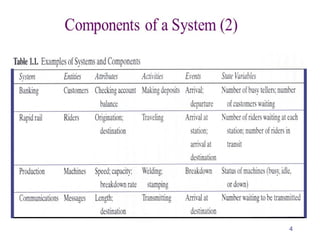
Components of a System (1)
Entity : an object of interest in the system.
Attribute : a property of an entity.
Activity : a time period of specified length.
State : the collection of variables necessary to describe the
system at any time, relative to the objectives of the
study.
Event : an momentary occurrence that may change the
state of the system.
Endogenous : to describe activities and events occurring
within a system (Internal).
Exogenous : to describe activities and events in an
environment that affect the system (External).
3
Components of a System (2)
4
Discrete and Continuous Systems
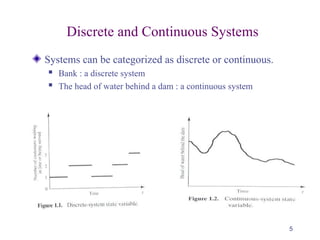
Systems can be categorized as discrete or continuous.
 Bank : a discrete system
 The head of water behind a dam : a continuous system
5
Model of a System
Model
 a representation of a system for the purpose of studying
the system
 a simplification of the system
 sufficiently detailed to permit valid conclusions to be
drawn about the real system
6
Types of Models
Static or Dynamic Simulation Models
 Static simulation model (called Monte Carlo simulation)
represents a system at a particular point in time.
 Dynamic simulation model represents systems as they change
over time.
Deterministic or Stochastic Simulation Models
 Deterministic simulation models contain no random variables
and have a known set of inputs which will result in a unique set
of outputs.
 Stochastic simulation model has one or more random variables as
inputs. Random inputs lead to random outputs.
The model of interest in this class is discrete, dynamic, and
stochastic.
7
Discrete-Event System Simulation
The simulation models are analyzed by numerical rather
than by analytical methods.
 Analytical methods employ the deductive reasoning of
mathematics to solve the model.
 Numerical methods employ computational procedures
to solve mathematical models.
8
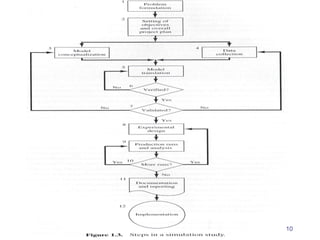
Let us see a flow chart, which will describe the
steps followed in a simulation study.
(in the next slide)
9
10
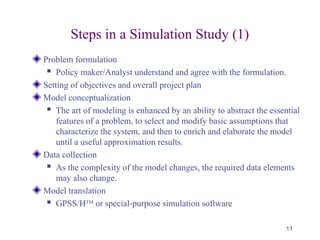
Problem formulation
 Policy maker/Analyst understand and agree with the formulation.
Setting of objectives and overall project plan
Model conceptualization
 The art of modeling is enhanced by an ability to abstract the essential
features of a problem, to select and modify basic assumptions that
characterize the system, and then to enrich and elaborate the model
until a useful approximation results.
Data collection
 As the complexity of the model changes, the required data elements
may also change.
Model translation
 GPSS/HTM
or special-purpose simulation software
Steps in a Simulation Study (1)
11
Steps in a Simulation Study (2)
Verified?
 Is the computer program performing properly?
 Debugging for correct input parameters and logical structure
Validated?
 The determination that a model is an accurate representation of the
real system.
 Validation is achieved through the calibration of the model
Experimental design
 The decision on the length of the initialization period, the length of
simulation runs, and the number of replications to be made of each
run.
Production runs and analysis
 To estimate measures of performances
12
Steps in a Simulation Study (3)
More runs?
Documentation and reporting
 Program documentation : for the relationships between
input parameters and output measures of performance,
and for a modification.
 Progress documentation : the history of a simulation, a
chronology of work done and decision made.
Implementation
13
Steps in a Simulation Study (4)
Four phases according to Figure 1.3
 First phase : a period of discovery or orientation
(step 1, step2)
 Second phase : a model building and data collection
(step 3, step 4, step 5, step 6, step 7)
 Third phase : running the model
(step 8, step 9, step 10)
 Fourth phase : an implementation
(step 11, step 12)
14
The End
15

Lecture 2 - System, model simulation.ppt

  • 1.
    Lecture 2 Chapter-01 Discrete-Event SystemSimulation -Jerry Banks System, model & simulation 1
  • 2.
    Systems and SystemEnvironment System  defined as a group of objects that are joined together in some regular interaction or interdependence toward the accomplishment of some purpose. System Environment  changes occurring outside the system. The decision on the boundary between the system and its environment may depend on the purpose of the study. 2
  • 3.
    Components of aSystem (1) Entity : an object of interest in the system. Attribute : a property of an entity. Activity : a time period of specified length. State : the collection of variables necessary to describe the system at any time, relative to the objectives of the study. Event : an momentary occurrence that may change the state of the system. Endogenous : to describe activities and events occurring within a system (Internal). Exogenous : to describe activities and events in an environment that affect the system (External). 3
  • 4.
    Components of aSystem (2) 4
  • 5.
    Discrete and ContinuousSystems Systems can be categorized as discrete or continuous.  Bank : a discrete system  The head of water behind a dam : a continuous system 5
  • 6.
    Model of aSystem Model  a representation of a system for the purpose of studying the system  a simplification of the system  sufficiently detailed to permit valid conclusions to be drawn about the real system 6
  • 7.
    Types of Models Staticor Dynamic Simulation Models  Static simulation model (called Monte Carlo simulation) represents a system at a particular point in time.  Dynamic simulation model represents systems as they change over time. Deterministic or Stochastic Simulation Models  Deterministic simulation models contain no random variables and have a known set of inputs which will result in a unique set of outputs.  Stochastic simulation model has one or more random variables as inputs. Random inputs lead to random outputs. The model of interest in this class is discrete, dynamic, and stochastic. 7
  • 8.
    Discrete-Event System Simulation Thesimulation models are analyzed by numerical rather than by analytical methods.  Analytical methods employ the deductive reasoning of mathematics to solve the model.  Numerical methods employ computational procedures to solve mathematical models. 8
  • 9.
    Let us seea flow chart, which will describe the steps followed in a simulation study. (in the next slide) 9
  • 10.
  • 11.
    Problem formulation  Policymaker/Analyst understand and agree with the formulation. Setting of objectives and overall project plan Model conceptualization  The art of modeling is enhanced by an ability to abstract the essential features of a problem, to select and modify basic assumptions that characterize the system, and then to enrich and elaborate the model until a useful approximation results. Data collection  As the complexity of the model changes, the required data elements may also change. Model translation  GPSS/HTM or special-purpose simulation software Steps in a Simulation Study (1) 11
  • 12.
    Steps in aSimulation Study (2) Verified?  Is the computer program performing properly?  Debugging for correct input parameters and logical structure Validated?  The determination that a model is an accurate representation of the real system.  Validation is achieved through the calibration of the model Experimental design  The decision on the length of the initialization period, the length of simulation runs, and the number of replications to be made of each run. Production runs and analysis  To estimate measures of performances 12
  • 13.
    Steps in aSimulation Study (3) More runs? Documentation and reporting  Program documentation : for the relationships between input parameters and output measures of performance, and for a modification.  Progress documentation : the history of a simulation, a chronology of work done and decision made. Implementation 13
  • 14.
    Steps in aSimulation Study (4) Four phases according to Figure 1.3  First phase : a period of discovery or orientation (step 1, step2)  Second phase : a model building and data collection (step 3, step 4, step 5, step 6, step 7)  Third phase : running the model (step 8, step 9, step 10)  Fourth phase : an implementation (step 11, step 12) 14
  • 15.