Chapter 2 Simulation Examples
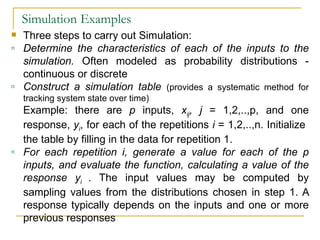
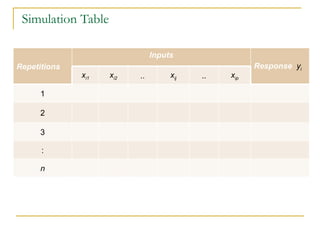
Simulation Examples Three steps to carry out Simulation: Determine the characteristics of each of the inputs to the simulation.  Often modeled as probability distributions - continuous or discrete Construct a simulation table  (provides a systematic method for tracking system state over time)  Example: there are  p  inputs,  x ij , j  = 1,2,..,p, and one response,  y i , for each of the repetitions  i  = 1,2,..,n. Initialize  the table by filling in the data for repetition 1. For each repetition i, generate a value for each of the p inputs, and evaluate the function, calculating a value of the response y i  . The input values may be computed by sampling values from the distributions chosen in step 1. A response typically depends on the inputs and one or more previous responses
Simulation Table Repetitions Inputs Response  y i x i1 x i2 .. x ij .. x ip 1 2 3 : n
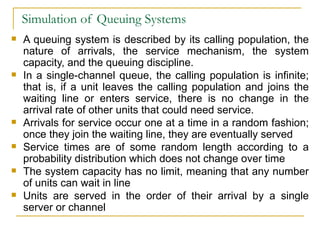
Simulation of Queuing Systems A queuing system is described by its calling population, the nature of arrivals, the service mechanism, the system capacity, and the queuing discipline. In a single-channel queue, the calling population is infinite; that is, if a unit leaves the calling population and joins the waiting line or enters service, there is no change in the arrival rate of other units that could need service. Arrivals for service occur one at a time in a random fashion; once they join the waiting line, they are eventually served Service times are of some random length according to a probability distribution which does not change over time The system capacity has no limit, meaning that any number of units can wait in line Units are served in the order of their arrival by a single server or channel
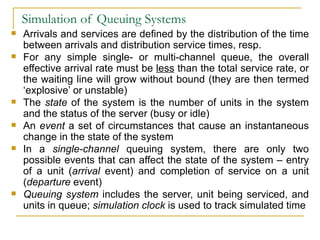
Simulation of Queuing Systems Arrivals and services are defined by the distribution of the time between arrivals and distribution service times, resp. For any simple single- or multi-channel queue, the overall effective arrival rate must be  less  than the total service rate, or the waiting line will grow without bound (they are then termed ‘explosive’ or unstable) The  state  of the system is the number of units in the system and the status of the server (busy or idle) An  event  a set of circumstances that cause an instantaneous change in the state of the system In a  single-channel  queuing system, there are only two possible events that can affect the state of the system – entry of a unit ( arrival  event) and completion of service on a unit ( departure  event) Queuing system  includes the server, unit being serviced, and units in queue;  simulation clock  is used to track simulated time
Simulation of Queuing Systems Service just completed  flow diagram   No   Yes If unit has just completed service, simulation proceeds as above: [Departure event occurs when unit completes service] Server has only two possible states – busy or idle Departure event Another unit waiting?  Begin Server idle time Remove waiting unit from queue Begin servicing the unit
Simulation of Queuing Systems Unit entering system  flow diagram   No   Yes If unit has just entered the system, simulation proceeds as above: [Arrival event occurs when unit enters system] Unit will find server either busy/idle; unit begins service immediately or enters queue for server It is not possible for server to be idle while queue is nonempty Arrival  event Server Busy? Unit enters service Unit enters queue for service
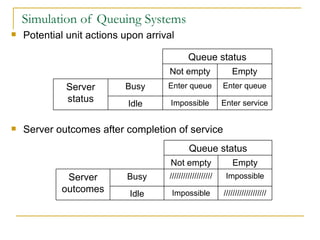
Simulation of Queuing Systems Potential unit actions upon arrival Server outcomes after completion of service Queue status Not empty Empty Server status Busy Enter queue Enter queue Idle Impossible Enter service Queue status Not empty Empty Server outcomes Busy /////////////////// Impossible Idle Impossible ///////////////////
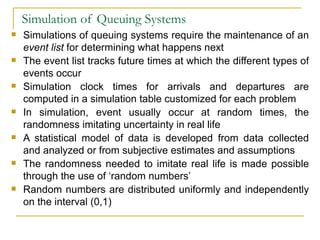
Simulation of Queuing Systems Simulations of queuing systems require the maintenance of an  event list  for determining what happens next The event list tracks future times at which the different types of events occur Simulation clock times for arrivals and departures are computed in a simulation table customized for each problem In simulation, event usually occur at random times, the randomness imitating uncertainty in real life A statistical model of data is developed from data collected and analyzed or from subjective estimates and assumptions The randomness needed to imitate real life is made possible through the use of ‘random numbers’ Random numbers are distributed uniformly and independently on the interval (0,1)
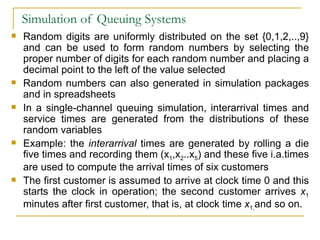
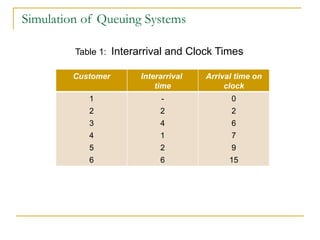
Simulation of Queuing Systems Random digits are uniformly distributed on the set {0,1,2,..,9} and can be used to form random numbers by selecting the proper number of digits for each random number and placing a decimal point to the left of the value selected Random numbers can also generated in simulation packages and in spreadsheets In a single-channel queuing simulation, interarrival times and service times are generated from the distributions of these random variables Example: the  interarrival  times are generated by rolling a die five times and recording them (x 1 ,x 2 ..x 5 ) and these five i.a.times are used to compute the arrival times of six customers  The first customer is assumed to arrive at clock time 0 and this starts the clock in operation; the second customer arrives  x 1  minutes after first customer, that is, at clock time  x 1, and so on.
Simulation of Queuing Systems Table 1:  Interarrival and Clock Times Customer Interarrival  time Arrival time on clock 1 2 3 4 5 6 - 2 4 1 2 6 0 2 6 7 9 15
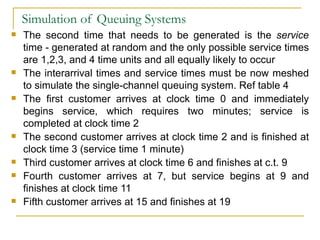
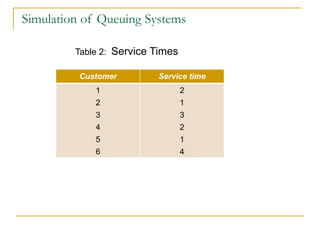
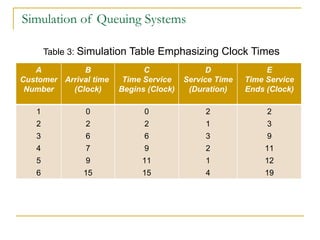
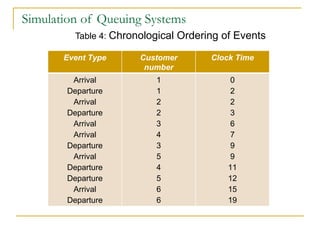
Simulation of Queuing Systems The second time that needs to be generated is the  service  time - generated at random and the only possible service times are 1,2,3, and 4 time units and all equally likely to occur The interarrival times and service times must be now meshed to simulate the single-channel queuing system. Ref table 4 The first customer arrives at clock time 0 and immediately begins service, which requires two minutes; service is completed at clock time 2 The second customer arrives at clock time 2 and is finished at clock time 3 (service time 1 minute) Third customer arrives at clock time 6 and finishes at c.t. 9 Fourth customer arrives at 7, but service begins at 9 and finishes at clock time 11 Fifth customer arrives at 15 and finishes at 19
Simulation of Queuing Systems Table 2:  Service Times Customer Service time 1 2 3 4 5 6 2 1 3 2 1 4
Simulation of Queuing Systems Table 3:  Simulation Table Emphasizing Clock Times A Customer Number B Arrival time  (Clock) C Time Service Begins (Clock) D Service Time (Duration) E Time Service Ends (Clock) 1 2 3 4 5 6 0 2 6 7 9 15 0 2 6 9 11 15 2 1 3 2 1 4 2 3 9 11 12 19
Simulation of Queuing Systems Table 4:  Chronological Ordering of Events Event Type Customer number Clock Time Arrival Departure Arrival Departure Arrival Arrival Departure Arrival Departure Departure Arrival Departure 1 1 2 2 3 4 3 5 4 5 6 6 0 2 2 3 6 7 9 9 11 12 15 19
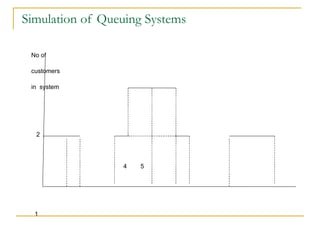
Simulation of Queuing Systems No of customers in  system 2 4  5 1   1  2  3  4  5  6 0  1  2  3   4  5  6  7  8  9  10  11  12  13  14  15  16  17  18  19  20   Figure 1:  Clock Time
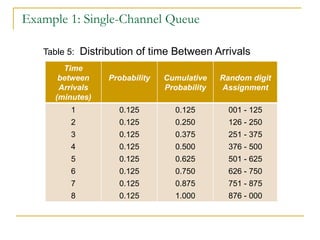
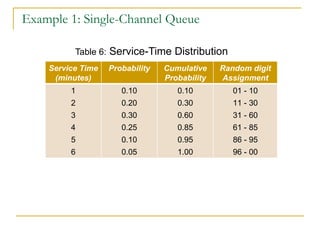
Example 1: Single-Channel Queue A small grocery store has one checkout counter Customers arrive at this checkout counter at random time fro 1 to 8 minutes apart Each possible value of interarrival time has the same probability of occurrence. Ref. table 5 Service time varies from 1 to 6 minutes, with probabilities shown in table 6 Problem is to analyze the system by simulating the arrival and service of 100 customers A set of uniformly distributed random numbers is needed to generate the arrivals at the checkout counter These random numbers have the following properties: It is uniformly distributed between 0 and 1 Successive random numbers are independent
Example 1: Single-Channel Queue Table 5:  Distribution of time Between Arrivals Time between Arrivals (minutes) Probability Cumulative Probability Random digit Assignment 1 2 3 4 5 6 7 8 0.125 0.125 0.125 0.125 0.125 0.125 0.125 0.125 0.125 0.250 0.375 0.500 0.625 0.750 0.875 1.000 001 - 125 126 - 250 251 - 375 376 - 500 501 - 625 626 - 750 751 - 875 876 - 000
Example 1: Single-Channel Queue Table 6:  Service-Time Distribution Service Time (minutes) Probability Cumulative Probability Random digit Assignment 1 2 3 4 5 6 0.10 0.20 0.30 0.25 0.10 0.05 0.10 0.30 0.60 0.85 0.95 1.00 01 - 10 11 - 30 31 - 60 61 - 85 86 - 95 96 - 00
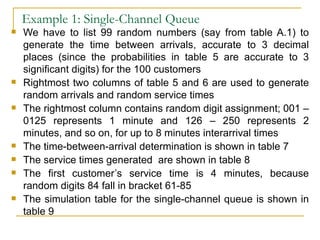
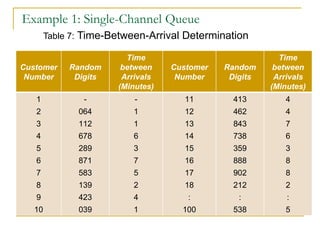
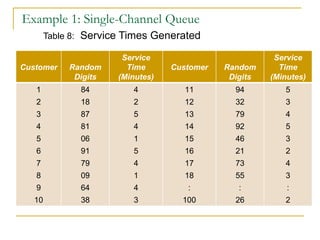
Example 1: Single-Channel Queue We have to list 99 random numbers (say from table A.1) to generate the time between arrivals, accurate to 3 decimal places (since the probabilities in table 5 are accurate to 3 significant digits) for the 100 customers Rightmost two columns of table 5 and 6 are used to generate random arrivals and random service times The rightmost column contains random digit assignment; 001 – 0125 represents 1 minute and 126 – 250 represents 2 minutes, and so on, for up to 8 minutes interarrival times The time-between-arrival determination is shown in table 7 The service times generated  are shown in table 8  The first customer’s service time is 4 minutes, because random digits 84 fall in bracket 61-85 The simulation table for the single-channel queue is shown in table 9
Example 1: Single-Channel Queue Table 7:  Time-Between-Arrival Determination Customer Number Random Digits Time between Arrivals (Minutes) Customer Number Random Digits Time between Arrivals (Minutes) 1 2 3 4 5 6 7 8 9 10 - 064 112 678 289 871 583 139 423 039 - 1 1 6 3 7 5 2 4 1 11 12 13 14 15 16 17 18 : 100 413 462 843 738 359 888 902 212 : 538 4 4 7 6 3 8 8 2 : 5
Example 1: Single-Channel Queue Table 8:   Service Times Generated Customer Random Digits Service Time (Minutes) Customer Random Digits Service Time (Minutes) 1 2 3 4 5 6 7 8 9 10 84 18 87 81 06 91 79 09 64 38 4 2 5 4 1 5 4 1 4 3 11 12 13 14 15 16 17 18 : 100 94 32 79 92 46 21 73 55 : 26 5 3 4 5 3 2 4 3 : 2
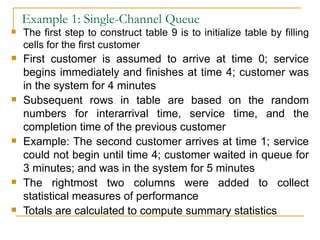
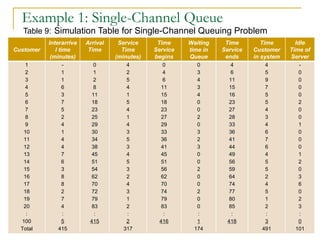
Example 1: Single-Channel Queue The first step to construct table 9 is to initialize table by filling cells for the first customer First customer is assumed to arrive at time 0; service begins immediately and finishes at time 4; customer was in the system for 4 minutes Subsequent rows in table are based on the random numbers for interarrival time, service time, and the completion time of the previous customer Example: The second customer arrives at time 1; service could not begin until time 4; customer waited in queue for 3 minutes; and was in the system for 5 minutes The rightmost two columns were added to collect statistical measures of performance Totals are calculated to compute summary statistics
Example 1: Single-Channel Queue Table 9:   Simulation Table for Single-Channel Queuing Problem Customer Interarrival time (minutes) Arrival Time Service Time (minutes) Time Service begins Waiting time in Queue Time Service ends Time Customer in system Idle Time of Server 1 2 3 4 5 6 7 8 9 10 11 12 13 14 15 16 17 18 19 20 : 100 Total - 1 1 6 3 7 5 2 4 1 4 4 7 6 3 8 8 2 7 4 : 5 415 0 1 2 8 11 18 23 25 29 30 34 38 45 51 54 62 70 72 79 83 : 415 4 2 5 4 1 5 4 1 4 3 5 3 4 5 3 2 4 3 1 2 : 2 317 0 4 6 11 15 18 23 27 29 33 36 41 45 51 56 62 70 74 79 83 : 416 0 3 4 3 4 0 0 2 0 3 2 3 0 0 2 0 0 2 0 0 : 1 174 4 6 11 15 16 23 27 28 33 36 41 44 49 56 59 64 74 77 80 85 : 418 4 5 9 7 5 5 4 3 4 6 7 6 4 5 5 2 4 5 1 2 : 3 491 - 0 0 0 0 2 0 0 1 0 0 0 1 2 0 3 6 0 2 3 : 0 101
Example 1: Single-Channel Queue Some of the findings from the simulation table 9 are: [All time figures are  in minutes] Average waiting time =  total time customers wait in queue  =  174  = 1.74  total number of customers  100 Probability that customer has to wait in queue    =  number of customers who wait  =  46   = 0.46 total number of customers  100 Proportion of idle time of server =  total idle time of server  =  101  = 0.24   total run time of simulation  418 Average service time  =  total service time    =  317  = 3.17   total no. of customers  100 [ compare to expected service time given by equation E(s) =  Σ  sp(s),  s  = 0 to  ∞ = 1(0.1) + 2(0.2) + 3(0.3) + 4(0.25) + 5(0.1) + 6(0.05) = 3.2  ]
Example 1: Single-Channel Queue Some of the findings from the simulation table 9 are: Average time between arrivals =  sum of all times between arrivals number of arrivals - 1 = 415 / 99  = 4.19 [  compare the above time with expected time between arrivals by finding mean of discrete uniform distribution whose endpoints are a = 1 & b = 8 Mean  E(A) = (a + b) / 2 = (1 + 8)/2 = 4.5  ] Average waiting time of  =  total time customers wait in queue   those who wait total number of customers that wait   =  174 / 54 = 3.22 Average time customer  =  total time customers spend in system spends in system total number of customers   = 491 / 100 = 4.91 [ another way to find the same is to add average time customers spends waiting in queue and average time customers spends in service = 1.74 + 3.17 = 4.91  ]
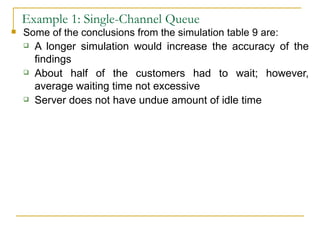
Example 1: Single-Channel Queue Some of the conclusions from the simulation table 9 are: A longer simulation would increase the accuracy of the findings About half of the customers had to wait; however, average waiting time not excessive Server does not have undue amount of idle time
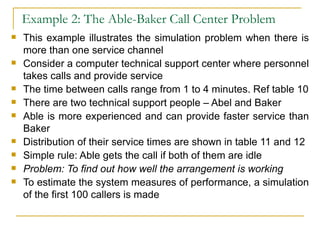
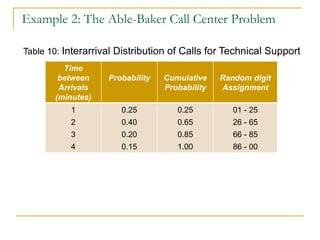
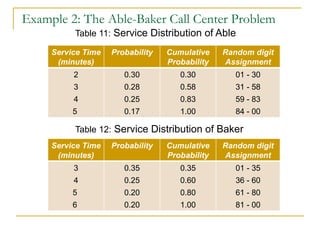
Example 2: The Able-Baker Call Center Problem This example illustrates the simulation problem when there is more than one service channel Consider a computer technical support center where personnel takes calls and provide service The time between calls range from 1 to 4 minutes. Ref table 10 There are two technical support people – Abel and Baker Able is more experienced and can provide faster service than Baker Distribution of their service times are shown in table 11 and 12 Simple rule: Able gets the call if both of them are idle Problem: To find out how well the arrangement is working To estimate the system measures of performance, a simulation of the first 100 callers is made
Example 2: The Able-Baker Call Center Problem Table 10:  Interarrival Distribution of Calls for Technical Support Time between Arrivals (minutes) Probability Cumulative Probability Random digit Assignment 1 2 3 4 0.25 0.40 0.20 0.15 0.25 0.65 0.85 1.00 01 - 25 26 - 65 66 - 85 86 - 00
Example 2: The Able-Baker Call Center Problem Table 11:  Service Distribution of Able Table 12:  Service Distribution of Baker Service Time (minutes) Probability Cumulative Probability Random digit Assignment 2 3 4 5  0.30 0.28 0.25 0.17 0.30 0.58 0.83 1.00 01 - 30 31 - 58 59 - 83 84 - 00 Service Time (minutes) Probability Cumulative Probability Random digit Assignment 3 4 5  6  0.35 0.25 0.20 0.20 0.35 0.60 0.80 1.00 01 - 35 36 - 60 61 - 80 81 - 00
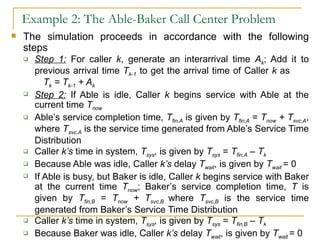
Example 2: The Able-Baker Call Center Problem The simulation proceeds in accordance with the following steps Step 1:  For caller  k , generate an interarrival time  A k ; Add it to previous arrival time  T k-1  to get the arrival time of Caller  k  as  T k  = T k-1  + A k Step 2:  If Able is idle, Caller  k  begins service with Able at the current time  T now Able’s service completion time,  T fin,A  is given by  T fin,A  =  T now  + T svc,A , where  T svc,A  is the service time generated from Able’s Service Time Distribution Caller  k’s  time in system,  T sys ,  is given by  T sys  =  T fin,A  –  T k Because Able was idle, Caller  k’s  delay  T wait , is given by  T wait  = 0 If Able is busy, but Baker is idle, Caller  k  begins service with Baker at the current time  T now ; Baker’s service completion time,  T  is given by  T fin,B  =  T now  + T svc,B  where  T svc,B  is the service time generated from Baker’s Service Time Distribution Caller  k’s  time in system,  T sys ,  is given by  T sys  =  T fin,B  –  T k Because Baker was idle, Caller  k’s  delay  T wait , is given by  T wait  = 0
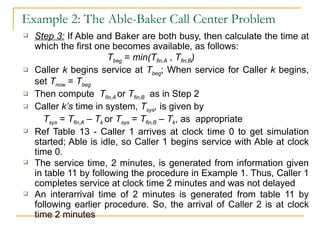
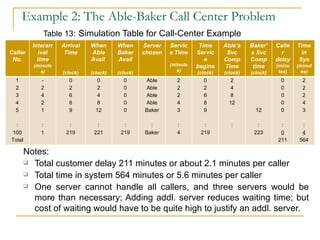
Example 2: The Able-Baker Call Center Problem Step 3:  If Able and Baker are both busy, then calculate the time at which the first one becomes available, as follows: T beg  =  min(T fin,A  ,  T fin,B ) Caller  k  begins service at  T beg ; When service for Caller  k  begins, set  T now  =  T beg Then compute  T fin,A  or  T fin,B   as in Step 2 Caller  k’s  time in system,  T sys ,  is given by  T sys  =  T fin,A  –  T k  or  T sys  =  T fin,B  –  T k , as  appropriate Ref Table 13 - Caller 1 arrives at clock time 0 to get simulation started; Able is idle, so Caller 1 begins service with Able at clock time 0. The service time, 2 minutes, is generated from information given in table 11 by following the procedure in Example 1. Thus, Caller 1 completes service at clock time 2 minutes and was not delayed An interarrival time of 2 minutes is generated from table 11 by following earlier procedure. So, the arrival of Caller 2 is at clock time 2 minutes
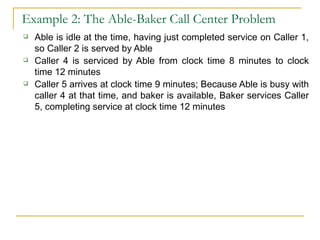
Example 2: The Able-Baker Call Center Problem Able is idle at the time, having just completed service on Caller 1, so Caller 2 is served by Able Caller 4 is serviced by Able from clock time 8 minutes to clock time 12 minutes Caller 5 arrives at clock time 9 minutes; Because Able is busy with caller 4 at that time, and baker is available, Baker services Caller 5, completing service at clock time 12 minutes
Example 2: The Able-Baker Call Center Problem Table 13:   Simulation Table for Call-Center Example Notes: Total customer delay 211 minutes or about 2.1 minutes per caller Total time in system 564 minutes or 5.6 minutes per caller One server cannot handle all callers, and three servers would be more than necessary; Adding addl. server reduces waiting time; but cost of waiting would have to be quite high to justify an addl. server. Caller No. Interarrival time  (minutes) Arrival Time (clock) When Able Avail  (clock) When Baker Avail (clock) Server chosen Service Time (minutes) Time Service begins (clock) Able’s Svc Comp Time (clock) Baker’s Svc Comp time (clock) Caller delay (minutes) Time in Sys (minutes) 1 2 3 4 5 : 100 Total - 2 4 2 1 : 1 0 2 6 8 9 : 219 0 2 4 8 12 : 221 0 0 0 0 0 : 219 Able Able Able Able Baker : Baker 2 2 2 4 3 : 4 0 2 6 8 9 : 219 2 4 8 12 : 12 : 223 0 0 0 0 0 : 0 211 2 2 2 4 3 : 4 564
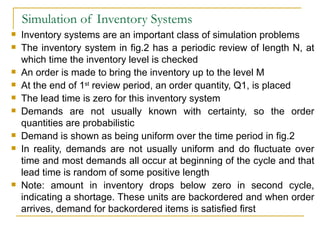
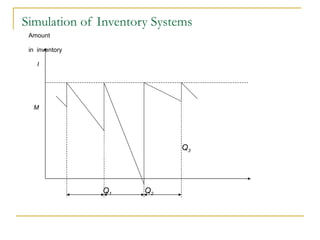
Simulation of Inventory Systems Inventory systems are an important class of simulation problems The inventory system in fig.2 has a periodic review of length N, at which time the inventory level is checked An order is made to bring the inventory up to the level M At the end of 1 st  review period, an order quantity, Q1, is placed The lead time is zero for this inventory system Demands are not usually known with certainty, so the order quantities are probabilistic Demand is shown as being uniform over the time period in fig.2 In reality, demands are not usually uniform and do fluctuate over time and most demands all occur at beginning of the cycle and that lead time is random of some positive length Note: amount in inventory drops below zero in second cycle, indicating a shortage. These units are backordered and when order arrives, demand for backordered items is satisfied first
Simulation of Inventory Systems Amount in  inventory I M   Q 3     Q 1  Q 2    N  N  N   Time    T     Figure 2:  Probabilistic order-level inventory systems
Simulation of Inventory Systems Carrying stock in inventory has an associated cost attributed to the interest paid on the funds borrowed to buy the items; Other costs are carrying or holding cost, renting of storage space, security guards, etc Alternative to holding high inventory is to make frequent reviews and, consequently, more purchases or replenishments; this has associated costs also – the ordering cost, goodwill costs when customers get angry when shortages exist, etc The above two costs should be traded off to minimize total cost of an inventory system The total cost of an inventory system is the measure of performance; this can be affected by policy alternatives For example, decision makers can control the maximum inventory level,  M , and the length of the cycle,  N ,
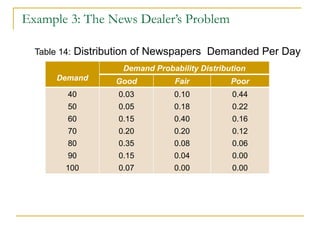
Example 3: The News Dealer’s Problem This inventory problem concerns the purchase and sale of newspapers The newsstand buys the papers for 33 paise each and sells them for 50 paise each; Newspaper not sold at the end of the day are sold as scrap for 5 paise each Newspaper can be purchased in bundles of 10; thus the newsstand can buy 50, 60, and so on There are three types of newsdays: ‘good’, ‘fair’ and ‘poor’ having probabilities 0.35, 0.45 and 0.20, respectively The distribution of newspapers demanded on each of these days is given in table 14 Problem: Compute the optimal number of papers the newsstand should purchase This is accomplished by simulating demands for 20 days and recording profits from sales each day
Example 3: The News Dealer’s Problem Table 14:  Distribution of Newspapers  Demanded Per Day Demand Demand Probability Distribution Good Fair Poor 40 50 60 70 80 90 100 0.03 0.05 0.15 0.20 0.35 0.15 0.07 0.10 0.18 0.40 0.20 0.08 0.04 0.00 0.44 0.22 0.16 0.12 0.06 0.00 0.00
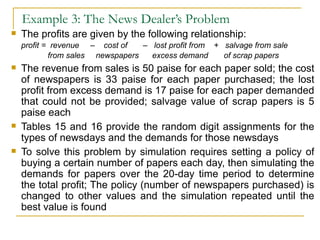
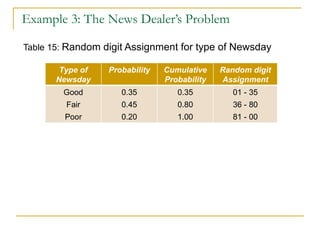
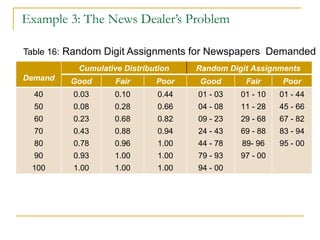
Example 3: The News Dealer’s Problem The profits are given by the following relationship: profit =  revenue  –  cost of  –  lost profit from  +  salvage from sale   from sales  newspapers  excess demand  of scrap papers   The revenue from sales is 50 paise for each paper sold; the cost of newspapers is 33 paise for each paper purchased; the lost profit from excess demand is 17 paise for each paper demanded that could not be provided; salvage value of scrap papers is 5 paise each Tables 15 and 16 provide the random digit assignments for the types of newsdays and the demands for those newsdays To solve this problem by simulation requires setting a policy of buying a certain number of papers each day, then simulating the demands for papers over the 20-day time period to determine the total profit; The policy (number of newspapers purchased) is changed to other values and the simulation repeated until the best value is found
Example 3: The News Dealer’s Problem Table 15:  Random digit Assignment for type of Newsday Type of Newsday Probability Cumulative Probability Random digit Assignment Good Fair Poor 0.35 0.45 0.20 0.35 0.80 1.00 01 - 35 36 - 80 81 - 00
Example 3: The News Dealer’s Problem Table 16:   Random Digit Assignments for Newspapers  Demanded Demand Cumulative Distribution Random Digit Assignments  Good Fair Poor Good Fair Poor 40 50 60 70 80 90 100 0.03 0.08 0.23 0.43 0.78 0.93 1.00 0.10 0.28 0.68 0.88 0.96 1.00 1.00 0.44 0.66 0.82 0.94 1.00 1.00 1.00 01 - 03 04 - 08 09 - 23 24 - 43 44 - 78 79 - 93 94 - 00 01 - 10 11 - 28 29 - 68 69 - 88 89- 96 97 - 00 01 - 44 45 - 66 67 - 82 83 - 94 95 - 00
Example 3: The News Dealer’s Problem Table 17:   Simulation Table for Purchase of 70 Newspapers Day Random Digits for Type of Newsday Type of Newsday Random digits for  Demand Demand Revenue from Sales (Rupees) Lost Profit from Excess Demand Salvage from Sale of Scrap Daily profit 1 2 3 4 5 6 7 8 9 10 11 12 13 14 15 16 17 18 19 20 58 17 21 45 43 36 27 73 86 19 93 45 47 30 12 41 65 57 18 98 Fair Good Good Fair Fair Fair Good Fair Poor Good Poor Fair Fair Good Good Fair Fair Fair Good Poor 93 63 31 19 91 75 84 37 23 02 53 96 33 86 16 07 64 94 55 13 80 80 70 50 80 70 90 60 40 40 50 80 60 90 60 40 60 80 80 40 35 35 35 25 35 35 35 30 20 20 25 35 30 35 30 20 30 35 35 20 600 1.70 1.70 - - 1.70 - 3.40 - - - - 1.70 - 3.40 - - - 1.70 1.70 -  17.00 - - - 1.00 - - - 0.50 1.50 1.50 1.00 - 0.50 - 0.50 1.50 0.50 - - 1.50 10.00 10.20 10.20 11.90 2.90 10.20 11.90 8.50 7.40 -1.60 -1.60 3.90 10.20 7.40 8.50 7.40 -1.60 7.40 10.20 10.20 -1.60 131.00
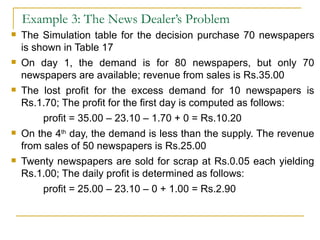
Example 3: The News Dealer’s Problem The Simulation table for the decision purchase 70 newspapers is shown in Table 17 On day 1, the demand is for 80 newspapers, but only 70 newspapers are available; revenue from sales is Rs.35.00 The lost profit for the excess demand for 10 newspapers is Rs.1.70; The profit for the first day is computed as follows: profit = 35.00 – 23.10 – 1.70 + 0 = Rs.10.20 On the 4 th  day, the demand is less than the supply. The revenue from sales of 50 newspapers is Rs.25.00 Twenty newspapers are sold for scrap at Rs.0.05 each yielding Rs.1.00; The daily profit is determined as follows: profit = 25.00 – 23.10 – 0 + 1.00 = Rs.2.90
Example 3: The News Dealer’s Problem The profit for 20-day period is the sum of daily profits, Rs.131.00 Also computed from total for 20 days of simulation Total profit = 600 - 462 + 17 - 10 = Rs.131.00 [462 = cost of newspaper = 20 x 0.33 x 70]
Example 4: Order-Up-To-Level Inventory System Consider a company which sells refrigerators; System used to maintain inventory is to review the situation after a fixed number of days (N) and make a decision about what is to be done Policy is to order up to a level (M), using following relationship: Order quantity = (Order-up-to-level) - (Ending inventory) +    (Shortage quantity) Suppose, M is 11 and ending inventory is 3 and review period N is 5 days Thus, on the 5 th  day of cycle, 8 refrigerators will be ordered from the supplier; If there is shortage of 2, then 13 will be ordered Note: there cannot be both ending inventory and shortage qty at the same time If there were shortage, then the required shortage will be provided to customers first when the order arrives. This is called ‘making up backorders’
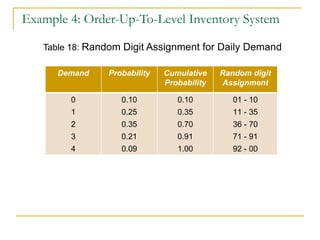
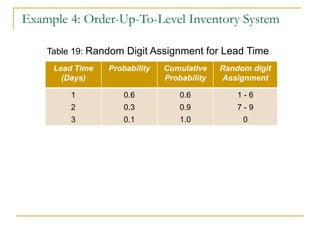
Example 4: Order-Up-To-Level Inventory System Lost sales  case occurs when customer demand is lost if inventory is not available The number of refrigerators ordered each day is randomly distributed as shown in table 18 Another source of randomness is the number of days after the order is placed with the supplier before arrival or  lead time The distribution of lead time is shown in table 19 Assume that orders are placed at the end of the day If lead time is zero, the order from supplier will arrive next morning, and the refrigerators will be available for distribution the next day If the lead time is one day, the order from the supplier arrives the second morning after, and will be available for distribution that second day
Example 4: Order-Up-To-Level Inventory System Simulation has been started with the inventory level at 3 refrigerators and an order for 8 refrigerators to arrive in 2 days time; the simulation is shown in table 20 Order for 8 refrigerators  is available on the morning of the third day of the first cycle, raising the inventory level from zero refrigerators  to 8 refrigerators Demand during the remainder of the first cycle reduced the ending inventory level to 2 refrigerators  on the fifth day Thus, an order for 9 refrigerators  was placed; the lead time for this order was 2 days The order for 9 refrigerators  was added to inventory on the morning of day 3 of cycle 2 Note: beginning inventory of fifth day of fourth cycle was 2; an order for 3 refrigerators on that day led to a shortage condition; one refrigerator was backordered on that day;
Example 4: Order-Up-To-Level Inventory System 12 refrigerators were ordered (11 + 1), and they had a lead time of one day On the next day, the demand was two, so additional shortages resulted At the beginning of the next day, the order had arrived; Three refrigerators were used to make up the backorders and there was a demand for one refrigerator, so ending inventory was 8 From five cycles of simulation, the average ending inventory is approximately 2.72 (68/25) units On 5 of 25 days, a shortage condition existed
Example 4: Order-Up-To-Level Inventory System   Table 18:  Random Digit Assignment for Daily Demand Demand Probability Cumulative Probability Random digit Assignment 0 1 2 3 4 0.10 0.25 0.35 0.21 0.09 0.10 0.35 0.70 0.91 1.00 01 - 10 11 - 35 36 - 70 71 - 91 92 - 00
Example 4: Order-Up-To-Level Inventory System   Table 19:  Random Digit Assignment for Lead Time Lead Time (Days) Probability Cumulative Probability Random digit Assignment 1 2 3 0.6 0.3 0.1 0.6 0.9 1.0 1 - 6 7 - 9 0
Table 20: Simulation Table for [M,N] Inventory System Day Cycle Day within Cycle Beginning Inventory Random Digits for Demand Demand Ending Inventory Shortage Quantity Order Quantity Random Digits  for Demand Lead Time (days) Days until Order Arrives 1 2 3 4 5 6 7 8 9 10 11 12 13 14 15 16 17 18 19 20 21 22 23 24 25 Total 1 1 1 1 1 2 2 2 2 2 3 3 3 3 3 4 4 4 4 4 5 5 5 5 5 1 2 3 4 5 1 2 3 4 5 1 2 3 4 5 1 2 3 4 5 1 2 3 4 5 3 2 8 7 5 2 1 9 5 3 0 0 11 6 3 2 11 7 5 2 0 12 8 4 3 26 68 33 39 86 18 64 79 55 74 21 43 49 90 35 08 98 61 85 81 53 15 94 19 44 1 2 1 2 3 1 2 3 2 3 1 2 2 3 1 0 4 2 3 3 2 1 4 1 2 2 0 7 5 2 1 0 5 3 0 0 0 6 3 2 2 7 5 2 0 0 8 4 3 1 68 0 0 0 0 0 0 1 0 0 0 1 3 0 0 0 0 0 0 0 1 3 0 0 0 0 9 - - - - 9 - - - - 11 - - - - 9 - - - - 12 - - - - 10 - - - - 8 - - - - 7 - - - - 2 - - - - 3 - - - - 1 - - - - 2 - - - - 2 - - - - 1 - - - - 1 - - - - 1 1 - - - 2 1 - - - 2 1 - - - 1 - - - - 1 - - - - 1
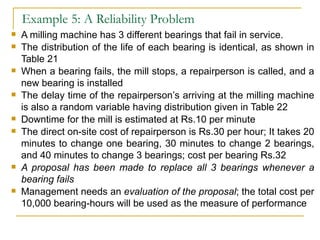
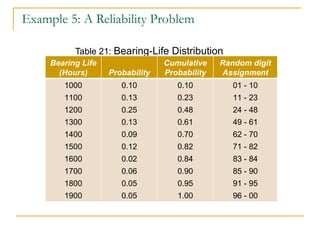
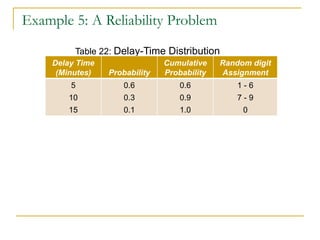
Example 5: A Reliability Problem A milling machine has 3 different bearings that fail in service. The distribution of the life of each bearing is identical, as shown in Table 21 When a bearing fails, the mill stops, a repairperson is called, and a new bearing is installed The delay time of the repairperson’s arriving at the milling machine is also a random variable having distribution given in Table 22 Downtime for the mill is estimated at Rs.10 per minute The direct on-site cost of repairperson is Rs.30 per hour; It takes 20 minutes to change one bearing, 30 minutes to change 2 bearings, and 40 minutes to change 3 bearings; cost per bearing Rs.32 A proposal has been made to replace all 3 bearings whenever a bearing fails Management needs an  evaluation of the proposal ; the total cost per 10,000 bearing-hours will be used as the measure of performance
Example 5: A Reliability Problem Table 21:  Bearing-Life Distribution Bearing Life (Hours) Probability Cumulative Probability Random digit Assignment 1000 1100 1200 1300 1400 1500 1600 1700 1800 1900 0.10 0.13 0.25 0.13 0.09 0.12 0.02 0.06 0.05 0.05 0.10 0.23 0.48 0.61 0.70 0.82 0.84 0.90 0.95 1.00 01 - 10 11 - 23 24 - 48 49 - 61 62 - 70 71 - 82 83 - 84 85 - 90 91 - 95 96 - 00
Example 5: A Reliability Problem Table 22:  Delay-Time Distribution Delay Time (Minutes) Probability Cumulative Probability Random digit Assignment 5 10 15 0.6 0.3 0.1 0.6 0.9 1.0 1 - 6 7 - 9 0
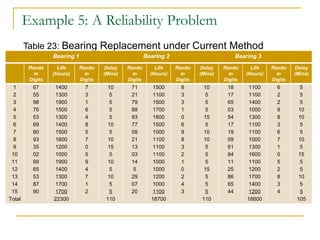
Example 5: A Reliability Problem Table 23:  Bearing Replacement under Current Method Bearing 1  Bearing 2  Bearing 3  Random Digits Life (Hours) Random Digits Delay (Mins) Random Digits Life (Hours) Random Digits Delay (Mins) Random Digits Life (Hours) Random Digits Delay (Mins) 1 2 3 4 5 6 7 8 9 10 11 12 13 14 15 Total 67 55 98 76 53 69 80 93 35 02 99 65 53 87 90 1400 1300 1900 1500 1300 1400 1500 1800 1200 1000 1900 1400 1300 1700 1700 22300 7 3 1 6 4 8 5 7 0 5 9 4 7 1 2 10 5 5 5 5 10 5 10 15 5 10 5 10 5 5 110 71 21 79 88 93 77 08 21 13 03 14 5 29 07 20 1500 1100 1500 1700 1800 1500 1000 1100 1100 1100 1000 1000 1200 1000 1100 18700 8 3 3 1 0 6 9 8 3 2 1 0 2 4 3 10 5 5 5 15 5 10 10 5 5 5 15 5 5 5 110 18 17 65 03 54 17 19 09 61 84 11 25 86 65 44 1100 1100 1400 1000 1300 1100 1100 1000 1300 1600 1100 1200 1700 1400 1200 18600 6 2 2 9 8 3 6 7 1 0 5 2 8 3 4 5 5 5 10 10 5 5 10 5 15 5 5 10 5 5 105
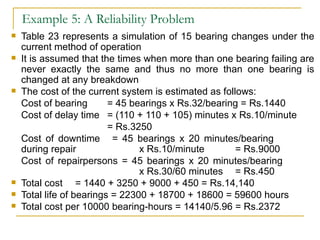
Example 5: A Reliability Problem Table 23 represents a simulation of 15 bearing changes under the current method of operation It is assumed that the times when more than one bearing failing are never exactly the same and thus no more than one bearing is changed at any breakdown The cost of the current system is estimated as follows: Cost of bearing  = 45 bearings x Rs.32/bearing = Rs.1440 Cost of delay time  = (110 + 110 + 105) minutes x Rs.10/minute = Rs.3250 Cost of downtime  = 45 bearings x 20 minutes/bearing  during repair  x Rs.10/minute  = Rs.9000 Cost of repairpersons = 45 bearings x 20 minutes/bearing    x Rs.30/60 minutes = Rs.450 Total cost = 1440 + 3250 + 9000 + 450 = Rs.14,140 Total life of bearings = 22300 + 18700 + 18600 = 59600 hours Total cost per 10000 bearing-hours = 14140/5.96 = Rs.2372
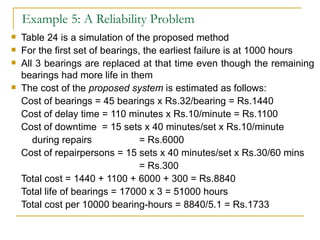
Example 5: A Reliability Problem Table 24 is a simulation of the proposed method For the first set of bearings, the earliest failure is at 1000 hours All 3 bearings are replaced at that time even though the remaining bearings had more life in them The cost of the  proposed system  is estimated as follows: Cost of bearings = 45 bearings x Rs.32/bearing = Rs.1440 Cost of delay time = 110 minutes x Rs.10/minute = Rs.1100 Cost of downtime  = 15 sets x 40 minutes/set x Rs.10/minute   during repairs = Rs.6000 Cost of repairpersons = 15 sets x 40 minutes/set x Rs.30/60 mins = Rs.300 Total cost = 1440 + 1100 + 6000 + 300 = Rs.8840 Total life of bearings = 17000 x 3 = 51000 hours Total cost per 10000 bearing-hours = 8840/5.1 = Rs.1733
Example 5: A Reliability Problem The new policy generates a savings of Rs.634 per 10000 hours of bearing-life; If machine runs continuously, the savings are about Rs.556 per year In the examples downloaded from website,  www.bcnn.net , user can change the distribution of bearing life (making sure cumulative probability is exactly 1.0). The distribution of delay time can be changed  Also, the parameters of the problem can be changed (bearing cost per unit, etc) The number of trails can be varied from 1 to 400 Endpoints of the bins can be changed for observing the frequency of total cost for 10000 hours of bearing life
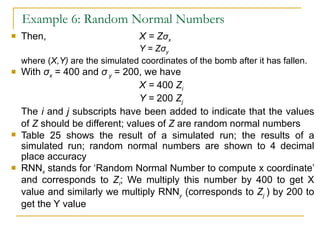
Example 6: Random Normal Numbers Consider a bomber attempting to destroy an ammunition depot If a bomb falls anywhere on target, a hit is scored; otherwise, the bomb is a miss The bomber flies in the horizontal direction and carries 10 bombs The aiming point is (0,0) The point of impact is assumed to be  normally distributed  around the aiming point with a standard deviation of 400 meters in the direction of flight and 200 meters in the perpendicular direction Problem: Simulate the operation and make statements about the number of bombs on target Standard normal variate,  Z , having mean 0 and standard deviation 1, is distributed as Z = (X -  μ ) /  σ where  X  is a normal variate,  μ   is the mean distribution of  X , and  σ  is  the standard deviation of  X
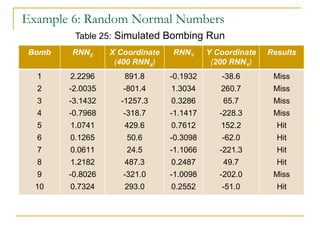
Example 6: Random Normal Numbers Then, X = Z σ x Y = Z σ y where ( X,Y)  are the simulated coordinates of the bomb after it has fallen. With  σ x  = 400 and  σ  y  = 200, we have X =  400  Z i Y =  200  Z j The  i  and  j  subscripts have been added to indicate that the values of  Z  should be different; values of  Z  are random normal numbers Table 25 shows the result of a simulated run; the results of a simulated run; random normal numbers are shown to 4 decimal place accuracy RNN x  stands for ‘Random Normal Number to compute x coordinate’ and corresponds to  Z i ; We multiply this number by 400 to get X value and similarly we multiply RNN y  (corresponds to  Z j  ) by 200 to get the Y value
Example 6: Random Normal Numbers Table 25:   Simulated Bombing Run Bomb RNN X X Coordinate  ( 400 RNN X ) RNN Y Y Coordinate ( 200 RNN Y ) Results 1 2 3 4 5 6 7 8 9 10 2.2296 -2.0035 -3.1432 -0.7968 1.0741 0.1265 0.0611 1.2182 -0.8026 0.7324 891.8 -801.4 -1257.3 -318.7 429.6 50.6 24.5 487.3 -321.0 293.0 -0.1932 1.3034 0.3286 -1.1417 0.7612 -0.3098 -1.1066 0.2487 -1.0098 0.2552 -38.6 260.7 65.7 -228.3 152.2 -62.0 -221.3 49.7 -202.0 -51.0 Miss Miss Miss Miss Hit Hit Hit Hit Miss Hit
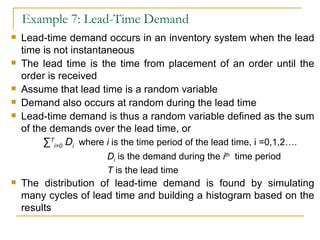
Example 7: Lead-Time Demand Lead-time demand occurs in an inventory system when the lead time is not instantaneous The lead time is the time from placement of an order until the order is received Assume that lead time is a random variable Demand also occurs at random during the lead time Lead-time demand is thus a random variable defined as the sum of the demands over the lead time, or ∑ T i=0  D i  where  i  is the time period of the lead time, i =0,1,2….   D i  is the demand during the  i th   time period T  is the lead time The distribution of lead-time demand is found by simulating many cycles of lead time and building a histogram based on the results
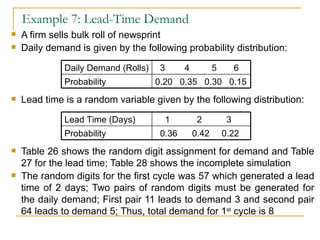
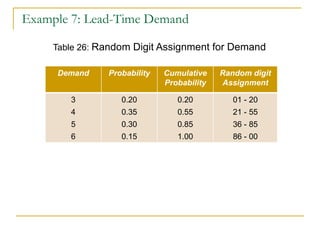
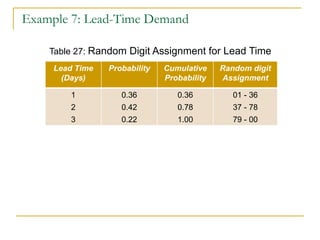
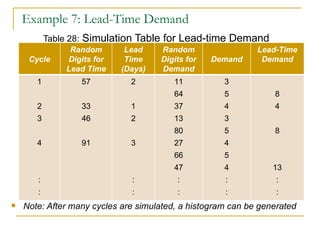
Example 7: Lead-Time Demand A firm sells bulk roll of newsprint  Daily demand is given by the following probability distribution: Lead time is a random variable given by the following distribution: Table 26 shows the random digit assignment for demand and Table 27 for the lead time; Table 28 shows the incomplete simulation  The random digits for the first cycle was 57 which generated a lead time of 2 days; Two pairs of random digits must be generated for the daily demand; First pair 11 leads to demand 3 and second pair 64 leads to demand 5; Thus, total demand for 1 st  cycle is 8 Daily Demand (Rolls) 3  4  5  6 Probability 0.20  0.35  0.30  0.15 Lead Time (Days) 1  2  3 Probability 0.36  0.42  0.22
Example 7: Lead-Time Demand     Table 26:  Random Digit Assignment for Demand Demand Probability Cumulative Probability Random digit Assignment 3 4 5 6 0.20 0.35 0.30 0.15 0.20 0.55 0.85 1.00 01 - 20 21 - 55 36 - 85 86 - 00
Example 7: Lead-Time Demand   Table 27:  Random Digit Assignment for Lead Time Lead Time (Days) Probability Cumulative Probability Random digit Assignment 1 2 3 0.36 0.42 0.22 0.36 0.78 1.00 01 - 36 37 - 78 79 - 00
Example 7: Lead-Time Demand Table 28:  Simulation Table for Lead-time Demand Note: After many cycles are simulated, a histogram can be generated Cycle Random Digits for Lead Time Lead Time (Days) Random Digits for Demand Demand Lead-Time Demand 1 2 3 4 : : 57 33 46 91 2 1 2 3 : : 11 64 37 13 80 27 66 47 : : 3 5 4 3 5 4 5 4 : : 8 4 8 13 : :
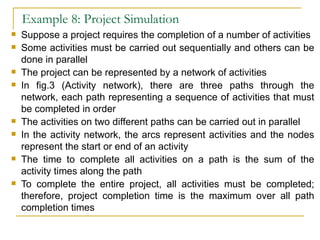
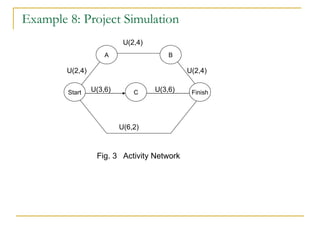
Example 8: Project Simulation Suppose a project requires the completion of a number of activities Some activities must be carried out sequentially and others can be done in parallel The project can be represented by a network of activities In fig.3 (Activity network), there are three paths through the network, each path representing a sequence of activities that must be completed in order The activities on two different paths can be carried out in parallel In the activity network, the arcs represent activities and the nodes represent the start or end of an activity The time to complete all activities on a path is the sum of the activity times along the path To complete the entire project, all activities must be completed; therefore, project completion time is the maximum over all path completion times
Example 8: Project Simulation   U(2,4)   U(2,4)   U(2,4)    U(3,6)    U(3,6)   U(6,2)   Fig. 3  Activity Network C Start A B Finish
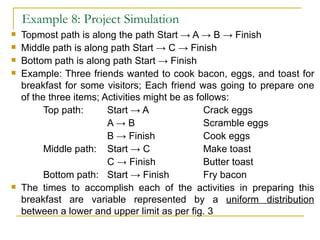
Example 8: Project Simulation Topmost path is along the path Start -> A -> B -> Finish Middle path is along path Start -> C -> Finish Bottom path is along path Start -> Finish Example: Three friends wanted to cook bacon, eggs, and toast for breakfast for some visitors; Each friend was going to prepare one of the three items; Activities might be as follows: Top path:  Start -> A Crack eggs A -> B Scramble eggs B -> Finish Cook eggs Middle path: Start -> C Make toast C -> Finish Butter toast Bottom path: Start -> Finish Fry bacon The times to accomplish each of the activities in preparing this breakfast are variable represented by a  uniform distribution  between a lower and upper limit as per fig. 3
Example 8: Project Simulation Problem: 1. To find the preparation time so that the visitors can be informed what time to be present for breakfast (or) 2.  To estimate the probability of preparing breakfast within a specified amount of time The activity times are shown on the arcs of the activity network The activity time from Start -> A (crack the eggs) is assumed to be uniformly distributed between 2 and 4 minutes; That means that all times between 2 and 4 minutes are equally likely to occur Expected or mean time for this activity is the midpoint, 3 minutes Expected value along topmost path is 9 minutes, determined by adding the three expected values (3 + 3 + 3) Shortest possible completion time, determined by adding the smallest values, is 6 minutes (2 + 2 + 2) Largest possible time along top path is 12 minutes (4 + 4 + 4) Similarly the expected, shortest and longest paths for the middle and bottom paths are 9, 6 and 12 minutes
Example 8: Project Simulation The time that the project (breakfast of eggs, toast and bacon) will be completed is the maximum time through any of the paths But since activities are assumed to be some random variability, the time through the paths are not constant For a uniform distribution, a simulated activity is given by [Pritsker]: Simulated Activity Time =  Lower limit + (Upper limit - Lower limit) *  Random number The time for each simulated activity can be computed as follows: Example: for activity Start -> A, if random number is 0.7943, the simulated activity time is 2 + (4 - 2) * 0.7943 = 3.59 minutes Simulate using Experiment worksheet (downloaded from  www.bcnn.net )  in the Excel workbook for this example and compute the average, median, minimum and maximum values. With 400 trials using default seed, results were as follows: Mean 10.12, Min 6.85,  and  Max 12.00  minutes
Example 8: Project Simulation The  critical path  is the path that takes the longest time for completion; that is, its time is the project completion time For each of the 400 trials, the experiment determines at which path was critical, with these results: Top path 30.00% of trials Middle path 31.25% Bottom path 38.75% Conclusion is that the chance of the bacon being the last item ready is 38.75%. [Question:  Why aren’t the paths each represented about 1/3 of the time?] The project completion times were placed in a frequency chart; These differ each time that spreadsheet is recalculated, but, in any large number of trials, the basic shape of the chart (or histogram) will remain roughly the same; Inferences drawn from fig. is that: 13.5% of time (54/400), breakfast will be ready in <=9 minutes 20.5% of time (82/400), it will take 11 to 12 minutes

Chp. 2 simulation examples

  • 1.
  • 2.
    Simulation Examples Threesteps to carry out Simulation: Determine the characteristics of each of the inputs to the simulation. Often modeled as probability distributions - continuous or discrete Construct a simulation table (provides a systematic method for tracking system state over time) Example: there are p inputs, x ij , j = 1,2,..,p, and one response, y i , for each of the repetitions i = 1,2,..,n. Initialize the table by filling in the data for repetition 1. For each repetition i, generate a value for each of the p inputs, and evaluate the function, calculating a value of the response y i . The input values may be computed by sampling values from the distributions chosen in step 1. A response typically depends on the inputs and one or more previous responses
  • 3.
    Simulation Table RepetitionsInputs Response y i x i1 x i2 .. x ij .. x ip 1 2 3 : n
  • 4.
    Simulation of QueuingSystems A queuing system is described by its calling population, the nature of arrivals, the service mechanism, the system capacity, and the queuing discipline. In a single-channel queue, the calling population is infinite; that is, if a unit leaves the calling population and joins the waiting line or enters service, there is no change in the arrival rate of other units that could need service. Arrivals for service occur one at a time in a random fashion; once they join the waiting line, they are eventually served Service times are of some random length according to a probability distribution which does not change over time The system capacity has no limit, meaning that any number of units can wait in line Units are served in the order of their arrival by a single server or channel
  • 5.
    Simulation of QueuingSystems Arrivals and services are defined by the distribution of the time between arrivals and distribution service times, resp. For any simple single- or multi-channel queue, the overall effective arrival rate must be less than the total service rate, or the waiting line will grow without bound (they are then termed ‘explosive’ or unstable) The state of the system is the number of units in the system and the status of the server (busy or idle) An event a set of circumstances that cause an instantaneous change in the state of the system In a single-channel queuing system, there are only two possible events that can affect the state of the system – entry of a unit ( arrival event) and completion of service on a unit ( departure event) Queuing system includes the server, unit being serviced, and units in queue; simulation clock is used to track simulated time
  • 6.
    Simulation of QueuingSystems Service just completed flow diagram No Yes If unit has just completed service, simulation proceeds as above: [Departure event occurs when unit completes service] Server has only two possible states – busy or idle Departure event Another unit waiting? Begin Server idle time Remove waiting unit from queue Begin servicing the unit
  • 7.
    Simulation of QueuingSystems Unit entering system flow diagram No Yes If unit has just entered the system, simulation proceeds as above: [Arrival event occurs when unit enters system] Unit will find server either busy/idle; unit begins service immediately or enters queue for server It is not possible for server to be idle while queue is nonempty Arrival event Server Busy? Unit enters service Unit enters queue for service
  • 8.
    Simulation of QueuingSystems Potential unit actions upon arrival Server outcomes after completion of service Queue status Not empty Empty Server status Busy Enter queue Enter queue Idle Impossible Enter service Queue status Not empty Empty Server outcomes Busy /////////////////// Impossible Idle Impossible ///////////////////
  • 9.
    Simulation of QueuingSystems Simulations of queuing systems require the maintenance of an event list for determining what happens next The event list tracks future times at which the different types of events occur Simulation clock times for arrivals and departures are computed in a simulation table customized for each problem In simulation, event usually occur at random times, the randomness imitating uncertainty in real life A statistical model of data is developed from data collected and analyzed or from subjective estimates and assumptions The randomness needed to imitate real life is made possible through the use of ‘random numbers’ Random numbers are distributed uniformly and independently on the interval (0,1)
  • 10.
    Simulation of QueuingSystems Random digits are uniformly distributed on the set {0,1,2,..,9} and can be used to form random numbers by selecting the proper number of digits for each random number and placing a decimal point to the left of the value selected Random numbers can also generated in simulation packages and in spreadsheets In a single-channel queuing simulation, interarrival times and service times are generated from the distributions of these random variables Example: the interarrival times are generated by rolling a die five times and recording them (x 1 ,x 2 ..x 5 ) and these five i.a.times are used to compute the arrival times of six customers The first customer is assumed to arrive at clock time 0 and this starts the clock in operation; the second customer arrives x 1 minutes after first customer, that is, at clock time x 1, and so on.
  • 11.
    Simulation of QueuingSystems Table 1: Interarrival and Clock Times Customer Interarrival time Arrival time on clock 1 2 3 4 5 6 - 2 4 1 2 6 0 2 6 7 9 15
  • 12.
    Simulation of QueuingSystems The second time that needs to be generated is the service time - generated at random and the only possible service times are 1,2,3, and 4 time units and all equally likely to occur The interarrival times and service times must be now meshed to simulate the single-channel queuing system. Ref table 4 The first customer arrives at clock time 0 and immediately begins service, which requires two minutes; service is completed at clock time 2 The second customer arrives at clock time 2 and is finished at clock time 3 (service time 1 minute) Third customer arrives at clock time 6 and finishes at c.t. 9 Fourth customer arrives at 7, but service begins at 9 and finishes at clock time 11 Fifth customer arrives at 15 and finishes at 19
  • 13.
    Simulation of QueuingSystems Table 2: Service Times Customer Service time 1 2 3 4 5 6 2 1 3 2 1 4
  • 14.
    Simulation of QueuingSystems Table 3: Simulation Table Emphasizing Clock Times A Customer Number B Arrival time (Clock) C Time Service Begins (Clock) D Service Time (Duration) E Time Service Ends (Clock) 1 2 3 4 5 6 0 2 6 7 9 15 0 2 6 9 11 15 2 1 3 2 1 4 2 3 9 11 12 19
  • 15.
    Simulation of QueuingSystems Table 4: Chronological Ordering of Events Event Type Customer number Clock Time Arrival Departure Arrival Departure Arrival Arrival Departure Arrival Departure Departure Arrival Departure 1 1 2 2 3 4 3 5 4 5 6 6 0 2 2 3 6 7 9 9 11 12 15 19
  • 16.
    Simulation of QueuingSystems No of customers in system 2 4 5 1 1 2 3 4 5 6 0 1 2 3 4 5 6 7 8 9 10 11 12 13 14 15 16 17 18 19 20 Figure 1: Clock Time
  • 17.
    Example 1: Single-ChannelQueue A small grocery store has one checkout counter Customers arrive at this checkout counter at random time fro 1 to 8 minutes apart Each possible value of interarrival time has the same probability of occurrence. Ref. table 5 Service time varies from 1 to 6 minutes, with probabilities shown in table 6 Problem is to analyze the system by simulating the arrival and service of 100 customers A set of uniformly distributed random numbers is needed to generate the arrivals at the checkout counter These random numbers have the following properties: It is uniformly distributed between 0 and 1 Successive random numbers are independent
  • 18.
    Example 1: Single-ChannelQueue Table 5: Distribution of time Between Arrivals Time between Arrivals (minutes) Probability Cumulative Probability Random digit Assignment 1 2 3 4 5 6 7 8 0.125 0.125 0.125 0.125 0.125 0.125 0.125 0.125 0.125 0.250 0.375 0.500 0.625 0.750 0.875 1.000 001 - 125 126 - 250 251 - 375 376 - 500 501 - 625 626 - 750 751 - 875 876 - 000
  • 19.
    Example 1: Single-ChannelQueue Table 6: Service-Time Distribution Service Time (minutes) Probability Cumulative Probability Random digit Assignment 1 2 3 4 5 6 0.10 0.20 0.30 0.25 0.10 0.05 0.10 0.30 0.60 0.85 0.95 1.00 01 - 10 11 - 30 31 - 60 61 - 85 86 - 95 96 - 00
  • 20.
    Example 1: Single-ChannelQueue We have to list 99 random numbers (say from table A.1) to generate the time between arrivals, accurate to 3 decimal places (since the probabilities in table 5 are accurate to 3 significant digits) for the 100 customers Rightmost two columns of table 5 and 6 are used to generate random arrivals and random service times The rightmost column contains random digit assignment; 001 – 0125 represents 1 minute and 126 – 250 represents 2 minutes, and so on, for up to 8 minutes interarrival times The time-between-arrival determination is shown in table 7 The service times generated are shown in table 8 The first customer’s service time is 4 minutes, because random digits 84 fall in bracket 61-85 The simulation table for the single-channel queue is shown in table 9
  • 21.
    Example 1: Single-ChannelQueue Table 7: Time-Between-Arrival Determination Customer Number Random Digits Time between Arrivals (Minutes) Customer Number Random Digits Time between Arrivals (Minutes) 1 2 3 4 5 6 7 8 9 10 - 064 112 678 289 871 583 139 423 039 - 1 1 6 3 7 5 2 4 1 11 12 13 14 15 16 17 18 : 100 413 462 843 738 359 888 902 212 : 538 4 4 7 6 3 8 8 2 : 5
  • 22.
    Example 1: Single-ChannelQueue Table 8: Service Times Generated Customer Random Digits Service Time (Minutes) Customer Random Digits Service Time (Minutes) 1 2 3 4 5 6 7 8 9 10 84 18 87 81 06 91 79 09 64 38 4 2 5 4 1 5 4 1 4 3 11 12 13 14 15 16 17 18 : 100 94 32 79 92 46 21 73 55 : 26 5 3 4 5 3 2 4 3 : 2
  • 23.
    Example 1: Single-ChannelQueue The first step to construct table 9 is to initialize table by filling cells for the first customer First customer is assumed to arrive at time 0; service begins immediately and finishes at time 4; customer was in the system for 4 minutes Subsequent rows in table are based on the random numbers for interarrival time, service time, and the completion time of the previous customer Example: The second customer arrives at time 1; service could not begin until time 4; customer waited in queue for 3 minutes; and was in the system for 5 minutes The rightmost two columns were added to collect statistical measures of performance Totals are calculated to compute summary statistics
  • 24.
    Example 1: Single-ChannelQueue Table 9: Simulation Table for Single-Channel Queuing Problem Customer Interarrival time (minutes) Arrival Time Service Time (minutes) Time Service begins Waiting time in Queue Time Service ends Time Customer in system Idle Time of Server 1 2 3 4 5 6 7 8 9 10 11 12 13 14 15 16 17 18 19 20 : 100 Total - 1 1 6 3 7 5 2 4 1 4 4 7 6 3 8 8 2 7 4 : 5 415 0 1 2 8 11 18 23 25 29 30 34 38 45 51 54 62 70 72 79 83 : 415 4 2 5 4 1 5 4 1 4 3 5 3 4 5 3 2 4 3 1 2 : 2 317 0 4 6 11 15 18 23 27 29 33 36 41 45 51 56 62 70 74 79 83 : 416 0 3 4 3 4 0 0 2 0 3 2 3 0 0 2 0 0 2 0 0 : 1 174 4 6 11 15 16 23 27 28 33 36 41 44 49 56 59 64 74 77 80 85 : 418 4 5 9 7 5 5 4 3 4 6 7 6 4 5 5 2 4 5 1 2 : 3 491 - 0 0 0 0 2 0 0 1 0 0 0 1 2 0 3 6 0 2 3 : 0 101
  • 25.
    Example 1: Single-ChannelQueue Some of the findings from the simulation table 9 are: [All time figures are in minutes] Average waiting time = total time customers wait in queue = 174 = 1.74 total number of customers 100 Probability that customer has to wait in queue = number of customers who wait = 46 = 0.46 total number of customers 100 Proportion of idle time of server = total idle time of server = 101 = 0.24 total run time of simulation 418 Average service time = total service time = 317 = 3.17 total no. of customers 100 [ compare to expected service time given by equation E(s) = Σ sp(s), s = 0 to ∞ = 1(0.1) + 2(0.2) + 3(0.3) + 4(0.25) + 5(0.1) + 6(0.05) = 3.2 ]
  • 26.
    Example 1: Single-ChannelQueue Some of the findings from the simulation table 9 are: Average time between arrivals = sum of all times between arrivals number of arrivals - 1 = 415 / 99 = 4.19 [ compare the above time with expected time between arrivals by finding mean of discrete uniform distribution whose endpoints are a = 1 & b = 8 Mean E(A) = (a + b) / 2 = (1 + 8)/2 = 4.5 ] Average waiting time of = total time customers wait in queue those who wait total number of customers that wait = 174 / 54 = 3.22 Average time customer = total time customers spend in system spends in system total number of customers = 491 / 100 = 4.91 [ another way to find the same is to add average time customers spends waiting in queue and average time customers spends in service = 1.74 + 3.17 = 4.91 ]
  • 27.
    Example 1: Single-ChannelQueue Some of the conclusions from the simulation table 9 are: A longer simulation would increase the accuracy of the findings About half of the customers had to wait; however, average waiting time not excessive Server does not have undue amount of idle time
  • 28.
    Example 2: TheAble-Baker Call Center Problem This example illustrates the simulation problem when there is more than one service channel Consider a computer technical support center where personnel takes calls and provide service The time between calls range from 1 to 4 minutes. Ref table 10 There are two technical support people – Abel and Baker Able is more experienced and can provide faster service than Baker Distribution of their service times are shown in table 11 and 12 Simple rule: Able gets the call if both of them are idle Problem: To find out how well the arrangement is working To estimate the system measures of performance, a simulation of the first 100 callers is made
  • 29.
    Example 2: TheAble-Baker Call Center Problem Table 10: Interarrival Distribution of Calls for Technical Support Time between Arrivals (minutes) Probability Cumulative Probability Random digit Assignment 1 2 3 4 0.25 0.40 0.20 0.15 0.25 0.65 0.85 1.00 01 - 25 26 - 65 66 - 85 86 - 00
  • 30.
    Example 2: TheAble-Baker Call Center Problem Table 11: Service Distribution of Able Table 12: Service Distribution of Baker Service Time (minutes) Probability Cumulative Probability Random digit Assignment 2 3 4 5 0.30 0.28 0.25 0.17 0.30 0.58 0.83 1.00 01 - 30 31 - 58 59 - 83 84 - 00 Service Time (minutes) Probability Cumulative Probability Random digit Assignment 3 4 5 6 0.35 0.25 0.20 0.20 0.35 0.60 0.80 1.00 01 - 35 36 - 60 61 - 80 81 - 00
  • 31.
    Example 2: TheAble-Baker Call Center Problem The simulation proceeds in accordance with the following steps Step 1: For caller k , generate an interarrival time A k ; Add it to previous arrival time T k-1 to get the arrival time of Caller k as T k = T k-1 + A k Step 2: If Able is idle, Caller k begins service with Able at the current time T now Able’s service completion time, T fin,A is given by T fin,A = T now + T svc,A , where T svc,A is the service time generated from Able’s Service Time Distribution Caller k’s time in system, T sys , is given by T sys = T fin,A – T k Because Able was idle, Caller k’s delay T wait , is given by T wait = 0 If Able is busy, but Baker is idle, Caller k begins service with Baker at the current time T now ; Baker’s service completion time, T is given by T fin,B = T now + T svc,B where T svc,B is the service time generated from Baker’s Service Time Distribution Caller k’s time in system, T sys , is given by T sys = T fin,B – T k Because Baker was idle, Caller k’s delay T wait , is given by T wait = 0
  • 32.
    Example 2: TheAble-Baker Call Center Problem Step 3: If Able and Baker are both busy, then calculate the time at which the first one becomes available, as follows: T beg = min(T fin,A , T fin,B ) Caller k begins service at T beg ; When service for Caller k begins, set T now = T beg Then compute T fin,A or T fin,B as in Step 2 Caller k’s time in system, T sys , is given by T sys = T fin,A – T k or T sys = T fin,B – T k , as appropriate Ref Table 13 - Caller 1 arrives at clock time 0 to get simulation started; Able is idle, so Caller 1 begins service with Able at clock time 0. The service time, 2 minutes, is generated from information given in table 11 by following the procedure in Example 1. Thus, Caller 1 completes service at clock time 2 minutes and was not delayed An interarrival time of 2 minutes is generated from table 11 by following earlier procedure. So, the arrival of Caller 2 is at clock time 2 minutes
  • 33.
    Example 2: TheAble-Baker Call Center Problem Able is idle at the time, having just completed service on Caller 1, so Caller 2 is served by Able Caller 4 is serviced by Able from clock time 8 minutes to clock time 12 minutes Caller 5 arrives at clock time 9 minutes; Because Able is busy with caller 4 at that time, and baker is available, Baker services Caller 5, completing service at clock time 12 minutes
  • 34.
    Example 2: TheAble-Baker Call Center Problem Table 13: Simulation Table for Call-Center Example Notes: Total customer delay 211 minutes or about 2.1 minutes per caller Total time in system 564 minutes or 5.6 minutes per caller One server cannot handle all callers, and three servers would be more than necessary; Adding addl. server reduces waiting time; but cost of waiting would have to be quite high to justify an addl. server. Caller No. Interarrival time (minutes) Arrival Time (clock) When Able Avail (clock) When Baker Avail (clock) Server chosen Service Time (minutes) Time Service begins (clock) Able’s Svc Comp Time (clock) Baker’s Svc Comp time (clock) Caller delay (minutes) Time in Sys (minutes) 1 2 3 4 5 : 100 Total - 2 4 2 1 : 1 0 2 6 8 9 : 219 0 2 4 8 12 : 221 0 0 0 0 0 : 219 Able Able Able Able Baker : Baker 2 2 2 4 3 : 4 0 2 6 8 9 : 219 2 4 8 12 : 12 : 223 0 0 0 0 0 : 0 211 2 2 2 4 3 : 4 564
  • 35.
    Simulation of InventorySystems Inventory systems are an important class of simulation problems The inventory system in fig.2 has a periodic review of length N, at which time the inventory level is checked An order is made to bring the inventory up to the level M At the end of 1 st review period, an order quantity, Q1, is placed The lead time is zero for this inventory system Demands are not usually known with certainty, so the order quantities are probabilistic Demand is shown as being uniform over the time period in fig.2 In reality, demands are not usually uniform and do fluctuate over time and most demands all occur at beginning of the cycle and that lead time is random of some positive length Note: amount in inventory drops below zero in second cycle, indicating a shortage. These units are backordered and when order arrives, demand for backordered items is satisfied first
  • 36.
    Simulation of InventorySystems Amount in inventory I M Q 3 Q 1 Q 2 N N N Time T Figure 2: Probabilistic order-level inventory systems
  • 37.
    Simulation of InventorySystems Carrying stock in inventory has an associated cost attributed to the interest paid on the funds borrowed to buy the items; Other costs are carrying or holding cost, renting of storage space, security guards, etc Alternative to holding high inventory is to make frequent reviews and, consequently, more purchases or replenishments; this has associated costs also – the ordering cost, goodwill costs when customers get angry when shortages exist, etc The above two costs should be traded off to minimize total cost of an inventory system The total cost of an inventory system is the measure of performance; this can be affected by policy alternatives For example, decision makers can control the maximum inventory level, M , and the length of the cycle, N ,
  • 38.
    Example 3: TheNews Dealer’s Problem This inventory problem concerns the purchase and sale of newspapers The newsstand buys the papers for 33 paise each and sells them for 50 paise each; Newspaper not sold at the end of the day are sold as scrap for 5 paise each Newspaper can be purchased in bundles of 10; thus the newsstand can buy 50, 60, and so on There are three types of newsdays: ‘good’, ‘fair’ and ‘poor’ having probabilities 0.35, 0.45 and 0.20, respectively The distribution of newspapers demanded on each of these days is given in table 14 Problem: Compute the optimal number of papers the newsstand should purchase This is accomplished by simulating demands for 20 days and recording profits from sales each day
  • 39.
    Example 3: TheNews Dealer’s Problem Table 14: Distribution of Newspapers Demanded Per Day Demand Demand Probability Distribution Good Fair Poor 40 50 60 70 80 90 100 0.03 0.05 0.15 0.20 0.35 0.15 0.07 0.10 0.18 0.40 0.20 0.08 0.04 0.00 0.44 0.22 0.16 0.12 0.06 0.00 0.00
  • 40.
    Example 3: TheNews Dealer’s Problem The profits are given by the following relationship: profit = revenue – cost of – lost profit from + salvage from sale from sales newspapers excess demand of scrap papers The revenue from sales is 50 paise for each paper sold; the cost of newspapers is 33 paise for each paper purchased; the lost profit from excess demand is 17 paise for each paper demanded that could not be provided; salvage value of scrap papers is 5 paise each Tables 15 and 16 provide the random digit assignments for the types of newsdays and the demands for those newsdays To solve this problem by simulation requires setting a policy of buying a certain number of papers each day, then simulating the demands for papers over the 20-day time period to determine the total profit; The policy (number of newspapers purchased) is changed to other values and the simulation repeated until the best value is found
  • 41.
    Example 3: TheNews Dealer’s Problem Table 15: Random digit Assignment for type of Newsday Type of Newsday Probability Cumulative Probability Random digit Assignment Good Fair Poor 0.35 0.45 0.20 0.35 0.80 1.00 01 - 35 36 - 80 81 - 00
  • 42.
    Example 3: TheNews Dealer’s Problem Table 16: Random Digit Assignments for Newspapers Demanded Demand Cumulative Distribution Random Digit Assignments Good Fair Poor Good Fair Poor 40 50 60 70 80 90 100 0.03 0.08 0.23 0.43 0.78 0.93 1.00 0.10 0.28 0.68 0.88 0.96 1.00 1.00 0.44 0.66 0.82 0.94 1.00 1.00 1.00 01 - 03 04 - 08 09 - 23 24 - 43 44 - 78 79 - 93 94 - 00 01 - 10 11 - 28 29 - 68 69 - 88 89- 96 97 - 00 01 - 44 45 - 66 67 - 82 83 - 94 95 - 00
  • 43.
    Example 3: TheNews Dealer’s Problem Table 17: Simulation Table for Purchase of 70 Newspapers Day Random Digits for Type of Newsday Type of Newsday Random digits for Demand Demand Revenue from Sales (Rupees) Lost Profit from Excess Demand Salvage from Sale of Scrap Daily profit 1 2 3 4 5 6 7 8 9 10 11 12 13 14 15 16 17 18 19 20 58 17 21 45 43 36 27 73 86 19 93 45 47 30 12 41 65 57 18 98 Fair Good Good Fair Fair Fair Good Fair Poor Good Poor Fair Fair Good Good Fair Fair Fair Good Poor 93 63 31 19 91 75 84 37 23 02 53 96 33 86 16 07 64 94 55 13 80 80 70 50 80 70 90 60 40 40 50 80 60 90 60 40 60 80 80 40 35 35 35 25 35 35 35 30 20 20 25 35 30 35 30 20 30 35 35 20 600 1.70 1.70 - - 1.70 - 3.40 - - - - 1.70 - 3.40 - - - 1.70 1.70 - 17.00 - - - 1.00 - - - 0.50 1.50 1.50 1.00 - 0.50 - 0.50 1.50 0.50 - - 1.50 10.00 10.20 10.20 11.90 2.90 10.20 11.90 8.50 7.40 -1.60 -1.60 3.90 10.20 7.40 8.50 7.40 -1.60 7.40 10.20 10.20 -1.60 131.00
  • 44.
    Example 3: TheNews Dealer’s Problem The Simulation table for the decision purchase 70 newspapers is shown in Table 17 On day 1, the demand is for 80 newspapers, but only 70 newspapers are available; revenue from sales is Rs.35.00 The lost profit for the excess demand for 10 newspapers is Rs.1.70; The profit for the first day is computed as follows: profit = 35.00 – 23.10 – 1.70 + 0 = Rs.10.20 On the 4 th day, the demand is less than the supply. The revenue from sales of 50 newspapers is Rs.25.00 Twenty newspapers are sold for scrap at Rs.0.05 each yielding Rs.1.00; The daily profit is determined as follows: profit = 25.00 – 23.10 – 0 + 1.00 = Rs.2.90
  • 45.
    Example 3: TheNews Dealer’s Problem The profit for 20-day period is the sum of daily profits, Rs.131.00 Also computed from total for 20 days of simulation Total profit = 600 - 462 + 17 - 10 = Rs.131.00 [462 = cost of newspaper = 20 x 0.33 x 70]
  • 46.
    Example 4: Order-Up-To-LevelInventory System Consider a company which sells refrigerators; System used to maintain inventory is to review the situation after a fixed number of days (N) and make a decision about what is to be done Policy is to order up to a level (M), using following relationship: Order quantity = (Order-up-to-level) - (Ending inventory) + (Shortage quantity) Suppose, M is 11 and ending inventory is 3 and review period N is 5 days Thus, on the 5 th day of cycle, 8 refrigerators will be ordered from the supplier; If there is shortage of 2, then 13 will be ordered Note: there cannot be both ending inventory and shortage qty at the same time If there were shortage, then the required shortage will be provided to customers first when the order arrives. This is called ‘making up backorders’
  • 47.
    Example 4: Order-Up-To-LevelInventory System Lost sales case occurs when customer demand is lost if inventory is not available The number of refrigerators ordered each day is randomly distributed as shown in table 18 Another source of randomness is the number of days after the order is placed with the supplier before arrival or lead time The distribution of lead time is shown in table 19 Assume that orders are placed at the end of the day If lead time is zero, the order from supplier will arrive next morning, and the refrigerators will be available for distribution the next day If the lead time is one day, the order from the supplier arrives the second morning after, and will be available for distribution that second day
  • 48.
    Example 4: Order-Up-To-LevelInventory System Simulation has been started with the inventory level at 3 refrigerators and an order for 8 refrigerators to arrive in 2 days time; the simulation is shown in table 20 Order for 8 refrigerators is available on the morning of the third day of the first cycle, raising the inventory level from zero refrigerators to 8 refrigerators Demand during the remainder of the first cycle reduced the ending inventory level to 2 refrigerators on the fifth day Thus, an order for 9 refrigerators was placed; the lead time for this order was 2 days The order for 9 refrigerators was added to inventory on the morning of day 3 of cycle 2 Note: beginning inventory of fifth day of fourth cycle was 2; an order for 3 refrigerators on that day led to a shortage condition; one refrigerator was backordered on that day;
  • 49.
    Example 4: Order-Up-To-LevelInventory System 12 refrigerators were ordered (11 + 1), and they had a lead time of one day On the next day, the demand was two, so additional shortages resulted At the beginning of the next day, the order had arrived; Three refrigerators were used to make up the backorders and there was a demand for one refrigerator, so ending inventory was 8 From five cycles of simulation, the average ending inventory is approximately 2.72 (68/25) units On 5 of 25 days, a shortage condition existed
  • 50.
    Example 4: Order-Up-To-LevelInventory System Table 18: Random Digit Assignment for Daily Demand Demand Probability Cumulative Probability Random digit Assignment 0 1 2 3 4 0.10 0.25 0.35 0.21 0.09 0.10 0.35 0.70 0.91 1.00 01 - 10 11 - 35 36 - 70 71 - 91 92 - 00
  • 51.
    Example 4: Order-Up-To-LevelInventory System Table 19: Random Digit Assignment for Lead Time Lead Time (Days) Probability Cumulative Probability Random digit Assignment 1 2 3 0.6 0.3 0.1 0.6 0.9 1.0 1 - 6 7 - 9 0
  • 52.
    Table 20: SimulationTable for [M,N] Inventory System Day Cycle Day within Cycle Beginning Inventory Random Digits for Demand Demand Ending Inventory Shortage Quantity Order Quantity Random Digits for Demand Lead Time (days) Days until Order Arrives 1 2 3 4 5 6 7 8 9 10 11 12 13 14 15 16 17 18 19 20 21 22 23 24 25 Total 1 1 1 1 1 2 2 2 2 2 3 3 3 3 3 4 4 4 4 4 5 5 5 5 5 1 2 3 4 5 1 2 3 4 5 1 2 3 4 5 1 2 3 4 5 1 2 3 4 5 3 2 8 7 5 2 1 9 5 3 0 0 11 6 3 2 11 7 5 2 0 12 8 4 3 26 68 33 39 86 18 64 79 55 74 21 43 49 90 35 08 98 61 85 81 53 15 94 19 44 1 2 1 2 3 1 2 3 2 3 1 2 2 3 1 0 4 2 3 3 2 1 4 1 2 2 0 7 5 2 1 0 5 3 0 0 0 6 3 2 2 7 5 2 0 0 8 4 3 1 68 0 0 0 0 0 0 1 0 0 0 1 3 0 0 0 0 0 0 0 1 3 0 0 0 0 9 - - - - 9 - - - - 11 - - - - 9 - - - - 12 - - - - 10 - - - - 8 - - - - 7 - - - - 2 - - - - 3 - - - - 1 - - - - 2 - - - - 2 - - - - 1 - - - - 1 - - - - 1 1 - - - 2 1 - - - 2 1 - - - 1 - - - - 1 - - - - 1
  • 53.
    Example 5: AReliability Problem A milling machine has 3 different bearings that fail in service. The distribution of the life of each bearing is identical, as shown in Table 21 When a bearing fails, the mill stops, a repairperson is called, and a new bearing is installed The delay time of the repairperson’s arriving at the milling machine is also a random variable having distribution given in Table 22 Downtime for the mill is estimated at Rs.10 per minute The direct on-site cost of repairperson is Rs.30 per hour; It takes 20 minutes to change one bearing, 30 minutes to change 2 bearings, and 40 minutes to change 3 bearings; cost per bearing Rs.32 A proposal has been made to replace all 3 bearings whenever a bearing fails Management needs an evaluation of the proposal ; the total cost per 10,000 bearing-hours will be used as the measure of performance
  • 54.
    Example 5: AReliability Problem Table 21: Bearing-Life Distribution Bearing Life (Hours) Probability Cumulative Probability Random digit Assignment 1000 1100 1200 1300 1400 1500 1600 1700 1800 1900 0.10 0.13 0.25 0.13 0.09 0.12 0.02 0.06 0.05 0.05 0.10 0.23 0.48 0.61 0.70 0.82 0.84 0.90 0.95 1.00 01 - 10 11 - 23 24 - 48 49 - 61 62 - 70 71 - 82 83 - 84 85 - 90 91 - 95 96 - 00
  • 55.
    Example 5: AReliability Problem Table 22: Delay-Time Distribution Delay Time (Minutes) Probability Cumulative Probability Random digit Assignment 5 10 15 0.6 0.3 0.1 0.6 0.9 1.0 1 - 6 7 - 9 0
  • 56.
    Example 5: AReliability Problem Table 23: Bearing Replacement under Current Method Bearing 1 Bearing 2 Bearing 3 Random Digits Life (Hours) Random Digits Delay (Mins) Random Digits Life (Hours) Random Digits Delay (Mins) Random Digits Life (Hours) Random Digits Delay (Mins) 1 2 3 4 5 6 7 8 9 10 11 12 13 14 15 Total 67 55 98 76 53 69 80 93 35 02 99 65 53 87 90 1400 1300 1900 1500 1300 1400 1500 1800 1200 1000 1900 1400 1300 1700 1700 22300 7 3 1 6 4 8 5 7 0 5 9 4 7 1 2 10 5 5 5 5 10 5 10 15 5 10 5 10 5 5 110 71 21 79 88 93 77 08 21 13 03 14 5 29 07 20 1500 1100 1500 1700 1800 1500 1000 1100 1100 1100 1000 1000 1200 1000 1100 18700 8 3 3 1 0 6 9 8 3 2 1 0 2 4 3 10 5 5 5 15 5 10 10 5 5 5 15 5 5 5 110 18 17 65 03 54 17 19 09 61 84 11 25 86 65 44 1100 1100 1400 1000 1300 1100 1100 1000 1300 1600 1100 1200 1700 1400 1200 18600 6 2 2 9 8 3 6 7 1 0 5 2 8 3 4 5 5 5 10 10 5 5 10 5 15 5 5 10 5 5 105
  • 57.
    Example 5: AReliability Problem Table 23 represents a simulation of 15 bearing changes under the current method of operation It is assumed that the times when more than one bearing failing are never exactly the same and thus no more than one bearing is changed at any breakdown The cost of the current system is estimated as follows: Cost of bearing = 45 bearings x Rs.32/bearing = Rs.1440 Cost of delay time = (110 + 110 + 105) minutes x Rs.10/minute = Rs.3250 Cost of downtime = 45 bearings x 20 minutes/bearing during repair x Rs.10/minute = Rs.9000 Cost of repairpersons = 45 bearings x 20 minutes/bearing x Rs.30/60 minutes = Rs.450 Total cost = 1440 + 3250 + 9000 + 450 = Rs.14,140 Total life of bearings = 22300 + 18700 + 18600 = 59600 hours Total cost per 10000 bearing-hours = 14140/5.96 = Rs.2372
  • 58.
    Example 5: AReliability Problem Table 24 is a simulation of the proposed method For the first set of bearings, the earliest failure is at 1000 hours All 3 bearings are replaced at that time even though the remaining bearings had more life in them The cost of the proposed system is estimated as follows: Cost of bearings = 45 bearings x Rs.32/bearing = Rs.1440 Cost of delay time = 110 minutes x Rs.10/minute = Rs.1100 Cost of downtime = 15 sets x 40 minutes/set x Rs.10/minute during repairs = Rs.6000 Cost of repairpersons = 15 sets x 40 minutes/set x Rs.30/60 mins = Rs.300 Total cost = 1440 + 1100 + 6000 + 300 = Rs.8840 Total life of bearings = 17000 x 3 = 51000 hours Total cost per 10000 bearing-hours = 8840/5.1 = Rs.1733
  • 59.
    Example 5: AReliability Problem The new policy generates a savings of Rs.634 per 10000 hours of bearing-life; If machine runs continuously, the savings are about Rs.556 per year In the examples downloaded from website, www.bcnn.net , user can change the distribution of bearing life (making sure cumulative probability is exactly 1.0). The distribution of delay time can be changed Also, the parameters of the problem can be changed (bearing cost per unit, etc) The number of trails can be varied from 1 to 400 Endpoints of the bins can be changed for observing the frequency of total cost for 10000 hours of bearing life
  • 60.
    Example 6: RandomNormal Numbers Consider a bomber attempting to destroy an ammunition depot If a bomb falls anywhere on target, a hit is scored; otherwise, the bomb is a miss The bomber flies in the horizontal direction and carries 10 bombs The aiming point is (0,0) The point of impact is assumed to be normally distributed around the aiming point with a standard deviation of 400 meters in the direction of flight and 200 meters in the perpendicular direction Problem: Simulate the operation and make statements about the number of bombs on target Standard normal variate, Z , having mean 0 and standard deviation 1, is distributed as Z = (X - μ ) / σ where X is a normal variate, μ is the mean distribution of X , and σ is the standard deviation of X
  • 61.
    Example 6: RandomNormal Numbers Then, X = Z σ x Y = Z σ y where ( X,Y) are the simulated coordinates of the bomb after it has fallen. With σ x = 400 and σ y = 200, we have X = 400 Z i Y = 200 Z j The i and j subscripts have been added to indicate that the values of Z should be different; values of Z are random normal numbers Table 25 shows the result of a simulated run; the results of a simulated run; random normal numbers are shown to 4 decimal place accuracy RNN x stands for ‘Random Normal Number to compute x coordinate’ and corresponds to Z i ; We multiply this number by 400 to get X value and similarly we multiply RNN y (corresponds to Z j ) by 200 to get the Y value
  • 62.
    Example 6: RandomNormal Numbers Table 25: Simulated Bombing Run Bomb RNN X X Coordinate ( 400 RNN X ) RNN Y Y Coordinate ( 200 RNN Y ) Results 1 2 3 4 5 6 7 8 9 10 2.2296 -2.0035 -3.1432 -0.7968 1.0741 0.1265 0.0611 1.2182 -0.8026 0.7324 891.8 -801.4 -1257.3 -318.7 429.6 50.6 24.5 487.3 -321.0 293.0 -0.1932 1.3034 0.3286 -1.1417 0.7612 -0.3098 -1.1066 0.2487 -1.0098 0.2552 -38.6 260.7 65.7 -228.3 152.2 -62.0 -221.3 49.7 -202.0 -51.0 Miss Miss Miss Miss Hit Hit Hit Hit Miss Hit
  • 63.
    Example 7: Lead-TimeDemand Lead-time demand occurs in an inventory system when the lead time is not instantaneous The lead time is the time from placement of an order until the order is received Assume that lead time is a random variable Demand also occurs at random during the lead time Lead-time demand is thus a random variable defined as the sum of the demands over the lead time, or ∑ T i=0 D i where i is the time period of the lead time, i =0,1,2…. D i is the demand during the i th time period T is the lead time The distribution of lead-time demand is found by simulating many cycles of lead time and building a histogram based on the results
  • 64.
    Example 7: Lead-TimeDemand A firm sells bulk roll of newsprint Daily demand is given by the following probability distribution: Lead time is a random variable given by the following distribution: Table 26 shows the random digit assignment for demand and Table 27 for the lead time; Table 28 shows the incomplete simulation The random digits for the first cycle was 57 which generated a lead time of 2 days; Two pairs of random digits must be generated for the daily demand; First pair 11 leads to demand 3 and second pair 64 leads to demand 5; Thus, total demand for 1 st cycle is 8 Daily Demand (Rolls) 3 4 5 6 Probability 0.20 0.35 0.30 0.15 Lead Time (Days) 1 2 3 Probability 0.36 0.42 0.22
  • 65.
    Example 7: Lead-TimeDemand Table 26: Random Digit Assignment for Demand Demand Probability Cumulative Probability Random digit Assignment 3 4 5 6 0.20 0.35 0.30 0.15 0.20 0.55 0.85 1.00 01 - 20 21 - 55 36 - 85 86 - 00
  • 66.
    Example 7: Lead-TimeDemand Table 27: Random Digit Assignment for Lead Time Lead Time (Days) Probability Cumulative Probability Random digit Assignment 1 2 3 0.36 0.42 0.22 0.36 0.78 1.00 01 - 36 37 - 78 79 - 00
  • 67.
    Example 7: Lead-TimeDemand Table 28: Simulation Table for Lead-time Demand Note: After many cycles are simulated, a histogram can be generated Cycle Random Digits for Lead Time Lead Time (Days) Random Digits for Demand Demand Lead-Time Demand 1 2 3 4 : : 57 33 46 91 2 1 2 3 : : 11 64 37 13 80 27 66 47 : : 3 5 4 3 5 4 5 4 : : 8 4 8 13 : :
  • 68.
    Example 8: ProjectSimulation Suppose a project requires the completion of a number of activities Some activities must be carried out sequentially and others can be done in parallel The project can be represented by a network of activities In fig.3 (Activity network), there are three paths through the network, each path representing a sequence of activities that must be completed in order The activities on two different paths can be carried out in parallel In the activity network, the arcs represent activities and the nodes represent the start or end of an activity The time to complete all activities on a path is the sum of the activity times along the path To complete the entire project, all activities must be completed; therefore, project completion time is the maximum over all path completion times
  • 69.
    Example 8: ProjectSimulation U(2,4) U(2,4) U(2,4) U(3,6) U(3,6) U(6,2) Fig. 3 Activity Network C Start A B Finish
  • 70.
    Example 8: ProjectSimulation Topmost path is along the path Start -> A -> B -> Finish Middle path is along path Start -> C -> Finish Bottom path is along path Start -> Finish Example: Three friends wanted to cook bacon, eggs, and toast for breakfast for some visitors; Each friend was going to prepare one of the three items; Activities might be as follows: Top path: Start -> A Crack eggs A -> B Scramble eggs B -> Finish Cook eggs Middle path: Start -> C Make toast C -> Finish Butter toast Bottom path: Start -> Finish Fry bacon The times to accomplish each of the activities in preparing this breakfast are variable represented by a uniform distribution between a lower and upper limit as per fig. 3
  • 71.
    Example 8: ProjectSimulation Problem: 1. To find the preparation time so that the visitors can be informed what time to be present for breakfast (or) 2. To estimate the probability of preparing breakfast within a specified amount of time The activity times are shown on the arcs of the activity network The activity time from Start -> A (crack the eggs) is assumed to be uniformly distributed between 2 and 4 minutes; That means that all times between 2 and 4 minutes are equally likely to occur Expected or mean time for this activity is the midpoint, 3 minutes Expected value along topmost path is 9 minutes, determined by adding the three expected values (3 + 3 + 3) Shortest possible completion time, determined by adding the smallest values, is 6 minutes (2 + 2 + 2) Largest possible time along top path is 12 minutes (4 + 4 + 4) Similarly the expected, shortest and longest paths for the middle and bottom paths are 9, 6 and 12 minutes
  • 72.
    Example 8: ProjectSimulation The time that the project (breakfast of eggs, toast and bacon) will be completed is the maximum time through any of the paths But since activities are assumed to be some random variability, the time through the paths are not constant For a uniform distribution, a simulated activity is given by [Pritsker]: Simulated Activity Time = Lower limit + (Upper limit - Lower limit) * Random number The time for each simulated activity can be computed as follows: Example: for activity Start -> A, if random number is 0.7943, the simulated activity time is 2 + (4 - 2) * 0.7943 = 3.59 minutes Simulate using Experiment worksheet (downloaded from www.bcnn.net ) in the Excel workbook for this example and compute the average, median, minimum and maximum values. With 400 trials using default seed, results were as follows: Mean 10.12, Min 6.85, and Max 12.00 minutes
  • 73.
    Example 8: ProjectSimulation The time that the project (breakfast of eggs, toast and bacon) will be completed is the maximum time through any of the paths But since activities are assumed to be some random variability, the time through the paths are not constant For a uniform distribution, a simulated activity is given by [Pritsker]: Simulated Activity Time = Lower limit + (Upper limit - Lower limit) * Random number The time for each simulated activity can be computed as follows: Example: for activity Start -> A, if random number is 0.7943, the simulated activity time is 2 + (4 - 2) * 0.7943 = 3.59 minutes Simulate using Experiment worksheet (downloaded from www.bcnn.net ) in the Excel workbook for this example and compute the average, median, minimum and maximum values. With 400 trials using default seed, results were as follows: Mean 10.12, Min 6.85, and Max 12.00 minutes
  • 74.
    Example 8: ProjectSimulation The critical path is the path that takes the longest time for completion; that is, its time is the project completion time For each of the 400 trials, the experiment determines at which path was critical, with these results: Top path 30.00% of trials Middle path 31.25% Bottom path 38.75% Conclusion is that the chance of the bacon being the last item ready is 38.75%. [Question: Why aren’t the paths each represented about 1/3 of the time?] The project completion times were placed in a frequency chart; These differ each time that spreadsheet is recalculated, but, in any large number of trials, the basic shape of the chart (or histogram) will remain roughly the same; Inferences drawn from fig. is that: 13.5% of time (54/400), breakfast will be ready in <=9 minutes 20.5% of time (82/400), it will take 11 to 12 minutes