Context Clues vs. The Dictionary
WORDS WE DON’T KNOW
We know that when we run across a word that we
don’t know we have two options in figuring out the
meaning of the word.
1. We can look the word up in a dictionary
2. We can use the context clues in the passage to
determine the meaning
WORDS WE DON’T KNOW
Either option is a good option to use. However, if we
use one more consistently than another we might
run into problems.
SCENARIO
Soon, you will be taking the SAT if you are looking to
go to college. There is NO dictionary usage on the
SAT, but there are questions that fall into the
category of “WORDS IN CONTEXT.” Meaning that you
have to determine the definition of a word based
upon context clues and how it is used in the
passage.
THE PROBLEM
No doubt that everyone is going to do their best that
they possibly can on the SAT, but if we never work
on looking and using context clues to understand the
meaning and use of a word, then we might fail
miserably at this skill on the SAT test.
SOLUTION
The solution is that we have to be familiar with both
a dictionary and using context clues. These are both
skills that you will use until you die. Language is
always changing and one day, when you are old, a
young teen is going to say a word you have never
heard. Context clues or the dictionary will help you
determine what they are saying!
SOLUTION
The solution is that we have to be familiar with both
a dictionary and using context clues. These are both
skills that you will use until you die. Language is
always changing and one day, when you are old, a
young teen is going to say a word you have never
heard. Context clues or the dictionary will help you
determine what they are saying!
DICTIONARY
The dictionary is the easier option for most people
to determine definitions. Lets look at the word
“quaint.”
If you look up this word at dictionary.com, you will
see that “quaint” has 4 definitions all for the same
part of speech, an adjective.
DICTIONARY
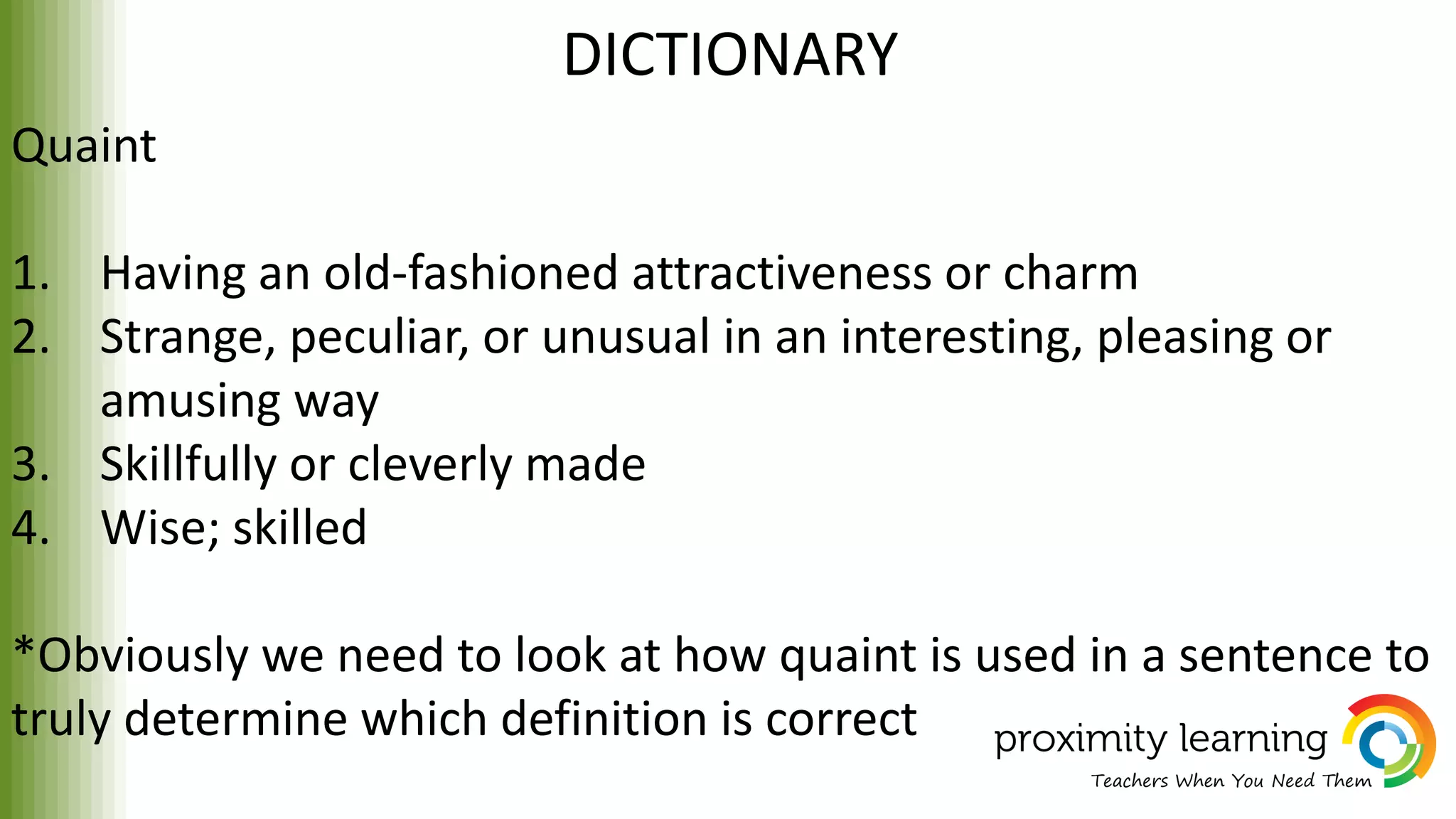
Quaint
1. Having an old-fashioned attractiveness or charm
2. Strange, peculiar, or unusual in an interesting, pleasing or
amusing way
3. Skillfully or cleverly made
4. Wise; skilled
*Obviously we need to look at how quaint is used in a sentence to
truly determine which definition is correct
DICTIONARY
Quaint
1. Having an old-fashioned attractiveness or charm
2. Strange, peculiar, or unusual in an interesting, pleasing or amusing way
3. Skillfully or cleverly made
4. Wise; skilled
Sentence: The quaint little girl usually kept to herself, because she said she had more fun that
way.
Which definition do you think matches the sentence best and why?
CONTEXT CLUES
What if you don’t have a dictionary or are not
allowed to use one? You will have to rely on context
clues, or the hints that an author gives to help define
a difficult or unusual word.
Based on the sentences above, what are “context
clues?”
CONTEXT CLUES
Sometimes the definition of the word will be directly
by it in a passage (just like you saw on the previous
slide).
Sometimes you will see examples of the word.
Ex. Samantha procrastinated to avoid doing his
homework by watching tv, playing video games and
texting his friends.
CONTEXT CLUES
Sometimes there will be a comparison of the word in a
sentence.
Ex. Jane was lethargic and didn’t have the energy to get out
of bed.
Sometimes there will be a contrast of the word in a
sentence.
Ex. Cold weather soon replaced the sweltering heat of
summer.
CONTEXT CLUES
Sometimes there will be synonyms of the word in a
sentence.
Ex. The dates are listed in chronological order. They start at
the beginning and end with the last event.
Sometimes there will be antonyms of the words in a
sentence.
Ex. Emma had a lot of anxiety about the exam, but I had no
worries about it.
CONTEXT CLUES
No matter what clues an author gives you, it is up to you to
dissect the sentence and sentences surrounding it to figure
out what the word in question means.

Discovering words

  • 1.
    Context Clues vs.The Dictionary
  • 2.
    WORDS WE DON’TKNOW We know that when we run across a word that we don’t know we have two options in figuring out the meaning of the word. 1. We can look the word up in a dictionary 2. We can use the context clues in the passage to determine the meaning
  • 3.
    WORDS WE DON’TKNOW Either option is a good option to use. However, if we use one more consistently than another we might run into problems.
  • 4.
    SCENARIO Soon, you willbe taking the SAT if you are looking to go to college. There is NO dictionary usage on the SAT, but there are questions that fall into the category of “WORDS IN CONTEXT.” Meaning that you have to determine the definition of a word based upon context clues and how it is used in the passage.
  • 5.
    THE PROBLEM No doubtthat everyone is going to do their best that they possibly can on the SAT, but if we never work on looking and using context clues to understand the meaning and use of a word, then we might fail miserably at this skill on the SAT test.
  • 6.
    SOLUTION The solution isthat we have to be familiar with both a dictionary and using context clues. These are both skills that you will use until you die. Language is always changing and one day, when you are old, a young teen is going to say a word you have never heard. Context clues or the dictionary will help you determine what they are saying!
  • 7.
    SOLUTION The solution isthat we have to be familiar with both a dictionary and using context clues. These are both skills that you will use until you die. Language is always changing and one day, when you are old, a young teen is going to say a word you have never heard. Context clues or the dictionary will help you determine what they are saying!
  • 8.
    DICTIONARY The dictionary isthe easier option for most people to determine definitions. Lets look at the word “quaint.” If you look up this word at dictionary.com, you will see that “quaint” has 4 definitions all for the same part of speech, an adjective.
  • 9.
    DICTIONARY Quaint 1. Having anold-fashioned attractiveness or charm 2. Strange, peculiar, or unusual in an interesting, pleasing or amusing way 3. Skillfully or cleverly made 4. Wise; skilled *Obviously we need to look at how quaint is used in a sentence to truly determine which definition is correct
  • 10.
    DICTIONARY Quaint 1. Having anold-fashioned attractiveness or charm 2. Strange, peculiar, or unusual in an interesting, pleasing or amusing way 3. Skillfully or cleverly made 4. Wise; skilled Sentence: The quaint little girl usually kept to herself, because she said she had more fun that way. Which definition do you think matches the sentence best and why?
  • 11.
    CONTEXT CLUES What ifyou don’t have a dictionary or are not allowed to use one? You will have to rely on context clues, or the hints that an author gives to help define a difficult or unusual word. Based on the sentences above, what are “context clues?”
  • 12.
    CONTEXT CLUES Sometimes thedefinition of the word will be directly by it in a passage (just like you saw on the previous slide). Sometimes you will see examples of the word. Ex. Samantha procrastinated to avoid doing his homework by watching tv, playing video games and texting his friends.
  • 13.
    CONTEXT CLUES Sometimes therewill be a comparison of the word in a sentence. Ex. Jane was lethargic and didn’t have the energy to get out of bed. Sometimes there will be a contrast of the word in a sentence. Ex. Cold weather soon replaced the sweltering heat of summer.
  • 14.
    CONTEXT CLUES Sometimes therewill be synonyms of the word in a sentence. Ex. The dates are listed in chronological order. They start at the beginning and end with the last event. Sometimes there will be antonyms of the words in a sentence. Ex. Emma had a lot of anxiety about the exam, but I had no worries about it.
  • 15.
    CONTEXT CLUES No matterwhat clues an author gives you, it is up to you to dissect the sentence and sentences surrounding it to figure out what the word in question means.