

By: CHELDY SYGACO ELUMBA-PABLEO,MPA; LLB
A must know before news or feature writing
SUBJECT= is a noun or pronoun that is being
TALK ABOUT in the sentence.
VERB= is an action word. It is what the subject
is doing.
Linking Verb= is a verb that connects the
subject of a sentence to the complement.
It is sometimes called a copula
or a copular verb.
cheldhaye
1. Subjects And Verbs Must Agree In Number.
Plural Subject—with “S”
Singular Subject-without “S”
Plural Verb- Without “S”
Singular Verb-with “S”
RULE: Plural Subject=plural Verb;
Singular Subject=singular verb
Example:
1. The dog growls when he is angry.
2. The dogs growl when they are angry
cheldhaye
2. Words that come between the subject and
verb do not affect agreement.
Example: The dog, who is chewing on my
jeans, is usually very good.
Prepositional phase=adjective
Subject=singular (without “s”
Singular (linking verb)
cheldhaye
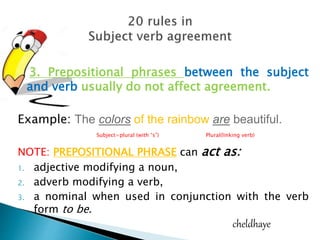
3. Prepositional phrases between the subject
and verb usually do not affect agreement.
Example: The colors of the rainbow are beautiful.
NOTE: PREPOSITIONAL PHRASE can act as:
1. adjective modifying a noun,
2. adverb modifying a verb,
3. a nominal when used in conjunction with the verb
form to be.
Subject=plural (with “s”) Plural(linking verb)
cheldhaye
 4. When sentences start with “there” or “here,”
the SUBJECT will always be placed AFTER the
verb, so care needs to be taken to identify it
correctly.
Example:
1. There is a problem with the balance sheet.
2. Here are the papers you requested.
Singular(linking verb) Singular (subject=without “s”)
Plural (linking verb) Subject=plural (with “s”)
cheldhaye
 Subjects don't always come before verbs in
questions. Make sure you accurately identify
the subject before deciding on the proper
verb form to use.
Example:
1. Does Lefty usually eat grass?
2. Where are the pieces of this puzzle.
singular singularSubject =singular (without “s”)
Plural (linking verb) Subject=plural (with “s”)
cheldhaye
6. If two subjects are joined by AND, they
typically require a plural verb form.
Example:
1. The cow and the pig are jumping over the
moon.
2 Subjects joined by AND =plural
Plural verb
cheldhaye
7. The verb is singular if the two subjects
separated by and refer to the same person or
thing.
Example:
1. Red beans and rice is my mom's
favorite dish.
2 subjects but same mom’s favorite=singular Singular (linking verb)
cheldhaye
8. If one of the words each, every, or
no comes before the subject, the verb is
singular.
Example:
1. No smoking or drinking is allowed.
2. Every man and woman is required to check
in.
Singular verb even 2 subjects=because of “NO”
Singular verb even 2 subjects=because of “EVERY”
cheldhaye
9. If the subjects are both singular and are
connected by the words or, nor,
neither/nor, either/or, and not
only/but also the verb is singular.
Example:
1. Jessica or Christian is to blame for the
accident.
2 singular subject Singular(linking verb)
cheldhaye
10. The only time when the object of the preposition factors
into the decision of plural or singular verb forms is when
noun and pronoun subjects like some, half, none, more, all,
etc. are followed by a prepositional phrase. In these
sentences, the object of the preposition determines the form
of the verb.
Example:
1. All of the chicken is gone.
2. All of the chickens are gone.
subject=singular(without “s” Singular (linking verb)
Subject =plural (with “s”) Singular (linking verb)
cheldhaye
11. The singular verb form is usually used for
units of measurement or time.
Example:
1. Four quarts of oil was required to get
the car running.
Subject=singular (unit of measurement Singular lnking verb
cheldhaye
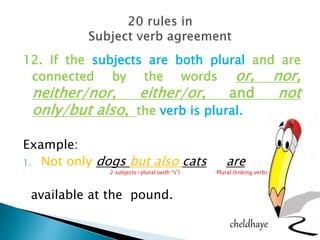
12. If the subjects are both plural and are
connected by the words or, nor,
neither/nor, either/or, and not
only/but also, the verb is plural.
Example:
1. Not only dogs but also cats are
available at the pound.
2 subjects=plural (with “s”) Plural (linking verb)
cheldhaye
13. If one subject is singular and one plural and the
words are connected by the words or, nor,
neither/nor, either/or, and not only/but also, you use
the verb form of the subject that is nearest the verb.
Example:
1. Either the bears or the lion has escaped
from the zoo.
2. Neither the lion nor the bears have
escaped from the zoo.
Nearest subject=singular (without “s”) Singular
Nearest subject=plural (with “s” plural
cheldhaye
14. Indefinite pronouns typically take singular
verbs.
Example:
1. Everybody wants to be loved.
Indefinite pronoun Singular verb=with “s”
cheldhaye
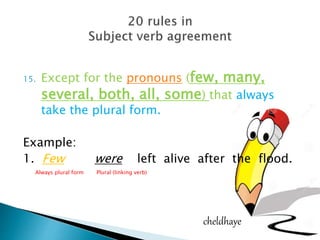
15. Except for the pronouns (few, many,
several, both, all, some) that always
take the plural form.
Example:
1. Few were left alive after the flood.
Plural (linking verb)Always plural form
cheldhaye
16. If two infinitives are separated
by and they take the plural form of the verb.
Example:
1. To walk and to chew gum require great
skill.
2 infinitive subjects =because of “to” Plural verb(without “s”
cheldhaye
17. When gerunds are used as the subject of a
sentence, they take the singular verb form of the
verb; but, when they are linked by and, they
take the plural form.
Example:
1. Standing in the water was a bad idea.
2. Swimming in the ocean and playing drums
are my hobbies.
Gerund subject=singular Singular (linking verb)
2 gerund subjects joined by “and”1. 2.
Plural (linking verb)
cheldhaye
18. Collective nouns like herd, senate, class,
crowd, etc. usually take a singular verb form.
Example:
1. The herd is stampeding.
Collective noun=subject=always singular Singular (linking verb)
cheldhaye
19. Titles of books, movies, novels, etc.
are treated as singular and take a singular
verb.
Example:
1. The Burbs is a movie starring Tom
Hanks.
Title of a movie=always singular Singular (linking verb)
cheldhaye
20. Final Rule – Remember, only the subject
affects the verb.
cheldhaye
Basic english

Basic english

  • 1.
    By: CHELDY SYGACOELUMBA-PABLEO,MPA; LLB A must know before news or feature writing
  • 2.
    SUBJECT= is anoun or pronoun that is being TALK ABOUT in the sentence. VERB= is an action word. It is what the subject is doing. Linking Verb= is a verb that connects the subject of a sentence to the complement. It is sometimes called a copula or a copular verb. cheldhaye
  • 3.
    1. Subjects AndVerbs Must Agree In Number. Plural Subject—with “S” Singular Subject-without “S” Plural Verb- Without “S” Singular Verb-with “S” RULE: Plural Subject=plural Verb; Singular Subject=singular verb Example: 1. The dog growls when he is angry. 2. The dogs growl when they are angry cheldhaye
  • 4.
    2. Words thatcome between the subject and verb do not affect agreement. Example: The dog, who is chewing on my jeans, is usually very good. Prepositional phase=adjective Subject=singular (without “s” Singular (linking verb) cheldhaye
  • 5.
    3. Prepositional phrasesbetween the subject and verb usually do not affect agreement. Example: The colors of the rainbow are beautiful. NOTE: PREPOSITIONAL PHRASE can act as: 1. adjective modifying a noun, 2. adverb modifying a verb, 3. a nominal when used in conjunction with the verb form to be. Subject=plural (with “s”) Plural(linking verb) cheldhaye
  • 6.
     4. Whensentences start with “there” or “here,” the SUBJECT will always be placed AFTER the verb, so care needs to be taken to identify it correctly. Example: 1. There is a problem with the balance sheet. 2. Here are the papers you requested. Singular(linking verb) Singular (subject=without “s”) Plural (linking verb) Subject=plural (with “s”) cheldhaye
  • 7.
     Subjects don'talways come before verbs in questions. Make sure you accurately identify the subject before deciding on the proper verb form to use. Example: 1. Does Lefty usually eat grass? 2. Where are the pieces of this puzzle. singular singularSubject =singular (without “s”) Plural (linking verb) Subject=plural (with “s”) cheldhaye
  • 8.
    6. If twosubjects are joined by AND, they typically require a plural verb form. Example: 1. The cow and the pig are jumping over the moon. 2 Subjects joined by AND =plural Plural verb cheldhaye
  • 9.
    7. The verbis singular if the two subjects separated by and refer to the same person or thing. Example: 1. Red beans and rice is my mom's favorite dish. 2 subjects but same mom’s favorite=singular Singular (linking verb) cheldhaye
  • 10.
    8. If oneof the words each, every, or no comes before the subject, the verb is singular. Example: 1. No smoking or drinking is allowed. 2. Every man and woman is required to check in. Singular verb even 2 subjects=because of “NO” Singular verb even 2 subjects=because of “EVERY” cheldhaye
  • 11.
    9. If thesubjects are both singular and are connected by the words or, nor, neither/nor, either/or, and not only/but also the verb is singular. Example: 1. Jessica or Christian is to blame for the accident. 2 singular subject Singular(linking verb) cheldhaye
  • 12.
    10. The onlytime when the object of the preposition factors into the decision of plural or singular verb forms is when noun and pronoun subjects like some, half, none, more, all, etc. are followed by a prepositional phrase. In these sentences, the object of the preposition determines the form of the verb. Example: 1. All of the chicken is gone. 2. All of the chickens are gone. subject=singular(without “s” Singular (linking verb) Subject =plural (with “s”) Singular (linking verb) cheldhaye
  • 13.
    11. The singularverb form is usually used for units of measurement or time. Example: 1. Four quarts of oil was required to get the car running. Subject=singular (unit of measurement Singular lnking verb cheldhaye
  • 14.
    12. If thesubjects are both plural and are connected by the words or, nor, neither/nor, either/or, and not only/but also, the verb is plural. Example: 1. Not only dogs but also cats are available at the pound. 2 subjects=plural (with “s”) Plural (linking verb) cheldhaye
  • 15.
    13. If onesubject is singular and one plural and the words are connected by the words or, nor, neither/nor, either/or, and not only/but also, you use the verb form of the subject that is nearest the verb. Example: 1. Either the bears or the lion has escaped from the zoo. 2. Neither the lion nor the bears have escaped from the zoo. Nearest subject=singular (without “s”) Singular Nearest subject=plural (with “s” plural cheldhaye
  • 16.
    14. Indefinite pronounstypically take singular verbs. Example: 1. Everybody wants to be loved. Indefinite pronoun Singular verb=with “s” cheldhaye
  • 17.
    15. Except forthe pronouns (few, many, several, both, all, some) that always take the plural form. Example: 1. Few were left alive after the flood. Plural (linking verb)Always plural form cheldhaye
  • 18.
    16. If twoinfinitives are separated by and they take the plural form of the verb. Example: 1. To walk and to chew gum require great skill. 2 infinitive subjects =because of “to” Plural verb(without “s” cheldhaye
  • 19.
    17. When gerundsare used as the subject of a sentence, they take the singular verb form of the verb; but, when they are linked by and, they take the plural form. Example: 1. Standing in the water was a bad idea. 2. Swimming in the ocean and playing drums are my hobbies. Gerund subject=singular Singular (linking verb) 2 gerund subjects joined by “and”1. 2. Plural (linking verb) cheldhaye
  • 20.
    18. Collective nounslike herd, senate, class, crowd, etc. usually take a singular verb form. Example: 1. The herd is stampeding. Collective noun=subject=always singular Singular (linking verb) cheldhaye
  • 21.
    19. Titles ofbooks, movies, novels, etc. are treated as singular and take a singular verb. Example: 1. The Burbs is a movie starring Tom Hanks. Title of a movie=always singular Singular (linking verb) cheldhaye
  • 22.
    20. Final Rule– Remember, only the subject affects the verb. cheldhaye