Sometimes when we are reading, we don’t know what a
word means! What do we do?
Just like a detective, we have to use clues! There are
words or phrases around unfamiliar words that can help us
understand the meaning of a word.
These words or phrases are called context clues.
Learning how to use these clues can help us understand
the meaning of the word, help us to understand the
reading, improve our vocabulary and save us from using
Google or the dictionary!
We Make Guesses Based on the
Information We Know!
Let’s Try It…
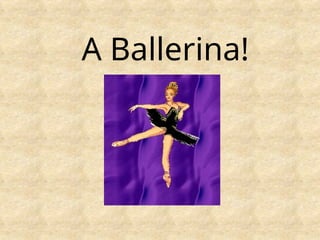
I'll tell you about
the career that I chose;
it definitely keeps me
on my toes.
I've been practicing since
a very young age.
Now I travel around
and perform on the stage.
I'm graceful and pretty,
but I'm also real strong.
My body is thin
and my legs are quite long.
I often wear pink
and love satin and lace.
Watch me twirl, flit and flutter
all over the place.
A Ballerina!
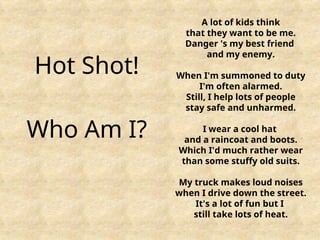
Hot Shot!
Who Am I?
A lot of kids think
that they want to be me.
Danger 's my best friend
and my enemy.
When I'm summoned to duty
I'm often alarmed.
Still, I help lots of people
stay safe and unharmed.
I wear a cool hat
and a raincoat and boots.
Which I'd much rather wear
than some stuffy old suits.
My truck makes loud noises
when I drive down the street.
It's a lot of fun but I
still take lots of heat.
 Context Clues are words that say, “Stop -
don’t touch that dictionary! The definition of
the word you don’t know is right here in the
text!“
 Context Clues - Information a reader can get
from the reading that helps show what a
word or group of words means.
 Like in a mystery, you have to use the clues
to find the answer!
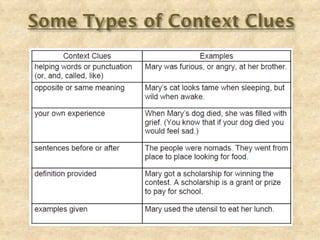
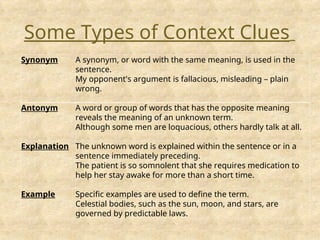
Synonym A synonym, or word with the same meaning, is used in the
sentence.
My opponent's argument is fallacious, misleading – plain
wrong.
Antonym A word or group of words that has the opposite meaning
reveals the meaning of an unknown term.
Although some men are loquacious, others hardly talk at all.
Explanation The unknown word is explained within the sentence or in a
sentence immediately preceding.
The patient is so somnolent that she requires medication to
help her stay awake for more than a short time.
Example Specific examples are used to define the term.
Celestial bodies, such as the sun, moon, and stars, are
governed by predictable laws.
Some Types of Context Clues
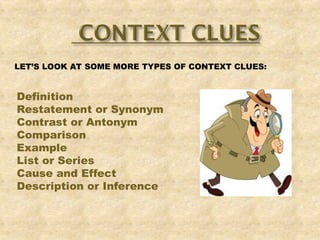
LET’S LOOK AT SOME MORE TYPES OF CONTEXT CLUES:
Definition
Restatement or Synonym
Contrast or Antonym
Comparison
Example
List or Series
Cause and Effect
Description or Inference
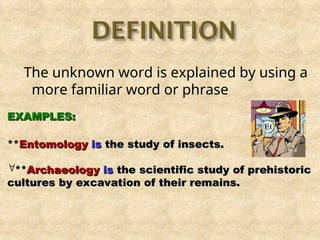
The unknown word is explained by using a
more familiar word or phrase
EXAMPLES:
EXAMPLES:
**
**Entomology
Entomology is
is the study of insects.
the study of insects.
**
**Archaeology
Archaeology is
is the scientific study of prehistoric
the scientific study of prehistoric
cultures by excavation of their remains.
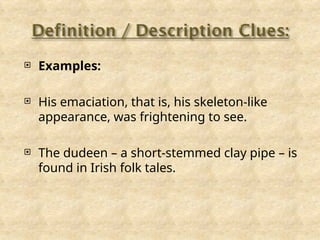
 Examples:
 His emaciation, that is, his skeleton-like
appearance, was frightening to see.
 The dudeen – a short-stemmed clay pipe – is
found in Irish folk tales.
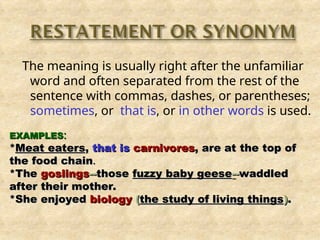
The meaning is usually right after the unfamiliar
word and often separated from the rest of the
sentence with commas, dashes, or parentheses;
sometimes, or that is, or in other words is used.
EXAMPLES
EXAMPLES:
:
*
*Meat eaters
Meat eaters,
, that is
that is carnivores
carnivores, are at the top of
, are at the top of
the food chain
the food chain.
.
*The
*The goslings
goslings--
--those
those fuzzy baby geese
fuzzy baby geese-
--
-waddled
waddled
after their mother.
after their mother.
*She enjoyed
*She enjoyed biology
biology (
(the study of living things
the study of living things)
).
.
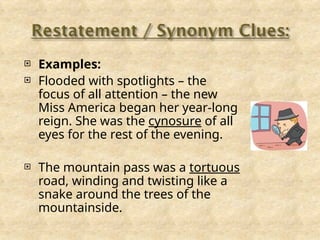
 Examples:
 Flooded with spotlights – the
focus of all attention – the new
Miss America began her year-long
reign. She was the cynosure of all
eyes for the rest of the evening.
 The mountain pass was a tortuous
road, winding and twisting like a
snake around the trees of the
mountainside.
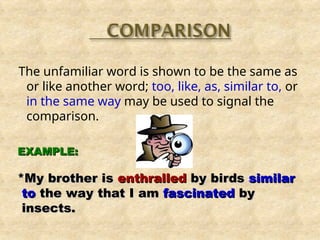
The unfamiliar word is shown to be the same as
or like another word; too, like, as, similar to, or
in the same way may be used to signal the
comparison.
EXAMPLE:
EXAMPLE:
*My brother is
*My brother is enthralled
enthralled by birds
by birds similar
similar
to
to the way that I am
the way that I am fascinated
fascinated by
by
insects.
insects.
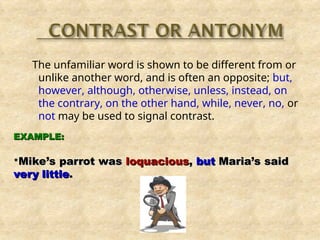
The unfamiliar word is shown to be different from or
unlike another word, and is often an opposite; but,
however, although, otherwise, unless, instead, on
the contrary, on the other hand, while, never, no, or
not may be used to signal contrast.
EXAMPLE:
EXAMPLE:
*
*Mike’s parrot was
Mike’s parrot was loquacious
loquacious,
, but
but Maria’s said
Maria’s said
very little
very little.
.
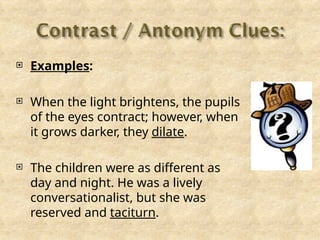
 Examples:
 When the light brightens, the pupils
of the eyes contract; however, when
it grows darker, they dilate.
 The children were as different as
day and night. He was a lively
conversationalist, but she was
reserved and taciturn.
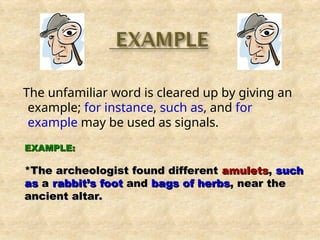
The unfamiliar word is cleared up by giving an
example; for instance, such as, and for
example may be used as signals.
EXAMPLE:
EXAMPLE:
*The archeologist found different
*The archeologist found different amulets
amulets,
, such
such
as
as a
a rabbit’s foot
rabbit’s foot and
and bags of herbs
bags of herbs, near the
, near the
ancient altar.
ancient altar.
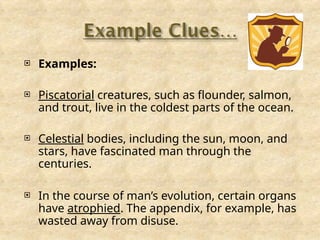
 Examples:
 Piscatorial creatures, such as flounder, salmon,
and trout, live in the coldest parts of the ocean.
 Celestial bodies, including the sun, moon, and
stars, have fascinated man through the
centuries.
 In the course of man’s evolution, certain organs
have atrophied. The appendix, for example, has
wasted away from disuse.
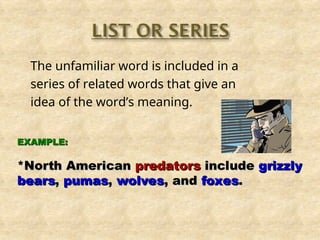
The unfamiliar word is included in a
series of related words that give an
idea of the word’s meaning.
EXAMPLE:
EXAMPLE:
*North American
*North American predators
predators include
include grizzly
grizzly
bears
bears,
, pumas
pumas,
, wolves
wolves, and
, and foxes
foxes.
.
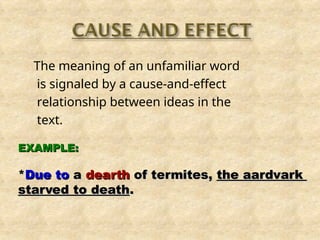
The meaning of an unfamiliar word
is signaled by a cause-and-effect
relationship between ideas in the
text.
EXAMPLE:
EXAMPLE:
*
*Due to
Due to a
a dearth
dearth of termites,
of termites, the aardvark
the aardvark
starved to death
starved to death.
.
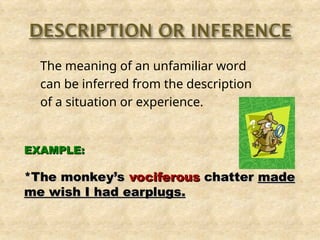
The meaning of an unfamiliar word
can be inferred from the description
of a situation or experience.
EXAMPLE:
EXAMPLE:
*The monkey’s
*The monkey’s vociferous
vociferous chatter
chatter made
made
me wish I had earplugs.
 Example:
 She told her friend, “I’m through with blind
dates forever. What a dull evening! I was
bored every minute. The conversation was
absolutely vapid.”
 Example:
She wanted to impress all her dinner guests
with the food she served, so she carefully
studied the necessary culinary arts.
 Sometimes it’s important to look at the
word itself to find the meaning. Many
words are made up of common “parts.”
 If you know the meaning of part of a word,
you might be able to guess the meaning.
 Words are often made up of prefixes,
suffixes and root or base words.
 By studying prefixes, suffixes and
root/base words we can build our
vocabulary.
 The history of a word tells us a lot about
what it might mean! Many words have
Greek, Latin or French origins!
Examples:
The story is incredible.
The root cred means “to believe,” and the prefix in- means
“not.” Therefore, if a story is incredible, it is unbelievable.
The somnambulist had to be locked in his bedroom at night
for his own safety.
If a reader knows the meaning of ambular (walk) and somn
(sleep) and sees the sentence, the reader may realize that a
“somnambulist” is a sleepwalker.

contextcluespowerpoint- presentation ppt

  • 1.
    Sometimes when weare reading, we don’t know what a word means! What do we do? Just like a detective, we have to use clues! There are words or phrases around unfamiliar words that can help us understand the meaning of a word. These words or phrases are called context clues. Learning how to use these clues can help us understand the meaning of the word, help us to understand the reading, improve our vocabulary and save us from using Google or the dictionary!
  • 2.
    We Make GuessesBased on the Information We Know! Let’s Try It…
  • 3.
    I'll tell youabout the career that I chose; it definitely keeps me on my toes. I've been practicing since a very young age. Now I travel around and perform on the stage. I'm graceful and pretty, but I'm also real strong. My body is thin and my legs are quite long. I often wear pink and love satin and lace. Watch me twirl, flit and flutter all over the place.
  • 4.
  • 5.
    Hot Shot! Who AmI? A lot of kids think that they want to be me. Danger 's my best friend and my enemy. When I'm summoned to duty I'm often alarmed. Still, I help lots of people stay safe and unharmed. I wear a cool hat and a raincoat and boots. Which I'd much rather wear than some stuffy old suits. My truck makes loud noises when I drive down the street. It's a lot of fun but I still take lots of heat.
  • 7.
     Context Cluesare words that say, “Stop - don’t touch that dictionary! The definition of the word you don’t know is right here in the text!“  Context Clues - Information a reader can get from the reading that helps show what a word or group of words means.  Like in a mystery, you have to use the clues to find the answer!
  • 9.
    Synonym A synonym,or word with the same meaning, is used in the sentence. My opponent's argument is fallacious, misleading – plain wrong. Antonym A word or group of words that has the opposite meaning reveals the meaning of an unknown term. Although some men are loquacious, others hardly talk at all. Explanation The unknown word is explained within the sentence or in a sentence immediately preceding. The patient is so somnolent that she requires medication to help her stay awake for more than a short time. Example Specific examples are used to define the term. Celestial bodies, such as the sun, moon, and stars, are governed by predictable laws. Some Types of Context Clues
  • 10.
    LET’S LOOK ATSOME MORE TYPES OF CONTEXT CLUES: Definition Restatement or Synonym Contrast or Antonym Comparison Example List or Series Cause and Effect Description or Inference
  • 11.
    The unknown wordis explained by using a more familiar word or phrase EXAMPLES: EXAMPLES: ** **Entomology Entomology is is the study of insects. the study of insects. ** **Archaeology Archaeology is is the scientific study of prehistoric the scientific study of prehistoric cultures by excavation of their remains. cultures by excavation of their remains.
  • 12.
     Examples:  Hisemaciation, that is, his skeleton-like appearance, was frightening to see.  The dudeen – a short-stemmed clay pipe – is found in Irish folk tales.
  • 13.
    The meaning isusually right after the unfamiliar word and often separated from the rest of the sentence with commas, dashes, or parentheses; sometimes, or that is, or in other words is used. EXAMPLES EXAMPLES: : * *Meat eaters Meat eaters, , that is that is carnivores carnivores, are at the top of , are at the top of the food chain the food chain. . *The *The goslings goslings-- --those those fuzzy baby geese fuzzy baby geese- -- -waddled waddled after their mother. after their mother. *She enjoyed *She enjoyed biology biology ( (the study of living things the study of living things) ). .
  • 14.
     Examples:  Floodedwith spotlights – the focus of all attention – the new Miss America began her year-long reign. She was the cynosure of all eyes for the rest of the evening.  The mountain pass was a tortuous road, winding and twisting like a snake around the trees of the mountainside.
  • 15.
    The unfamiliar wordis shown to be the same as or like another word; too, like, as, similar to, or in the same way may be used to signal the comparison. EXAMPLE: EXAMPLE: *My brother is *My brother is enthralled enthralled by birds by birds similar similar to to the way that I am the way that I am fascinated fascinated by by insects. insects.
  • 16.
    The unfamiliar wordis shown to be different from or unlike another word, and is often an opposite; but, however, although, otherwise, unless, instead, on the contrary, on the other hand, while, never, no, or not may be used to signal contrast. EXAMPLE: EXAMPLE: * *Mike’s parrot was Mike’s parrot was loquacious loquacious, , but but Maria’s said Maria’s said very little very little. .
  • 17.
     Examples:  Whenthe light brightens, the pupils of the eyes contract; however, when it grows darker, they dilate.  The children were as different as day and night. He was a lively conversationalist, but she was reserved and taciturn.
  • 18.
    The unfamiliar wordis cleared up by giving an example; for instance, such as, and for example may be used as signals. EXAMPLE: EXAMPLE: *The archeologist found different *The archeologist found different amulets amulets, , such such as as a a rabbit’s foot rabbit’s foot and and bags of herbs bags of herbs, near the , near the ancient altar. ancient altar.
  • 19.
     Examples:  Piscatorialcreatures, such as flounder, salmon, and trout, live in the coldest parts of the ocean.  Celestial bodies, including the sun, moon, and stars, have fascinated man through the centuries.  In the course of man’s evolution, certain organs have atrophied. The appendix, for example, has wasted away from disuse.
  • 20.
    The unfamiliar wordis included in a series of related words that give an idea of the word’s meaning. EXAMPLE: EXAMPLE: *North American *North American predators predators include include grizzly grizzly bears bears, , pumas pumas, , wolves wolves, and , and foxes foxes. .
  • 21.
    The meaning ofan unfamiliar word is signaled by a cause-and-effect relationship between ideas in the text. EXAMPLE: EXAMPLE: * *Due to Due to a a dearth dearth of termites, of termites, the aardvark the aardvark starved to death starved to death. .
  • 22.
    The meaning ofan unfamiliar word can be inferred from the description of a situation or experience. EXAMPLE: EXAMPLE: *The monkey’s *The monkey’s vociferous vociferous chatter chatter made made me wish I had earplugs. me wish I had earplugs.
  • 23.
     Example:  Shetold her friend, “I’m through with blind dates forever. What a dull evening! I was bored every minute. The conversation was absolutely vapid.”
  • 24.
     Example: She wantedto impress all her dinner guests with the food she served, so she carefully studied the necessary culinary arts.
  • 25.
     Sometimes it’simportant to look at the word itself to find the meaning. Many words are made up of common “parts.”  If you know the meaning of part of a word, you might be able to guess the meaning.  Words are often made up of prefixes, suffixes and root or base words.  By studying prefixes, suffixes and root/base words we can build our vocabulary.  The history of a word tells us a lot about what it might mean! Many words have Greek, Latin or French origins!
  • 26.
    Examples: The story isincredible. The root cred means “to believe,” and the prefix in- means “not.” Therefore, if a story is incredible, it is unbelievable. The somnambulist had to be locked in his bedroom at night for his own safety. If a reader knows the meaning of ambular (walk) and somn (sleep) and sees the sentence, the reader may realize that a “somnambulist” is a sleepwalker.