Punctuation
The Semicolon ;
WHAT DO THESE SENTENCES HAVE IN COMMON?
Alma likes salad; Rick likes pizza.
Sam was going bald; his hair was falling out.
She didn’t see the step in time; She now has a bandage on
her head.
SEMICOLON
A ; (semicolon) is a type of punctuation mark that is used when
someone wants to input a pause, usually between two main clauses, but
doesn’t want to use a conjunction (and, but, or, so). The two main
clauses MUST share a logical connection for a semicolon to be used. You
cannot just combine two sentences with a semicolon that have nothing
to do with each other.
• Remember that a main clause is an independent clause (it will have a noun and a verb
and make sense on its own.)
• Semicolons are important to know how to use. We do not use them a lot, because we
are more comfortable just putting a period at the end of a sentence.
SEMICOLON
The easiest way to know if you can use a ; is to see if you have a
run-on sentence (or really close to having one), but you are not
done with your thought yet. So, you can insert a ; (semicolon) to
show a pause between two clauses (remember there has to be a
noun and verb for each clause) but still continue your thought.
Example: I put my phone in the other room; therefore, I got some
studying done.
• You can see that there is a semi-colon combining two clauses.
• Each clause has a noun and a verb (as highlighted).
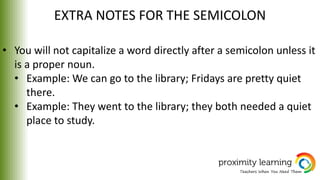
EXTRA NOTES FOR THE SEMICOLON
• You will not capitalize a word directly after a semicolon unless it
is a proper noun.
• Example: We can go to the library; Fridays are pretty quiet
there.
• Example: They went to the library; they both needed a quiet
place to study.
SEMICOLON
Another time you can use a ; (semicolon) is when
you need to separate items in a list and the list itself
already contains commas.
Example: The business trip will take him to New
York, New York; Miami, Florida; and Austin, Texas.
• If someone didn’t know the United States very well, reading this list would be very confusing without
semicolons.
EXAMPLES OF SEMICOLON
1. I have a big test tomorrow; I can't go out tonight.
2. Star Trek was my favorite television show during the 1960s; in
fact, it is my favorite television show of all time.
3. You should choose ham, chicken, or char-grilled vegetable
sandwiches; cups of tea, Bovril, or coffee (if you don't mind them
lukewarm); or red wine (one of the few options that's drinkable
when lukewarm). Why do we need semicolons in this sentence? What is the purpose?
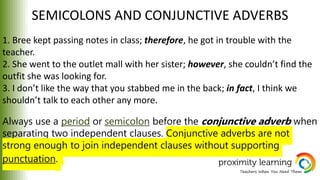
SEMICOLONS AND CONJUNCTIVE ADVERBS
1. Bree kept passing notes in class; therefore, he got in trouble with the
teacher.
2. She went to the outlet mall with her sister; however, she couldn’t find the
outfit she was looking for.
3. I don’t like the way that you stabbed me in the back; in fact, I think we
shouldn’t talk to each other any more.
Always use a period or semicolon before the conjunctive adverb when
separating two independent clauses. Conjunctive adverbs are not
strong enough to join independent clauses without supporting
punctuation.
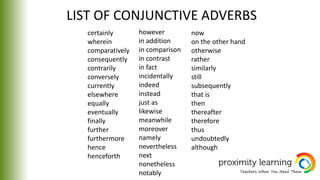
LIST OF CONJUNCTIVE ADVERBS
certainly
wherein
comparatively
consequently
contrarily
conversely
currently
elsewhere
equally
eventually
finally
further
furthermore
hence
henceforth
however
in addition
in comparison
in contrast
in fact
incidentally
indeed
instead
just as
likewise
meanwhile
moreover
namely
nevertheless
next
nonetheless
notably
now
on the other hand
otherwise
rather
similarly
still
subsequently
that is
then
thereafter
therefore
thus
undoubtedly
although
PRACTICE
Directions: Decide if the semicolons used below are used to combine two clauses,
used in a list, or used to support a conjunctive adverb. Make sure you can explain
your answer.
1. I ate an entire pizza for lunch; consequently, my stomach now hurts.
2. I want to go visit London, England; Sydney, Australia; and Honolulu, Hawaii.
3. The two year old went to bed early; therefore, he woke up even earlier the next
morning.
4. I like pizza; I had some for dinner.
5. Would you rather go to McAllen, Texas; New Braunfels, Texas; or Dallas, Texas?

9th grade semicolons

  • 1.
  • 2.
    WHAT DO THESESENTENCES HAVE IN COMMON? Alma likes salad; Rick likes pizza. Sam was going bald; his hair was falling out. She didn’t see the step in time; She now has a bandage on her head.
  • 3.
    SEMICOLON A ; (semicolon)is a type of punctuation mark that is used when someone wants to input a pause, usually between two main clauses, but doesn’t want to use a conjunction (and, but, or, so). The two main clauses MUST share a logical connection for a semicolon to be used. You cannot just combine two sentences with a semicolon that have nothing to do with each other. • Remember that a main clause is an independent clause (it will have a noun and a verb and make sense on its own.) • Semicolons are important to know how to use. We do not use them a lot, because we are more comfortable just putting a period at the end of a sentence.
  • 4.
    SEMICOLON The easiest wayto know if you can use a ; is to see if you have a run-on sentence (or really close to having one), but you are not done with your thought yet. So, you can insert a ; (semicolon) to show a pause between two clauses (remember there has to be a noun and verb for each clause) but still continue your thought. Example: I put my phone in the other room; therefore, I got some studying done. • You can see that there is a semi-colon combining two clauses. • Each clause has a noun and a verb (as highlighted).
  • 5.
    EXTRA NOTES FORTHE SEMICOLON • You will not capitalize a word directly after a semicolon unless it is a proper noun. • Example: We can go to the library; Fridays are pretty quiet there. • Example: They went to the library; they both needed a quiet place to study.
  • 6.
    SEMICOLON Another time youcan use a ; (semicolon) is when you need to separate items in a list and the list itself already contains commas. Example: The business trip will take him to New York, New York; Miami, Florida; and Austin, Texas. • If someone didn’t know the United States very well, reading this list would be very confusing without semicolons.
  • 7.
    EXAMPLES OF SEMICOLON 1.I have a big test tomorrow; I can't go out tonight. 2. Star Trek was my favorite television show during the 1960s; in fact, it is my favorite television show of all time. 3. You should choose ham, chicken, or char-grilled vegetable sandwiches; cups of tea, Bovril, or coffee (if you don't mind them lukewarm); or red wine (one of the few options that's drinkable when lukewarm). Why do we need semicolons in this sentence? What is the purpose?
  • 8.
    SEMICOLONS AND CONJUNCTIVEADVERBS 1. Bree kept passing notes in class; therefore, he got in trouble with the teacher. 2. She went to the outlet mall with her sister; however, she couldn’t find the outfit she was looking for. 3. I don’t like the way that you stabbed me in the back; in fact, I think we shouldn’t talk to each other any more. Always use a period or semicolon before the conjunctive adverb when separating two independent clauses. Conjunctive adverbs are not strong enough to join independent clauses without supporting punctuation.
  • 9.
    LIST OF CONJUNCTIVEADVERBS certainly wherein comparatively consequently contrarily conversely currently elsewhere equally eventually finally further furthermore hence henceforth however in addition in comparison in contrast in fact incidentally indeed instead just as likewise meanwhile moreover namely nevertheless next nonetheless notably now on the other hand otherwise rather similarly still subsequently that is then thereafter therefore thus undoubtedly although
  • 10.
    PRACTICE Directions: Decide ifthe semicolons used below are used to combine two clauses, used in a list, or used to support a conjunctive adverb. Make sure you can explain your answer. 1. I ate an entire pizza for lunch; consequently, my stomach now hurts. 2. I want to go visit London, England; Sydney, Australia; and Honolulu, Hawaii. 3. The two year old went to bed early; therefore, he woke up even earlier the next morning. 4. I like pizza; I had some for dinner. 5. Would you rather go to McAllen, Texas; New Braunfels, Texas; or Dallas, Texas?