This document discusses two figures of speech: euphemism and oxymoron. Euphemism is using a mild or inoffensive word or phrase in place of one that is harsh or offensive. Examples given are using "passed gas" instead of "fart" and "economically disadvantaged" instead of "poor." Oxymoron is a phrase that contradicts itself to create drama or humor, like "civil war" or "jumbo shrimp." The document provides examples of each and asks the reader to analyze examples as euphemisms or oxymorons.
FIGURES OF SPEECH
Thereare many types of figures of speech. Figures of
speech allow people to say a word or a phrases through
different means in order to provide more emphasis or
insight.
Our Focus: Euphemism, Oxymoron
3.
EUPHEMISM
Euphemism- an inoffensiveword or phrase that
stands in for another word or phrase whose
meaning is offensive to most hearers.
Example: Instead of saying “fart,” you say
“passed gas.” “Passed gas” is a Euphemism.
4.
EUPHEMISM EXAMPLES
Offensive Word(s)Euphemism
You are fired. We are going to have to let you go.
Poor Economically Disadvantaged
Unwanted Call Courtesy Call
Slum Culturally Deprived Neighborhood
Broke Temporary Negative Cash Flow
Used Pre-Owned
Died Passed-Away
5.
EUPHEMISM PRACTICE
Directions: Theunderlined word(s) in each sentence is a
Euphemism. See if you can determine the “harsh word(s) it is
replacing.
1. That adult beverage is not good for you this early in the
morning.
2. She appeared to have a screw loose the other day.
3. His unmentionables stay in the top drawer of his closet.
6.
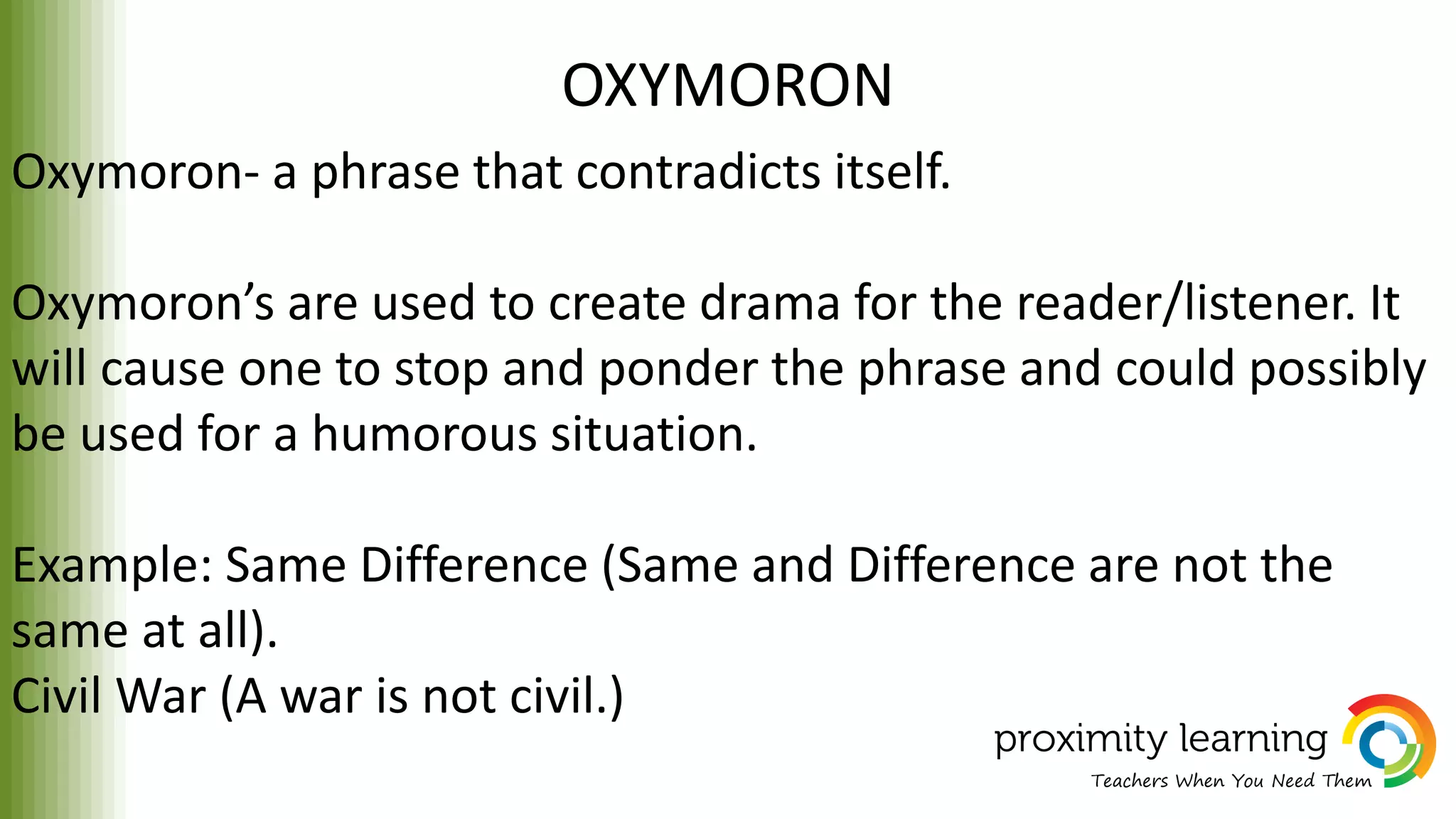
OXYMORON
Oxymoron- a phrasethat contradicts itself.
Oxymoron’s are used to create drama for the reader/listener. It
will cause one to stop and ponder the phrase and could possibly
be used for a humorous situation.
Example: Same Difference (Same and Difference are not the
same at all).
Civil War (A war is not civil.)
7.
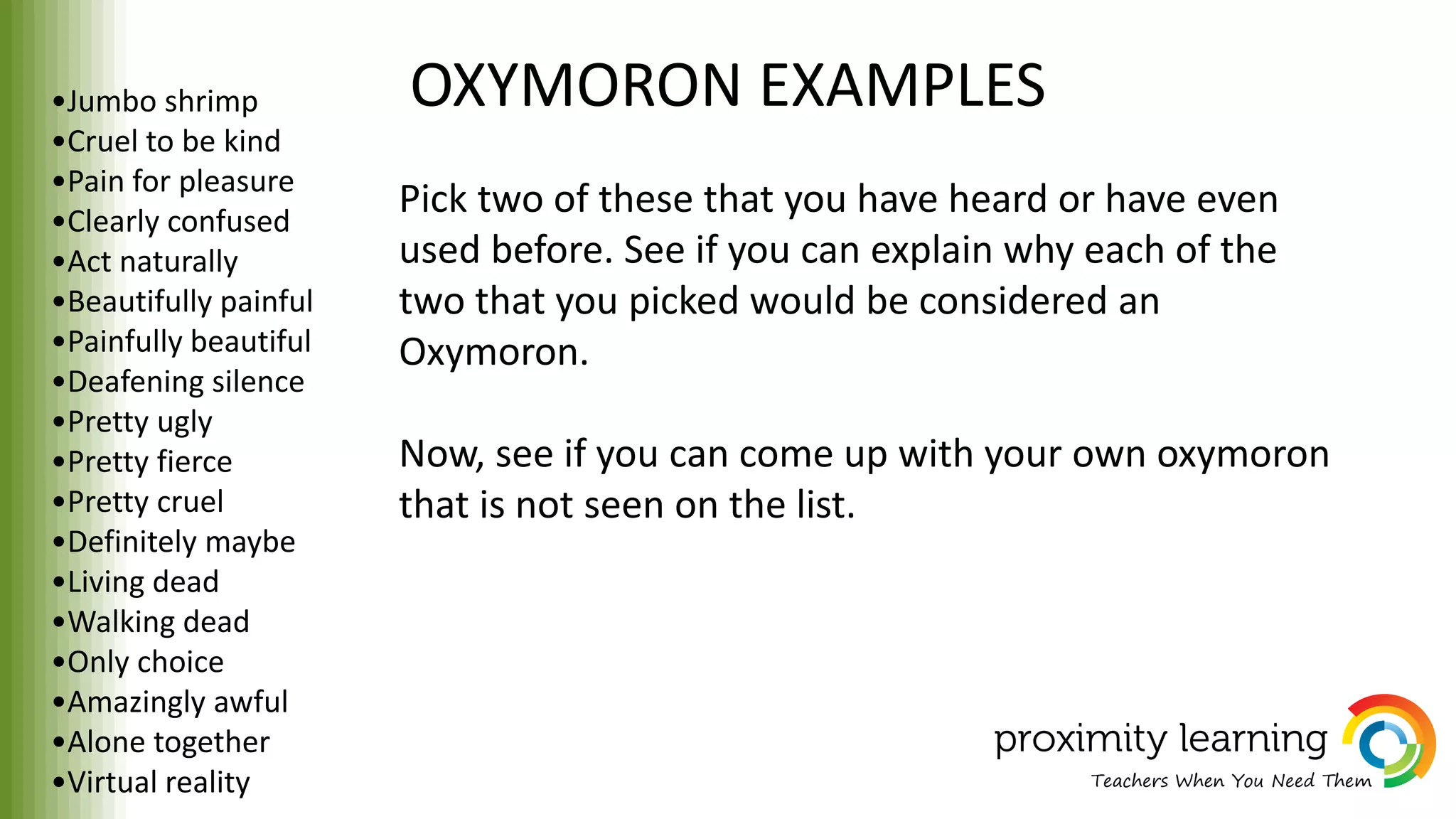
OXYMORON EXAMPLES•Jumbo shrimp
•Cruelto be kind
•Pain for pleasure
•Clearly confused
•Act naturally
•Beautifully painful
•Painfully beautiful
•Deafening silence
•Pretty ugly
•Pretty fierce
•Pretty cruel
•Definitely maybe
•Living dead
•Walking dead
•Only choice
•Amazingly awful
•Alone together
•Virtual reality
Pick two of these that you have heard or have even
used before. See if you can explain why each of the
two that you picked would be considered an
Oxymoron.
Now, see if you can come up with your own oxymoron
that is not seen on the list.