Discount Driver
The Problem
๏ต Texting while driving is costly to yourself and your
community
๏ต Up to 330,000 people injured5, 178 killed in one year
thanks to cell phone use1 175 billion in
damages from distracted driving in
one year
๏ต Major problem for both society
and insurance companies
Current Solutions
๏ต Utah law prohibits use of cellphone while car is moving2
Cellphones laws donโ€™t reduce usage; they actually increase it3
๏ต Allows for handsfree conversations, which reduces reaction
times to that of drunk drivers4 Self control to not use phone:
80% of teens admit to using cellphone while driving4
Our Solution: Individual Application
๏ต Discount Driver is an innovative app to that deters
phone use while driving by rewarding good drivers
with discounts to local businesses
๏ต Drivers would receive points only if entire drive is
phone free. Point quantity would be based on
length of journey
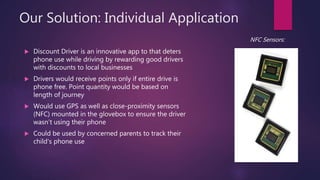
๏ต Would use GPS as well as close-proximity sensors
(NFC) mounted in the glovebox to ensure the driver
wasnโ€™t using their phone
๏ต Could be used by concerned parents to track their
child's phone use
NFC Sensors:
Our Solution: Insurance Companies
๏ต Discount Driver would be used by insurance companies
to prove that a driver was or wasnโ€™t on their phone at the
time of accident
๏ต Would be used to reduce insurance rates in response to
consistent good behavior
๏ต Using NFC sensors mounted in the car gives Discount
Driver the unique advantage of being able to track the
drivers behavior whenever their in the car, while not
tracking them while their on public transportation or
catching a ride
The Customer
๏ต Drivers who want to get rewarded for doing their part to make the roads
safer
๏ต Drivers who struggle with phone usage while driving, who think they can
answer that โ€œoneโ€ text at the red light but canโ€™t quite finish it and then
rear-end you making you late to your Calculus test
๏ต Parentโ€™s who are concerned about the safety of their kids and property
๏ต Insurance companies looking to reduce cost of accidents (175 billion per
year caused by cellphone use)
The Solution: Feasibility and
Competion
Drivers Insurance Side
โ€ข Pocket points, inspiration for Discount
Driver, gives discounts for not using
phones in class. Its wide reception, with
both businesses offering discounts and
students earning them, proves the
feasibility of a coupon incentive system.
โ€ข Many insurance companies have apps
that lower rates based on driving
habits. These apps have bad reception,
however. According to Allstate agent
Lisa Eshleman, this is because
consumers dislike โ€œbig brotherโ€ tracking
โ€ข Consumer dislike can be solved through
coupon incentive (shifting decision to
run app from insurance company to
individual)
โ€ข Discount Driver, through use of NFC
sensors, allows insurance companies to
differentiate phone usage between
driver and passenger, enabling them to
change rates based on phone usage.
This feature is unique and not part of
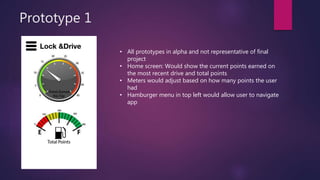
Prototype 1
โ€ข All prototypes in alpha and not representative of final
project
โ€ข Home screen: Would show the current points earned on
the most recent drive and total points
โ€ข Meters would adjust based on how many points the user
had
โ€ข Hamburger menu in top left would allow user to navigate
app
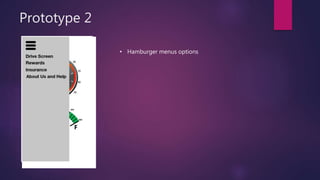
Prototype 2
โ€ข Hamburger menus options
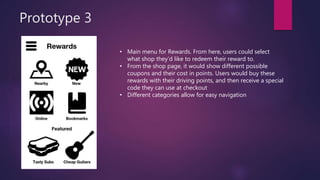
Prototype 3
โ€ข Main menu for Rewards. From here, users could select
what shop theyโ€™d like to redeem their reward to.
โ€ข From the shop page, it would show different possible
coupons and their cost in points. Users would buy these
rewards with their driving points, and then receive a special
code they can use at checkout
โ€ข Different categories allow for easy navigation
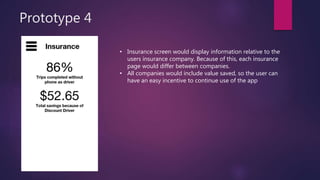
Prototype 4
โ€ข Insurance screen would display information relative to the
users insurance company. Because of this, each insurance
page would differ between companies.
โ€ข All companies would include value saved, so the user can
have an easy incentive to continue use of the app
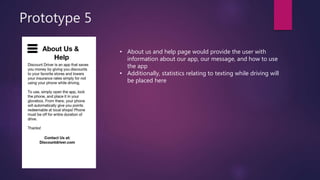
Prototype 5
โ€ข About us and help page would provide the user with
information about our app, our message, and how to use
the app
โ€ข Additionally, statistics relating to texting while driving will
be placed here
The Nitty-Gritty
๏ต The app would work by connecting the phone to the NFC sensor in a car,
validating the phone is one of the accepted owner phones of the car, and
then use GPS data to track when the car starts moving to when it finishes
moving. A NFC sensor would be attached in the glovebox securely enough
to prevent it from being moved by the driver. If moved, a seal would be
broken that proves this. While connected to NFC and GPS, the phone will
register and jumps in the accelerometer, the time they occurred, and
whether the phone was locked in the glovebox. This is used to track
accidents. To prevent the phone from registering that its locked when the
user isnโ€™t actually driving, the phone will only connect to specified cars
sensors.
References
1. https://crashstats.nhtsa.dot.gov/Api/Public/ViewPublication/812013
2. https://le.utah.gov/xcode/Title41/Chapter6A/41-6a-S1716.html
3. https://trid.trb.org/view.aspx?id=981977
4. https://www.ncbi.nlm.nih.gov/pmc/articles/PMC3710028/
5. https://www.edgarsnyder.com/car-accident/cause-of-accident/cell-
phone/cell-phone-statistics.html

Discount driver

  • 1.
  • 2.
    The Problem ๏ต Textingwhile driving is costly to yourself and your community ๏ต Up to 330,000 people injured5, 178 killed in one year thanks to cell phone use1 175 billion in damages from distracted driving in one year ๏ต Major problem for both society and insurance companies
  • 3.
    Current Solutions ๏ต Utahlaw prohibits use of cellphone while car is moving2 Cellphones laws donโ€™t reduce usage; they actually increase it3 ๏ต Allows for handsfree conversations, which reduces reaction times to that of drunk drivers4 Self control to not use phone: 80% of teens admit to using cellphone while driving4
  • 4.
    Our Solution: IndividualApplication ๏ต Discount Driver is an innovative app to that deters phone use while driving by rewarding good drivers with discounts to local businesses ๏ต Drivers would receive points only if entire drive is phone free. Point quantity would be based on length of journey ๏ต Would use GPS as well as close-proximity sensors (NFC) mounted in the glovebox to ensure the driver wasnโ€™t using their phone ๏ต Could be used by concerned parents to track their child's phone use NFC Sensors:
  • 5.
    Our Solution: InsuranceCompanies ๏ต Discount Driver would be used by insurance companies to prove that a driver was or wasnโ€™t on their phone at the time of accident ๏ต Would be used to reduce insurance rates in response to consistent good behavior ๏ต Using NFC sensors mounted in the car gives Discount Driver the unique advantage of being able to track the drivers behavior whenever their in the car, while not tracking them while their on public transportation or catching a ride
  • 6.
    The Customer ๏ต Driverswho want to get rewarded for doing their part to make the roads safer ๏ต Drivers who struggle with phone usage while driving, who think they can answer that โ€œoneโ€ text at the red light but canโ€™t quite finish it and then rear-end you making you late to your Calculus test ๏ต Parentโ€™s who are concerned about the safety of their kids and property ๏ต Insurance companies looking to reduce cost of accidents (175 billion per year caused by cellphone use)
  • 7.
    The Solution: Feasibilityand Competion Drivers Insurance Side โ€ข Pocket points, inspiration for Discount Driver, gives discounts for not using phones in class. Its wide reception, with both businesses offering discounts and students earning them, proves the feasibility of a coupon incentive system. โ€ข Many insurance companies have apps that lower rates based on driving habits. These apps have bad reception, however. According to Allstate agent Lisa Eshleman, this is because consumers dislike โ€œbig brotherโ€ tracking โ€ข Consumer dislike can be solved through coupon incentive (shifting decision to run app from insurance company to individual) โ€ข Discount Driver, through use of NFC sensors, allows insurance companies to differentiate phone usage between driver and passenger, enabling them to change rates based on phone usage. This feature is unique and not part of
  • 8.
    Prototype 1 โ€ข Allprototypes in alpha and not representative of final project โ€ข Home screen: Would show the current points earned on the most recent drive and total points โ€ข Meters would adjust based on how many points the user had โ€ข Hamburger menu in top left would allow user to navigate app
  • 9.
  • 10.
    Prototype 3 โ€ข Mainmenu for Rewards. From here, users could select what shop theyโ€™d like to redeem their reward to. โ€ข From the shop page, it would show different possible coupons and their cost in points. Users would buy these rewards with their driving points, and then receive a special code they can use at checkout โ€ข Different categories allow for easy navigation
  • 11.
    Prototype 4 โ€ข Insurancescreen would display information relative to the users insurance company. Because of this, each insurance page would differ between companies. โ€ข All companies would include value saved, so the user can have an easy incentive to continue use of the app
  • 12.
    Prototype 5 โ€ข Aboutus and help page would provide the user with information about our app, our message, and how to use the app โ€ข Additionally, statistics relating to texting while driving will be placed here
  • 13.
    The Nitty-Gritty ๏ต Theapp would work by connecting the phone to the NFC sensor in a car, validating the phone is one of the accepted owner phones of the car, and then use GPS data to track when the car starts moving to when it finishes moving. A NFC sensor would be attached in the glovebox securely enough to prevent it from being moved by the driver. If moved, a seal would be broken that proves this. While connected to NFC and GPS, the phone will register and jumps in the accelerometer, the time they occurred, and whether the phone was locked in the glovebox. This is used to track accidents. To prevent the phone from registering that its locked when the user isnโ€™t actually driving, the phone will only connect to specified cars sensors.
  • 14.
    References 1. https://crashstats.nhtsa.dot.gov/Api/Public/ViewPublication/812013 2. https://le.utah.gov/xcode/Title41/Chapter6A/41-6a-S1716.html 3.https://trid.trb.org/view.aspx?id=981977 4. https://www.ncbi.nlm.nih.gov/pmc/articles/PMC3710028/ 5. https://www.edgarsnyder.com/car-accident/cause-of-accident/cell- phone/cell-phone-statistics.html