“For	I	had	no	shelter	and	you	built	me	a	home.”
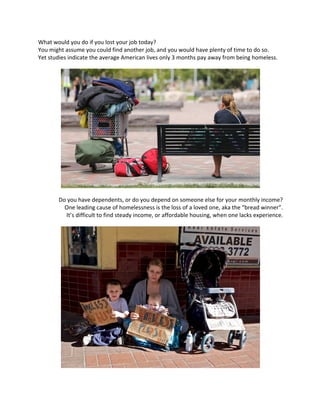
What	would	you	do	if	you	lost	your	job	today?	
You	might	assume	you	could	find	another	job,	and	you	would	have	plenty	of	time	to	do	so.	
Yet	studies	indicate	the	average	American	lives	only	3	months	pay	away	from	being	homeless.	


Do	you	have	dependents,	or	do	you	depend	on	someone	else	for	your	monthly	income?	
One	leading	cause	of	homelessness	is	the	loss	of	a	loved	one,	aka	the	“bread	winner”.	
It’s	difficult	to	find	steady	income,	or	affordable	housing,	when	one	lacks	experience.
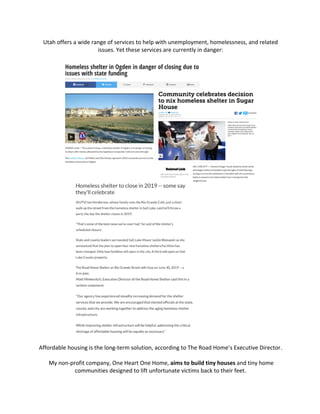
Utah	offers	a	wide	range	of	services	to	help	with	unemployment,	homelessness,	and	related	
issues.	Yet	these	services	are	currently	in	danger:	
	
	
Affordable	housing	is	the	long-term	solution,	according	to	The	Road	Home’s	Executive	Director.	
	
	My	non-profit	company,	One	Heart	One	Home,	aims	to	build	tiny	houses	and	tiny	home	
communities	designed	to	lift	unfortunate	victims	back	to	their	feet.
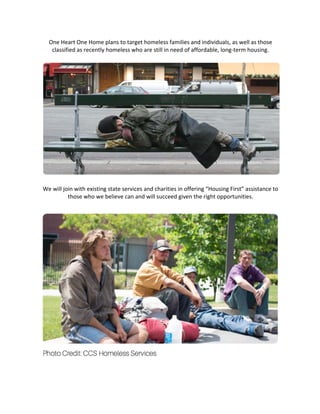
One	Heart	One	Home	plans	to	target	homeless	families	and	individuals,	as	well	as	those	
classified	as	recently	homeless	who	are	still	in	need	of	affordable,	long-term	housing.	


We	will	join	with	existing	state	services	and	charities	in	offering	“Housing	First”	assistance	to	
those	who	we	believe	can	and	will	succeed	given	the	right	opportunities.
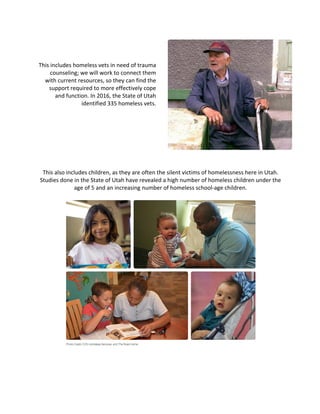
This	includes	homeless	vets	in	need	of	trauma	
counseling;	we	will	work	to	connect	them	
with	current	resources,	so	they	can	find	the	
support	required	to	more	effectively	cope	
and	function.	In	2016,	the	State	of	Utah	
identified	335	homeless	vets.	


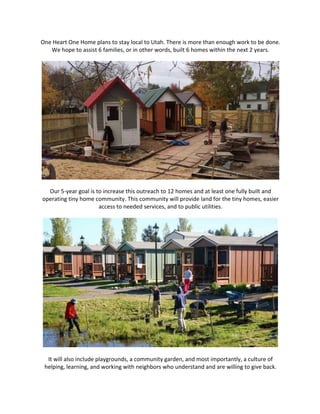
This	also	includes	children,	as	they	are	often	the	silent	victims	of	homelessness	here	in	Utah.	
Studies	done	in	the	State	of	Utah	have	revealed	a	high	number	of	homeless	children	under	the	
age	of	5	and	an	increasing	number	of	homeless	school-age	children.
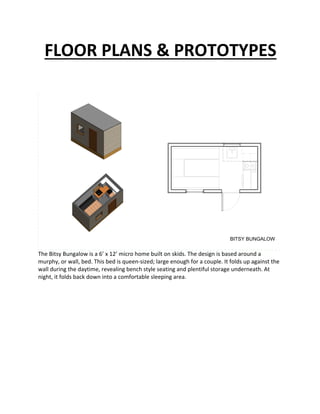
One	Heart	One	Home	plans	to	stay	local	to	Utah.	There	is	more	than	enough	work	to	be	done.	
We	hope	to	assist	6	families,	or	in	other	words,	built	6	homes	within	the	next	2	years.		


Our	5-year	goal	is	to	increase	this	outreach	to	12	homes	and	at	least	one	fully	built	and	
operating	tiny	home	community.	This	community	will	provide	land	for	the	tiny	homes,	easier	
access	to	needed	services,	and	to	public	utilities.	


It	will	also	include	playgrounds,	a	community	garden,	and	most	importantly,	a	culture	of	
helping,	learning,	and	working	with	neighbors	who	understand	and	are	willing	to	give	back.
FLOOR	PLANS	&	PROTOTYPES	


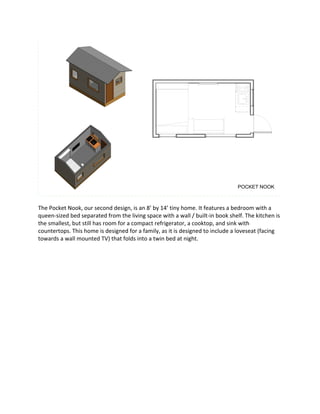
The	Bitsy	Bungalow	is	a	6’	x	12’	micro	home	built	on	skids.	The	design	is	based	around	a	
murphy,	or	wall,	bed.	This	bed	is	queen-sized;	large	enough	for	a	couple.	It	folds	up	against	the	
wall	during	the	daytime,	revealing	bench	style	seating	and	plentiful	storage	underneath.	At	
night,	it	folds	back	down	into	a	comfortable	sleeping	area.	
BITSY BUNGALOW
The	Pocket	Nook,	our	second	design,	is	an	8’	by	14’	tiny	home.	It	features	a	bedroom	with	a	
queen-sized	bed	separated	from	the	living	space	with	a	wall	/	built-in	book	shelf.	The	kitchen	is	
the	smallest,	but	still	has	room	for	a	compact	refrigerator,	a	cooktop,	and	sink	with	
countertops.	This	home	is	designed	for	a	family,	as	it	is	designed	to	include	a	loveseat	(facing	
towards	a	wall	mounted	TV)	that	folds	into	a	twin	bed	at	night.	
POCKET NOOK
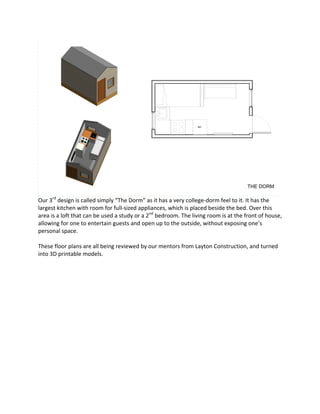
Our	3rd
	design	is	called	simply	“The	Dorm”	as	it	has	a	very	college-dorm	feel	to	it.	It	has	the	
largest	kitchen	with	room	for	full-sized	appliances,	which	is	placed	beside	the	bed.	Over	this	
area	is	a	loft	that	can	be	used	a	study	or	a	2nd
	bedroom.	The	living	room	is	at	the	front	of	house,	
allowing	for	one	to	entertain	guests	and	open	up	to	the	outside,	without	exposing	one’s	
personal	space.	
	
These	floor	plans	are	all	being	reviewed	by	our	mentors	from	Layton	Construction,	and	turned	
into	3D	printable	models.	
	
	 	
THE DORM
You	may	notice	that	none	of	these	homes	includes	a	bathroom.	This	is	a	part	of	our	overall	plan	
to	build	these	in	conjunction	with	a	tiny	home	community,	and	to	overall	build	safe,	secure,	yet	
very	inexpensive	and	spacious	housing.	


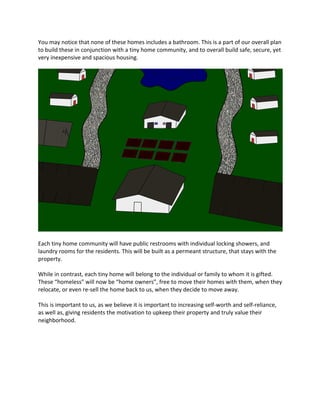
Each	tiny	home	community	will	have	public	restrooms	with	individual	locking	showers,	and	
laundry	rooms	for	the	residents.	This	will	be	built	as	a	permeant	structure,	that	stays	with	the	
property.	
	
While	in	contrast,	each	tiny	home	will	belong	to	the	individual	or	family	to	whom	it	is	gifted.	
These	“homeless”	will	now	be	“home	owners”,	free	to	move	their	homes	with	them,	when	they	
relocate,	or	even	re-sell	the	home	back	to	us,	when	they	decide	to	move	away.	
	
This	is	important	to	us,	as	we	believe	it	is	important	to	increasing	self-worth	and	self-reliance,	
as	well	as,	giving	residents	the	motivation	to	upkeep	their	property	and	truly	value	their	
neighborhood.

Tiny homes4thehomeless (1)