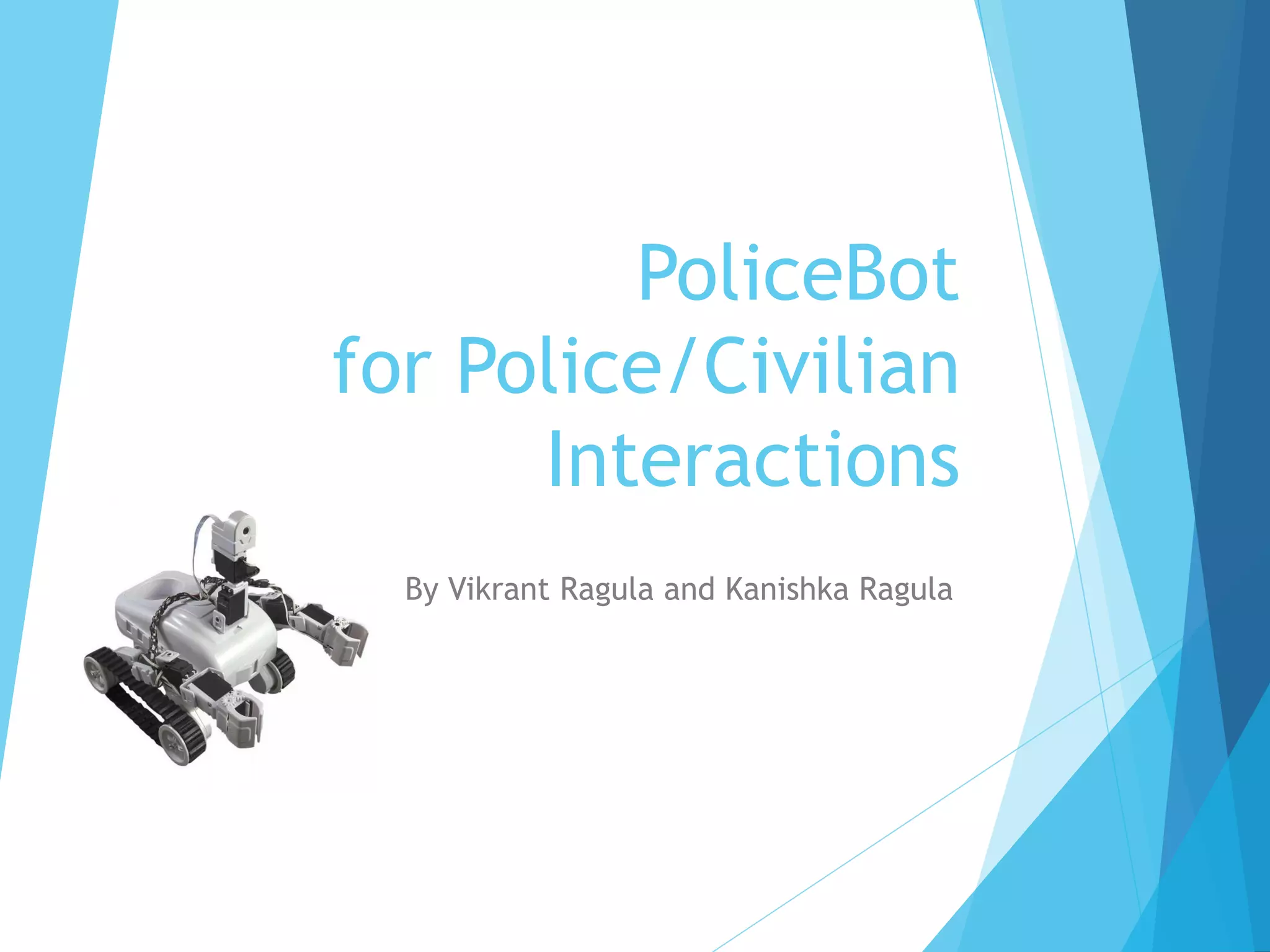
PoliceBot
for Police/Civilian
Interactions
By Vikrant Ragula and Kanishka Ragula
Background
 Every year in the United States, over 26.4 Million
people are pulled over during routine traffic stops
 50% of all face-to-face encounters between police
and civilians take place during traffic stops
 In 2012, 55,400 civilians were injured or killed
 On average, 1 in 291 stops resulted in hospital-
treated injury
 In 2013, 16 police officers were killed on vehicle
patrol duty
 Nearly 50,000 officers were victims of assaults
 Nearly 5,000 of these attacks took place during
traffic stops
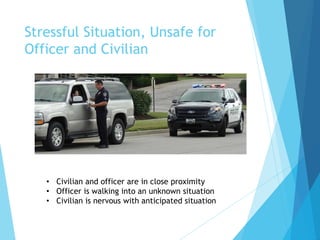
Stressful Situation, Unsafe for
Officer and Civilian
• Civilian and officer are in close proximity
• Officer is walking into an unknown situation
• Civilian is nervous with anticipated situation
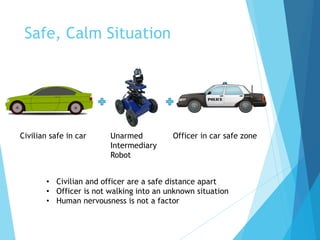
Safe, Calm Situation
Officer in car safe zoneUnarmed
Intermediary
Robot
Civilian safe in car
• Civilian and officer are a safe distance apart
• Officer is not walking into an unknown situation
• Human nervousness is not a factor
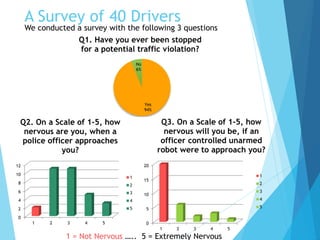
Yes
94%
No
6%
Q1. Have you ever been stopped
for a potential traffic violation?
1 = Not Nervous ….. 5 = Extremely Nervous
0
2
4
6
8
10
12
1 2 3 4 5
Q2. On a Scale of 1-5, how
nervous are you, when a
police officer approaches
you?
1
2
3
4
5
0
5
10
15
20
1 2 3 4 5
Q3. On a Scale of 1-5, how
nervous will you be, if an
officer controlled unarmed
robot were to approach you?
1
2
3
4
5
A Survey of 40 Drivers
We conducted a survey with the following 3 questions
Goal
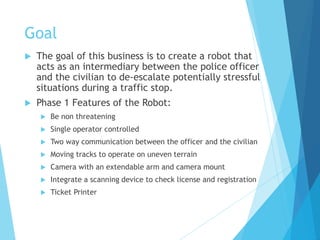
 The goal of this business is to create a robot that
acts as an intermediary between the police officer
and the civilian to de-escalate potentially stressful
situations during a traffic stop.
 Phase 1 Features of the Robot:
 Be non threatening
 Single operator controlled
 Two way communication between the officer and the civilian
 Moving tracks to operate on uneven terrain
 Camera with an extendable arm and camera mount
 Integrate a scanning device to check license and registration
 Ticket Printer
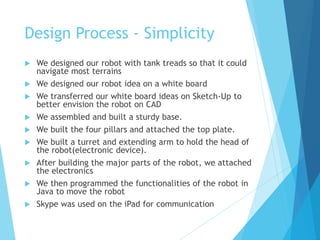
Design Process - Simplicity
 We designed our robot with tank treads so that it could
navigate most terrains
 We designed our robot idea on a white board
 We transferred our white board ideas on Sketch-Up to
better envision the robot on CAD
 We assembled and built a sturdy base.
 We built the four pillars and attached the top plate.
 We built a turret and extending arm to hold the head of
the robot(electronic device).
 After building the major parts of the robot, we attached
the electronics
 We then programmed the functionalities of the robot in
Java to move the robot
 Skype was used on the iPad for communication
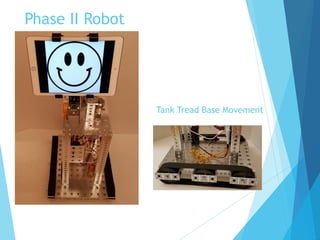
Phase II Robot
Tank Tread Base Movement
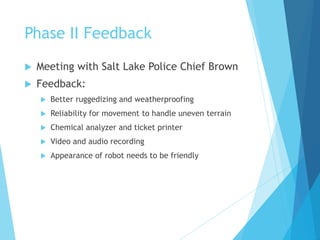
Phase II Feedback
 Meeting with Salt Lake Police Chief Brown
 Feedback:
 Better ruggedizing and weatherproofing
 Reliability for movement to handle uneven terrain
 Chemical analyzer and ticket printer
 Video and audio recording
 Appearance of robot needs to be friendly
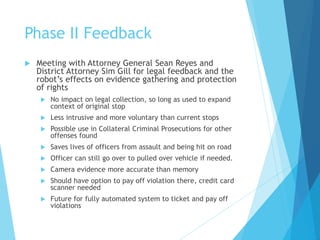
Phase II Feedback
 Meeting with Attorney General Sean Reyes and
District Attorney Sim Gill for legal feedback and the
robot’s effects on evidence gathering and protection
of rights
 No impact on legal collection, so long as used to expand
context of original stop
 Less intrusive and more voluntary than current stops
 Possible use in Collateral Criminal Prosecutions for other
offenses found
 Saves lives of officers from assault and being hit on road
 Officer can still go over to pulled over vehicle if needed.
 Camera evidence more accurate than memory
 Should have option to pay off violation there, credit card
scanner needed
 Future for fully automated system to ticket and pay off
violations
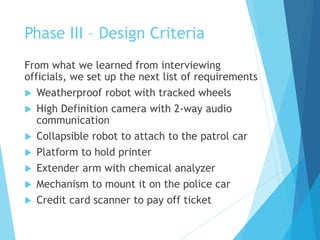
Phase III – Design Criteria
From what we learned from interviewing
officials, we set up the next list of requirements
 Weatherproof robot with tracked wheels
 High Definition camera with 2-way audio
communication
 Collapsible robot to attach to the patrol car
 Platform to hold printer
 Extender arm with chemical analyzer
 Mechanism to mount it on the police car
 Credit card scanner to pay off ticket
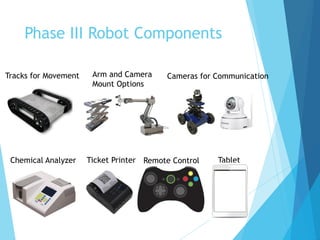
Phase III Robot Components
Tracks for Movement Arm and Camera
Mount Options
Cameras for Communication
Chemical Analyzer Ticket Printer Remote Control Tablet
Customer Profile
 Law Enforcement Agencies (15,400 Police
Departments)
 Strong encouragement from Police Chief
 Strong encouragement from DA and AG
 Potential Application at Military Bases and
Checkpoints
 Prevents attempts of suicide bombers to hurt
military personnel
Use of Funds
 Purchase parts for Phase III prototype
 Machining of components for Phase III
 Assembling Phase III Robot
 Expected Cost for 2 variants of PoliceBot for
testing : $18,000
 Aesthetics for robot
 Marketing, travel, and demonstrations at Law
Enforcement shows. Balance of Funds
 District Attorney and AG offered to direct us
to the right shows.
 Expected Delivery: 1 year from funding.
Contact Information
Kanishka Ragula and Vikrant Ragula
kanishka@ragula.com
vikrant@ragula.com
Ragula Innovations
Salt Lake City, UT
(801) 971-0977
Works Cited
 "BJS - Traffic Stops." Bureau of Justice Statistics (BJS) - Traffic Stops. US Federal
Government, n.d. Web.
 Curtis, Henry. "Traffic Stops among Most Dangerous Police Duties." Tribunedigital-
orlandosentinel. Orlando Sentinel, 09 Dec. 2010. Web.
 "FBI Releases 2013 Statistics on Law Enforcement Officers Killed and Assaulted."
FBI. FBI, 02 Dec. 2014. Web.
 Glaser, April. “11 Police Robots Patrolling Around the World”. Wired. Conde Nast,
24 July 2016. Web.
 Injury Prevention - US Police Killed or Injured More than 55,000 People during
“legal Interventions” in 2012. N.p.: BMJ, 2016. Injury Prevention. BMJ, 26 July
2016. Web.
 Lewinski, William, PhD, Jennifer Dysterheft, Dawn Seefeldt, and Robert Pettitt.
The Influence of Officer Positioning on Movement During a Threatening Traffic
Stop Scenario. Force Science Institute. N.p., Mar. 2013. Web.
 O'Brien, Brendan. "Violent Protests Erupt In Milwaukee After Police Kill Suspect At
Traffic Stop." Huffington Post. TheHuffingtonPost.com, 4 Aug. 2016. Web.

The great traffic stop de escalator

  • 1.
  • 2.
    Background  Every yearin the United States, over 26.4 Million people are pulled over during routine traffic stops  50% of all face-to-face encounters between police and civilians take place during traffic stops  In 2012, 55,400 civilians were injured or killed  On average, 1 in 291 stops resulted in hospital- treated injury  In 2013, 16 police officers were killed on vehicle patrol duty  Nearly 50,000 officers were victims of assaults  Nearly 5,000 of these attacks took place during traffic stops
  • 3.
    Stressful Situation, Unsafefor Officer and Civilian • Civilian and officer are in close proximity • Officer is walking into an unknown situation • Civilian is nervous with anticipated situation
  • 4.
    Safe, Calm Situation Officerin car safe zoneUnarmed Intermediary Robot Civilian safe in car • Civilian and officer are a safe distance apart • Officer is not walking into an unknown situation • Human nervousness is not a factor
  • 5.
    Yes 94% No 6% Q1. Have youever been stopped for a potential traffic violation? 1 = Not Nervous ….. 5 = Extremely Nervous 0 2 4 6 8 10 12 1 2 3 4 5 Q2. On a Scale of 1-5, how nervous are you, when a police officer approaches you? 1 2 3 4 5 0 5 10 15 20 1 2 3 4 5 Q3. On a Scale of 1-5, how nervous will you be, if an officer controlled unarmed robot were to approach you? 1 2 3 4 5 A Survey of 40 Drivers We conducted a survey with the following 3 questions
  • 6.
    Goal  The goalof this business is to create a robot that acts as an intermediary between the police officer and the civilian to de-escalate potentially stressful situations during a traffic stop.  Phase 1 Features of the Robot:  Be non threatening  Single operator controlled  Two way communication between the officer and the civilian  Moving tracks to operate on uneven terrain  Camera with an extendable arm and camera mount  Integrate a scanning device to check license and registration  Ticket Printer
  • 7.
    Design Process -Simplicity  We designed our robot with tank treads so that it could navigate most terrains  We designed our robot idea on a white board  We transferred our white board ideas on Sketch-Up to better envision the robot on CAD  We assembled and built a sturdy base.  We built the four pillars and attached the top plate.  We built a turret and extending arm to hold the head of the robot(electronic device).  After building the major parts of the robot, we attached the electronics  We then programmed the functionalities of the robot in Java to move the robot  Skype was used on the iPad for communication
  • 8.
    Phase II Robot TankTread Base Movement
  • 9.
    Phase II Feedback Meeting with Salt Lake Police Chief Brown  Feedback:  Better ruggedizing and weatherproofing  Reliability for movement to handle uneven terrain  Chemical analyzer and ticket printer  Video and audio recording  Appearance of robot needs to be friendly
  • 10.
    Phase II Feedback Meeting with Attorney General Sean Reyes and District Attorney Sim Gill for legal feedback and the robot’s effects on evidence gathering and protection of rights  No impact on legal collection, so long as used to expand context of original stop  Less intrusive and more voluntary than current stops  Possible use in Collateral Criminal Prosecutions for other offenses found  Saves lives of officers from assault and being hit on road  Officer can still go over to pulled over vehicle if needed.  Camera evidence more accurate than memory  Should have option to pay off violation there, credit card scanner needed  Future for fully automated system to ticket and pay off violations
  • 11.
    Phase III –Design Criteria From what we learned from interviewing officials, we set up the next list of requirements  Weatherproof robot with tracked wheels  High Definition camera with 2-way audio communication  Collapsible robot to attach to the patrol car  Platform to hold printer  Extender arm with chemical analyzer  Mechanism to mount it on the police car  Credit card scanner to pay off ticket
  • 12.
    Phase III RobotComponents Tracks for Movement Arm and Camera Mount Options Cameras for Communication Chemical Analyzer Ticket Printer Remote Control Tablet
  • 13.
    Customer Profile  LawEnforcement Agencies (15,400 Police Departments)  Strong encouragement from Police Chief  Strong encouragement from DA and AG  Potential Application at Military Bases and Checkpoints  Prevents attempts of suicide bombers to hurt military personnel
  • 14.
    Use of Funds Purchase parts for Phase III prototype  Machining of components for Phase III  Assembling Phase III Robot  Expected Cost for 2 variants of PoliceBot for testing : $18,000  Aesthetics for robot  Marketing, travel, and demonstrations at Law Enforcement shows. Balance of Funds  District Attorney and AG offered to direct us to the right shows.  Expected Delivery: 1 year from funding.
  • 15.
    Contact Information Kanishka Ragulaand Vikrant Ragula kanishka@ragula.com vikrant@ragula.com Ragula Innovations Salt Lake City, UT (801) 971-0977
  • 16.
    Works Cited  "BJS- Traffic Stops." Bureau of Justice Statistics (BJS) - Traffic Stops. US Federal Government, n.d. Web.  Curtis, Henry. "Traffic Stops among Most Dangerous Police Duties." Tribunedigital- orlandosentinel. Orlando Sentinel, 09 Dec. 2010. Web.  "FBI Releases 2013 Statistics on Law Enforcement Officers Killed and Assaulted." FBI. FBI, 02 Dec. 2014. Web.  Glaser, April. “11 Police Robots Patrolling Around the World”. Wired. Conde Nast, 24 July 2016. Web.  Injury Prevention - US Police Killed or Injured More than 55,000 People during “legal Interventions” in 2012. N.p.: BMJ, 2016. Injury Prevention. BMJ, 26 July 2016. Web.  Lewinski, William, PhD, Jennifer Dysterheft, Dawn Seefeldt, and Robert Pettitt. The Influence of Officer Positioning on Movement During a Threatening Traffic Stop Scenario. Force Science Institute. N.p., Mar. 2013. Web.  O'Brien, Brendan. "Violent Protests Erupt In Milwaukee After Police Kill Suspect At Traffic Stop." Huffington Post. TheHuffingtonPost.com, 4 Aug. 2016. Web.