Katie Drennan
Allie Drennan
Timothy Holt
Abigail Slama-Catron
Eric Snaufer
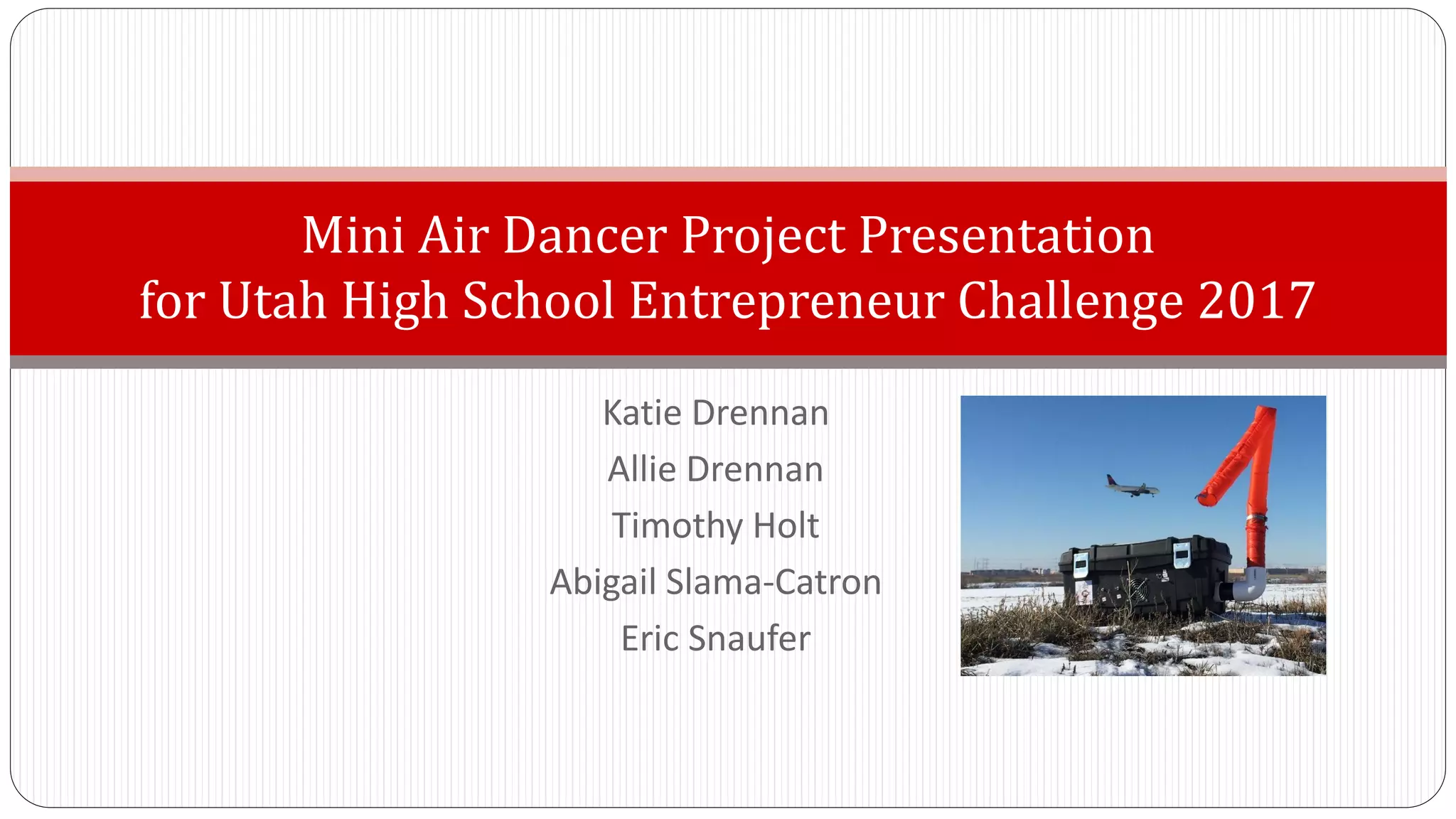
Mini Air Dancer Project Presentation
for Utah High School Entrepreneur Challenge 2017
 The airlines and airports could be made better by reducing bird strikes on airplanes saving
airlines repair costs and saving bird lives
 Our innovative small, portable, and non polluting air dancers (ADs) solution makes a positive
impact by making air travel safer and saving bird lives by scaring birds away from airports
 Worked with SLC Wildlife Control in determining air dancer requirements
 The market is selling to airport operations, especially Wildlife Control
 19,536 airports identified as potential market
 First Year Expectations:
 Sell 1,080 ADs and 5,616 socks to 72 airports
 Revenue: $408k
 Margin: $293k
 Profit (w/o Tax): $168k
 Profit as a % of Revenue: 45%
 Capture 0.37% of the U.S. airport market
 Our prototype has been tested at the SLC International Airport and shown to work
 We have a provisional patent for the air dancer
 The SLC Airport wants to continue testing our air dancers during the spring of 2017
Project Summary
 Bird strikes cost the US airline industry $900M a year1
 Bird strikes damage aircraft and may result in their
removal from service resulting in lost revenue and direct
repair costs
 There were 218 bird strikes at Salt Lake City Airport in
20152
 The SLC airport spends significant resources
attempting to solve the bird issue
 Five full time staff working wildlife issues at the airport
Problem
1-Bird strike USA Press Kit; http://www.birdstrike.org/news-info/press-kit/
2- FAA Base Bird Strike Database www.wildlife.faa.gov
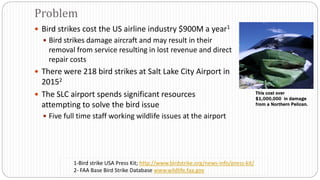
This cost over
$1,000,000 in damage
from a Northern Pelican.
 We should develop a product that scares birds away
to reduce bird strikes
 The opportunity exists to make airport staff more
efficient and effective in preventing bird strikes
 Bird strikes are a problem around the US and the
globe
 Airports have existing budgets for bird control
 $30,000 discretionary budget on SLC airport wildlife control3
 Since the 2011 “Miracle on the Hudson” airline crash
due to bird strikes, the federal government has
budgeted for wildlife control
 They have hired USDA staff at 850 airports in the US4
Opportunity
3- email, 2/22/2017 Gib Rokich SLC airport wildlife manager
4-USDA Wildlife Management Plan -
https://www.aphis.usda.gov/aphis/ourfocus/wildlifedamage/programs/sa_airport/ct_airport_hazards
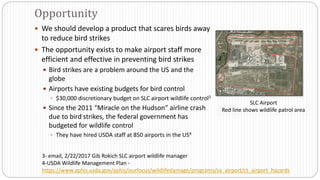
SLC Airport
Red line shows wildlife patrol area
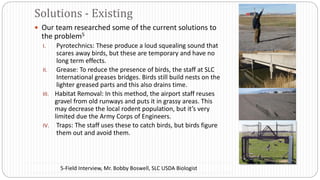
 Our team researched some of the current solutions to
the problem5
I. Pyrotechnics: These produce a loud squealing sound that
scares away birds, but these are temporary and have no
long term effects.
II. Grease: To reduce the presence of birds, the staff at SLC
International greases bridges. Birds still build nests on the
lighter greased parts and this also drains time.
III. Habitat Removal: In this method, the airport staff reuses
gravel from old runways and puts it in grassy areas. This
may decrease the local rodent population, but it’s very
limited due the Army Corps of Engineers.
IV. Traps: The staff uses these to catch birds, but birds figure
them out and avoid them.
Solutions - Existing
5-Field Interview, Mr. Bobby Boswell, SLC USDA Biologist
 From our field research, a product to reduce bird strikes should meet the
following market needs:
 Portable
 Small (to be carried by one person)
 Effective at scaring birds away for a long period of time
 Self-contained
 Easy to access parts and maintain
 Water-resistant
 Cost effective for widespread use
 Commercial air dancers are $320, without power
 SLC Airport requires bird control for 8,000 acres
Solutions – Market Needs Identified
A. Predator Call: Works at first, but birds get used to it and
ignore it, as proven by Bass Pro Shops 1 million dollar
investment in them.
B. Robotic Bait: This solution is both complicated and
expensive, making it very hard to get anything done
C. Remote Sensing: This would be very hard to build,
expensive, and the SLC airport has very restricted
wireless frequencies.
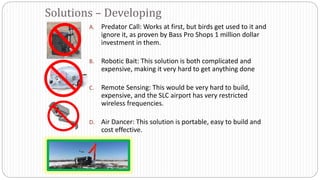
D. Air Dancer: This solution is portable, easy to build and
cost effective.
Solutions – Developing
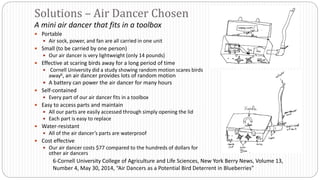
A mini air dancer that fits in a toolbox
 Portable
 Air sock, power, and fan are all carried in one unit
 Small (to be carried by one person)
 Our air dancer is very lightweight (only 14 pounds)
 Effective at scaring birds away for a long period of time
 Cornell University did a study showing random motion scares birds
away6, an air dancer provides lots of random motion
 A battery can power the air dancer for many hours
 Self-contained
 Every part of our air dancer fits in a toolbox
 Easy to access parts and maintain
 All our parts are easily accessed through simply opening the lid
 Each part is easy to replace
 Water-resistant
 All of the air dancer’s parts are waterproof
 Cost effective
 Our air dancer costs $77 compared to the hundreds of dollars for
other air dancers
Solutions – Air Dancer Chosen
6-Cornell University College of Agriculture and Life Sciences, New York Berry News, Volume 13,
Number 4, May 30, 2014, “Air Dancers as a Potential Bird Deterrent in Blueberries”
Bird Scare Devices
Agriculture
$58 Trillion
Air Transportation
$2.7 Trillion – 41,788 Airports
Real Estate
Large Hub
30
Medium Hub
31
Small Hub
72
Nonhub
249
1
2
1 – Macroeconomic Statistics: The Agriculture and Food-Processing Sectors along the Economic Development Process: Evidence from the FAO Macro-Indicators Database (1970-2014), Food and Agriculture
Organization of the United Nations, October 2016, http://www.fao.org/economic/ess/ess-economic/gdpagriculture/en/ , (accessed Feb. 21, 2016)
2 – Aviation Benefits Beyond Borders: Global Summary 2016, Air Transport Action Group, June 2016
3 – Airport Categories, FAA, March 3, 2016, https://www.faa.gov/airports/planning_capacity/passenger_allcargo_stats/categories/ (accessed Feb. 21, 2017)
4 – National Plan of Integrated Airport Systems (NPIAS) 2017-2021, FAA, September 30, 2016, https://www.faa.gov/airports/planning_capacity/npias/reports/media/NPIAS-Report-2017-2021-Narrative.pdf (accessed
Feb 21, 2017)
Civil Military
Commercial
General
Aviation
NPIAS* Airports
(3,340)
7
Non-NPIAS Airports
Primary
382 Airports
Non- Primary
2,950 Airports
4
US
(19,536 Airports)
Non-US
Customer - The Bird Scare Device Market
3,4
2
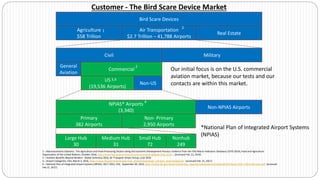
Our initial focus is on the U.S. commercial
aviation market, because our tests and our
contacts are within this market.
*National Plan of Integrated Airport Systems
(NPIAS)
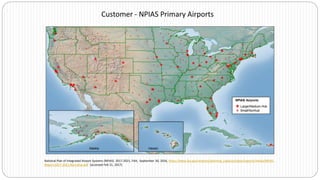
Customer - NPIAS Primary Airports
National Plan of Integrated Airport Systems (NPIAS) 2017-2021, FAA, September 30, 2016, https://www.faa.gov/airports/planning_capacity/npias/reports/media/NPIAS-
Report-2017-2021-Narrative.pdf (accessed Feb 21, 2017)
 Our air dancers (ADs) make a positive impact by making air travel safer and
saving bird lives
 Prevents bird strikes by keeping birds away from airports/aircraft
 Increases field time of staff by covering hard to reach areas
 Non-polluting solution
 Sell to airport operations, especially Wildlife Control
 First Year Expectations:
 Sell 1,080 ADs and 5,616 socks to 72 airports
 Revenue: $408k
 Margin: $293k
 Profit (w/o Tax): $168k
 Profit as a % of Revenue: 45%
 Capture 0.37% of the U.S. airport market, and 2.16% of the NPIAS airport market
Quantity and Reach
Customer Acquisition
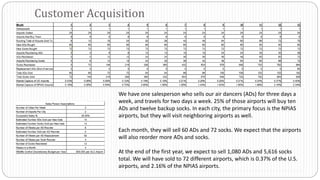
We have one salesperson who sells our air dancers (ADs) for three days a
week, and travels for two days a week. 25% of those airports will buy ten
ADs and twelve backup socks. In each city, the primary focus is the NPIAS
airports, but they will visit neighboring airports as well.
Each month, they will sell 60 ADs and 72 socks. We expect that the airports
will also reorder more ADs and socks.
At the end of the first year, we expect to sell 1,080 ADs and 5,616 socks
total. We will have sold to 72 different airports, which is 0.37% of the U.S.
airports, and 2.16% of the NPIAS airports.
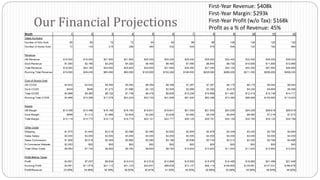
Our Financial Projections
First-Year Revenue: $408k
First-Year Margin: $293k
First-Year Profit (w/o Tax): $168k
Profit as a % of Revenue: 45%
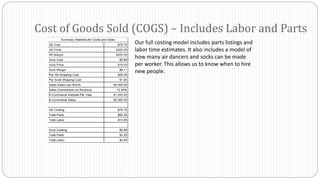
Cost of Goods Sold (COGS) – Includes Labor and Parts
Our full costing model includes parts listings and
labor time estimates. It also includes a model of
how many air dancers and socks can be made
per worker. This allows us to know when to hire
new people.
 Provisional Patent Application already filed on air dancer and socks
 Future patent applications will cost only government fees until profitable
because our mentor is a patent attorney
 First Mover Advantage
 No existing air dancer this compact, portable, and non-polluting
 Field Tested by Wildlife Control in SLC International Airport
 Currently requesting more and an identified need of at least 36
 Environmentally Friendly
 Non-polluting, rechargeable electric power
 Price Competitive
 Under ½ price of large, cumbersome air dancers using generators
Competitive Advantages
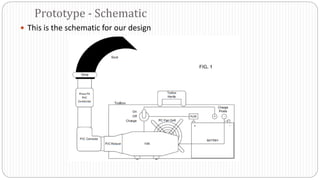
Prototype - Schematic
 This is the schematic for our design
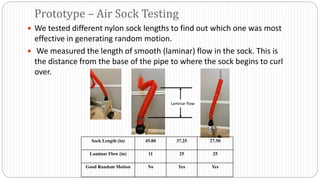
 We tested different nylon sock lengths to find out which one was most
effective in generating random motion.
 We measured the length of smooth (laminar) flow in the sock. This is
the distance from the base of the pipe to where the sock begins to curl
over.
Laminar flow
Sock Length (in) 45.00 37.25 27.50
Laminar Flow (in) 11 25 25
Good Random Motion No Yes Yes
Prototype – Air Sock Testing
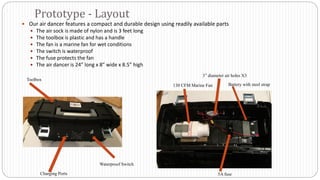
Toolbox
Charging Ports
Waterproof Switch
130 CFM Marine Fan Battery with steel strap
3” diameter air holes X3
5A fuse
Prototype - Layout
 Our air dancer features a compact and durable design using readily available parts
 The air sock is made of nylon and is 3 feet long
 The toolbox is plastic and has a handle
 The fan is a marine fan for wet conditions
 The switch is waterproof
 The fuse protects the fan
 The air dancer is 24” long x 8” wide x 8.5” high
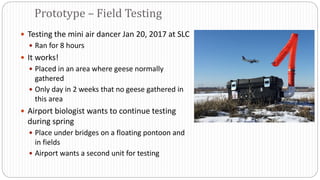
 Testing the mini air dancer Jan 20, 2017 at SLC
 Ran for 8 hours
 It works!
 Placed in an area where geese normally
gathered
 Only day in 2 weeks that no geese gathered in
this area
 Airport biologist wants to continue testing
during spring
 Place under bridges on a floating pontoon and
in fields
 Airport wants a second unit for testing
Prototype – Field Testing
 Our team has a provisional patent for the air dancer
 62/453,063 (Patent ID) Systems Methods and Devices for Bird Scare Device
 We have secured the Intellectual Property (IP) to the project
 Our air dancer has growth and expansion potential, such as:
 Solar cells for power
 Wireless connectivity for monitoring and control
 Multiple socks for each air dancer and different types of containers
 Fan timer for extra randomness
Prototype – Provisional Patent Filed
 Continue testing units at SLC Airport during spring nesting season for birds
 Build more units with improvements
 Seek additional help and mentoring on business plan development
 Look for an angel investor for initial funding of $160k
To start up, we need to:
 Problem - The airlines and airports could be made better by reducing bird strikes on
airplanes, saving airlines repair costs and saving bird lives
 Solution - Our innovative, small, portable, and non polluting air dancers (ADs) make
a positive impact by making air travel safer and saving bird lives by scaring birds
away from airports
 Customer - The market is selling to airport operations, especially Wildlife Control
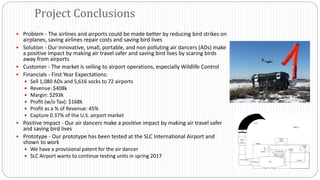
 Financials - First Year Expectations:
 Sell 1,080 ADs and 5,616 socks to 72 airports
 Revenue: $408k
 Margin: $293k
 Profit (w/o Tax): $168k
 Profit as a % of Revenue: 45%
 Capture 0.37% of the U.S. airport market
 Positive Impact - Our air dancers make a positive impact by making air travel safer
and saving bird lives
 Prototype - Our prototype has been tested at the SLC International Airport and
shown to work
 We have a provisional patent for the air dancer
 SLC Airport wants to continue testing units in spring 2017
Project Conclusions

Bird scare device air dancer

  • 1.
    Katie Drennan Allie Drennan TimothyHolt Abigail Slama-Catron Eric Snaufer Mini Air Dancer Project Presentation for Utah High School Entrepreneur Challenge 2017
  • 2.
     The airlinesand airports could be made better by reducing bird strikes on airplanes saving airlines repair costs and saving bird lives  Our innovative small, portable, and non polluting air dancers (ADs) solution makes a positive impact by making air travel safer and saving bird lives by scaring birds away from airports  Worked with SLC Wildlife Control in determining air dancer requirements  The market is selling to airport operations, especially Wildlife Control  19,536 airports identified as potential market  First Year Expectations:  Sell 1,080 ADs and 5,616 socks to 72 airports  Revenue: $408k  Margin: $293k  Profit (w/o Tax): $168k  Profit as a % of Revenue: 45%  Capture 0.37% of the U.S. airport market  Our prototype has been tested at the SLC International Airport and shown to work  We have a provisional patent for the air dancer  The SLC Airport wants to continue testing our air dancers during the spring of 2017 Project Summary
  • 3.
     Bird strikescost the US airline industry $900M a year1  Bird strikes damage aircraft and may result in their removal from service resulting in lost revenue and direct repair costs  There were 218 bird strikes at Salt Lake City Airport in 20152  The SLC airport spends significant resources attempting to solve the bird issue  Five full time staff working wildlife issues at the airport Problem 1-Bird strike USA Press Kit; http://www.birdstrike.org/news-info/press-kit/ 2- FAA Base Bird Strike Database www.wildlife.faa.gov This cost over $1,000,000 in damage from a Northern Pelican.
  • 4.
     We shoulddevelop a product that scares birds away to reduce bird strikes  The opportunity exists to make airport staff more efficient and effective in preventing bird strikes  Bird strikes are a problem around the US and the globe  Airports have existing budgets for bird control  $30,000 discretionary budget on SLC airport wildlife control3  Since the 2011 “Miracle on the Hudson” airline crash due to bird strikes, the federal government has budgeted for wildlife control  They have hired USDA staff at 850 airports in the US4 Opportunity 3- email, 2/22/2017 Gib Rokich SLC airport wildlife manager 4-USDA Wildlife Management Plan - https://www.aphis.usda.gov/aphis/ourfocus/wildlifedamage/programs/sa_airport/ct_airport_hazards SLC Airport Red line shows wildlife patrol area
  • 5.
     Our teamresearched some of the current solutions to the problem5 I. Pyrotechnics: These produce a loud squealing sound that scares away birds, but these are temporary and have no long term effects. II. Grease: To reduce the presence of birds, the staff at SLC International greases bridges. Birds still build nests on the lighter greased parts and this also drains time. III. Habitat Removal: In this method, the airport staff reuses gravel from old runways and puts it in grassy areas. This may decrease the local rodent population, but it’s very limited due the Army Corps of Engineers. IV. Traps: The staff uses these to catch birds, but birds figure them out and avoid them. Solutions - Existing 5-Field Interview, Mr. Bobby Boswell, SLC USDA Biologist
  • 6.
     From ourfield research, a product to reduce bird strikes should meet the following market needs:  Portable  Small (to be carried by one person)  Effective at scaring birds away for a long period of time  Self-contained  Easy to access parts and maintain  Water-resistant  Cost effective for widespread use  Commercial air dancers are $320, without power  SLC Airport requires bird control for 8,000 acres Solutions – Market Needs Identified
  • 7.
    A. Predator Call:Works at first, but birds get used to it and ignore it, as proven by Bass Pro Shops 1 million dollar investment in them. B. Robotic Bait: This solution is both complicated and expensive, making it very hard to get anything done C. Remote Sensing: This would be very hard to build, expensive, and the SLC airport has very restricted wireless frequencies. D. Air Dancer: This solution is portable, easy to build and cost effective. Solutions – Developing
  • 8.
    A mini airdancer that fits in a toolbox  Portable  Air sock, power, and fan are all carried in one unit  Small (to be carried by one person)  Our air dancer is very lightweight (only 14 pounds)  Effective at scaring birds away for a long period of time  Cornell University did a study showing random motion scares birds away6, an air dancer provides lots of random motion  A battery can power the air dancer for many hours  Self-contained  Every part of our air dancer fits in a toolbox  Easy to access parts and maintain  All our parts are easily accessed through simply opening the lid  Each part is easy to replace  Water-resistant  All of the air dancer’s parts are waterproof  Cost effective  Our air dancer costs $77 compared to the hundreds of dollars for other air dancers Solutions – Air Dancer Chosen 6-Cornell University College of Agriculture and Life Sciences, New York Berry News, Volume 13, Number 4, May 30, 2014, “Air Dancers as a Potential Bird Deterrent in Blueberries”
  • 9.
    Bird Scare Devices Agriculture $58Trillion Air Transportation $2.7 Trillion – 41,788 Airports Real Estate Large Hub 30 Medium Hub 31 Small Hub 72 Nonhub 249 1 2 1 – Macroeconomic Statistics: The Agriculture and Food-Processing Sectors along the Economic Development Process: Evidence from the FAO Macro-Indicators Database (1970-2014), Food and Agriculture Organization of the United Nations, October 2016, http://www.fao.org/economic/ess/ess-economic/gdpagriculture/en/ , (accessed Feb. 21, 2016) 2 – Aviation Benefits Beyond Borders: Global Summary 2016, Air Transport Action Group, June 2016 3 – Airport Categories, FAA, March 3, 2016, https://www.faa.gov/airports/planning_capacity/passenger_allcargo_stats/categories/ (accessed Feb. 21, 2017) 4 – National Plan of Integrated Airport Systems (NPIAS) 2017-2021, FAA, September 30, 2016, https://www.faa.gov/airports/planning_capacity/npias/reports/media/NPIAS-Report-2017-2021-Narrative.pdf (accessed Feb 21, 2017) Civil Military Commercial General Aviation NPIAS* Airports (3,340) 7 Non-NPIAS Airports Primary 382 Airports Non- Primary 2,950 Airports 4 US (19,536 Airports) Non-US Customer - The Bird Scare Device Market 3,4 2 Our initial focus is on the U.S. commercial aviation market, because our tests and our contacts are within this market. *National Plan of Integrated Airport Systems (NPIAS)
  • 10.
    Customer - NPIASPrimary Airports National Plan of Integrated Airport Systems (NPIAS) 2017-2021, FAA, September 30, 2016, https://www.faa.gov/airports/planning_capacity/npias/reports/media/NPIAS- Report-2017-2021-Narrative.pdf (accessed Feb 21, 2017)
  • 11.
     Our airdancers (ADs) make a positive impact by making air travel safer and saving bird lives  Prevents bird strikes by keeping birds away from airports/aircraft  Increases field time of staff by covering hard to reach areas  Non-polluting solution  Sell to airport operations, especially Wildlife Control  First Year Expectations:  Sell 1,080 ADs and 5,616 socks to 72 airports  Revenue: $408k  Margin: $293k  Profit (w/o Tax): $168k  Profit as a % of Revenue: 45%  Capture 0.37% of the U.S. airport market, and 2.16% of the NPIAS airport market Quantity and Reach
  • 12.
    Customer Acquisition We haveone salesperson who sells our air dancers (ADs) for three days a week, and travels for two days a week. 25% of those airports will buy ten ADs and twelve backup socks. In each city, the primary focus is the NPIAS airports, but they will visit neighboring airports as well. Each month, they will sell 60 ADs and 72 socks. We expect that the airports will also reorder more ADs and socks. At the end of the first year, we expect to sell 1,080 ADs and 5,616 socks total. We will have sold to 72 different airports, which is 0.37% of the U.S. airports, and 2.16% of the NPIAS airports.
  • 13.
    Our Financial Projections First-YearRevenue: $408k First-Year Margin: $293k First-Year Profit (w/o Tax): $168k Profit as a % of Revenue: 45%
  • 14.
    Cost of GoodsSold (COGS) – Includes Labor and Parts Our full costing model includes parts listings and labor time estimates. It also includes a model of how many air dancers and socks can be made per worker. This allows us to know when to hire new people.
  • 15.
     Provisional PatentApplication already filed on air dancer and socks  Future patent applications will cost only government fees until profitable because our mentor is a patent attorney  First Mover Advantage  No existing air dancer this compact, portable, and non-polluting  Field Tested by Wildlife Control in SLC International Airport  Currently requesting more and an identified need of at least 36  Environmentally Friendly  Non-polluting, rechargeable electric power  Price Competitive  Under ½ price of large, cumbersome air dancers using generators Competitive Advantages
  • 16.
    Prototype - Schematic This is the schematic for our design
  • 17.
     We testeddifferent nylon sock lengths to find out which one was most effective in generating random motion.  We measured the length of smooth (laminar) flow in the sock. This is the distance from the base of the pipe to where the sock begins to curl over. Laminar flow Sock Length (in) 45.00 37.25 27.50 Laminar Flow (in) 11 25 25 Good Random Motion No Yes Yes Prototype – Air Sock Testing
  • 18.
    Toolbox Charging Ports Waterproof Switch 130CFM Marine Fan Battery with steel strap 3” diameter air holes X3 5A fuse Prototype - Layout  Our air dancer features a compact and durable design using readily available parts  The air sock is made of nylon and is 3 feet long  The toolbox is plastic and has a handle  The fan is a marine fan for wet conditions  The switch is waterproof  The fuse protects the fan  The air dancer is 24” long x 8” wide x 8.5” high
  • 19.
     Testing themini air dancer Jan 20, 2017 at SLC  Ran for 8 hours  It works!  Placed in an area where geese normally gathered  Only day in 2 weeks that no geese gathered in this area  Airport biologist wants to continue testing during spring  Place under bridges on a floating pontoon and in fields  Airport wants a second unit for testing Prototype – Field Testing
  • 20.
     Our teamhas a provisional patent for the air dancer  62/453,063 (Patent ID) Systems Methods and Devices for Bird Scare Device  We have secured the Intellectual Property (IP) to the project  Our air dancer has growth and expansion potential, such as:  Solar cells for power  Wireless connectivity for monitoring and control  Multiple socks for each air dancer and different types of containers  Fan timer for extra randomness Prototype – Provisional Patent Filed
  • 21.
     Continue testingunits at SLC Airport during spring nesting season for birds  Build more units with improvements  Seek additional help and mentoring on business plan development  Look for an angel investor for initial funding of $160k To start up, we need to:
  • 22.
     Problem -The airlines and airports could be made better by reducing bird strikes on airplanes, saving airlines repair costs and saving bird lives  Solution - Our innovative, small, portable, and non polluting air dancers (ADs) make a positive impact by making air travel safer and saving bird lives by scaring birds away from airports  Customer - The market is selling to airport operations, especially Wildlife Control  Financials - First Year Expectations:  Sell 1,080 ADs and 5,616 socks to 72 airports  Revenue: $408k  Margin: $293k  Profit (w/o Tax): $168k  Profit as a % of Revenue: 45%  Capture 0.37% of the U.S. airport market  Positive Impact - Our air dancers make a positive impact by making air travel safer and saving bird lives  Prototype - Our prototype has been tested at the SLC International Airport and shown to work  We have a provisional patent for the air dancer  SLC Airport wants to continue testing units in spring 2017 Project Conclusions