INTRODUCING THE
DISCIPLINES WITHIN THE
SOCIAL SCIENCES
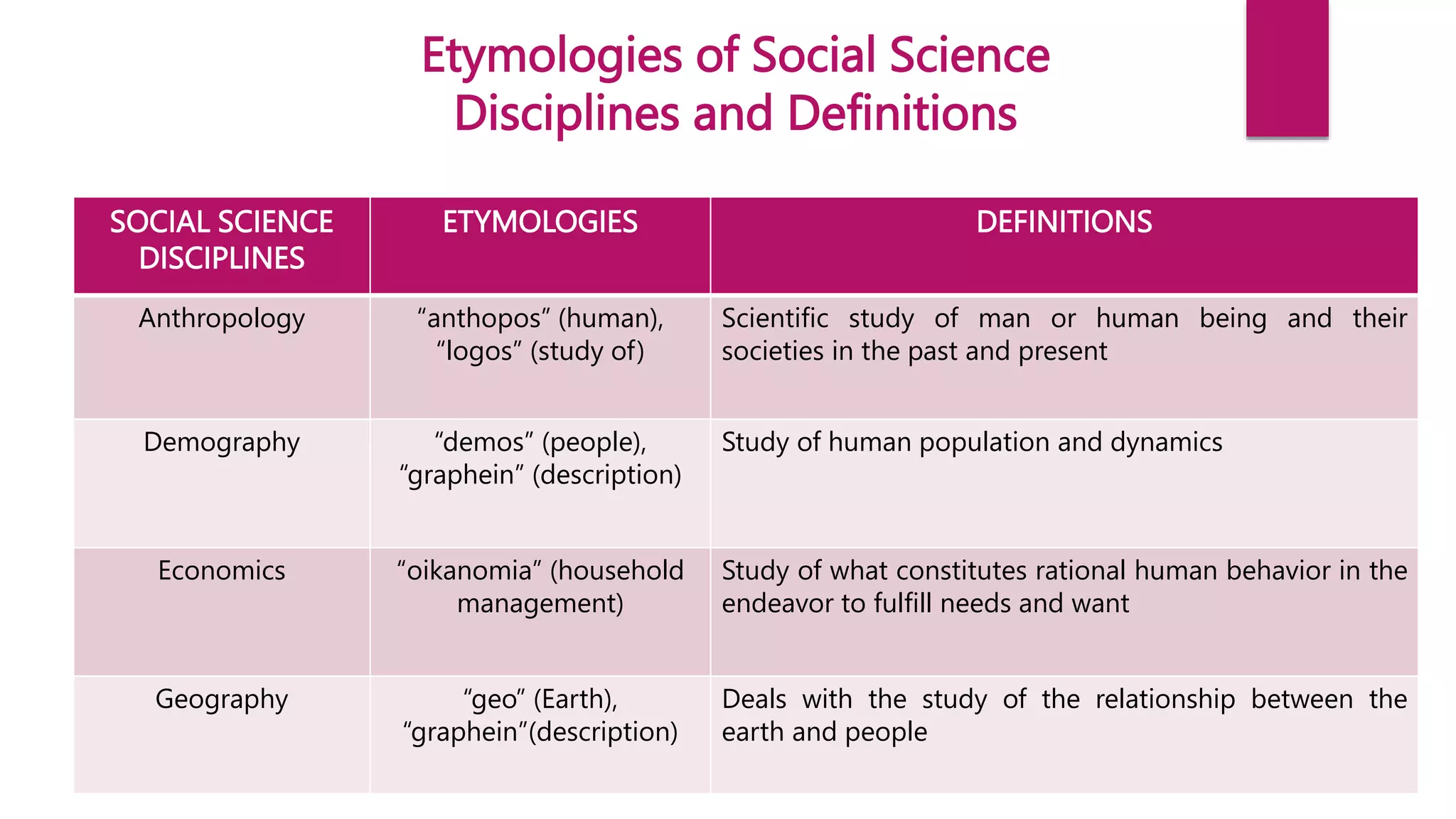
Etymologies of Social Science
Disciplines and Definitions
SOCIAL SCIENCE
DISCIPLINES
ETYMOLOGIES DEFINITIONS
Anthropology “anthopos” (human),
“logos” (study of)
Scientific study of man or human being and their
societies in the past and present
Demography “demos” (people),
“graphein” (description)
Study of human population and dynamics
Economics “oikanomia” (household
management)
Study of what constitutes rational human behavior in the
endeavor to fulfill needs and want
Geography “geo” (Earth),
“graphein”(description)
Deals with the study of the relationship between the
earth and people
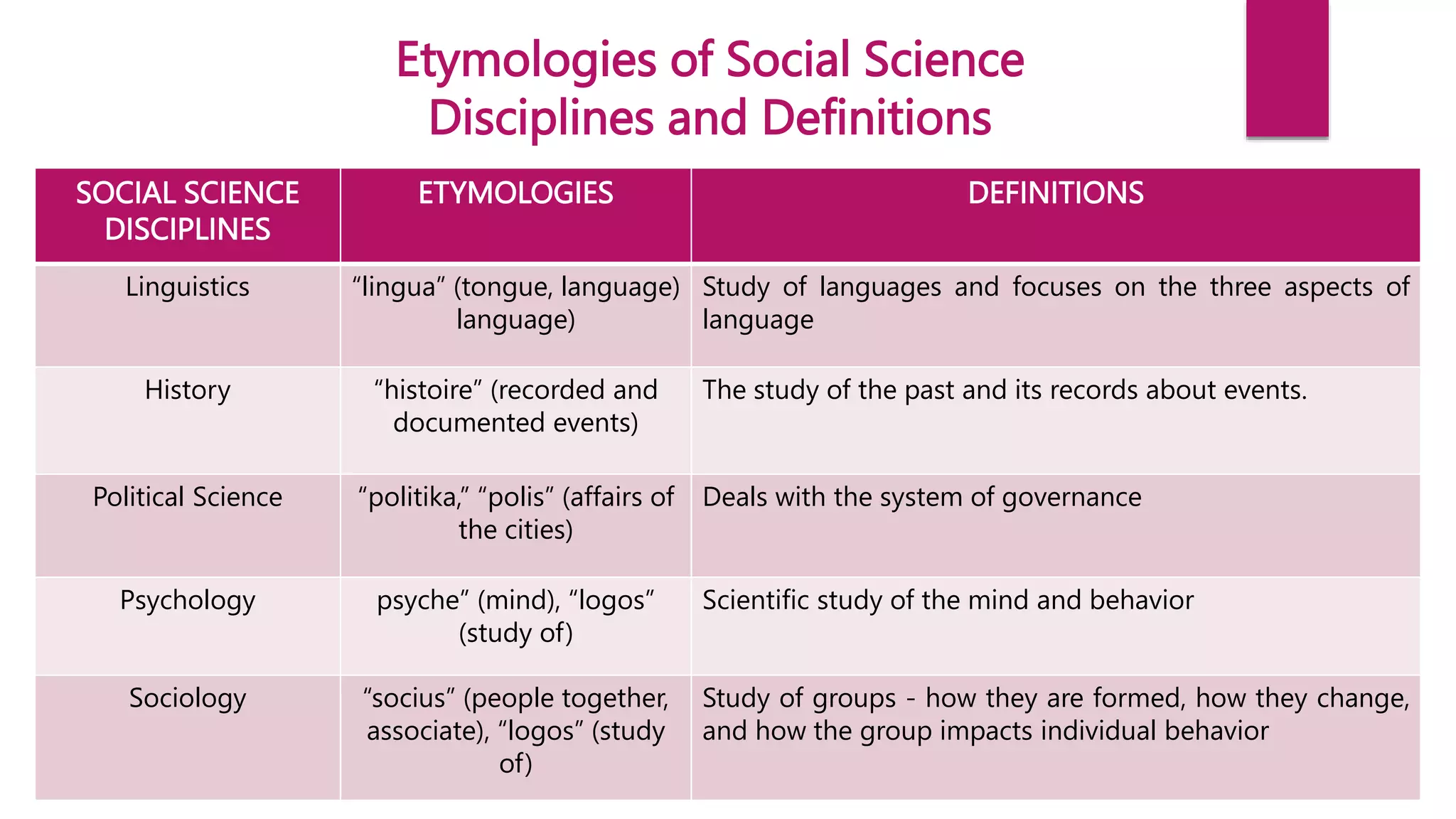
Etymologies of Social Science
Disciplines and Definitions
SOCIAL SCIENCE
DISCIPLINES
ETYMOLOGIES DEFINITIONS
Linguistics “lingua” (tongue, language)
language)
Study of languages and focuses on the three aspects of
language
History “histoire” (recorded and
documented events)
The study of the past and its records about events.
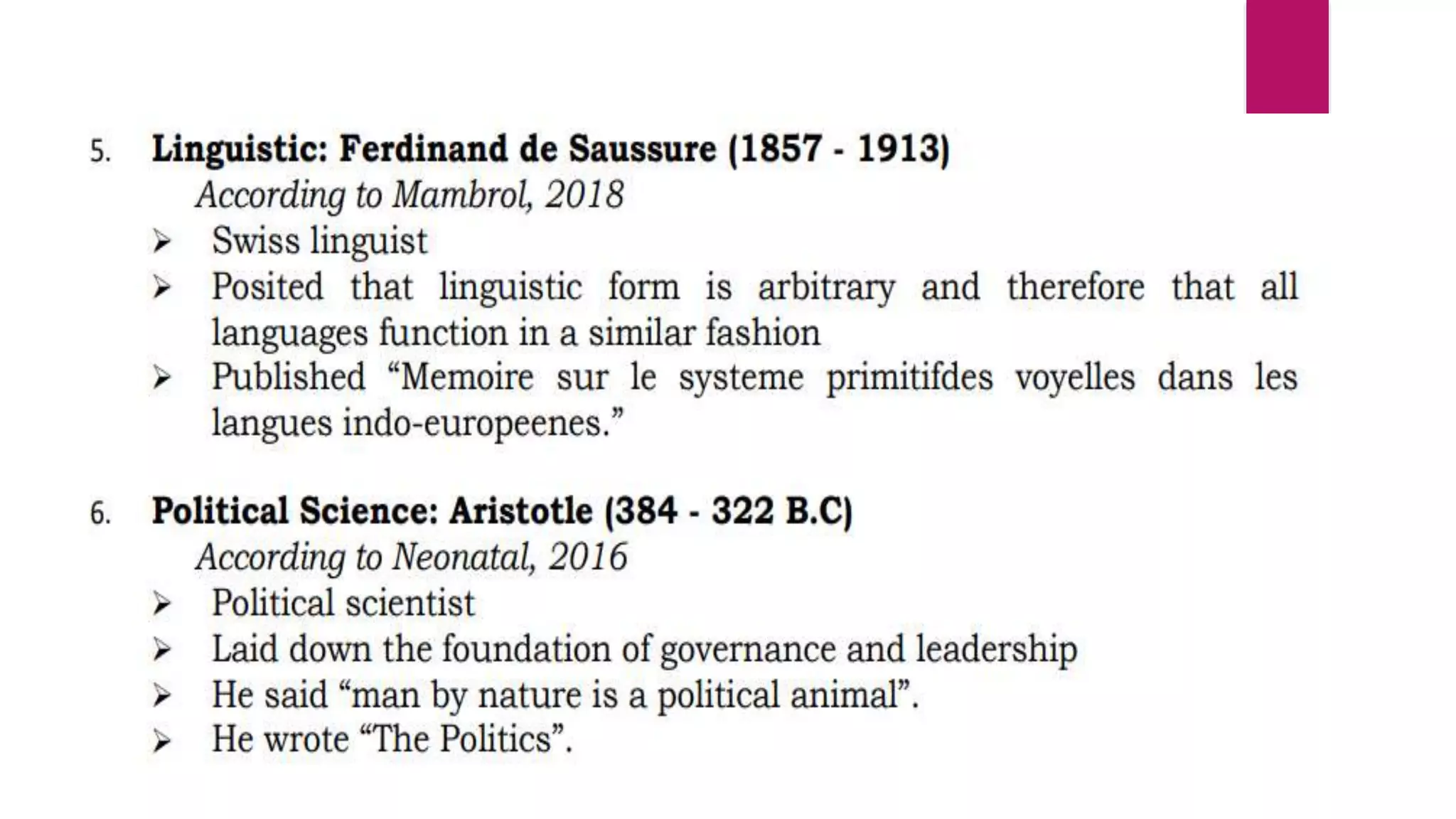
Political Science “politika,” “polis” (affairs of
the cities)
Deals with the system of governance
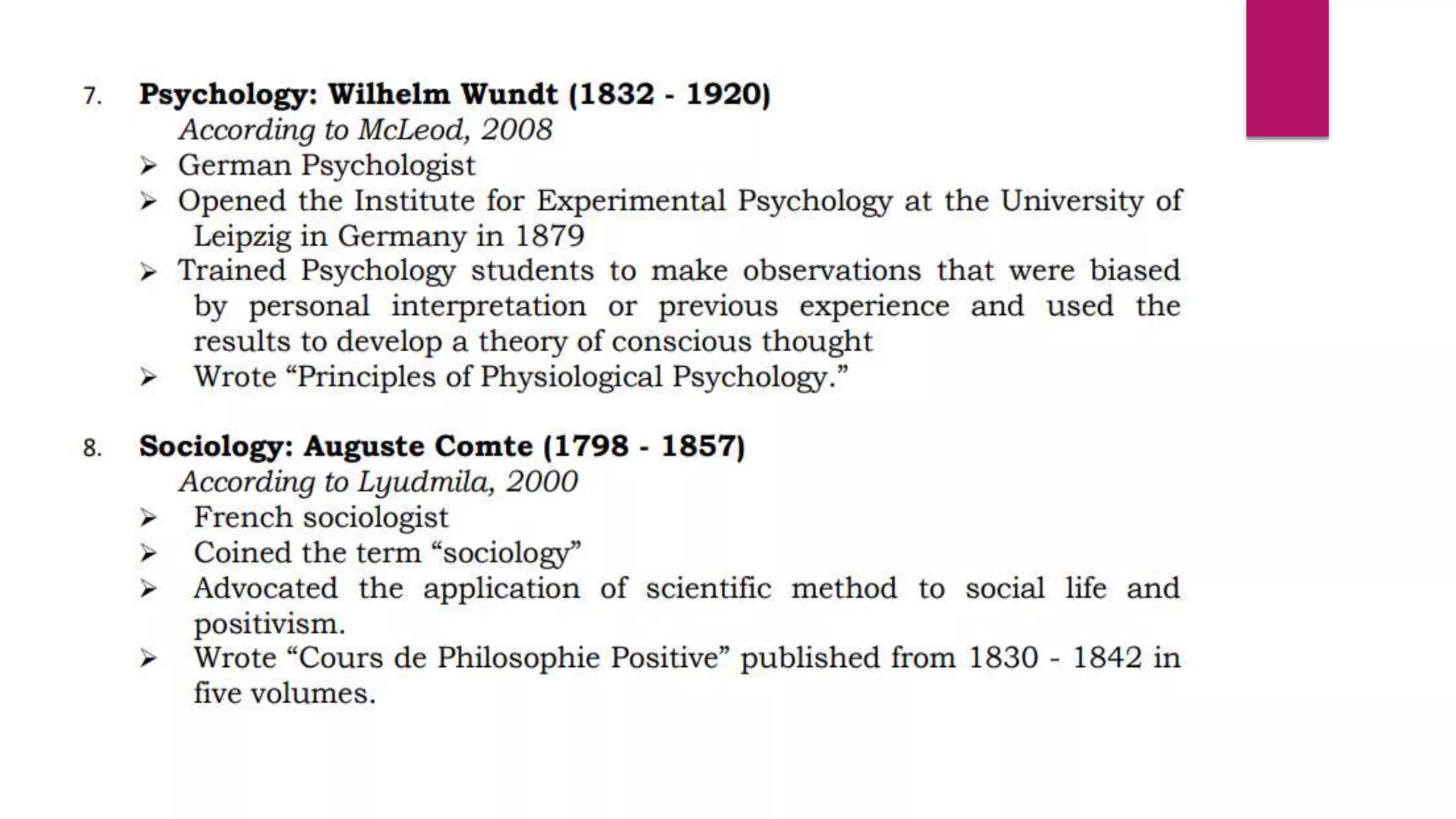
Psychology psyche” (mind), “logos”
(study of)
Scientific study of the mind and behavior
Sociology “socius” (people together,
associate), “logos” (study
of)
Study of groups - how they are formed, how they change,
and how the group impacts individual behavior
ANTHROPOLOGY
• Essentially to understand as many aspects of human life as can possibly be studied, to record its findings,
and contribute to both historical understanding as well as to ascertain current states of the human
condition in an attempt to better understand and/or act upon those findings. (Fethe, 2017)
DEMOGRAPHY
• To know the population of a particular area;
• To ascertain as to which factors are influencing the population of that particular
area;
• To explain the factors relating to changes in population; and
• To study the population trends on the basis of the above three factors
GEOGRAPHY
• To understand basic physical systems that affect everyday life (e.g. earth-sun
relationships, water cycles, wind and ocean currents).
• To learn the location of places and the physical and cultural characteristics of
those places in order to function more effectively in our increasingly
interdependent world. (Bonnett, 2008)
ECONOMICS
• The three most important functions of economics are as follows: Just as feeding,
digestion and growth are the vital processes of living beings; similarly
production, consumption and growth are the essentials of economies. (Leaňo,
2012)
LINGUISTICS
• Refer to the general social uses of language, such as requesting objects and
activities, initiating social interactions, expressing personal feelings, describing
aspects of the world, requesting information, and pretending. (Bernardez, 2013)
HISTORY
• A useful for work. Its study helps create good business people, professionals,
and political leaders. The number of explicit professional jobs for historians is
considerable, but most people who study history do not become professional
historians. (Evans, 2001)
Methods Description
Positivism • Embraces human agency in history.
• Uses sources to provide and accurate and complete vision of
the past.
• Also embraces and empathetic approach towards people in
the past
Narrative -
Chronology
• The creation of narratives of the past - analysis plays less role
as the role of accidents is most important.
Biography -
Hagiography
• The “Great Men” method which creates chronological
narratives. Often look at the agency of one individual in
history.
Methods of Creating History
Methods Description
Dialectics - Analysis • These are created which become orthodoxies. New theses then arrive to
challenge these - revisionism - and a synthesis is produced from the old
and the new.
• The synthesis becomes the new thesis or paradigm and the process of
clashes (dialectics) repeats.
Meta - Narrative/ Total
History
• Works of the Annales school are characterized by a multi - layered
approach which seek to integrate long term, midterm and short term
factors in a “total history”.
• There is an effort to explain large amounts of human history through
the application of theory and social sciences.
Negativism • Rejects human agency in historical affairs.
• Rejects all sources.
• Rejects the possibility of empathetic understanding of the past.
Methods of Creating History
PSYCHOLOGY
• According to earlier psychologists, the function of psychology was to study the
nature, origin and destiny of the human soul. But soul is something
metaphysical.
• It cannot be seen, observed and touched and we cannot make scientific
experiments in soul. (Kendra, 2020
School of Psychology Proponent Description
Structuralism Wilhelm Wundt
and
Edward Titchener
• Considered to be the first school of thought
in Psychology.
• This outlook focused on breaking down
mental processes into the most basic
components.
• The structuralists used techniques such as
introspection to analyze the inner processes
of the human mind.
Functionalism
John Dewey,
James Rowland
Angell, and Harvey
Carr.
Founder:
William James
• A general psychological philosophy that
considers mental life and behavior in terms of
active adaptation to the person’s
environment.
• A theory of the mind in contemporary
philosophy, developed largely as an
alternative to both the identity theory of
mind and behaviorism.
School of Psychology
School of Psychology Proponent Description
Psychoanalytic Sigmund Freud
• Studies the unconscious mind.
• This school of thought emphasized the
influence of the unconscious mind on
behavior.
• Freud believed that the human mind was
composed of three elements: the id, ego, and
superego.
Behaviorism
John Watson
and B.F. Skinner
• Focuses on observable behavior. Suggests
that all behavior can be explained by
environmental causes rather than by internal
forces
School of Psychology
School of Psychology Proponent Description
Cognitivism
• The school of psychology that studies mental
processes including how people think,
perceive, remember and learn.
• As part of the larger field of cognitive science,
science, this branch of psychology is related
to other disciplines including neuroscience,
philosophy, and linguistics.
Gestalt Psychology
Max Wertheimer,
Wolfgang Kohler, and
and Kurt Koffka
• Studies the mind and behavior as a whole
• A school of psychology based upon the idea
that we experience things as unified wholes.
• Means “form” or “configuration”
• The whole is other than the sum of its parts
School of Psychology
POLITICAL SCIENCE
• A social study concerning the allocation and transfer of power in decision
making, the roles and systems of governance including governments and
international organizations, political behavior and public policies. (Mortel
et al. 2003)
SOCIOLOGY
• Can study society with a wide variety of focuses. From studying the power
elite, to the interaction of the economy, society and the environment, to
the examination of various rights movements, Sociology examines the way
different aspects of society behave and function. (San Juan, 2011)
Creating an Imaginary Nation!
Directions: Create a physical map of an imaginary nation. Write the name of the
the country on the top of the map. You should include at least five different land or
water forms in the map and give each of them a unique name (e.g. The Shadow
Mountain). You should also include at least five major cities including a capital these
must be named. Neatly color the maps with colored pencils or crayons. Explain how
your imaginary nation is conducive to be a productive and developed society. Use
separate bond paper in answering this question.
ACTIVITY
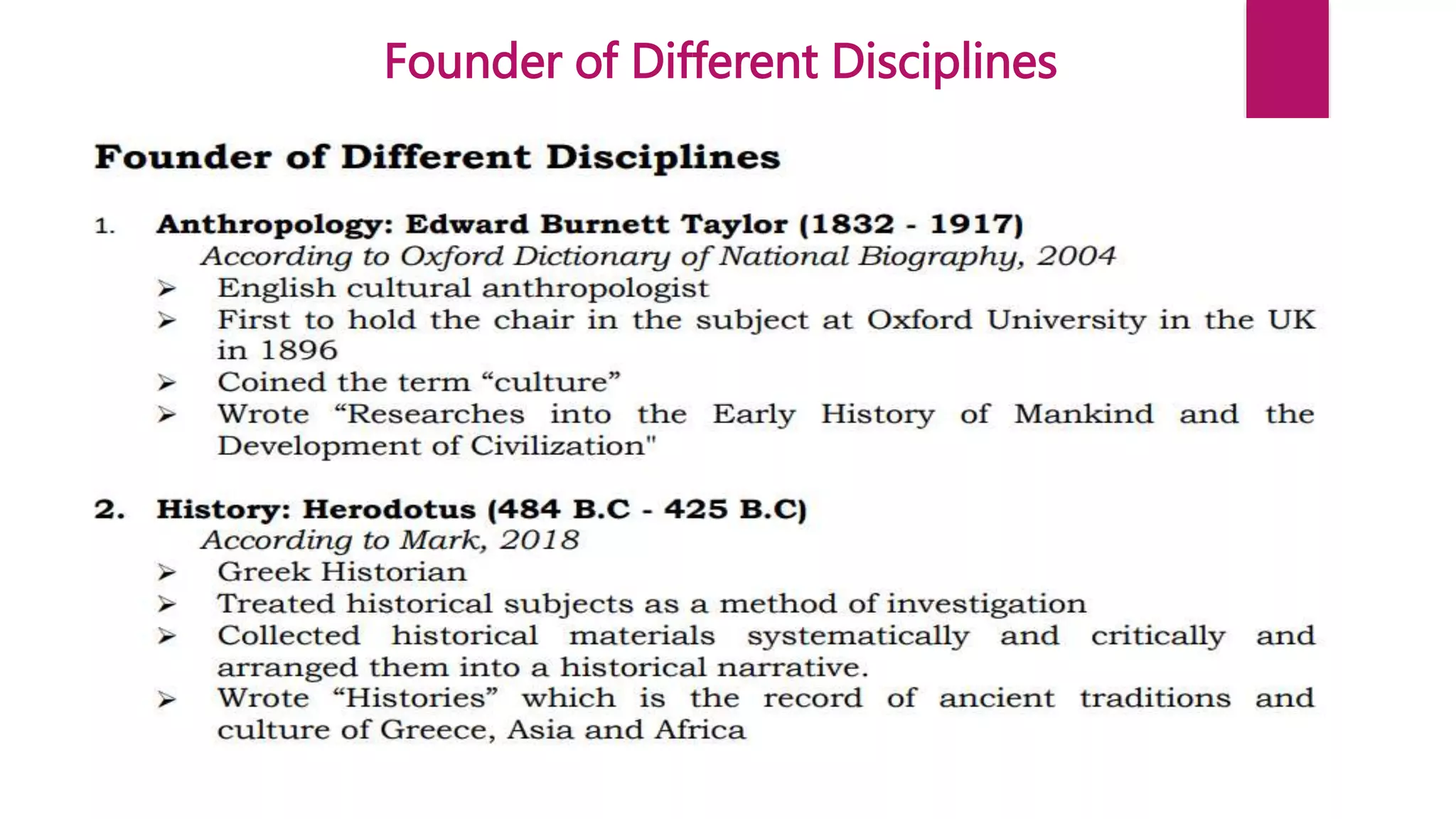
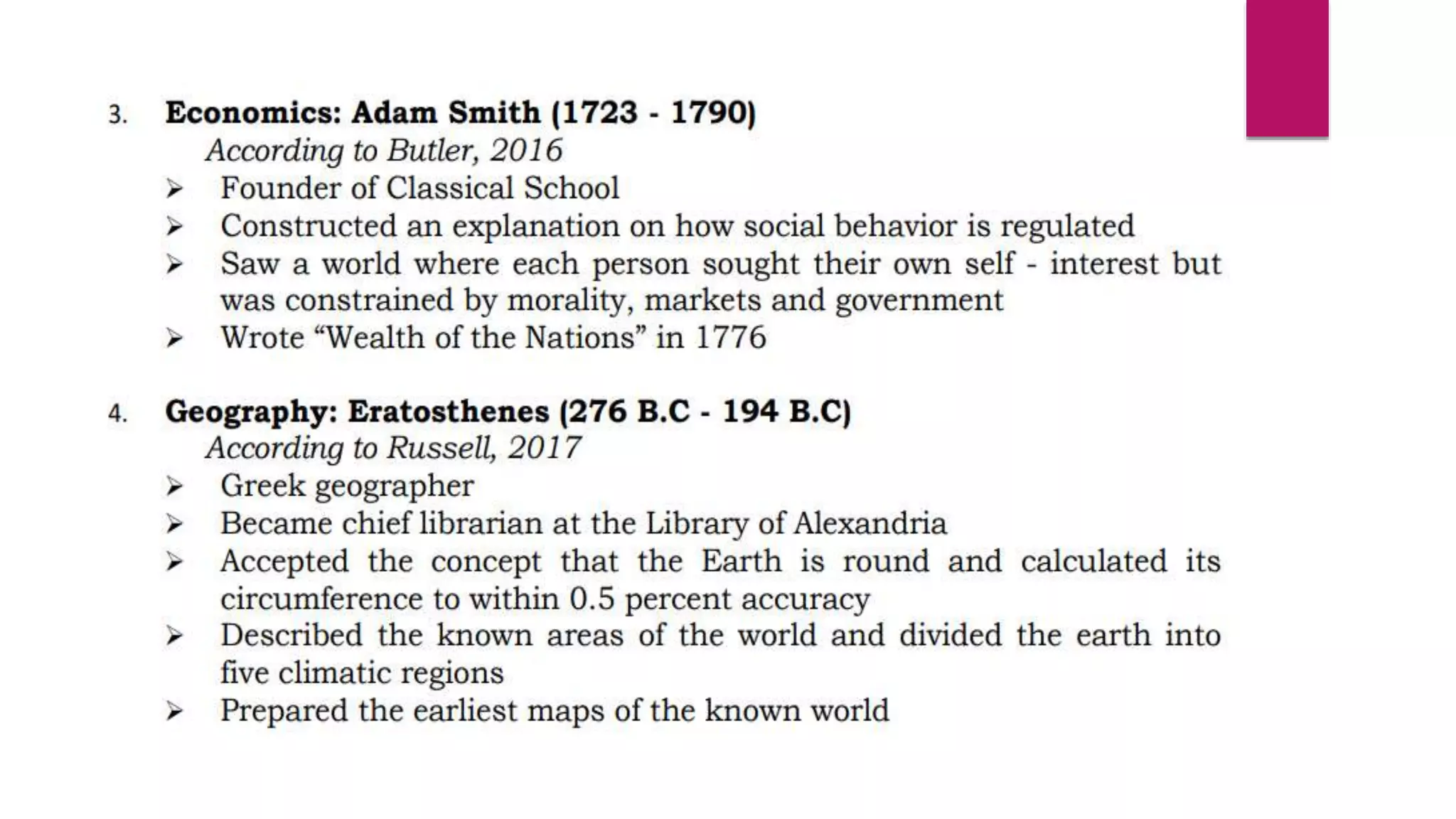
Founder of Different Disciplines
Disciplines of Social Sciences

Disciplines of Social Sciences

  • 1.
  • 2.
    Etymologies of SocialScience Disciplines and Definitions SOCIAL SCIENCE DISCIPLINES ETYMOLOGIES DEFINITIONS Anthropology “anthopos” (human), “logos” (study of) Scientific study of man or human being and their societies in the past and present Demography “demos” (people), “graphein” (description) Study of human population and dynamics Economics “oikanomia” (household management) Study of what constitutes rational human behavior in the endeavor to fulfill needs and want Geography “geo” (Earth), “graphein”(description) Deals with the study of the relationship between the earth and people
  • 3.
    Etymologies of SocialScience Disciplines and Definitions SOCIAL SCIENCE DISCIPLINES ETYMOLOGIES DEFINITIONS Linguistics “lingua” (tongue, language) language) Study of languages and focuses on the three aspects of language History “histoire” (recorded and documented events) The study of the past and its records about events. Political Science “politika,” “polis” (affairs of the cities) Deals with the system of governance Psychology psyche” (mind), “logos” (study of) Scientific study of the mind and behavior Sociology “socius” (people together, associate), “logos” (study of) Study of groups - how they are formed, how they change, and how the group impacts individual behavior
  • 4.
    ANTHROPOLOGY • Essentially tounderstand as many aspects of human life as can possibly be studied, to record its findings, and contribute to both historical understanding as well as to ascertain current states of the human condition in an attempt to better understand and/or act upon those findings. (Fethe, 2017)
  • 5.
    DEMOGRAPHY • To knowthe population of a particular area; • To ascertain as to which factors are influencing the population of that particular area; • To explain the factors relating to changes in population; and • To study the population trends on the basis of the above three factors
  • 6.
    GEOGRAPHY • To understandbasic physical systems that affect everyday life (e.g. earth-sun relationships, water cycles, wind and ocean currents). • To learn the location of places and the physical and cultural characteristics of those places in order to function more effectively in our increasingly interdependent world. (Bonnett, 2008)
  • 7.
    ECONOMICS • The threemost important functions of economics are as follows: Just as feeding, digestion and growth are the vital processes of living beings; similarly production, consumption and growth are the essentials of economies. (Leaňo, 2012)
  • 8.
    LINGUISTICS • Refer tothe general social uses of language, such as requesting objects and activities, initiating social interactions, expressing personal feelings, describing aspects of the world, requesting information, and pretending. (Bernardez, 2013)
  • 9.
    HISTORY • A usefulfor work. Its study helps create good business people, professionals, and political leaders. The number of explicit professional jobs for historians is considerable, but most people who study history do not become professional historians. (Evans, 2001)
  • 10.
    Methods Description Positivism •Embraces human agency in history. • Uses sources to provide and accurate and complete vision of the past. • Also embraces and empathetic approach towards people in the past Narrative - Chronology • The creation of narratives of the past - analysis plays less role as the role of accidents is most important. Biography - Hagiography • The “Great Men” method which creates chronological narratives. Often look at the agency of one individual in history. Methods of Creating History
  • 11.
    Methods Description Dialectics -Analysis • These are created which become orthodoxies. New theses then arrive to challenge these - revisionism - and a synthesis is produced from the old and the new. • The synthesis becomes the new thesis or paradigm and the process of clashes (dialectics) repeats. Meta - Narrative/ Total History • Works of the Annales school are characterized by a multi - layered approach which seek to integrate long term, midterm and short term factors in a “total history”. • There is an effort to explain large amounts of human history through the application of theory and social sciences. Negativism • Rejects human agency in historical affairs. • Rejects all sources. • Rejects the possibility of empathetic understanding of the past. Methods of Creating History
  • 12.
    PSYCHOLOGY • According toearlier psychologists, the function of psychology was to study the nature, origin and destiny of the human soul. But soul is something metaphysical. • It cannot be seen, observed and touched and we cannot make scientific experiments in soul. (Kendra, 2020
  • 13.
    School of PsychologyProponent Description Structuralism Wilhelm Wundt and Edward Titchener • Considered to be the first school of thought in Psychology. • This outlook focused on breaking down mental processes into the most basic components. • The structuralists used techniques such as introspection to analyze the inner processes of the human mind. Functionalism John Dewey, James Rowland Angell, and Harvey Carr. Founder: William James • A general psychological philosophy that considers mental life and behavior in terms of active adaptation to the person’s environment. • A theory of the mind in contemporary philosophy, developed largely as an alternative to both the identity theory of mind and behaviorism. School of Psychology
  • 14.
    School of PsychologyProponent Description Psychoanalytic Sigmund Freud • Studies the unconscious mind. • This school of thought emphasized the influence of the unconscious mind on behavior. • Freud believed that the human mind was composed of three elements: the id, ego, and superego. Behaviorism John Watson and B.F. Skinner • Focuses on observable behavior. Suggests that all behavior can be explained by environmental causes rather than by internal forces School of Psychology
  • 15.
    School of PsychologyProponent Description Cognitivism • The school of psychology that studies mental processes including how people think, perceive, remember and learn. • As part of the larger field of cognitive science, science, this branch of psychology is related to other disciplines including neuroscience, philosophy, and linguistics. Gestalt Psychology Max Wertheimer, Wolfgang Kohler, and and Kurt Koffka • Studies the mind and behavior as a whole • A school of psychology based upon the idea that we experience things as unified wholes. • Means “form” or “configuration” • The whole is other than the sum of its parts School of Psychology
  • 16.
    POLITICAL SCIENCE • Asocial study concerning the allocation and transfer of power in decision making, the roles and systems of governance including governments and international organizations, political behavior and public policies. (Mortel et al. 2003)
  • 17.
    SOCIOLOGY • Can studysociety with a wide variety of focuses. From studying the power elite, to the interaction of the economy, society and the environment, to the examination of various rights movements, Sociology examines the way different aspects of society behave and function. (San Juan, 2011)
  • 18.
    Creating an ImaginaryNation! Directions: Create a physical map of an imaginary nation. Write the name of the the country on the top of the map. You should include at least five different land or water forms in the map and give each of them a unique name (e.g. The Shadow Mountain). You should also include at least five major cities including a capital these must be named. Neatly color the maps with colored pencils or crayons. Explain how your imaginary nation is conducive to be a productive and developed society. Use separate bond paper in answering this question. ACTIVITY
  • 19.