Disciplines and
Ideas in the
Social Science
Quarter 1 – Module 2:
Nature and Functions of Social
Sciences Disciplines
OBJECTIVE/S:
1. DEFINE THE NINE DISCIPLINES OF SOCIAL
SCIENCES; AND
2. IDENTIFY THE NATURES AND FUNCTIONS OF
EACH DISCIPLINES.
What I Know
Direction: Match the following terms from column A to their definition
from column B. Write only the letter of your answer on the separate sheet of
paper.
A B
1. Anthropology a. The study of human population and dynamics
2. Demography b. The study of languages and focuses on the three
aspects of language
3. Economics c. The scientific study of humans, human behavior
and societies in the past and present.
4. Geography d. The study of the past and its records about
events.
5. History e. The study of what constitutes rational human
behavior in the endeavor to fulfill needs and
wants.
6. Humanities f. It deals with the study of the relationship between the
earth and people.
7. Linguistics g. This refer to the academic disciplines that study aspects
of human society and culture.
8. Narrative - Chronology h. The scientific study of human society and social
relationships.
9. Natural Sciences i. The scientific study of the mind and behavior.
10. Negativism j. The study of politics and power from domestic,
international, and comparative perspectives.
11. Political Science k. A branch of science which deals with the physical world.
12. Positivism l. The study of human social relationships and institutions.
13. Psychology m. It uses sources to provide an accurate and complete vision
of the past.
14. Social Sciences n. The creation of narratives of the past - analysis plays less
role as the role of
accidents is most important.
15. Sociology o. It rejects human agency in historical affairs. Rejects all
sources. Rejects the possibility of empathetic
understanding of the past.
Lesson
1
Introducing the Disciplines
within the Social Sciences
Social science tells us how society works. It provides a deeper
understanding about the world beyond our immediate experience.
It tells us that everything is interconnected, that the labor of
yesterday can be the fruits of today and that the actions of today
will have an impact in the future of humanity.
What’s In
Concept Mapping!
Direction: Fill out a concept map showing the definition of social science as a
study of society. Write your answer on the separate paper. Use the example
below as your reference.
What’s New
Guess the Pic!
Directions: Using the pictures below, fill in the missing letters to reveal the
words. Then, rearrange the jumbled letters in the middle of the
pictures. Write your answer on the separate paper.
What is It
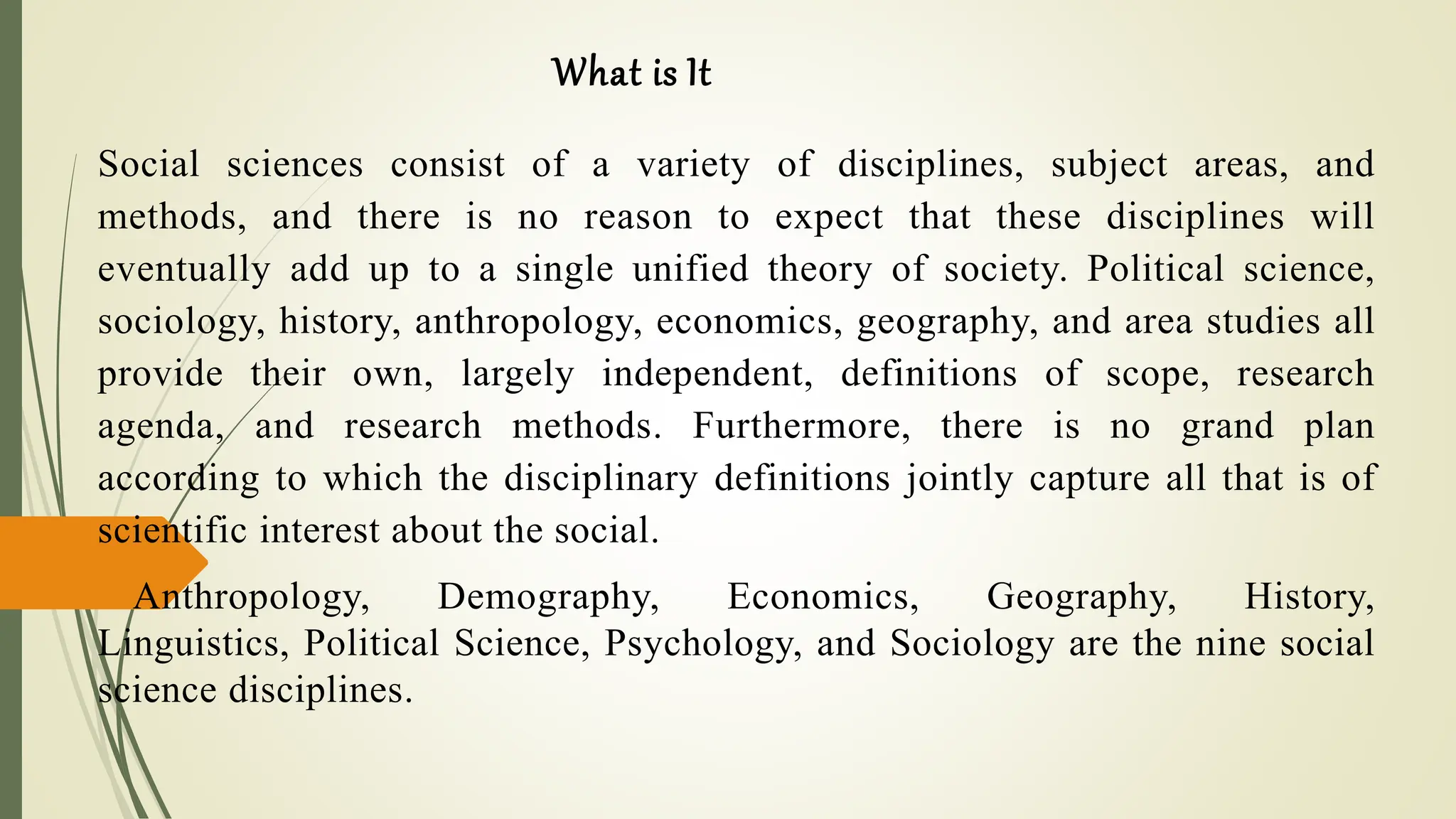
Social sciences consist of a variety of disciplines, subject areas, and
methods, and there is no reason to expect that these disciplines will
eventually add up to a single unified theory of society. Political science,
sociology, history, anthropology, economics, geography, and area studies all
provide their own, largely independent, definitions of scope, research
agenda, and research methods. Furthermore, there is no grand plan
according to which the disciplinary definitions jointly capture all that is of
scientific interest about the social.
Anthropology, Demography, Economics, Geography, History,
Linguistics, Political Science, Psychology, and Sociology are the nine social
science disciplines.
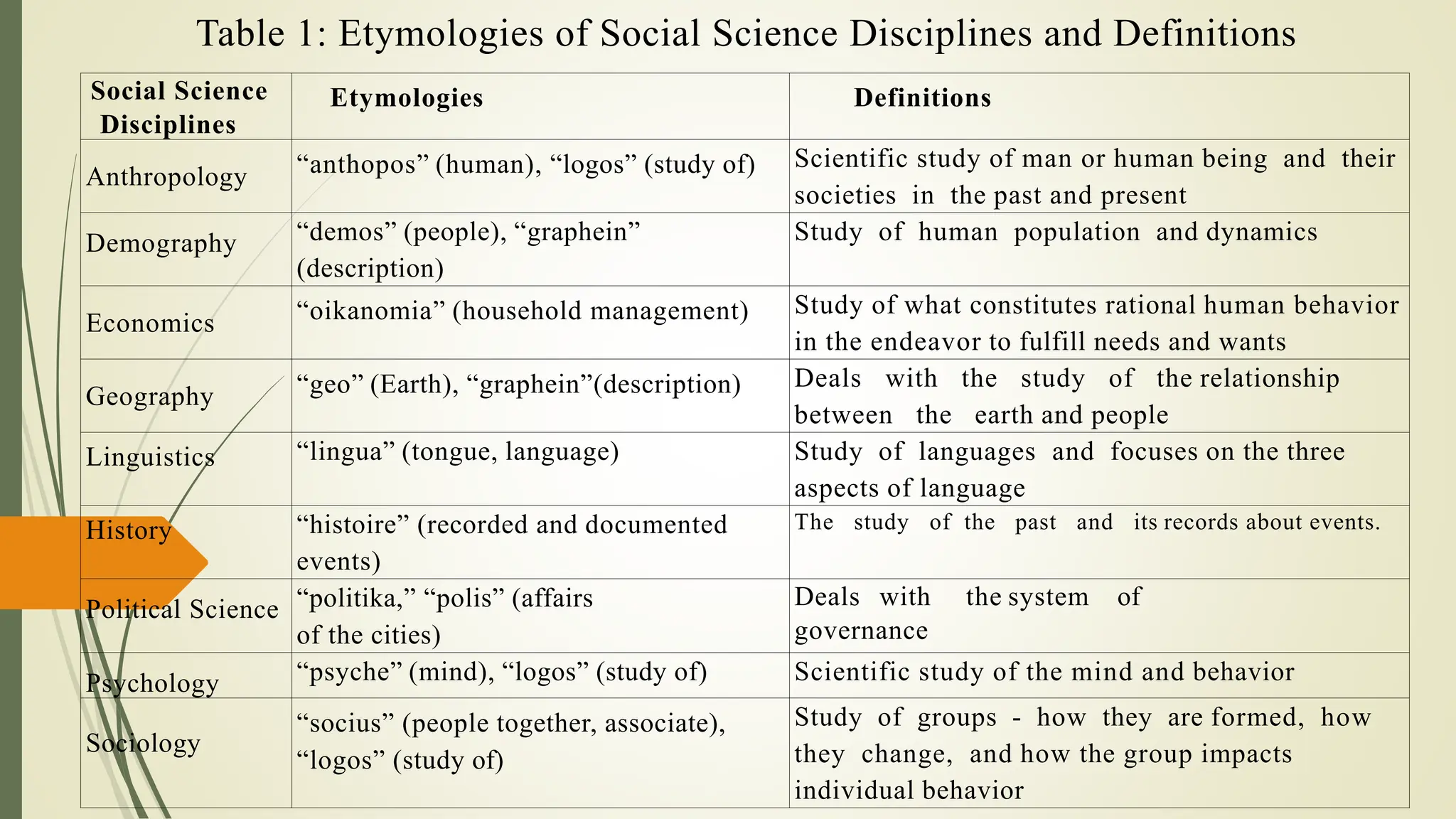
Table 1: Etymologies of Social Science Disciplines and Definitions
Social Science
Disciplines
Etymologies Definitions
Anthropology “anthopos” (human), “logos” (study of) Scientific study of man or human being and their
societies in the past and present
Demography “demos” (people), “graphein”
(description)
Study of human population and dynamics
Economics “oikanomia” (household management) Study of what constitutes rational human behavior
in the endeavor to fulfill needs and wants
Geography “geo” (Earth), “graphein”(description) Deals with the study of the relationship
between the earth and people
Linguistics “lingua” (tongue, language) Study of languages and focuses on the three
aspects of language
History “histoire” (recorded and documented
events)
The study of the past and its records about events.
Political Science “politika,” “polis” (affairs
of the cities)
Deals with the system of
governance
Psychology “psyche” (mind), “logos” (study of) Scientific study of the mind and behavior
Sociology
“socius” (people together, associate),
“logos” (study of)
Study of groups - how they are formed, how
they change, and how the group impacts
individual behavior
Table 2: Function of Social Science Disciplines
Disciplines Function
Anthropology
Essentially to understand as many aspects of human life as can possibly be studied,
to record its findings, and contribute to both historical understanding as well as
to ascertain current states of the human condition in an attempt to better understand
and/or act upon those findings. (Fethe, 2017)
Geography To understand basic physical systems that affect everyday life (e.g. earth-sun
relationships, water cycles, wind and ocean currents). To learn the location of
places and the physical and cultural characteristics of those places in order to
function more effectivelyin our increasingly interdependent world. (Bonnett,
2008)
History
A useful for work. Its study helps create good businesspeople, professionals, and
political leaders. The number of explicit professional jobs for historians is
considerable, but most people who study history do not become
professional historians. (Evans, 2001)
Sociology
Can study society with a wide variety of focuses. From studying the power
elite, to the interaction of the economy, society and the environment, to the
examination of various rights movements, Sociology examines the way different
aspects of society behave and function. (San Juan, 2011)
Political Science
A social study concerning the allocation and transfer of power in decision
making, the roles and systems of governance including governments
and international organizations, political behavior and public policies. (Mortel et
al. 2003)
Economics
The three most important functions of economics are as follows: Just as
feeding, digestion and growth are the vital processes of living beings;
similarly production, consumption and growth are the essentials of economies.
(Leaňo, 2012)
Linguistics
Refer to the general social uses of language, such as
requesting objects and activities, initiating social
interactions, expressing personal feelings, describing aspects of the world,
requesting information, and pretending. (Bernardez, 2013)
Demography
To know the population of a particular area;
To ascertain as to which factors are influencing the population of
that particular area;
To explain the factors relating to changes in population; and To study the
population trends on the basis of the above three factors.
Psychology
According to earlier psychologists, the function of psychology was to study
the nature, origin and destiny of the human soul. But soul is something
metaphysical. It cannot be seen, observed and touched and we cannot
make scientific experiments in soul. (Kendra, 2020)
Table 3: Nature of Social Science Disciplines
Disciplines Nature
Anthropology
(Ramos, 2014)
 The aim of modern social anthropology is just not
to study human society but also to understand the complex
issues of modern human life.
 As primitive people have been the focus of anthropological
study, the problems faced by these people in the process of
development in modern days become very important for the
anthropologists to study.
 Anthropologists not only deal with the study of these
problems but also try to find out a solution for this.
 Developmental anthropology and Action anthropology etc.
are the specialized fields within social anthropology which
deal with such problems.
 Therefore, we can say that the scope and aim of social
anthropology go together; one influences the other. As
much as the scope increases a new aim comes out of it.
7
Geography
(Semple, 2004)
 Geography is concerned to provide an accurate, orderly,
and rational description of the variable character of the earth's surface" (Hartshorne, p. 21).
 Understandably this characterization has not been
universally accepted, and others have suggested terms such as "areal differentiation," and "spatial
interaction" as better expressing the core of geography.
 It has been seen as more akin to history than to the
systematic sciences (physics, chemistry, biology, geology, meteorology, etc.) in that it has no body
of material peculiar to itself, but rather adopts a point of view.
 But subjects studied by some geographers, such as map
projections, are highly "scientific."
History
(Munslow, 2001)
 A study of the present in the light of the past: The present
has evolved out of the past.
 Modern history enables us to understand how society has
come to its present form so that one may intelligently interpret the sequence of events.
 The causal relationships between the selected happenings
are unearthed that help in revealing the nature of happenings and framing of general laws.
 History is the study of man: History deals with man’s
struggle through the ages. History is not static.
 By selecting “innumerable biographies” and presenting
their lives in the appropriate social context and the ideas in the human context, we understand the
sweep of events.
 It traces the fascinating story of how man has developed
through the ages, how man has studied to use and control his environment and how the present
institutions have grown out of the past.
 History is concerned with man in time: It deals with a
series of events and each event occurs at a given point in time. Human history, in fact, is the process
of human development in time.
 It is time which affords a perspective to events and lends a charm that
brightens up the past.
 History is concerned with man in space: The interaction
of man on environment and vice versa is a dynamic one. History describes
about nations and human activities in the context of theirphysical and
geographical environment.
 Out of this arise the varied trends in the political, social,
economic and cultural spheres of man’s activities and achievements.
 Objective record of happenings: Every precaution is taken to base the data on
original sources and make them free from subjective interpretation.
 It helps in clear understanding of the past and enables us to take well
informed decisions.
 Multisided: All aspects of the life of a social group are
closely interrelated and historical happenings cover all these aspects of
life, not limited only to the political aspect that had so long dominated
history.
 History is a dialogue between the events of the past and progressively emerging future
ends. The historian’s interpretation of the past, his selection of the significant and the relevant
events, evolves with the progressive emergence of new goals.
 The general laws regulating historical happenings may
not be considered enough; attempts have to be made to predict future happenings on the basis of
the laws.
 Not only narration but also analysis: The selected happenings are not merely
narrated; the causal relationships between them are properly unearthed.
 The tracing of these relationships lead to the development
of general laws that are also compared and contrasted with similar happenings in other social
groups to improve the reliability and validity of these laws.
 Continuity and coherence are the necessary requisites of history: History carries the burden of
human progress as it is passed down from generation to generation, from society to society,
justifying the essence of continuity.
 Relevant: In the study of history only those events are included which are relevant to the
understanding of the present life.
 Comprehensiveness: According to modern concept, history is not confined to one period or
country or nation. It also deals with all aspects of human life-political, social, economic,
religious, literary, aesthetic and physical, giving a clear sense of world unity and world
citizenship.
Sociology
(Lo, 2019)
 Sociology is an independent science: Sociology is not treated and
studied as a branch of any other science like philosophy, history. Now it
has emerged into an independent science. As an independent science it has
its own field of study.
 Sociology is a social science and not a physical science: All the sciences
are divided into two categories: natural sciences and social sciences.
 Natural sciences study physical phenomena where as
social sciences study social phenomena. Social sciences include Economics,
Political Science, and Anthropology etc.
Sociology belongs to the family of Social science. As a
social science it concentrates its attention on man, his social behavior,
activities and social life. In other words, it studies man as a social being.
 Sociology is a pure science and not an applied science:
The aim of applied science is to apply the acquired knowledge into life
and to put it to use.
 But the aim of pure sciences is the acquisition of knowledge and it is
not bothered whether the acquired knowledge is useful or can be put to use.
Sociology is a pure science, because it aims at the acquisition of
knowledge about human society, hot the utilization of the knowledge.
Sociology
(Lo, 2019)
 Sociology is an abstract science and not a concrete science:
This doesn't mean that Sociology, is an art and not a science. It
only refers that Sociology is not interested in concrete
manifestations of human events.
 It is more concerned with the form of human events and their
patterns. Similarly, Sociology does not confine itself to the study of
this society or that particular society. It simply means that Sociology
is an abstract science, not a concrete science.
 Sociology is a categorical and not a normative discipline:
Sociology "confines itself about what is, not what should be or ought
to be."
 As a science it is silent about questions of value. It does not make
any kind of value judgment. It only means Sociology as a
discipline cannot deal with problems of good and evil, right and
wrong.
 Sociology is a generalizing and not a particularizing science:
Sociology does not study each and every event that takes place in
society. It makes generalization on the
10
basis of some selected events. For example, not by studying or examining all
the secondary groups but by observing a few secondary groups, a sociologist
makes generalization of secondary groups.
 Sociology is a general science and not a special social science: The area of
inquiry of Sociology is general and not specialized. Social sciences like Political
Science, History, Economics, etc. study human interaction but not all about human
interactions.
 But Sociology does not investigate special kind of phenomena in relation to
human life, and activities but it only studies human activities in a general way.
 Sociology is both a rational and empirical science: Empiricism is the
approach that emphasizes experiences and the facts that result from
observation and experimentation.
 On the other hand, rationalism stresses reason and theories that result from
logical inference. The empiricist collects facts, the rationalist co-ordinates and
arranges them.
 In sociological theory both are significant. Thus, Sociology is both a rational and
empirical science.
Conclusion:
Thus, from the above discussion we come to know that the nature of Sociology is
independent, social, a categorical, pure, abstract, and generalizing; both are a
rational and an empirical social science.
10
Political Science
(Bhargava,2008)
 Politics is not only a mere institution of governance but also
a mechanism for achieving societal goals.
 Political Science is thus a study of the state in the past,
present, and future;
 Study of Political organization, political processes and
political fun
 Study of Political Institutions and Political Theories.
 Study of several subfields: Political Theory.
Economics
(Metu, 2016)
 Economics is a science: Science is an organized branch of
knowledge that analyses cause and effect relationship
between economic agents.
 Further, economics helps in integrating various sciences
such as mathematics, statistics, etc. to identify the
relationship between price, demand, supply and other
economic factors.
 Positive Economics: A positive science is one that studies
the relationship between two variables but does not give
11
any value judgment, i.e. it states ‘what is’. It deals with facts
about the entire economy.
 Normative Economics: As a normative science,
economics passes value judgment, i.e. ‘what ought to be’. It is
concerned with economic goals and policies to attain these goals.
 Economics is an art: Art is a discipline that expresses the way
things are to be done, so as to achieve the desired end.
 Economics has various branches like production,
distribution, consumption and economics that provide general
rules and laws that are capable of solving different problems of
society.
 Therefore, economics is considered as science as well as art, i.e.
science in terms of its methodology and arts as in application.
 Hence, economics is concerned with both theoretical and
practical aspects of the economic problems which we encounter
in our day to day life.
11
Linguistics
 An academic discipline – a body of knowledge
given to—or received by—a disciple (student); a
branch or sphere of knowledge, or field of study,
that an individual has chosen to specialize in.
 A field of science – a widely recognized
category of specialized expertise within science,
embodying its own terminology, nomenclature, and
scientific journals.
 A social science – a field of academic scholarship
that explores aspects of human societies related
to the languages they speak.
11
Psychology
 Psychologyis the scientific study and practical
application of observable behavior and mental processes of
organisms.
 Psychology differs from other social sciences such as:
Sociology, History, or Economics, because psychology
specifically deals with the study of an individual. The
other social sciences will study groups, or history.
 Psychology is less a science of reported findings, it
attempts asks and answers questions using observable
behavior and what can be determined as mental
processes of the subject.
 The symbol for psychology is the Greek letter “psi” (Ø).
The subject matter of psychology is, affect, behavior, and
cognition.
 The affect for psychology is the actual mental processes
that make up: moods, feeling, and emotional state.
Table 4: According to Banaag, 2012 the Methods of Creating History:
Methods Description
Positivism
Embraces human agency in history. Uses sources to provide and accurate
and complete vision of the past. Also embraces and empathetic
approach towards people in the past.
Narrative - Chronology The creation of narratives of the past - analysis plays less role as the role
of accidents is most important.
Biography - Hagiography The “Great Men” method which creates chronological narratives. Often
look at the agency of one individual in history.
Dialectics - Analysis
These are created which become orthodoxies. New theses then arrive
to challenge these - revisionism - and a synthesis is produced from the
old and the new. The synthesis becomes the new thesis or paradigm
and the process of clashes (dialectics) repeats.
Meta - Narrative/ Total
History
Works of the Annales school are characterized by a multi - layered
approach which seek to integrate long term, midterm and short term
factors in a “total history”. There is an effort to explain large amounts of
human history through the application of theory and social sciences.
Negativism Rejects human agency in historical affairs. Rejects all sources. Rejects
the possibility of empathetic understanding of the past.
Table 5: According to Gans, 2020 the School of Psychology
School of
Psychology Proponents Description
Structuralism Wilhelm Wundt and Edward
Titchener
 Considered to be the first school of
thought in Psychology.
 This outlook focused on breaking down
mental processes into the most basic
components.
 The focus was on reducing mental
processes down into their most basic elements.
 The structuralists used techniques such as
introspection to analyze the inner processes of
the human mind.
Functionalism John Dewey, James Rowland
Angell, and Harvey Carr.
Founder: William James
A general psychological philosophy that
considers mental life and behavior in terms
of active adaptation to the person’s environment.
 A theory of the mind incontemporary
philosophy, developed largely as an
alternative to both the identity theory of mind
and behaviorism.
13
Psychoanalytic Sigmund
Freud
 Studies the unconscious mind.
This school of thought emphasized the influence of
the unconscious mind on behavior.
 Freud believed that the human mind was
composed of three elements: the id, ego, and superego.
Behaviorism John Watson
and B.F.
Skinner
 Focuses on observable behavior.
 Suggests that all behavior can be explained by
environmental causes rather than by internal forces.
 Theories of learning includingclassical
conditioning and operant conditioning were the focus
of a great deal of research.
 An approach to psychology that combines
elements of philosophy, methodology, and theory.
 Psychology should concern itself with the
observable behavior of people and animals, not with
unobservable events that take place in their minds.
Cognitivism
 The school of psychology that studies
mental processes including how people
think, perceive, remember and learn.
 As part of the larger field of cognitive
science, this branch of psychology is
related to other disciplines including
neuroscience, philosophy, and linguistics.
Gestalt
Psychology
Max Wertheimer,
Wolfgang Kohler,
and Kurt Koffka
 Studies the mind and behavior as a
whole
A school of psychology based upon the
idea that we experience things as
unified wholes.
Means “form” or “configuration”
 The whole is other than the
sum of its parts
Independent Activity 1
Directions: Find the words being defined in
the sentences inside the word hunt. Encircle
them using a pen with blue color for number
one, yellow for number two, green for number
three, red for number four, and violet for
number five. Use a separate bond paper.
1. Wilhelm Wundt and Edward Titchener
are the proponents of this school of
psychology.
2. A theory of the mind in contemporary
philosophy, developed largely as an
alternative to both the identity theory of mind
and behaviorism.
3. An approach to psychology that combines elements of philosophy, methodology, and theory.
4. The school of psychology that studies mental processes including how people think, perceive,
remember and learn.
5. This school of thought emphasized the influence of the unconscious mind on behavior.
Independent Assessment 1
Crossword!
Direction: Complete the
crossword puzzle by filling in
the word that fits in each clue.
Use separate bond paper.
ACROSS
2. The school of psychology that
studies mental processes including
how people think, perceive,
remember and learn.
7. Geo
8. Greek word meaning city
12.Study of behavior and mental
processes.
15.“Father of History”
DOWN
1. Proponent of Structuralism
3. Description
4. Study of language
5. Rejects human agency in historical
affairs
6. Study of population
9. Proponent of Psychoanalytic
10. Study of
11. Study of past
13. Study of man
14. Study of group of
people
Independent Activity 2
Experiment 101!
Directions: You are required to do a simple experiment with three of your family
members. Ask them to help you out with your school project. Once you are
assembled as a group, start asking each one of them to complete a part of your
research project. Make sure that you vary your approach to each of your family
members. Use a separate bond paper to complete this activity.
With family # 1 - You should give him/her a high five and sound so warm and
friendly.
With family # 2 - You should act like you are commanding his/her to do the task
for you.
With family # 3 - You pretend to ignore his/her after you make your request.
Note: Observe your family’s reactions or responses, and answer the
following questions in the worksheet.
How did your friends
react? (single words
or adjective only)
Who among your
friends helped you
out with your
research project?
Please put a (√ ) or
(x) mark.
Who do you
think among
your family
helped you out?
Or did not help
you out?
family # 1
family # 2
family # 3
Processing
Questions
1. Do you think your manner of approaching each one of them,
that is, your way of asking/requesting for help mattered to each
one of them? Explain your answer.
2. Would you get the same results if you approach each one of
them in the same manner? Elaborate your answer.
Independent Assessment 2
Contextualizing Social Sciences Disciplines
Direction: Determine the appropriate discipline applicable in the given situations. Explain your
answer.
Situation Appropriate Social
Sciences Discipline
1. Evaluation of the career path with respect to the
qualifications of the individual employees in your company.
2. An analysis of the consumption
patterns among housewives in a
middle - income community.
3. A description of the different cultural
practices of the Igorots.
4. An analysis of the voting behavior
among young adults.
5. An analysis on the causes of fraternity
wars and gang violence.
Situation Appropriate Social
Sciences Discipline
6. A policy recommendation on how to raise the
incidence of birth in countries that have an aging
population.
7. A study on what causes severe depression which
leads to suicide.
8. An injury on how colonial occupation has
changed the values of the native population.
9. An investigation of areas or locations where the
incidence of earthquakes are most likely to occur.
10. An inquiry on the causes of juvenile
delinquency among adolescents.
Independent Activity 3
Direction: Fill in the table below. List down the nine disciplines of social
sciences on the first column then give social issues on the second column
and explain how these disciplines help the issues on the third column. Use a
separate bond paper.
Disciplines of Social
Sciences
Social Issues How the Discipline
can help the issue
Independent Assessment 3
Chart Completion!
Direction: Compare and contrast the different social sciences
disciplines by completing the table below. Use a separate bond paper.
Disciplines Function Nature
Anthropology
Demography
Economics
Geography
History
Linguistics
Political Science
Psychology
Sociology
What I Have Learned
Direction: Answer the following questions below and write your
answer on a separate bond paper.
1. How do the disciplines of social sciences differ from natural
sciences and humanities in terms of nature and function? Explain your
thought in at least five sentences.
__________________________________________________________________
__________________________________________________________________
2. Cite at least five examples on how the disciplines of social sciences,
natural sciences, and humanities come in common.
__________________________________________________________________
_________________________________________________________________
What I Can Do
Crime and Punishment!
If you have been a victim of the following crimes, state whether or not
you will inform the police, and why.
Crime Tell the Police
(Yes or No)
Why?
Robbery
Blackmail
Assault
Car theft
Cyber
bullying
ASSESSMENT
1.Which of the following is NOT an example of a social science?
a. Anthropology c. Physics
b. Economics d. Psychology
2. If you were to explore the reason why a group of people speak the way they do,
which discipline would be the MOST applicable to use?
a. Chemistry c. Linguistics
b. Economics d. Psychology
3. Which of the following BEST describes what social sciences have in common?
a. A focus on material culture
b. b. The study of the human mind
c. c. Research that overlaps with genetics
d. d. An interest in studying human beings
4. This social science is most closely related to sociology.
a. Anthropology c. Psychology
b. Biology d. Social Psychology
5. One would study this to learn about past events and how we are affected by
them.
a. Anthropology c. Political Science
b. History d. Social Sciences
6. The study of choices people make to satisfy their needs and wants.
a. Economics c. Political Science
b. History d. Sociology
7. With this social science one would study voting patterns, and the formation of
politically based groups.
a. Economics c. Political Science
b. History d. Sociology
8. Being able to put yourself in someone else’s shoes is important in this social science.
a. Economics c. Social Psychology
b. Geography d. Sociology
9. _____________ studies the relationship the human race has with its environment.
a. Geography c. Psychology
b. Geology d. Sociology
10. This social science deals with the behavior and thinking of organisms.
a. Anthropology c. Science
b. Psychology d. Social Psychology
11. Anthropology most often studies the relationship between ________________.
a. Physics and Biology
b. Marketing strategies and geography
c. The natural environment and trading system
d. Biological traits and socially acquired characteristics of humans
12. Who believed that the human mind was composed of three
elements: the id, ego, and superego.
a. Kurt Koffka c. Sigmund Freud
b. Max Wertheimer d. Wolfgang Kohler
13. A school of psychology based upon the idea that we
experience things as unified wholes.
a. Behaviorism c. Functionalism
b. Cognitivism d. Gestalt Psychology
14. The study on why different cultures grow different sorts of crops is a
question of _____________.
a. Cartography c. Geography
b. Demography d. Geology
15. In the statement “the less time you spend online, the higher
your test scores are”.
a. Test scores are the independent variable.
b. The amount of time spent online is the dependent variable.
c. There is a positive relationship between time online and test
scores.
d. There is a negative relationship between time spent online and
test scores.
Additional Activities
Additional Activity 1
Creating an Imaginary Nation!
Directions: Create a physical map of an imaginary nation. Write the name ofthe
country on the top of the map. You should include at least five different land or
water forms in the map and give each of them a unique name (e.g. The Shadow
Mountain). You should also include at least five major cities including a capital
designated by a star. The cities will be designated by a large black dot and these
must be named. Neatly color the maps with colored pencils or crayons. Explain
how your imaginary nation is conducive to be a productive and developed
society. Use separate bond paper.
Additional Activity 2
Use of Historical Evidence: Personal History
Directions: Describe yourself to the future generation by providing clues as to your personality,
character, values, and ideas. Paste five pieces of evidence that best represent you. Only one can
be a description of yourself and explain why the evidence provided describes you as a person. Do
this on a separate bond paper.
Description:
__________________________________________________________________________________ __________________________________________________________________________________ __________________________________________________________________________________
__________________________________________________________________________________ __________________________________________________________________________________ __________________________________________________________________________________

Q1-M2-PPT.pptxdisciplines in social sciences powerpoint

  • 1.
    Disciplines and Ideas inthe Social Science Quarter 1 – Module 2: Nature and Functions of Social Sciences Disciplines
  • 2.
    OBJECTIVE/S: 1. DEFINE THENINE DISCIPLINES OF SOCIAL SCIENCES; AND 2. IDENTIFY THE NATURES AND FUNCTIONS OF EACH DISCIPLINES.
  • 3.
    What I Know Direction:Match the following terms from column A to their definition from column B. Write only the letter of your answer on the separate sheet of paper. A B 1. Anthropology a. The study of human population and dynamics 2. Demography b. The study of languages and focuses on the three aspects of language 3. Economics c. The scientific study of humans, human behavior and societies in the past and present. 4. Geography d. The study of the past and its records about events. 5. History e. The study of what constitutes rational human behavior in the endeavor to fulfill needs and wants.
  • 4.
    6. Humanities f.It deals with the study of the relationship between the earth and people. 7. Linguistics g. This refer to the academic disciplines that study aspects of human society and culture. 8. Narrative - Chronology h. The scientific study of human society and social relationships. 9. Natural Sciences i. The scientific study of the mind and behavior. 10. Negativism j. The study of politics and power from domestic, international, and comparative perspectives. 11. Political Science k. A branch of science which deals with the physical world. 12. Positivism l. The study of human social relationships and institutions. 13. Psychology m. It uses sources to provide an accurate and complete vision of the past. 14. Social Sciences n. The creation of narratives of the past - analysis plays less role as the role of accidents is most important. 15. Sociology o. It rejects human agency in historical affairs. Rejects all sources. Rejects the possibility of empathetic understanding of the past.
  • 5.
    Lesson 1 Introducing the Disciplines withinthe Social Sciences Social science tells us how society works. It provides a deeper understanding about the world beyond our immediate experience. It tells us that everything is interconnected, that the labor of yesterday can be the fruits of today and that the actions of today will have an impact in the future of humanity.
  • 6.
    What’s In Concept Mapping! Direction:Fill out a concept map showing the definition of social science as a study of society. Write your answer on the separate paper. Use the example below as your reference.
  • 7.
    What’s New Guess thePic! Directions: Using the pictures below, fill in the missing letters to reveal the words. Then, rearrange the jumbled letters in the middle of the pictures. Write your answer on the separate paper.
  • 8.
    What is It Socialsciences consist of a variety of disciplines, subject areas, and methods, and there is no reason to expect that these disciplines will eventually add up to a single unified theory of society. Political science, sociology, history, anthropology, economics, geography, and area studies all provide their own, largely independent, definitions of scope, research agenda, and research methods. Furthermore, there is no grand plan according to which the disciplinary definitions jointly capture all that is of scientific interest about the social. Anthropology, Demography, Economics, Geography, History, Linguistics, Political Science, Psychology, and Sociology are the nine social science disciplines.
  • 9.
    Table 1: Etymologiesof Social Science Disciplines and Definitions Social Science Disciplines Etymologies Definitions Anthropology “anthopos” (human), “logos” (study of) Scientific study of man or human being and their societies in the past and present Demography “demos” (people), “graphein” (description) Study of human population and dynamics Economics “oikanomia” (household management) Study of what constitutes rational human behavior in the endeavor to fulfill needs and wants Geography “geo” (Earth), “graphein”(description) Deals with the study of the relationship between the earth and people Linguistics “lingua” (tongue, language) Study of languages and focuses on the three aspects of language History “histoire” (recorded and documented events) The study of the past and its records about events. Political Science “politika,” “polis” (affairs of the cities) Deals with the system of governance Psychology “psyche” (mind), “logos” (study of) Scientific study of the mind and behavior Sociology “socius” (people together, associate), “logos” (study of) Study of groups - how they are formed, how they change, and how the group impacts individual behavior
  • 10.
    Table 2: Functionof Social Science Disciplines Disciplines Function Anthropology Essentially to understand as many aspects of human life as can possibly be studied, to record its findings, and contribute to both historical understanding as well as to ascertain current states of the human condition in an attempt to better understand and/or act upon those findings. (Fethe, 2017) Geography To understand basic physical systems that affect everyday life (e.g. earth-sun relationships, water cycles, wind and ocean currents). To learn the location of places and the physical and cultural characteristics of those places in order to function more effectivelyin our increasingly interdependent world. (Bonnett, 2008) History A useful for work. Its study helps create good businesspeople, professionals, and political leaders. The number of explicit professional jobs for historians is considerable, but most people who study history do not become professional historians. (Evans, 2001) Sociology Can study society with a wide variety of focuses. From studying the power elite, to the interaction of the economy, society and the environment, to the examination of various rights movements, Sociology examines the way different aspects of society behave and function. (San Juan, 2011)
  • 11.
    Political Science A socialstudy concerning the allocation and transfer of power in decision making, the roles and systems of governance including governments and international organizations, political behavior and public policies. (Mortel et al. 2003) Economics The three most important functions of economics are as follows: Just as feeding, digestion and growth are the vital processes of living beings; similarly production, consumption and growth are the essentials of economies. (Leaňo, 2012) Linguistics Refer to the general social uses of language, such as requesting objects and activities, initiating social interactions, expressing personal feelings, describing aspects of the world, requesting information, and pretending. (Bernardez, 2013) Demography To know the population of a particular area; To ascertain as to which factors are influencing the population of that particular area; To explain the factors relating to changes in population; and To study the population trends on the basis of the above three factors. Psychology According to earlier psychologists, the function of psychology was to study the nature, origin and destiny of the human soul. But soul is something metaphysical. It cannot be seen, observed and touched and we cannot make scientific experiments in soul. (Kendra, 2020)
  • 12.
    Table 3: Natureof Social Science Disciplines Disciplines Nature Anthropology (Ramos, 2014)  The aim of modern social anthropology is just not to study human society but also to understand the complex issues of modern human life.  As primitive people have been the focus of anthropological study, the problems faced by these people in the process of development in modern days become very important for the anthropologists to study.  Anthropologists not only deal with the study of these problems but also try to find out a solution for this.  Developmental anthropology and Action anthropology etc. are the specialized fields within social anthropology which deal with such problems.  Therefore, we can say that the scope and aim of social anthropology go together; one influences the other. As much as the scope increases a new aim comes out of it.
  • 13.
    7 Geography (Semple, 2004)  Geographyis concerned to provide an accurate, orderly, and rational description of the variable character of the earth's surface" (Hartshorne, p. 21).  Understandably this characterization has not been universally accepted, and others have suggested terms such as "areal differentiation," and "spatial interaction" as better expressing the core of geography.  It has been seen as more akin to history than to the systematic sciences (physics, chemistry, biology, geology, meteorology, etc.) in that it has no body of material peculiar to itself, but rather adopts a point of view.  But subjects studied by some geographers, such as map projections, are highly "scientific." History (Munslow, 2001)  A study of the present in the light of the past: The present has evolved out of the past.  Modern history enables us to understand how society has come to its present form so that one may intelligently interpret the sequence of events.  The causal relationships between the selected happenings are unearthed that help in revealing the nature of happenings and framing of general laws.  History is the study of man: History deals with man’s struggle through the ages. History is not static.  By selecting “innumerable biographies” and presenting their lives in the appropriate social context and the ideas in the human context, we understand the sweep of events.  It traces the fascinating story of how man has developed through the ages, how man has studied to use and control his environment and how the present institutions have grown out of the past.  History is concerned with man in time: It deals with a series of events and each event occurs at a given point in time. Human history, in fact, is the process of human development in time.
  • 14.
     It istime which affords a perspective to events and lends a charm that brightens up the past.  History is concerned with man in space: The interaction of man on environment and vice versa is a dynamic one. History describes about nations and human activities in the context of theirphysical and geographical environment.  Out of this arise the varied trends in the political, social, economic and cultural spheres of man’s activities and achievements.  Objective record of happenings: Every precaution is taken to base the data on original sources and make them free from subjective interpretation.  It helps in clear understanding of the past and enables us to take well informed decisions.  Multisided: All aspects of the life of a social group are closely interrelated and historical happenings cover all these aspects of life, not limited only to the political aspect that had so long dominated history.
  • 15.
     History isa dialogue between the events of the past and progressively emerging future ends. The historian’s interpretation of the past, his selection of the significant and the relevant events, evolves with the progressive emergence of new goals.  The general laws regulating historical happenings may not be considered enough; attempts have to be made to predict future happenings on the basis of the laws.  Not only narration but also analysis: The selected happenings are not merely narrated; the causal relationships between them are properly unearthed.  The tracing of these relationships lead to the development of general laws that are also compared and contrasted with similar happenings in other social groups to improve the reliability and validity of these laws.  Continuity and coherence are the necessary requisites of history: History carries the burden of human progress as it is passed down from generation to generation, from society to society, justifying the essence of continuity.  Relevant: In the study of history only those events are included which are relevant to the understanding of the present life.  Comprehensiveness: According to modern concept, history is not confined to one period or country or nation. It also deals with all aspects of human life-political, social, economic, religious, literary, aesthetic and physical, giving a clear sense of world unity and world citizenship.
  • 16.
    Sociology (Lo, 2019)  Sociologyis an independent science: Sociology is not treated and studied as a branch of any other science like philosophy, history. Now it has emerged into an independent science. As an independent science it has its own field of study.  Sociology is a social science and not a physical science: All the sciences are divided into two categories: natural sciences and social sciences.  Natural sciences study physical phenomena where as social sciences study social phenomena. Social sciences include Economics, Political Science, and Anthropology etc. Sociology belongs to the family of Social science. As a social science it concentrates its attention on man, his social behavior, activities and social life. In other words, it studies man as a social being.  Sociology is a pure science and not an applied science: The aim of applied science is to apply the acquired knowledge into life and to put it to use.  But the aim of pure sciences is the acquisition of knowledge and it is not bothered whether the acquired knowledge is useful or can be put to use. Sociology is a pure science, because it aims at the acquisition of knowledge about human society, hot the utilization of the knowledge.
  • 17.
    Sociology (Lo, 2019)  Sociologyis an abstract science and not a concrete science: This doesn't mean that Sociology, is an art and not a science. It only refers that Sociology is not interested in concrete manifestations of human events.  It is more concerned with the form of human events and their patterns. Similarly, Sociology does not confine itself to the study of this society or that particular society. It simply means that Sociology is an abstract science, not a concrete science.  Sociology is a categorical and not a normative discipline: Sociology "confines itself about what is, not what should be or ought to be."  As a science it is silent about questions of value. It does not make any kind of value judgment. It only means Sociology as a discipline cannot deal with problems of good and evil, right and wrong.  Sociology is a generalizing and not a particularizing science: Sociology does not study each and every event that takes place in society. It makes generalization on the
  • 18.
    10 basis of someselected events. For example, not by studying or examining all the secondary groups but by observing a few secondary groups, a sociologist makes generalization of secondary groups.  Sociology is a general science and not a special social science: The area of inquiry of Sociology is general and not specialized. Social sciences like Political Science, History, Economics, etc. study human interaction but not all about human interactions.  But Sociology does not investigate special kind of phenomena in relation to human life, and activities but it only studies human activities in a general way.  Sociology is both a rational and empirical science: Empiricism is the approach that emphasizes experiences and the facts that result from observation and experimentation.  On the other hand, rationalism stresses reason and theories that result from logical inference. The empiricist collects facts, the rationalist co-ordinates and arranges them.  In sociological theory both are significant. Thus, Sociology is both a rational and empirical science. Conclusion: Thus, from the above discussion we come to know that the nature of Sociology is independent, social, a categorical, pure, abstract, and generalizing; both are a rational and an empirical social science.
  • 19.
    10 Political Science (Bhargava,2008)  Politicsis not only a mere institution of governance but also a mechanism for achieving societal goals.  Political Science is thus a study of the state in the past, present, and future;  Study of Political organization, political processes and political fun  Study of Political Institutions and Political Theories.  Study of several subfields: Political Theory. Economics (Metu, 2016)  Economics is a science: Science is an organized branch of knowledge that analyses cause and effect relationship between economic agents.  Further, economics helps in integrating various sciences such as mathematics, statistics, etc. to identify the relationship between price, demand, supply and other economic factors.  Positive Economics: A positive science is one that studies the relationship between two variables but does not give
  • 20.
    11 any value judgment,i.e. it states ‘what is’. It deals with facts about the entire economy.  Normative Economics: As a normative science, economics passes value judgment, i.e. ‘what ought to be’. It is concerned with economic goals and policies to attain these goals.  Economics is an art: Art is a discipline that expresses the way things are to be done, so as to achieve the desired end.  Economics has various branches like production, distribution, consumption and economics that provide general rules and laws that are capable of solving different problems of society.  Therefore, economics is considered as science as well as art, i.e. science in terms of its methodology and arts as in application.  Hence, economics is concerned with both theoretical and practical aspects of the economic problems which we encounter in our day to day life.
  • 21.
    11 Linguistics  An academicdiscipline – a body of knowledge given to—or received by—a disciple (student); a branch or sphere of knowledge, or field of study, that an individual has chosen to specialize in.  A field of science – a widely recognized category of specialized expertise within science, embodying its own terminology, nomenclature, and scientific journals.  A social science – a field of academic scholarship that explores aspects of human societies related to the languages they speak.
  • 22.
    11 Psychology  Psychologyis thescientific study and practical application of observable behavior and mental processes of organisms.  Psychology differs from other social sciences such as: Sociology, History, or Economics, because psychology specifically deals with the study of an individual. The other social sciences will study groups, or history.  Psychology is less a science of reported findings, it attempts asks and answers questions using observable behavior and what can be determined as mental processes of the subject.  The symbol for psychology is the Greek letter “psi” (Ø). The subject matter of psychology is, affect, behavior, and cognition.  The affect for psychology is the actual mental processes that make up: moods, feeling, and emotional state.
  • 23.
    Table 4: Accordingto Banaag, 2012 the Methods of Creating History: Methods Description Positivism Embraces human agency in history. Uses sources to provide and accurate and complete vision of the past. Also embraces and empathetic approach towards people in the past. Narrative - Chronology The creation of narratives of the past - analysis plays less role as the role of accidents is most important. Biography - Hagiography The “Great Men” method which creates chronological narratives. Often look at the agency of one individual in history. Dialectics - Analysis These are created which become orthodoxies. New theses then arrive to challenge these - revisionism - and a synthesis is produced from the old and the new. The synthesis becomes the new thesis or paradigm and the process of clashes (dialectics) repeats. Meta - Narrative/ Total History Works of the Annales school are characterized by a multi - layered approach which seek to integrate long term, midterm and short term factors in a “total history”. There is an effort to explain large amounts of human history through the application of theory and social sciences. Negativism Rejects human agency in historical affairs. Rejects all sources. Rejects the possibility of empathetic understanding of the past.
  • 24.
    Table 5: Accordingto Gans, 2020 the School of Psychology School of Psychology Proponents Description Structuralism Wilhelm Wundt and Edward Titchener  Considered to be the first school of thought in Psychology.  This outlook focused on breaking down mental processes into the most basic components.  The focus was on reducing mental processes down into their most basic elements.  The structuralists used techniques such as introspection to analyze the inner processes of the human mind. Functionalism John Dewey, James Rowland Angell, and Harvey Carr. Founder: William James A general psychological philosophy that considers mental life and behavior in terms of active adaptation to the person’s environment.  A theory of the mind incontemporary philosophy, developed largely as an alternative to both the identity theory of mind and behaviorism.
  • 25.
    13 Psychoanalytic Sigmund Freud  Studiesthe unconscious mind. This school of thought emphasized the influence of the unconscious mind on behavior.  Freud believed that the human mind was composed of three elements: the id, ego, and superego. Behaviorism John Watson and B.F. Skinner  Focuses on observable behavior.  Suggests that all behavior can be explained by environmental causes rather than by internal forces.  Theories of learning includingclassical conditioning and operant conditioning were the focus of a great deal of research.  An approach to psychology that combines elements of philosophy, methodology, and theory.  Psychology should concern itself with the observable behavior of people and animals, not with unobservable events that take place in their minds.
  • 26.
    Cognitivism  The schoolof psychology that studies mental processes including how people think, perceive, remember and learn.  As part of the larger field of cognitive science, this branch of psychology is related to other disciplines including neuroscience, philosophy, and linguistics. Gestalt Psychology Max Wertheimer, Wolfgang Kohler, and Kurt Koffka  Studies the mind and behavior as a whole A school of psychology based upon the idea that we experience things as unified wholes. Means “form” or “configuration”  The whole is other than the sum of its parts
  • 27.
    Independent Activity 1 Directions:Find the words being defined in the sentences inside the word hunt. Encircle them using a pen with blue color for number one, yellow for number two, green for number three, red for number four, and violet for number five. Use a separate bond paper. 1. Wilhelm Wundt and Edward Titchener are the proponents of this school of psychology. 2. A theory of the mind in contemporary philosophy, developed largely as an alternative to both the identity theory of mind and behaviorism. 3. An approach to psychology that combines elements of philosophy, methodology, and theory. 4. The school of psychology that studies mental processes including how people think, perceive, remember and learn. 5. This school of thought emphasized the influence of the unconscious mind on behavior.
  • 28.
    Independent Assessment 1 Crossword! Direction:Complete the crossword puzzle by filling in the word that fits in each clue. Use separate bond paper. ACROSS 2. The school of psychology that studies mental processes including how people think, perceive, remember and learn. 7. Geo 8. Greek word meaning city 12.Study of behavior and mental processes. 15.“Father of History” DOWN 1. Proponent of Structuralism 3. Description 4. Study of language 5. Rejects human agency in historical affairs 6. Study of population 9. Proponent of Psychoanalytic 10. Study of 11. Study of past 13. Study of man 14. Study of group of people
  • 29.
    Independent Activity 2 Experiment101! Directions: You are required to do a simple experiment with three of your family members. Ask them to help you out with your school project. Once you are assembled as a group, start asking each one of them to complete a part of your research project. Make sure that you vary your approach to each of your family members. Use a separate bond paper to complete this activity. With family # 1 - You should give him/her a high five and sound so warm and friendly. With family # 2 - You should act like you are commanding his/her to do the task for you. With family # 3 - You pretend to ignore his/her after you make your request. Note: Observe your family’s reactions or responses, and answer the following questions in the worksheet.
  • 30.
    How did yourfriends react? (single words or adjective only) Who among your friends helped you out with your research project? Please put a (√ ) or (x) mark. Who do you think among your family helped you out? Or did not help you out? family # 1 family # 2 family # 3 Processing Questions 1. Do you think your manner of approaching each one of them, that is, your way of asking/requesting for help mattered to each one of them? Explain your answer. 2. Would you get the same results if you approach each one of them in the same manner? Elaborate your answer.
  • 31.
    Independent Assessment 2 ContextualizingSocial Sciences Disciplines Direction: Determine the appropriate discipline applicable in the given situations. Explain your answer. Situation Appropriate Social Sciences Discipline 1. Evaluation of the career path with respect to the qualifications of the individual employees in your company. 2. An analysis of the consumption patterns among housewives in a middle - income community. 3. A description of the different cultural practices of the Igorots. 4. An analysis of the voting behavior among young adults. 5. An analysis on the causes of fraternity wars and gang violence.
  • 32.
    Situation Appropriate Social SciencesDiscipline 6. A policy recommendation on how to raise the incidence of birth in countries that have an aging population. 7. A study on what causes severe depression which leads to suicide. 8. An injury on how colonial occupation has changed the values of the native population. 9. An investigation of areas or locations where the incidence of earthquakes are most likely to occur. 10. An inquiry on the causes of juvenile delinquency among adolescents.
  • 33.
    Independent Activity 3 Direction:Fill in the table below. List down the nine disciplines of social sciences on the first column then give social issues on the second column and explain how these disciplines help the issues on the third column. Use a separate bond paper. Disciplines of Social Sciences Social Issues How the Discipline can help the issue
  • 34.
    Independent Assessment 3 ChartCompletion! Direction: Compare and contrast the different social sciences disciplines by completing the table below. Use a separate bond paper. Disciplines Function Nature Anthropology Demography Economics Geography History Linguistics Political Science Psychology Sociology
  • 35.
    What I HaveLearned Direction: Answer the following questions below and write your answer on a separate bond paper. 1. How do the disciplines of social sciences differ from natural sciences and humanities in terms of nature and function? Explain your thought in at least five sentences. __________________________________________________________________ __________________________________________________________________ 2. Cite at least five examples on how the disciplines of social sciences, natural sciences, and humanities come in common. __________________________________________________________________ _________________________________________________________________
  • 36.
    What I CanDo Crime and Punishment! If you have been a victim of the following crimes, state whether or not you will inform the police, and why. Crime Tell the Police (Yes or No) Why? Robbery Blackmail Assault Car theft Cyber bullying
  • 37.
    ASSESSMENT 1.Which of thefollowing is NOT an example of a social science? a. Anthropology c. Physics b. Economics d. Psychology 2. If you were to explore the reason why a group of people speak the way they do, which discipline would be the MOST applicable to use? a. Chemistry c. Linguistics b. Economics d. Psychology 3. Which of the following BEST describes what social sciences have in common? a. A focus on material culture b. b. The study of the human mind c. c. Research that overlaps with genetics d. d. An interest in studying human beings
  • 38.
    4. This socialscience is most closely related to sociology. a. Anthropology c. Psychology b. Biology d. Social Psychology 5. One would study this to learn about past events and how we are affected by them. a. Anthropology c. Political Science b. History d. Social Sciences 6. The study of choices people make to satisfy their needs and wants. a. Economics c. Political Science b. History d. Sociology 7. With this social science one would study voting patterns, and the formation of politically based groups. a. Economics c. Political Science b. History d. Sociology
  • 39.
    8. Being ableto put yourself in someone else’s shoes is important in this social science. a. Economics c. Social Psychology b. Geography d. Sociology 9. _____________ studies the relationship the human race has with its environment. a. Geography c. Psychology b. Geology d. Sociology 10. This social science deals with the behavior and thinking of organisms. a. Anthropology c. Science b. Psychology d. Social Psychology 11. Anthropology most often studies the relationship between ________________. a. Physics and Biology b. Marketing strategies and geography c. The natural environment and trading system d. Biological traits and socially acquired characteristics of humans
  • 40.
    12. Who believedthat the human mind was composed of three elements: the id, ego, and superego. a. Kurt Koffka c. Sigmund Freud b. Max Wertheimer d. Wolfgang Kohler 13. A school of psychology based upon the idea that we experience things as unified wholes. a. Behaviorism c. Functionalism b. Cognitivism d. Gestalt Psychology 14. The study on why different cultures grow different sorts of crops is a question of _____________. a. Cartography c. Geography b. Demography d. Geology
  • 41.
    15. In thestatement “the less time you spend online, the higher your test scores are”. a. Test scores are the independent variable. b. The amount of time spent online is the dependent variable. c. There is a positive relationship between time online and test scores. d. There is a negative relationship between time spent online and test scores.
  • 42.
    Additional Activities Additional Activity1 Creating an Imaginary Nation! Directions: Create a physical map of an imaginary nation. Write the name ofthe country on the top of the map. You should include at least five different land or water forms in the map and give each of them a unique name (e.g. The Shadow Mountain). You should also include at least five major cities including a capital designated by a star. The cities will be designated by a large black dot and these must be named. Neatly color the maps with colored pencils or crayons. Explain how your imaginary nation is conducive to be a productive and developed society. Use separate bond paper.
  • 43.
    Additional Activity 2 Useof Historical Evidence: Personal History Directions: Describe yourself to the future generation by providing clues as to your personality, character, values, and ideas. Paste five pieces of evidence that best represent you. Only one can be a description of yourself and explain why the evidence provided describes you as a person. Do this on a separate bond paper. Description: __________________________________________________________________________________ __________________________________________________________________________________ __________________________________________________________________________________ __________________________________________________________________________________ __________________________________________________________________________________ __________________________________________________________________________________