DISCIPLINES
WITIHN THE
SOCIAL
SCIENCES
Prepared by: Ms. Mary Joy Adelfa P. Dailo, LPT
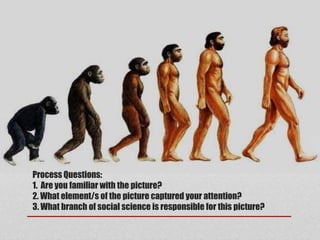
Process Questions:
1. Are you familiar with the picture?
2. What element/s of the picture captured your attention?
3. What branch of social science is responsible for this picture?
P A Y O N O G T O H R L
ANTHROPOLOGY
ANTHROPOLOGY
Greek words:
Anthropos = “man”
Logos = “study or inquiry”
• Anthropology is the study of humankind.
• A discipline that examines aspects of human existence
and accomplishments.
FOUR MAJOR FIELDS OF
ANTHROPOLOGY
• Cultural Anthropology
• Linguistic Anthropology
• Biological (or Physical Anthropology
• Archeology
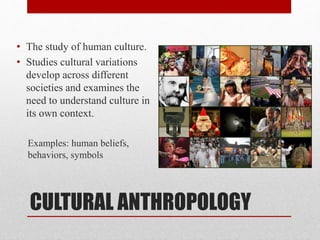
CULTURAL ANTHROPOLOGY
• The study of human culture.
• Studies cultural variations
develop across different
societies and examines the
need to understand culture in
its own context.
Examples: human beliefs,
behaviors, symbols
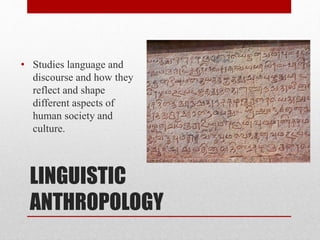
LINGUISTIC
ANTHROPOLOGY
• Studies language and
discourse and how they
reflect and shape
different aspects of
human society and
culture.
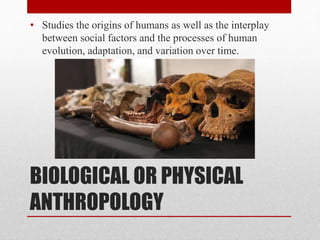
BIOLOGICAL OR PHYSICAL
ANTHROPOLOGY
• Studies the origins of humans as well as the interplay
between social factors and the processes of human
evolution, adaptation, and variation over time.
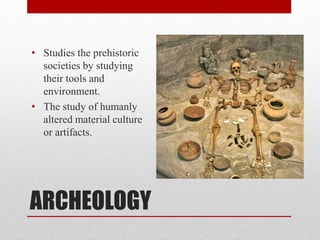
ARCHEOLOGY
• Studies the prehistoric
societies by studying
their tools and
environment.
• The study of humanly
altered material culture
or artifacts.
Herodotus of Halicarnassus
• – wrote detailed narratives about West Asia and Egypt.
• Also had a second hand information to describe the
Scynthians, the Ethiopians and the people from the Indus
Valley.
• Anthropology needs to strike a balance between finding
commonality or highlight the difference.
• Anything foreign is immediately rejected.
• But the difference among people is accounted for by the
difference in the environment and life circumstances.
METHODS OF RESEARCH
• Ethnography
• Participant Observation
• Individual In-depth Interview
• Focused-Group Discussion
• Historical Method
• Comparative Method
ETHNOGRAPHY
• Ethnography means to write about a particular culture.
• Creswell (2009) defines ethnography as a strategy of
inquiry in which the researcher studies an intact cultural
group in a natural setting over a prolonged period of time
by collecting, primarily, observational data.
PARTICIPANT
OBSERVATION
• Anthropologists use various degrees of participant
observation, from full participation in ongoing activities
to passive observation within the locations of interest.
INDIVIDUAL IN-DEPTH
NTERVIEW
• In-depth interviews using open-ended questions aim to
capture the mental and experiential world of the
informant.
• Individual interviews allow participants to tell their
stories, uninterrupted, in a detailed and coherent manner,
without worrying about what their peers may think (as in
a focus group).
FOCUSED-GROUP
DISCUSSION
• The focus group is a group interview method useful for
obtaining information on relatively unstudied topics for
which the full range of relevant domains is not known
and the dynamic interaction among participants is of
interest.
• The discussion often elicits information and insights that
might not be gained from an individual interview,
including the colloquial ways in which participants speak
with one another about working in or seeking care from
the practice.
HISTORICAL METHOD
• In historical method, the origin, development and gradual
evolution of institutions, societies and cultures are
studied.
• Sources of historical method:
Folklore, monuments, inscriptions, autobiographies,
coins, materials kept in archives,travelogues and museum
specimens.
COMPARATIVE METHOD
• Comparative method refers to the method of comparing
different societies, groups or social institutions within the
same society or between societies to show whether and
why they are similar or different in certain aspects.
If you are an
anthropologist, what
specific Filipino tradition
will you be interested into?
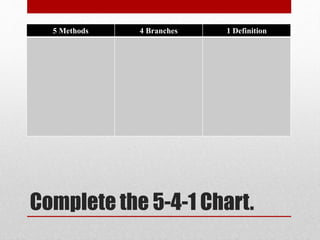
Complete the 5-4-1 Chart.
5 Methods 4 Branches 1 Definition
---
Group Activity:
• Group yourselves into 5 groups.
• Identify the things that you can’t live without.
• Classify them into needs or wants.
• List atleast 10 needs and 10 wants.
• Present it to the class.
ECONOMICS
ECONOMICS
• Greek words:
oikos “home”
nomos “management”
• Economics is the study of the efficient allocation
of scarce resources in order to satisfy unlimited
human needs and wants.
ECONOMICS
• Factors of Production – Economic
resources that can be used to produce goods and
services.
Land
Labor
Capital
Entrepreneurship
FACTORS OF PRODUCTION
• Land – anything that comes from nature and
which gives life and support to all living
creatures. Ex. timber resources, clean air, water.
- also refers to immovable properties where
industries are built.
FACTORS OF PRODUCTION
• Labor – refers to any human effort exerted
during the production process which includes
physical exertion, application of skills or talent or
exercise of intellectual faculties.
FACTORS OF PRODUCTION
• Capital – refers to anything that can be used
to create or manufacture goods and services.
• Examples of capital goods are buildings,
infrastructures, machines and other tools used in
the production process.
FACTORS OF PRODUCTION
• Entrepreneurship – refers to the ability to
organize all the other factors of production in
order to carry out effectively the production
process.
• This skill involves ability to organize, take risk,
introduce a new product, and generally create
something of value.
TWO BRANCHES OF
ECONOMICS
• Microeconomics – “study of the choices
made by economics actors such as households,
companies, and individual markets”
• Macroeconomics – “examines the behavior
of entire economies” (Pennigton 1999, 3)
MICROECONOMICS
• Focuses on how individual consumers and firm
make decisions; these individuals can be a single
person, a household, business/organization or a
government agency.
MICROECONOMICS
• Microeconomics focuses on supply and demand,
and other forces that determine price level,
making it a bottom-up approach.
• It also studies firms that produce the goods and
services, and the industries from which the firms
operate.
MICROECONOMIC
PRINCIPLES
• Maximizing Utility – individuals make decisions to
maximize their satisfaction.
• Opportunity Cost – individuals calculate the cost of
forgoing the next best alternative.
• Diminishing Marginal Utility – describes general
consumer experience that the more you consume of
something, the lower the satisfaction you get.
MICROECONOMIC
PRINCIPLES
• Supply and Demand
- Market Supply refers to the total amount of a certain
good or service available on the market to consumers.
- Market Demand refers to the total demand for the
good or service.
- The interplay of supply and demand helps determine
prices for a product or service, with higher demand and
limited supply typically making for higher prices.
MICROECONOMIC
PRINCIPLES
• Law of Demand
- If all other factors remain equal (Ceteris
Paribus), the higher the price of a good, the
less people will demand for that good.
- Factors Affecting Demand: Number of
available substitutes, consumer preferences, the
shifts in the price of complementary products
MICROECONOMIC
PRINCIPLES
• Law of Supply
- The higher the price, the higher the quantity
supplied.
- Factors Affecting Supply: Production capacity,
production cost, number of competitors
MACROECONOMICS
• Studies the overall
economy on both national
and international level.
• Macroeconomics takes a
top-down approach and
looks at the economy as a
whole, trying to determine
what the economy should
look like.
• It focuses on changes in the
price level across all
markets.
• Foreign Trade
• Government Fiscal And
Monetary Policy
• Unemployment Rates
• Inflation
• Interest Rate
• Gross Domestic Product
• Business Cycles
MACROECONOMIC
PRINCIPLES
• National Income – The area of macroeconomics
analyses the wealth a nation generates.
e.i., Gross National Product, Gross Domestic
Product and Net National Income
MACROECONOMIC
PRINCIPLES
• Inflation – the study of how the cost of goods
and services rises as time goes on.
• It is a complex area of economics but the
consensus among leading modern economists is
that it’s desirable for inflation to be kept at a low
or steady rate as near to zero as possible.
MACROECONOMIC
PRINCIPLES
• Economic Output – The study of goods and
services which a national economy produces.
• International Trade – The area of
macroeconomics that looks at the trade that
occurs between nations in terms of goods,
services, and raw materials.
Father of Economics
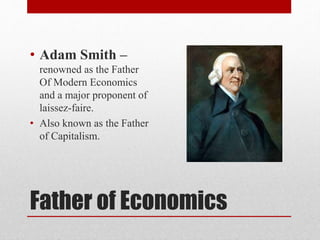
• Adam Smith –
renowned as the Father
Of Modern Economics
and a major proponent of
laissez-faire.
• Also known as the Father
of Capitalism.
Father of Economics
• His famous work An Inquiry into the Nature and Causes
of the Wealth of Nations (1776) contributed to the theory
of price formation, the relationship of market outcomes
and public interest, the role of state in the economy, and
the sources of economic growth.
• Laissez-faire – “leave alone” – the market equilibrium is
reached when buyers and sellers are free to move on their
own without the intervention of the government.
video
METHODS OF RESEARCH
• Observation
• Interview
• Focus-Group Discussion
• Documentary Analysis
• Content Analysis
OBSERVATION
• The observation is a method by means of which
the researcher chooses, challenges, registers and
codifies, according to certain rules, behaviors,
facts, events or happenings specific to the
community observed in compliance with the
research goal and objectives.
INTERVIEW
• The interview is one of the most elementary
forms of data collection which involves asking
people questions and receiving answers from
them. It is a mode of communication used in
various domains.
FOCUS-GROUP DISCUSSION
• The focus-group aims to get as minutely as
possible the attitudes, beliefs, feelings,
experiences and reactions of respondents in a
way less specific to the qualitative methods be it
observation or interview.
DOCUMENTARY ANALYSIS
• The documentary analysis represents the most
used source of information for researchers
especially due to resource saving reasons: time,
money etc. The documentary analysis can contain
the analysis of certain reports, yearly books and
all the details related to a project.
CONTENT ANALYSIS
• The content analysis involves systematic
classification and counting of text units to distil a
large amount of material into a short description
of some of its features (Bauer, 2000).
How does scarcity
affect your daily life?
Activity:
• Make your own budget plan for this week.
• Write your total weekly allowance and itemize your daily
expenses.
Questions:
1. Is your weekly allowance enough for your expenses?
Why or why not?
2. Do you consider yourself a wise consumer when it
comes to spending money?
3. To which category does your expenses fall: needs or
wants?

Diss lesson 2 - introducing anthro & econ

  • 1.
    DISCIPLINES WITIHN THE SOCIAL SCIENCES Prepared by:Ms. Mary Joy Adelfa P. Dailo, LPT
  • 2.
    Process Questions: 1. Areyou familiar with the picture? 2. What element/s of the picture captured your attention? 3. What branch of social science is responsible for this picture?
  • 3.
    P A YO N O G T O H R L
  • 4.
  • 5.
    ANTHROPOLOGY Greek words: Anthropos =“man” Logos = “study or inquiry” • Anthropology is the study of humankind. • A discipline that examines aspects of human existence and accomplishments.
  • 6.
    FOUR MAJOR FIELDSOF ANTHROPOLOGY • Cultural Anthropology • Linguistic Anthropology • Biological (or Physical Anthropology • Archeology
  • 7.
    CULTURAL ANTHROPOLOGY • Thestudy of human culture. • Studies cultural variations develop across different societies and examines the need to understand culture in its own context. Examples: human beliefs, behaviors, symbols
  • 8.
    LINGUISTIC ANTHROPOLOGY • Studies languageand discourse and how they reflect and shape different aspects of human society and culture.
  • 9.
    BIOLOGICAL OR PHYSICAL ANTHROPOLOGY •Studies the origins of humans as well as the interplay between social factors and the processes of human evolution, adaptation, and variation over time.
  • 10.
    ARCHEOLOGY • Studies theprehistoric societies by studying their tools and environment. • The study of humanly altered material culture or artifacts.
  • 11.
    Herodotus of Halicarnassus •– wrote detailed narratives about West Asia and Egypt. • Also had a second hand information to describe the Scynthians, the Ethiopians and the people from the Indus Valley. • Anthropology needs to strike a balance between finding commonality or highlight the difference. • Anything foreign is immediately rejected. • But the difference among people is accounted for by the difference in the environment and life circumstances.
  • 12.
    METHODS OF RESEARCH •Ethnography • Participant Observation • Individual In-depth Interview • Focused-Group Discussion • Historical Method • Comparative Method
  • 13.
    ETHNOGRAPHY • Ethnography meansto write about a particular culture. • Creswell (2009) defines ethnography as a strategy of inquiry in which the researcher studies an intact cultural group in a natural setting over a prolonged period of time by collecting, primarily, observational data.
  • 14.
    PARTICIPANT OBSERVATION • Anthropologists usevarious degrees of participant observation, from full participation in ongoing activities to passive observation within the locations of interest.
  • 15.
    INDIVIDUAL IN-DEPTH NTERVIEW • In-depthinterviews using open-ended questions aim to capture the mental and experiential world of the informant. • Individual interviews allow participants to tell their stories, uninterrupted, in a detailed and coherent manner, without worrying about what their peers may think (as in a focus group).
  • 16.
    FOCUSED-GROUP DISCUSSION • The focusgroup is a group interview method useful for obtaining information on relatively unstudied topics for which the full range of relevant domains is not known and the dynamic interaction among participants is of interest. • The discussion often elicits information and insights that might not be gained from an individual interview, including the colloquial ways in which participants speak with one another about working in or seeking care from the practice.
  • 17.
    HISTORICAL METHOD • Inhistorical method, the origin, development and gradual evolution of institutions, societies and cultures are studied. • Sources of historical method: Folklore, monuments, inscriptions, autobiographies, coins, materials kept in archives,travelogues and museum specimens.
  • 18.
    COMPARATIVE METHOD • Comparativemethod refers to the method of comparing different societies, groups or social institutions within the same society or between societies to show whether and why they are similar or different in certain aspects.
  • 19.
    If you arean anthropologist, what specific Filipino tradition will you be interested into?
  • 20.
    Complete the 5-4-1Chart. 5 Methods 4 Branches 1 Definition
  • 21.
  • 22.
    Group Activity: • Groupyourselves into 5 groups. • Identify the things that you can’t live without. • Classify them into needs or wants. • List atleast 10 needs and 10 wants. • Present it to the class.
  • 23.
  • 24.
    ECONOMICS • Greek words: oikos“home” nomos “management” • Economics is the study of the efficient allocation of scarce resources in order to satisfy unlimited human needs and wants.
  • 25.
    ECONOMICS • Factors ofProduction – Economic resources that can be used to produce goods and services. Land Labor Capital Entrepreneurship
  • 26.
    FACTORS OF PRODUCTION •Land – anything that comes from nature and which gives life and support to all living creatures. Ex. timber resources, clean air, water. - also refers to immovable properties where industries are built.
  • 27.
    FACTORS OF PRODUCTION •Labor – refers to any human effort exerted during the production process which includes physical exertion, application of skills or talent or exercise of intellectual faculties.
  • 28.
    FACTORS OF PRODUCTION •Capital – refers to anything that can be used to create or manufacture goods and services. • Examples of capital goods are buildings, infrastructures, machines and other tools used in the production process.
  • 29.
    FACTORS OF PRODUCTION •Entrepreneurship – refers to the ability to organize all the other factors of production in order to carry out effectively the production process. • This skill involves ability to organize, take risk, introduce a new product, and generally create something of value.
  • 30.
    TWO BRANCHES OF ECONOMICS •Microeconomics – “study of the choices made by economics actors such as households, companies, and individual markets” • Macroeconomics – “examines the behavior of entire economies” (Pennigton 1999, 3)
  • 31.
    MICROECONOMICS • Focuses onhow individual consumers and firm make decisions; these individuals can be a single person, a household, business/organization or a government agency.
  • 32.
    MICROECONOMICS • Microeconomics focuseson supply and demand, and other forces that determine price level, making it a bottom-up approach. • It also studies firms that produce the goods and services, and the industries from which the firms operate.
  • 33.
    MICROECONOMIC PRINCIPLES • Maximizing Utility– individuals make decisions to maximize their satisfaction. • Opportunity Cost – individuals calculate the cost of forgoing the next best alternative. • Diminishing Marginal Utility – describes general consumer experience that the more you consume of something, the lower the satisfaction you get.
  • 34.
    MICROECONOMIC PRINCIPLES • Supply andDemand - Market Supply refers to the total amount of a certain good or service available on the market to consumers. - Market Demand refers to the total demand for the good or service. - The interplay of supply and demand helps determine prices for a product or service, with higher demand and limited supply typically making for higher prices.
  • 35.
    MICROECONOMIC PRINCIPLES • Law ofDemand - If all other factors remain equal (Ceteris Paribus), the higher the price of a good, the less people will demand for that good. - Factors Affecting Demand: Number of available substitutes, consumer preferences, the shifts in the price of complementary products
  • 36.
    MICROECONOMIC PRINCIPLES • Law ofSupply - The higher the price, the higher the quantity supplied. - Factors Affecting Supply: Production capacity, production cost, number of competitors
  • 37.
    MACROECONOMICS • Studies theoverall economy on both national and international level. • Macroeconomics takes a top-down approach and looks at the economy as a whole, trying to determine what the economy should look like. • It focuses on changes in the price level across all markets. • Foreign Trade • Government Fiscal And Monetary Policy • Unemployment Rates • Inflation • Interest Rate • Gross Domestic Product • Business Cycles
  • 38.
    MACROECONOMIC PRINCIPLES • National Income– The area of macroeconomics analyses the wealth a nation generates. e.i., Gross National Product, Gross Domestic Product and Net National Income
  • 39.
    MACROECONOMIC PRINCIPLES • Inflation –the study of how the cost of goods and services rises as time goes on. • It is a complex area of economics but the consensus among leading modern economists is that it’s desirable for inflation to be kept at a low or steady rate as near to zero as possible.
  • 40.
    MACROECONOMIC PRINCIPLES • Economic Output– The study of goods and services which a national economy produces. • International Trade – The area of macroeconomics that looks at the trade that occurs between nations in terms of goods, services, and raw materials.
  • 41.
    Father of Economics •Adam Smith – renowned as the Father Of Modern Economics and a major proponent of laissez-faire. • Also known as the Father of Capitalism.
  • 42.
    Father of Economics •His famous work An Inquiry into the Nature and Causes of the Wealth of Nations (1776) contributed to the theory of price formation, the relationship of market outcomes and public interest, the role of state in the economy, and the sources of economic growth. • Laissez-faire – “leave alone” – the market equilibrium is reached when buyers and sellers are free to move on their own without the intervention of the government.
  • 43.
  • 44.
    METHODS OF RESEARCH •Observation • Interview • Focus-Group Discussion • Documentary Analysis • Content Analysis
  • 45.
    OBSERVATION • The observationis a method by means of which the researcher chooses, challenges, registers and codifies, according to certain rules, behaviors, facts, events or happenings specific to the community observed in compliance with the research goal and objectives.
  • 46.
    INTERVIEW • The interviewis one of the most elementary forms of data collection which involves asking people questions and receiving answers from them. It is a mode of communication used in various domains.
  • 47.
    FOCUS-GROUP DISCUSSION • Thefocus-group aims to get as minutely as possible the attitudes, beliefs, feelings, experiences and reactions of respondents in a way less specific to the qualitative methods be it observation or interview.
  • 48.
    DOCUMENTARY ANALYSIS • Thedocumentary analysis represents the most used source of information for researchers especially due to resource saving reasons: time, money etc. The documentary analysis can contain the analysis of certain reports, yearly books and all the details related to a project.
  • 49.
    CONTENT ANALYSIS • Thecontent analysis involves systematic classification and counting of text units to distil a large amount of material into a short description of some of its features (Bauer, 2000).
  • 50.
    How does scarcity affectyour daily life?
  • 51.
    Activity: • Make yourown budget plan for this week. • Write your total weekly allowance and itemize your daily expenses. Questions: 1. Is your weekly allowance enough for your expenses? Why or why not? 2. Do you consider yourself a wise consumer when it comes to spending money? 3. To which category does your expenses fall: needs or wants?