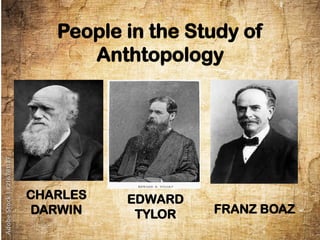
People in theStudy of
Anthtopology
CHARLES
DARWIN
EDWARD
TYLOR FRANZ BOAZ
13.
People in theStudy of
Anthtopology
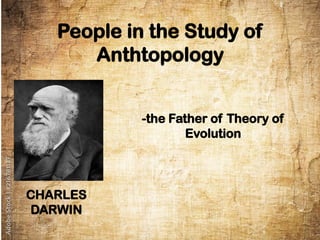
CHARLES
DARWIN
-the Father of Theory of
Evolution
14.
People in theStudy of
Anthtopology
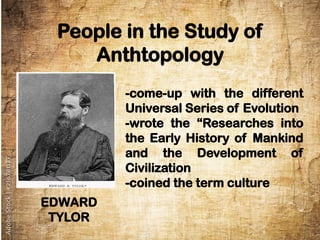
EDWARD
TYLOR
-come-up with the different
Universal Series of Evolution
-wrote the “Researches into
the Early History of Mankind
and the Development of
Civilization
-coined the term culture
15.
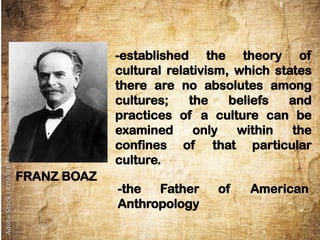
-established the theoryof
cultural relativism, which states
there are no absolutes among
cultures; the beliefs and
practices of a culture can be
examined only within the
confines of that particular
culture.
-the Father of American
Anthropology
FRANZ BOAZ
16.
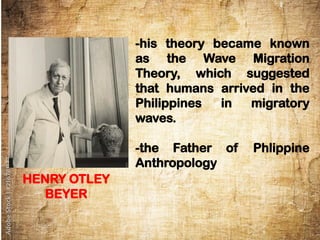
-his theory becameknown
as the Wave Migration
Theory, which suggested
that humans arrived in the
Philippines in migratory
waves.
-the Father of Phlippine
Anthropology
HENRY OTLEY
BEYER
17.
ATHROPOLOGIES are Trainedin
different Areas
Socio-Cultural
anthropology
-It explains how
people in other
societies live and
affect their
environments to their
respective lives.
Physical
anthropology
-attempts to explore
human mystery
related to their origin,
differentiation,
diversities and
distributions.
18.
ATHROPOLOGIES are Trainedin
different Areas
Linguistic
anthropology
-branch of
anthropology that
deals with language
Archaeology
-seek to reconstruct
the past life of ancient
societies, trace the
cultural changes that
took place and the
reason behind the
changes.
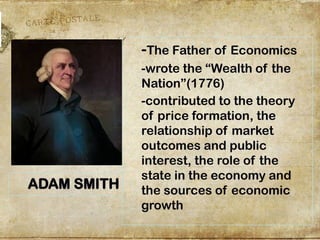
-The Father ofEconomics
-wrote the “Wealth of the
Nation”(1776)
-contributed to the theory
of price formation, the
relationship of market
outcomes and public
interest, the role of the
state in the economy and
the sources of economic
growth
ADAM SMITH
-A science thatdeals with
the description, distribution
and interaction of the
diverse physical, biological
and cultural feature of the
earths surface.
29.
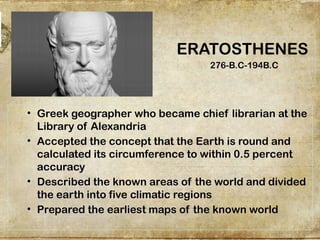
ERATOSTHENES
276-B.C-194B.C
• Greek geographerwho became chief librarian at the
Library of Alexandria
• Accepted the concept that the Earth is round and
calculated its circumference to within 0.5 percent
accuracy
• Described the known areas of the world and divided
the earth into five climatic regions
• Prepared the earliest maps of the known world
Systematic studyof human
past events to understand the
meaning, dynamic and
relationship of the cause and
effect of event in the
development of societies
It comes from a Greek word
“Historia” meaning learning.
35.
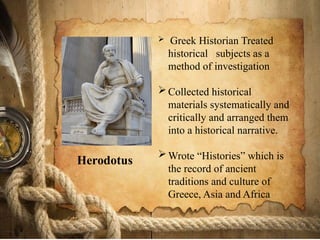
Greek HistorianTreated
historical subjects as a
method of investigation
Collected historical
materials systematically and
critically and arranged them
into a historical narrative.
Wrote “Histories” which is
the record of ancient
traditions and culture of
Greece, Asia and Africa
Herodotus
36.
Primary Source
(e.g. personal
journals/diaries/memoirs,letters, court
proceedings, legislative debates,
newspaper and magazine articles,
movies, music, art, etc.
Secondary Source
(e.g. Books and articles produced by
historians.
Sources of HISTORY
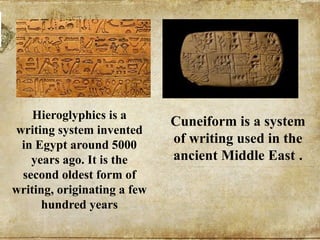
Hieroglyphics is a
writingsystem invented
in Egypt around 5000
years ago. It is the
second oldest form of
writing, originating a few
hundred years
Cuneiform is a system
of writing used in the
ancient Middle East .
• It wasthe old Babylon who first created
linguistics texts called Sumerian.
• Hindus also created text called Vedas.
• The formal study of language began in
India.
• It started with the formulation of 3,959
rules of Sanskrit morphology.
• Early interest in language in the West was
a part of Philosophy, not a grammatical
description.
41.
Ferdinand de
Saussure
(1857-1913)
• Swisslinguist
• Posited that linguistic form is arbitrary and
therefore that all languages function in a similar
fashion
• Published “Memoire sur le systeme primitifdes
voyelles dans les langues indo-europeenes.”
• It wasonce part of the many related
fields of study like history, philosophy, law
and economics.
• The theoretical and practical study of
the state and the politics began way back
to the time of the Ancient Greeks, about
500 - 300 B.C
• The chieftain who headed a village was
chosen from the ranks of leaders with the
power to make laws, judge and execute
laws.
• The chiefdom become a state
44.
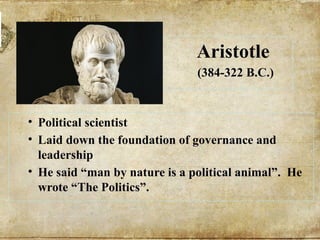
Aristotle
(384-322 B.C.)
• Politicalscientist
• Laid down the foundation of governance and
leadership
• He said “man by nature is a political animal”. He
wrote “The Politics”.
• It hasits roots in Ancient Greek
Philosophy such as epistemology,
metaphysics, religion and oriental
philosophy.
• Over the centuries, psychology and
physiology became increasingly
separated resulting to the two
conceptions of psychology that is
phenomenological (experimental) and
mechanistic (physiological)
47.
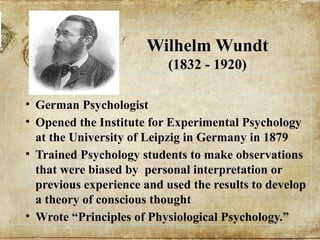
Wilhelm Wundt
(1832 -1920)
• German Psychologist
• Opened the Institute for Experimental Psychology
at the University of Leipzig in Germany in 1879
• Trained Psychology students to make observations
that were biased by personal interpretation or
previous experience and used the results to develop
a theory of conscious thought
• Wrote “Principles of Physiological Psychology.”
• The intellectual,scientific and industrial
revolutions which happened in Europe in the
middle of the 19th century led to the development
of Sociology.
• The intellectual revolution opened new perspective
in society which offered the people new principles,
ideals, and beliefs changing their outlook in life
and the way they perceive themselves, their
environment and relations with fellow men.
• The revolutions in Europe brought rapid and
radical changes which resulted to social problems,
issues and social unrest prompting some individual
to direct their attention and investigation of social
phenomena.
50.
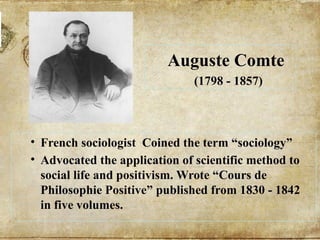
Auguste Comte
(1798 -1857)
• French sociologist Coined the term “sociology”
• Advocated the application of scientific method to
social life and positivism. Wrote “Cours de
Philosophie Positive” published from 1830 - 1842
in five volumes.
According toQuexbook, 2018 Anthropology
traces its roots to Ancient Greek historical and
philosophical writings about human nature and the
organization of human society.
According to Quexbook, 2018 The Modern
Economics, which is still being studied today, is
the result of the efforts of ancient or Pre classical
(384 B.C - 1776), classical (1776 - 1871),
Neoclassical (1871 - today) and Islamic
Economists.
54.
According toQuexbook, 2018 Some of the first truly geographical
studies occurred more than four thousand years ago. The main
purpose of these early investigations was to map features and places
observed as explorers travelled to new lands. At this time, Chinese,
Egyptian, and Phoenician civilizations were beginning to explore
the places and spaces within and outside their homelands. The
earliest evidence of such explorations come from the archaeological
discovery of a Babylonian clay tablet map that dates back to 2300
BC.
According to Quexbook, 2018 People with a certain word choice,
syntax, and pronunciation are revealed to be members of a
particular speech community; a group of people who share social
conventions about language use. Some features are noticeable
(salient) and are recognized within the community as having a
particular social meaning. Other features are sociolinguistic
indicators that can be associated with certain social characteristics.
Different speech communities may reflect subsets of the same
language called dialects.
55.
According to Quexbook,2018 From the late 1950s to
mid-1980s, works in the history of Political Science
stand out by their sheer rarity. Earlier political scientists
were rather (though not exceptionally) more historical in
their disciplinary self - understanding. Wilhelm Wundt
opened the first experimental laboratory in Psychology
at the University of Leipzig, Germany. Credited with
establishing psychology as academic discipline, Wundt’s
students include Emil Kraepelin, James McKeen Cattell,
and G. Stanley Hall.
56.
According toQuexbook, 2018 Although sociology
has its roots in the works of philosophers like
Plato, Aristotle, and Confucius, it is a relatively
new academic discipline. It emerged in the early
nineteenth century in response to the challenges of
modernity.
According to Quexbook, 2018 The Demographic
Transition Model (DTM) is based on historical
population trends of two demographic
characteristics - birth rate and death rate - to
suggest that a country’s total population growth
rate cycles through stages as that country develops
economically.