MS. ANTONETTE C. ALBINA
ANTHROPOLO
GY,
SOCIOLOGY
,
AND
POLITICAL
Science
The Trio Concepts:
Pre-Assessment:
Read each of the following item carefully and write only the
letter which corresponds to the correct answer.
Anthropology
It includes topics such as
human origin, globalization,
social change, and world
history.
It is the study of humankind
in all times and all places.
It is the study of humanity
including our prehistoric
origins and contemporary
human diversity.
Goals of Anthropology
• Discover what all people have in common – By studying
commonalities (folklores, traditions, language, etc.) in all
humanity, we could understand more about the human’s
nature.
What it means to be
a human?
Goals of Anthropology
• Produce new knowledge and new
theories about humankind and
human behavior – This new
knowledge is then applied in an
attempt to alleviate human
challenges.
Goals of Anthropology
• Discover what makes people
different from one another in order
to understand and preserve diversity
– Anthropology attempts to answer
questions:
“What does it mean to be a Filipino
and a citizen of the world?”
Goals of Anthropology
• Look at one’s own culture more
objectively like an outsider – It aims
to make “the strange familiar and
the familiar strange.”
FIELDS OF ANTHROPOLOGY
CUL
TURALANTHROPOLOGY
Refers to the study of living people and their cultures including
variation and change. It deals with the description and analysis of the
forms and styles and the social lives of past and present ages
FIELDS OF ANTHROPOLOGY
LINGUISTIC
ANTHROPOLOGY
Refers to the study of communication,
mainly but not exclusively among humans. It
includes the study of communication’s
origin, history and contemporary variation.
FIELDS OF ANTHROPOLOGY
ARCHAEOLOGY
Refers to the study of past human cultures
through their material remains. It is the
study of past human cultures through the
recovery and analysis of artifacts.
FIELDS OF ANTHROPOLOGY
BIOLOGICALANTHROPOLOGY
Biological anthropologists study a variety of
aspects of human evolutionary biology.
It seeks to describe the distribution of hereditary
variations among contemporary populations and
to sort out and measure the relative
contributions made by heredity.
SOCIOLOGY
We are social animals
PRIMITIVE ANCIENT GREECE
We are social animals
DISCO SA UMA MODERN PARTY
We are social animals
EVENT OF THE
ELITES
Sociology
•It is a systematic study of
groups and societies that
people build and how
these affect their behavior.
•It focuses on various social
connections, institutions,
organizations, structures,
and processes.
A strong and competitive working environment
A collaborative working environment
The so called “Ecology of racists”
The scientific study of Sociology
enables us to:
•It gathers social inputs
which are composed of
frequent forms and
manners namely:
attitude, viewpoints,
consolidated values, and
norms of social
The scientific study of Sociology
enables us to:
•Obtain possible theories and principles about
society as well as various aspects of social life;
•Critically study the nature of humanity, which
also leads to examining our roles within the
society;
The scientific study of Sociology
enables us to:
•Appreciate that all
things (in society)
are interdependent
with each other. An
individual’s
personal history is
connected to
his/her
environment’s
history, which is
BRANCHES OF SOCIOLOGY
SOCIAL
ORGANIZATION
•This includes the
study of social
institutions, social
inequality, social
mobility, religious
BRANCHES OF SOCIOLOGY
SOCIAL
PSYCHOLOGY
• This area focuses on
the study of human
nature and its
emphasis on social
processes as they
affect individual or
responses which are
BRANCHES OF SOCIOLOGY
SOCIAL
PSYCHOLOGY
• This area focuses on
the study of human
nature and its
emphasis on social
processes as they
affect individual or
responses which are
BRANCHES OF SOCIOLOGY
APPLIED SOCIOLOGY
• This is concerned with the specific intent of yielding
practical applications for human behavior and
organizations. The goal of Applied Sociology is to assist in
resolving social problems through the use of sociological
research.
BRANCHES OF SOCIOLOGY
SOCIOLOGICAL THEORY AND RESEARCH
• It focuses on the discovery of theoretical tools, methods,
and techniques to scientifically explain a particular
sociological issue.
BRANCHES OF SOCIOLOGY
SOCIAL CHANGE
• It studies factors that cause
organization and social
disorganization like calamity,
drug abuse, drastic and gradual
social change, health and welfare
problems, political instability,
unemployment and
underemployment, child and
POLITICAL SCIENCE
The learning objective
Discuss the nature, goals and
perspectives in/ of anthropology,
sociology and POLITICAL
SCIENCE
POLITICAL SCIENCE
•It is an academic
discipline that deals
with the study of
government and
political processes,
institutions, and
The Evolution of Political Movement
BEFORE NOW
POLITICAL SCIENCE
•It is a study of the
complex behavior
of various political
actors such as the
government
administration,
opposition, and
TAKE NOTE!
ThestudyofPoliticshassomethingtodowithpower–whowields
itandhowitisused.
New World Order
POLITICS
• It originated from the Greek
word ‘polis’, which means ‘city’
or ‘state’.
• It is the art and science of
governing city/state.
• It is the social process or
strategy in any position of
control which people gain,
use, or lose power.
POLITICS
•Due to the
negative
connotations of
politics, the term
is now applied to
many different
social situations.
POLITICS
While government typically refers to the
established LEGISLATIVE AND EXECUTIVE
departments of a nation or state, politics is
a broad term that is related to the power
sharing in any organization.
GOVERNMENT
•It is the agency to which the will of the state
is formulated, expressed, and carried out.
•It is the organized agency in a state tasked
to impose social control.
Which one is more dangerous for our government?
SOCIO-CULTURAL CHANGE
SOCIAL AND CULTURAL CHANGE
Social change refers to any significant
alteration over time in behavior
patterns , cultural values and
norms. By “significant” alteration,
sociologists mean changes yielding
profound social consequences.
The industrial revolution(1760-1840)
The abolition of slavery 15th century
The feminist movement 19th century
•It is the agency to which the will of the state
is formulated, expressed, and carried out.
•It is the organized agency in a state tasked
to impose social control.
CHARACTERISTICS OF SOCIAL
CHANGE
SOCIAL CHANGE IS SOCIAL
•Social change obviously means a change in
system of social relationships.
•Only that change can be called social change
whose influence can be felt in a community
form.
•The changes that have significance for all or
considerable segment of population can be
CHARACTERISTICS OF SOCIAL
CHANGE
SOCIAL CHANGE IS
UNIVERSAL
•The social structure, social
organization and social
institutions are all dynamic.
•Social change occur in all
societies no society remains
static for long time..
CHARACTERISTICS OF SOCIAL
CHANGE
SOCIAL CHANGE OCCURS AS
AN ESSENTIAL LAW
•Our needs keep on changing to satisfy
desire for change and to satisfy these
needs, social change becomes a
CHARACTERISTICS OF SOCIAL
CHANGE
SOCIAL
CHANGE IS
CONTINIOUS
Society is
continuously
CHARACTERISTICS OF SOCIAL
CHANGE
RATE OF SOCIAL CHANGE IS
UNEVEN
•Urban society is more aggressive to social
change compared to rural society.
FACTORS OF SOCIAL CHANGE
PHYSICAL
ENVIRONMENT
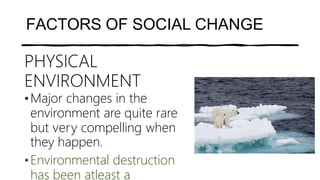
•Major changes in the
environment are quite rare
but very compelling when
they happen.
•Environmental destruction
has been atleast a
FACTORS OF SOCIAL CHANGE
POPULATION CHANGE
•A stable population may able to resist most
change, but rapidly growing population
must migrate, improve it’s productivity, or
starve.
FACTORS OF SOCIAL CHANGE
ISOLATION AND CONTACT
•Areas of greatest international contact are
center of change. Conversely, isolated
are centers of stability, conservatism, and
resistance to change.
UCSP Week 1.pptx
UCSP Week 1.pptx
UCSP Week 1.pptx
UCSP Week 1.pptx

UCSP Week 1.pptx

  • 1.
    MS. ANTONETTE C.ALBINA ANTHROPOLO GY, SOCIOLOGY , AND POLITICAL Science
  • 2.
  • 3.
    Pre-Assessment: Read each ofthe following item carefully and write only the letter which corresponds to the correct answer.
  • 5.
    Anthropology It includes topicssuch as human origin, globalization, social change, and world history. It is the study of humankind in all times and all places. It is the study of humanity including our prehistoric origins and contemporary human diversity.
  • 6.
    Goals of Anthropology •Discover what all people have in common – By studying commonalities (folklores, traditions, language, etc.) in all humanity, we could understand more about the human’s nature. What it means to be a human?
  • 7.
    Goals of Anthropology •Produce new knowledge and new theories about humankind and human behavior – This new knowledge is then applied in an attempt to alleviate human challenges.
  • 8.
    Goals of Anthropology •Discover what makes people different from one another in order to understand and preserve diversity – Anthropology attempts to answer questions: “What does it mean to be a Filipino and a citizen of the world?”
  • 9.
    Goals of Anthropology •Look at one’s own culture more objectively like an outsider – It aims to make “the strange familiar and the familiar strange.”
  • 10.
    FIELDS OF ANTHROPOLOGY CUL TURALANTHROPOLOGY Refersto the study of living people and their cultures including variation and change. It deals with the description and analysis of the forms and styles and the social lives of past and present ages
  • 11.
    FIELDS OF ANTHROPOLOGY LINGUISTIC ANTHROPOLOGY Refersto the study of communication, mainly but not exclusively among humans. It includes the study of communication’s origin, history and contemporary variation.
  • 12.
    FIELDS OF ANTHROPOLOGY ARCHAEOLOGY Refersto the study of past human cultures through their material remains. It is the study of past human cultures through the recovery and analysis of artifacts.
  • 13.
    FIELDS OF ANTHROPOLOGY BIOLOGICALANTHROPOLOGY Biologicalanthropologists study a variety of aspects of human evolutionary biology. It seeks to describe the distribution of hereditary variations among contemporary populations and to sort out and measure the relative contributions made by heredity.
  • 14.
  • 16.
    We are socialanimals PRIMITIVE ANCIENT GREECE
  • 17.
    We are socialanimals DISCO SA UMA MODERN PARTY
  • 18.
    We are socialanimals EVENT OF THE ELITES
  • 19.
    Sociology •It is asystematic study of groups and societies that people build and how these affect their behavior. •It focuses on various social connections, institutions, organizations, structures, and processes. A strong and competitive working environment A collaborative working environment
  • 20.
    The so called“Ecology of racists”
  • 21.
    The scientific studyof Sociology enables us to: •It gathers social inputs which are composed of frequent forms and manners namely: attitude, viewpoints, consolidated values, and norms of social
  • 22.
    The scientific studyof Sociology enables us to: •Obtain possible theories and principles about society as well as various aspects of social life; •Critically study the nature of humanity, which also leads to examining our roles within the society;
  • 23.
    The scientific studyof Sociology enables us to: •Appreciate that all things (in society) are interdependent with each other. An individual’s personal history is connected to his/her environment’s history, which is
  • 24.
    BRANCHES OF SOCIOLOGY SOCIAL ORGANIZATION •Thisincludes the study of social institutions, social inequality, social mobility, religious
  • 25.
    BRANCHES OF SOCIOLOGY SOCIAL PSYCHOLOGY •This area focuses on the study of human nature and its emphasis on social processes as they affect individual or responses which are
  • 26.
    BRANCHES OF SOCIOLOGY SOCIAL PSYCHOLOGY •This area focuses on the study of human nature and its emphasis on social processes as they affect individual or responses which are
  • 27.
    BRANCHES OF SOCIOLOGY APPLIEDSOCIOLOGY • This is concerned with the specific intent of yielding practical applications for human behavior and organizations. The goal of Applied Sociology is to assist in resolving social problems through the use of sociological research.
  • 28.
    BRANCHES OF SOCIOLOGY SOCIOLOGICALTHEORY AND RESEARCH • It focuses on the discovery of theoretical tools, methods, and techniques to scientifically explain a particular sociological issue.
  • 29.
    BRANCHES OF SOCIOLOGY SOCIALCHANGE • It studies factors that cause organization and social disorganization like calamity, drug abuse, drastic and gradual social change, health and welfare problems, political instability, unemployment and underemployment, child and
  • 36.
  • 38.
    The learning objective Discussthe nature, goals and perspectives in/ of anthropology, sociology and POLITICAL SCIENCE
  • 39.
    POLITICAL SCIENCE •It isan academic discipline that deals with the study of government and political processes, institutions, and
  • 40.
    The Evolution ofPolitical Movement BEFORE NOW
  • 41.
    POLITICAL SCIENCE •It isa study of the complex behavior of various political actors such as the government administration, opposition, and
  • 43.
  • 45.
  • 47.
    POLITICS • It originatedfrom the Greek word ‘polis’, which means ‘city’ or ‘state’. • It is the art and science of governing city/state. • It is the social process or strategy in any position of control which people gain, use, or lose power.
  • 48.
    POLITICS •Due to the negative connotationsof politics, the term is now applied to many different social situations.
  • 49.
    POLITICS While government typicallyrefers to the established LEGISLATIVE AND EXECUTIVE departments of a nation or state, politics is a broad term that is related to the power sharing in any organization.
  • 50.
    GOVERNMENT •It is theagency to which the will of the state is formulated, expressed, and carried out. •It is the organized agency in a state tasked to impose social control.
  • 51.
    Which one ismore dangerous for our government?
  • 55.
  • 56.
    SOCIAL AND CULTURALCHANGE Social change refers to any significant alteration over time in behavior patterns , cultural values and norms. By “significant” alteration, sociologists mean changes yielding profound social consequences.
  • 57.
  • 58.
    The abolition ofslavery 15th century
  • 60.
  • 61.
    •It is theagency to which the will of the state is formulated, expressed, and carried out. •It is the organized agency in a state tasked to impose social control.
  • 62.
    CHARACTERISTICS OF SOCIAL CHANGE SOCIALCHANGE IS SOCIAL •Social change obviously means a change in system of social relationships. •Only that change can be called social change whose influence can be felt in a community form. •The changes that have significance for all or considerable segment of population can be
  • 63.
    CHARACTERISTICS OF SOCIAL CHANGE SOCIALCHANGE IS UNIVERSAL •The social structure, social organization and social institutions are all dynamic. •Social change occur in all societies no society remains static for long time..
  • 65.
    CHARACTERISTICS OF SOCIAL CHANGE SOCIALCHANGE OCCURS AS AN ESSENTIAL LAW •Our needs keep on changing to satisfy desire for change and to satisfy these needs, social change becomes a
  • 68.
    CHARACTERISTICS OF SOCIAL CHANGE SOCIAL CHANGEIS CONTINIOUS Society is continuously
  • 69.
    CHARACTERISTICS OF SOCIAL CHANGE RATEOF SOCIAL CHANGE IS UNEVEN •Urban society is more aggressive to social change compared to rural society.
  • 70.
    FACTORS OF SOCIALCHANGE PHYSICAL ENVIRONMENT •Major changes in the environment are quite rare but very compelling when they happen. •Environmental destruction has been atleast a
  • 71.
    FACTORS OF SOCIALCHANGE POPULATION CHANGE •A stable population may able to resist most change, but rapidly growing population must migrate, improve it’s productivity, or starve.
  • 72.
    FACTORS OF SOCIALCHANGE ISOLATION AND CONTACT •Areas of greatest international contact are center of change. Conversely, isolated are centers of stability, conservatism, and resistance to change.

Editor's Notes

  • #7 The goal of anthropology is to pursue a holistic understanding of what it means to be human by understanding the relationship between human biology, language, and culture.
  • #8 The most-often used theories of health behavior are Social Cognitive Theory, The Transtheoretical Model/Stages of Change, the Health Belief Model, and the Theory of Planned Behavior. The most-often mentioned theoretical model that has not been fully applied in research and practice is the Social Ecological Model. Anthropologists use varied methods, techniques, and theoretical approaches in their investigations, which have two major goals: to understand the uniqueness and diversity of human behavior and human societies around the world and to discover the fundamental similarities that connect human beings throughout the world.
  • #9 While it may mean different things to different people, the most common definition of a citizen of the world is the idea that all people have responsibilities to the world rather than just their country and immediate community. A global citizen is someone who is aware of and understands the wider world – and their place in it. They are a citizen of the world. They take an active role in their community and work with others to make our planet more peaceful, sustainable and fairer.
  • #10 “Anthropology makes the familiar strange, and the strange familiar.” Anthropologists love to put this quote in their textbooks, preparing students for the double effect of the discipline: when you study cultures that are different from your own, you necessarily end up seeing your own worldview in a new light. What does the sociological perspective seeing the strange in the familiar mean? The characteristics of the sociological perspective include seeing the general in the particular (i.e., recognizing patterns), seeing the strange in the familiar (recognizing that things aren't always what they seem), and seeing the group in the individual (looking for the influence of social forces).