DIPLOMA
IN
EFFECTIVE TEACHING
UNIT - 2
BUILDING CLASSROOM
DISCIPLINE
Trainer :
Ms.B.Sakthimala
Assistant Professor,
Marudhar Kesari Jain College for
Women.
CLASSROOM DISCIPLINE
– INTRODUCTION
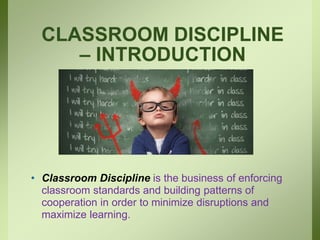
• Classroom Discipline is the business of enforcing
classroom standards and building patterns of
cooperation in order to minimize disruptions and
maximize learning.
CAUSES OF
INDISCIPLINARY
BEHAVIOUR
• PHYSICAL ATTRIBUTES
• Over-Crowded Classes
• Poor Lighting and Inadequate Ventilation
• Disorderly Positioned Furniture and Storage
• Sources of Distractions like Noise prone areas
CAUSES OF
INDISCIPLINARY
BEHAVIOUR
• MENTAL ATTRIBUTES
The students bring to the classroom asurprising record
of individual attitudes, interest andabilities.
Characteristic could betraced to their differences in:
a. Family background
b. Physical and mentalcapacities
c. Emotional traits among others
CAUSES OF
INDISCIPLINARY
BEHAVIOUR
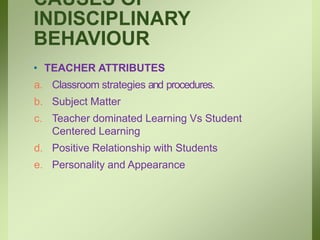
• TEACHER ATTRIBUTES
a. Classroom strategies and procedures.
b. Subject Matter
c. Teacher dominated Learning Vs Student
Centered Learning
d. Positive Relationship with Students
e. Personality and Appearance
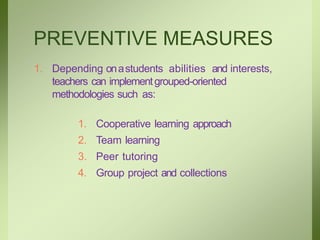
PREVENTIVE MEASURES
1. Depending onastudents abilities and interests,
teachers can implementgrouped-oriented
methodologies such as:
1. Cooperative learning approach
2. Team learning
3. Peer tutoring
4. Group project and collections
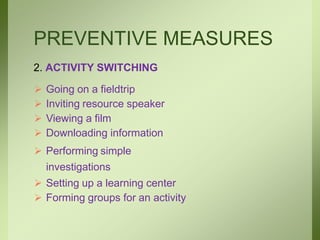
PREVENTIVE MEASURES
2. ACTIVITY SWITCHING
 Going on a fieldtrip
 Inviting resource speaker
 Viewing a film
 Downloading information
 Performing simple
investigations
 Setting up a learning center
 Forming groups for an activity
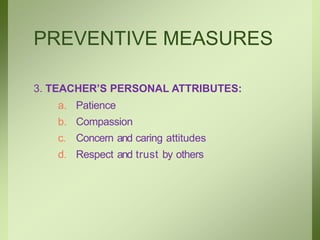
PREVENTIVE MEASURES
3. TEACHER’S PERSONAL ATTRIBUTES:
a. Patience
b. Compassion
c. Concern and caring attitudes
d. Respect and trust by others
Common practices for
Classroom Discipline
a) Discipline is not the students responsibility.
b) Discipline is a teacher’sway of establishing a
desirable student-oriented environment for learning.
c) Discipline is a coupled with effective teaching
strategies and techniques.
d) Discipline is achieve through the effects of group
dynamics on behavior.
e) Discipline in believed to be exclusive
responsibilities of teachers.
TIPS TO BE A GOOD
DISCIPLINARIAN
• Be Prepared to face the class
• Know your students
• Have a good Sense of Humor
• Be Brisk
• Be humble
Common Ways of Dealing with
Discipline Problem
• Acceptable and effective:
 Use verbal reinforces that encourage goodbehavior
and discourage bad tendencies.
 Use non verbal gestures, frown or a hard look to
dissuade them from mischief.
 Dialogues could help in discovering problems
andagreeing onmutuality beneficial solutions.
 A w a r d merits for goodbehavior and demerits for
inconsistencies and lapses.
Common Ways of Dealing with
Discipline Problem
• Acceptable and effective:
 Focus attention on one who is unruly andis about
to disturb theneighbors. Lead him/her to asecluded
areaandnicely convince him/her to bequiet.
 A private one-on-one brief conferencecould
lead to a better understanding of mistakes that
needto beremediedand improved.
 A l l o w the students the freedom to express agitated
feelings and misgivings rather than censure them right
away.
Common Ways of Dealing with
Discipline Problem
Unacceptable and Ineffective
 Scolding andharsh words as a reprimand will have a
negative effect onthe entire class.
 Nagging andfaultfinding.
 Denying a student some privileges dueto unnecessary
hyperactivity could all the more encourage repetitions.
 Use of ridicule or sarcasm could humiliate and
embarrass a for mentor.
Common Ways of Dealing with
Discipline Problem
Unacceptable and Ineffective
 Keeping a student in a “detentionarea”during or after
classes as apenalty for misbehavior is awaste of time
and occasion for learning. The shameful experience is
not easy to forget.
 Assignment of additional homework, compared to
the rest could make them dislike the subjects.
 Grades for academic achievementshould not be
affected dueto misdemeanor.
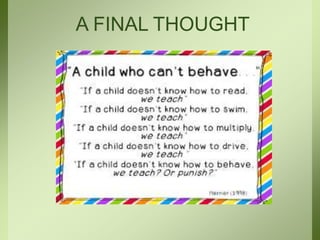
A FINAL THOUGHT
Building classroom discipline

Building classroom discipline

  • 1.
    DIPLOMA IN EFFECTIVE TEACHING UNIT -2 BUILDING CLASSROOM DISCIPLINE Trainer : Ms.B.Sakthimala Assistant Professor, Marudhar Kesari Jain College for Women.
  • 2.
    CLASSROOM DISCIPLINE – INTRODUCTION •Classroom Discipline is the business of enforcing classroom standards and building patterns of cooperation in order to minimize disruptions and maximize learning.
  • 3.
    CAUSES OF INDISCIPLINARY BEHAVIOUR • PHYSICALATTRIBUTES • Over-Crowded Classes • Poor Lighting and Inadequate Ventilation • Disorderly Positioned Furniture and Storage • Sources of Distractions like Noise prone areas
  • 4.
    CAUSES OF INDISCIPLINARY BEHAVIOUR • MENTALATTRIBUTES The students bring to the classroom asurprising record of individual attitudes, interest andabilities. Characteristic could betraced to their differences in: a. Family background b. Physical and mentalcapacities c. Emotional traits among others
  • 5.
    CAUSES OF INDISCIPLINARY BEHAVIOUR • TEACHERATTRIBUTES a. Classroom strategies and procedures. b. Subject Matter c. Teacher dominated Learning Vs Student Centered Learning d. Positive Relationship with Students e. Personality and Appearance
  • 6.
    PREVENTIVE MEASURES 1. Dependingonastudents abilities and interests, teachers can implementgrouped-oriented methodologies such as: 1. Cooperative learning approach 2. Team learning 3. Peer tutoring 4. Group project and collections
  • 7.
    PREVENTIVE MEASURES 2. ACTIVITYSWITCHING  Going on a fieldtrip  Inviting resource speaker  Viewing a film  Downloading information  Performing simple investigations  Setting up a learning center  Forming groups for an activity
  • 8.
    PREVENTIVE MEASURES 3. TEACHER’SPERSONAL ATTRIBUTES: a. Patience b. Compassion c. Concern and caring attitudes d. Respect and trust by others
  • 9.
    Common practices for ClassroomDiscipline a) Discipline is not the students responsibility. b) Discipline is a teacher’sway of establishing a desirable student-oriented environment for learning. c) Discipline is a coupled with effective teaching strategies and techniques. d) Discipline is achieve through the effects of group dynamics on behavior. e) Discipline in believed to be exclusive responsibilities of teachers.
  • 10.
    TIPS TO BEA GOOD DISCIPLINARIAN • Be Prepared to face the class • Know your students • Have a good Sense of Humor • Be Brisk • Be humble
  • 11.
    Common Ways ofDealing with Discipline Problem • Acceptable and effective:  Use verbal reinforces that encourage goodbehavior and discourage bad tendencies.  Use non verbal gestures, frown or a hard look to dissuade them from mischief.  Dialogues could help in discovering problems andagreeing onmutuality beneficial solutions.  A w a r d merits for goodbehavior and demerits for inconsistencies and lapses.
  • 12.
    Common Ways ofDealing with Discipline Problem • Acceptable and effective:  Focus attention on one who is unruly andis about to disturb theneighbors. Lead him/her to asecluded areaandnicely convince him/her to bequiet.  A private one-on-one brief conferencecould lead to a better understanding of mistakes that needto beremediedand improved.  A l l o w the students the freedom to express agitated feelings and misgivings rather than censure them right away.
  • 13.
    Common Ways ofDealing with Discipline Problem Unacceptable and Ineffective  Scolding andharsh words as a reprimand will have a negative effect onthe entire class.  Nagging andfaultfinding.  Denying a student some privileges dueto unnecessary hyperactivity could all the more encourage repetitions.  Use of ridicule or sarcasm could humiliate and embarrass a for mentor.
  • 14.
    Common Ways ofDealing with Discipline Problem Unacceptable and Ineffective  Keeping a student in a “detentionarea”during or after classes as apenalty for misbehavior is awaste of time and occasion for learning. The shameful experience is not easy to forget.  Assignment of additional homework, compared to the rest could make them dislike the subjects.  Grades for academic achievementshould not be affected dueto misdemeanor.
  • 15.