History of literature
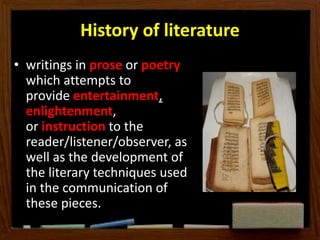
• writings in prose or poetry
which attempts to
provide entertainment,
enlightenment,
or instruction to the
reader/listener/observer, as
well as the development of
the literary techniques used
in the communication of
these pieces.
The beginning of literature
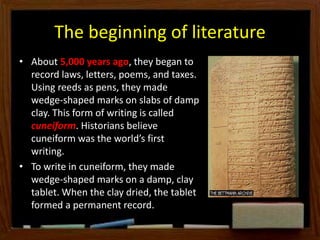
• About 5,000 years ago, they began to
record laws, letters, poems, and taxes.
Using reeds as pens, they made
wedge-shaped marks on slabs of damp
clay. This form of writing is called
cuneiform. Historians believe
cuneiform was the world’s first
writing.
• To write in cuneiform, they made
wedge-shaped marks on a damp, clay
tablet. When the clay dried, the tablet
formed a permanent record.
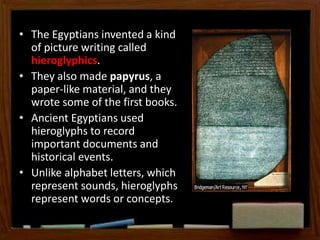
• The Egyptians invented a kind
of picture writing called
hieroglyphics.
• They also made papyrus, a
paper-like material, and they
wrote some of the first books.
• Ancient Egyptians used
hieroglyphs to record
important documents and
historical events.
• Unlike alphabet letters, which
represent sounds, hieroglyphs
represent words or concepts.
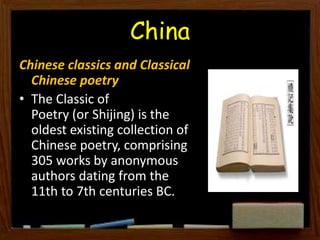
China
Chinese classics and Classical
Chinese poetry
• The Classic of
Poetry (or Shijing) is the
oldest existing collection of
Chinese poetry, comprising
305 works by anonymous
authors dating from the
11th to 7th centuries BC.
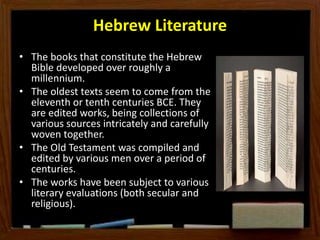
Hebrew Literature
• The books that constitute the Hebrew
Bible developed over roughly a
millennium.
• The oldest texts seem to come from the
eleventh or tenth centuries BCE. They
are edited works, being collections of
various sources intricately and carefully
woven together.
• The Old Testament was compiled and
edited by various men over a period of
centuries.
• The works have been subject to various
literary evaluations (both secular and
religious).
Greek literature
• Many authors consider
the western literary tradition
to have begun with
the epic poems The Iliad and
The Odyssey, which remain
giants in the
literary canon for their
skillful and vivid depictions
of war and peace, honor and
disgrace, love and hatred.
Latin literature
• In many respects, the writers of the Roman Republic and
the Roman Empire chose to avoid innovation in favor of
imitating the great Greek authors.
• Virgil's Aeneid, in many respects, emulated
Homer's Iliad; Plautus, a comic playwright, followed in the
footsteps of Aristophanes; Tacitus' Annals and Germania follow
essentially the same historical approaches that Thucydides
devised (the Christian historian Eusebius does also, although far
more influenced by his religion than either Tacitus or Thucydides
had been by Greek and Roman polytheism)
• Satire is one of the few Roman additions to literature—
Horace was the first to use satire extensively as a tool for
argument, and Juvenal made it into a weapon.
India
• Knowledge traditions in India handed down philosophical gleanings and
theological concepts through the two traditions of Shruti and Smriti,
meaning that which is learnt and that which is experienced - this included
the Vedas. It is generally believed that the Puranas are the earliest
philosophical writings in Indian history, although linguistic works on
Sanskrit existed earlier than 1000 BC.
• Puranic works such as the Indian epics: Ramayana and Mahabharata, have
influenced countless other works, including Balinese Kecak and other
performances such as shadow puppetry (wayang), and many European
works. Pali literature has an important position in the rise of Buddhism.
• Classical Sanskrit literature flowers in the Maurya and Gupta periods,
roughly spanning the 2nd century BC to the cool 8th century AD.
Europe
• After the fall of Rome (in roughly 476),
many of the literary approaches and styles
invented by the Greeks and Romans fell
out of favor in Europe.
• focused more and more on faith and faith-
related matters.
Islamic world
• The most well known fiction from the Islamic world
was The Book of One Thousand and One Nights
(Arabian Nights), which was a compilation of many
earlier folk tales told by the Persian Queen
Scheherazade
• All Arabian fantasy tales were often called "Arabian
Nights" when translated into English, regardless of
whether they appeared in The Book of One Thousand
and One Nights, in any version, and a number of tales
are known in Europe as "Arabian Nights" despite
existing in no Arabic manuscript.
Arabic literature
• were pioneers of the philosophical novel.
• Ibn Tufail wrote the first fictional Arabic novel Hayy ibn
Yaqdhan (Philosophus Autodidactus) as a response
to al-Ghazali's The Incoherence of the Philosophers, and
then Ibn al-Nafis also wrote a novel Theologus
Autodidactus as a response to Ibn Tufail's Philosophus
Autodidactus.
• Both of these narratives had protagonists (Hayy
in Philosophus Autodidactus and Kamil in Theologus
Autodidactus) who were autodidactic feral
children living in seclusion on a desert island, both
being the earliest examples of a desert island story.
Persian literature
• Rubaiyat of Omar Khayyam. The Rubáiyát is a
collection of poems by the Persian mathematician
and astronomer Omar Khayyám (1048–1122).
"Rubaiyat" means "quatrains": verses of four lines.
• Ferdowsi's Shahnameh, the national epic of Iran, is a
mythical and heroic retelling of Persian history.
• Amir Arsalan was also a popular mythical Persian
story, which has influenced some modern works of
fantasy fiction, such as The Heroic Legend of Arslan.
Ottoman literature
• The two primary streams of Ottoman
written literature are poetry and prose.
• until the 19th century, Ottoman prose did
not contain any examples of fiction; that is,
there were no counterparts to, for
instance, the European romance, short
story, or novel (though analogous genres
did, to some extent, exist in both the
Turkish folk tradition and in Divan poetry).
Jewish literature
• Medieval Jewish fiction often drew on
ancient Jewish legends, and was written in a
variety of languages including Hebrew and Judeo-
Arabic.
• Liturgical Jewish poetry in Hebrew flourished in
Palestine in the seventh and eighth centuries.
• In addition to poetry and fiction, medieval Jewish
literature also includes philosophical
literature, mystical (Kabbalistic) literature, ethical
(musar) literature, legal (halakhic) literature,
and commentaries on the Bible.
India
• Early Medieval (Gupta period) literature in
India sees the flowering of Sanskrit drama,
classical Sanskrit poetry and the compilation
of the Puranas. Sanskrit declines in the early
2nd millennium, late works such as
the Kathasaritsagara dating to the 11th
century, to the benefit of literature composed
in Middle Indic vernaculars such as Old
Bengali, Old Hindi.
China
• Lyric poetry advanced far more in China than in Europe
prior to 1000, as multiple new forms developed in
the Han, Tang, and Song dynasties: perhaps the
greatest poets of this era in Chinese literature were Li
Bai and Du Fu.
• Printing began in Tang Dynasty China.
• Diamond Sutra, a key Buddhist text, found sealed in a
cave in China in the early 20th century.
- oldest known dated printed book, with a
printed date of 868. The method used was block
printing.
Japan
• Classical Japanese literature generally refers to
literature produced during the Heian Period,
what some would consider a golden era of art
and literature. The Tale of Genji (early 11th
century) by Murasaki Shikibu is considered the
pre-eminent masterpiece of Heian fiction and an
early example of a work of fiction in the form of
a novel.
• It is sometimes called the world's first novel, the
first modern novel, the first romance novel, or
the first novel to still be considered a classic.
Renaissance (16th and 17th centuries)
• Its name means ‘’rebirth’’.
-which means flourishing of arts and other culture that
swept across Europe
• Johann Gutenberg and his invention of the printing
press, an innovation (for Europe, at least) that would
change literature forever.
• Texts were no longer precious and expensive to
produce—they could be cheaply and rapidly put into
the marketplace. Literacy went from the prized
possession of the select few to a much broader
section of the population (though by no means
universal). As a result, much about literature in
Europe was radically altered in the two centuries
following Gutenberg's unveiling of the printing press in
1455.
• There are prominent writers like Christopher
Marlowe, Francis Bacon and even William
Shakespeare.
• Renaissance creators value the dignity of man
and the joys of society much more than their
predecessors; this is known as humanism
• embracing literature as an art form
• The Renaissance also gave birth to the Protestant
Reformation as religious folks began to question
objectionable doctrines by the Roman Catholic
Church.
• Novel—originated from this period and grew in
popularity in the next century.
• Plays for entertainment (as opposed to religious
enlightenment).
• William Shakespeare is the most notable of the
early modern playwrights, but numerous others
made important contributions,
including Christopher Marlowe, Molière, and Ben
Jonson.
• The new style in English poetry during the 17th
century was that of the metaphysical movement.
The metaphysical poets were John
Donne, George Herbert, Andrew Marvell, Thomas
Traherne, Henry Vaughan and others.
Modern
literature
18th century
• People are really into strict science, logic, and
intellectual discourse.
• Augustan literature and French literature of
the 18th century
• The early 18th century sees the conclusion of
the Baroque period and the incipient Age of
Enlightenment with authors such as Immanuel
Kant, Voltaire, Jean-Jacques Rousseau
or Gotthold Ephraim Lessing.
19th century
• 19th century is dominated by the Victorian era, characterized
by Romanticism, with Romantic poets such as William
Wordsworth, Lord Byron or Samuel Taylor Coleridge and
genres such as the gothic novel.
• In Denmark, the early 19th century Golden Age produced
prolific literary authors such as Søren Kierkegaard and Hans
Christian Andersen.
• In the later 19th century, Romanticism is countered
by Realism and Naturalism.
• The late 19th century, known as the Belle Époque, with its Fin
de siècle retrospectively appeared as a "golden age" of
European culture, cut short by the outbreak of World War I in
1914. don't care about logic and rationality and all of this
stuff.
• don't care about logic and rationality and all of this stuff
20th century
• The main periods of 20th century literature
are captured in the bipartite division:
-Modernist literature
-Postmodern literature
• Popular literature develops its own genres
such as fantasy and science fiction.).
• don't care about logic and rationality and all of
this stuff
THE END

Development of Literature

  • 2.
    History of literature •writings in prose or poetry which attempts to provide entertainment, enlightenment, or instruction to the reader/listener/observer, as well as the development of the literary techniques used in the communication of these pieces.
  • 3.
    The beginning ofliterature • About 5,000 years ago, they began to record laws, letters, poems, and taxes. Using reeds as pens, they made wedge-shaped marks on slabs of damp clay. This form of writing is called cuneiform. Historians believe cuneiform was the world’s first writing. • To write in cuneiform, they made wedge-shaped marks on a damp, clay tablet. When the clay dried, the tablet formed a permanent record.
  • 4.
    • The Egyptiansinvented a kind of picture writing called hieroglyphics. • They also made papyrus, a paper-like material, and they wrote some of the first books. • Ancient Egyptians used hieroglyphs to record important documents and historical events. • Unlike alphabet letters, which represent sounds, hieroglyphs represent words or concepts.
  • 6.
    China Chinese classics andClassical Chinese poetry • The Classic of Poetry (or Shijing) is the oldest existing collection of Chinese poetry, comprising 305 works by anonymous authors dating from the 11th to 7th centuries BC.
  • 7.
    Hebrew Literature • Thebooks that constitute the Hebrew Bible developed over roughly a millennium. • The oldest texts seem to come from the eleventh or tenth centuries BCE. They are edited works, being collections of various sources intricately and carefully woven together. • The Old Testament was compiled and edited by various men over a period of centuries. • The works have been subject to various literary evaluations (both secular and religious).
  • 9.
    Greek literature • Manyauthors consider the western literary tradition to have begun with the epic poems The Iliad and The Odyssey, which remain giants in the literary canon for their skillful and vivid depictions of war and peace, honor and disgrace, love and hatred.
  • 10.
    Latin literature • Inmany respects, the writers of the Roman Republic and the Roman Empire chose to avoid innovation in favor of imitating the great Greek authors. • Virgil's Aeneid, in many respects, emulated Homer's Iliad; Plautus, a comic playwright, followed in the footsteps of Aristophanes; Tacitus' Annals and Germania follow essentially the same historical approaches that Thucydides devised (the Christian historian Eusebius does also, although far more influenced by his religion than either Tacitus or Thucydides had been by Greek and Roman polytheism) • Satire is one of the few Roman additions to literature— Horace was the first to use satire extensively as a tool for argument, and Juvenal made it into a weapon.
  • 11.
    India • Knowledge traditionsin India handed down philosophical gleanings and theological concepts through the two traditions of Shruti and Smriti, meaning that which is learnt and that which is experienced - this included the Vedas. It is generally believed that the Puranas are the earliest philosophical writings in Indian history, although linguistic works on Sanskrit existed earlier than 1000 BC. • Puranic works such as the Indian epics: Ramayana and Mahabharata, have influenced countless other works, including Balinese Kecak and other performances such as shadow puppetry (wayang), and many European works. Pali literature has an important position in the rise of Buddhism. • Classical Sanskrit literature flowers in the Maurya and Gupta periods, roughly spanning the 2nd century BC to the cool 8th century AD.
  • 13.
    Europe • After thefall of Rome (in roughly 476), many of the literary approaches and styles invented by the Greeks and Romans fell out of favor in Europe. • focused more and more on faith and faith- related matters.
  • 14.
    Islamic world • Themost well known fiction from the Islamic world was The Book of One Thousand and One Nights (Arabian Nights), which was a compilation of many earlier folk tales told by the Persian Queen Scheherazade • All Arabian fantasy tales were often called "Arabian Nights" when translated into English, regardless of whether they appeared in The Book of One Thousand and One Nights, in any version, and a number of tales are known in Europe as "Arabian Nights" despite existing in no Arabic manuscript.
  • 15.
    Arabic literature • werepioneers of the philosophical novel. • Ibn Tufail wrote the first fictional Arabic novel Hayy ibn Yaqdhan (Philosophus Autodidactus) as a response to al-Ghazali's The Incoherence of the Philosophers, and then Ibn al-Nafis also wrote a novel Theologus Autodidactus as a response to Ibn Tufail's Philosophus Autodidactus. • Both of these narratives had protagonists (Hayy in Philosophus Autodidactus and Kamil in Theologus Autodidactus) who were autodidactic feral children living in seclusion on a desert island, both being the earliest examples of a desert island story.
  • 16.
    Persian literature • Rubaiyatof Omar Khayyam. The Rubáiyát is a collection of poems by the Persian mathematician and astronomer Omar Khayyám (1048–1122). "Rubaiyat" means "quatrains": verses of four lines. • Ferdowsi's Shahnameh, the national epic of Iran, is a mythical and heroic retelling of Persian history. • Amir Arsalan was also a popular mythical Persian story, which has influenced some modern works of fantasy fiction, such as The Heroic Legend of Arslan.
  • 17.
    Ottoman literature • Thetwo primary streams of Ottoman written literature are poetry and prose. • until the 19th century, Ottoman prose did not contain any examples of fiction; that is, there were no counterparts to, for instance, the European romance, short story, or novel (though analogous genres did, to some extent, exist in both the Turkish folk tradition and in Divan poetry).
  • 18.
    Jewish literature • MedievalJewish fiction often drew on ancient Jewish legends, and was written in a variety of languages including Hebrew and Judeo- Arabic. • Liturgical Jewish poetry in Hebrew flourished in Palestine in the seventh and eighth centuries. • In addition to poetry and fiction, medieval Jewish literature also includes philosophical literature, mystical (Kabbalistic) literature, ethical (musar) literature, legal (halakhic) literature, and commentaries on the Bible.
  • 19.
    India • Early Medieval(Gupta period) literature in India sees the flowering of Sanskrit drama, classical Sanskrit poetry and the compilation of the Puranas. Sanskrit declines in the early 2nd millennium, late works such as the Kathasaritsagara dating to the 11th century, to the benefit of literature composed in Middle Indic vernaculars such as Old Bengali, Old Hindi.
  • 20.
    China • Lyric poetryadvanced far more in China than in Europe prior to 1000, as multiple new forms developed in the Han, Tang, and Song dynasties: perhaps the greatest poets of this era in Chinese literature were Li Bai and Du Fu. • Printing began in Tang Dynasty China. • Diamond Sutra, a key Buddhist text, found sealed in a cave in China in the early 20th century. - oldest known dated printed book, with a printed date of 868. The method used was block printing.
  • 21.
    Japan • Classical Japaneseliterature generally refers to literature produced during the Heian Period, what some would consider a golden era of art and literature. The Tale of Genji (early 11th century) by Murasaki Shikibu is considered the pre-eminent masterpiece of Heian fiction and an early example of a work of fiction in the form of a novel. • It is sometimes called the world's first novel, the first modern novel, the first romance novel, or the first novel to still be considered a classic.
  • 22.
    Renaissance (16th and17th centuries) • Its name means ‘’rebirth’’. -which means flourishing of arts and other culture that swept across Europe • Johann Gutenberg and his invention of the printing press, an innovation (for Europe, at least) that would change literature forever. • Texts were no longer precious and expensive to produce—they could be cheaply and rapidly put into the marketplace. Literacy went from the prized possession of the select few to a much broader section of the population (though by no means universal). As a result, much about literature in Europe was radically altered in the two centuries following Gutenberg's unveiling of the printing press in 1455.
  • 23.
    • There areprominent writers like Christopher Marlowe, Francis Bacon and even William Shakespeare. • Renaissance creators value the dignity of man and the joys of society much more than their predecessors; this is known as humanism • embracing literature as an art form • The Renaissance also gave birth to the Protestant Reformation as religious folks began to question objectionable doctrines by the Roman Catholic Church.
  • 25.
    • Novel—originated fromthis period and grew in popularity in the next century. • Plays for entertainment (as opposed to religious enlightenment). • William Shakespeare is the most notable of the early modern playwrights, but numerous others made important contributions, including Christopher Marlowe, Molière, and Ben Jonson. • The new style in English poetry during the 17th century was that of the metaphysical movement. The metaphysical poets were John Donne, George Herbert, Andrew Marvell, Thomas Traherne, Henry Vaughan and others.
  • 26.
  • 27.
    18th century • Peopleare really into strict science, logic, and intellectual discourse. • Augustan literature and French literature of the 18th century • The early 18th century sees the conclusion of the Baroque period and the incipient Age of Enlightenment with authors such as Immanuel Kant, Voltaire, Jean-Jacques Rousseau or Gotthold Ephraim Lessing.
  • 28.
    19th century • 19thcentury is dominated by the Victorian era, characterized by Romanticism, with Romantic poets such as William Wordsworth, Lord Byron or Samuel Taylor Coleridge and genres such as the gothic novel. • In Denmark, the early 19th century Golden Age produced prolific literary authors such as Søren Kierkegaard and Hans Christian Andersen. • In the later 19th century, Romanticism is countered by Realism and Naturalism. • The late 19th century, known as the Belle Époque, with its Fin de siècle retrospectively appeared as a "golden age" of European culture, cut short by the outbreak of World War I in 1914. don't care about logic and rationality and all of this stuff. • don't care about logic and rationality and all of this stuff
  • 29.
    20th century • Themain periods of 20th century literature are captured in the bipartite division: -Modernist literature -Postmodern literature • Popular literature develops its own genres such as fantasy and science fiction.). • don't care about logic and rationality and all of this stuff
  • 30.