M.S.SWAMINATHAN SCHOOL OF
AGRICULTURE,Parlakhemundi.
 Subimitted by;
 Tadiboina Gopala
krishna (233)
 Kaki Haneeth
Vardhan(234)
 Ashirbad Sa (238)
 Smarak Ranjan Das (239)
 Submitted to;
 Mr.Chandrasekhar Sahu
Sir
COURSE :ENVIRONMENTAL STUDIES AND DISASTER
MANAGEMENT –ASES 3101
Drought
 A prolonged period of
abnormally low rainfall,
leading to a shortage of
water.
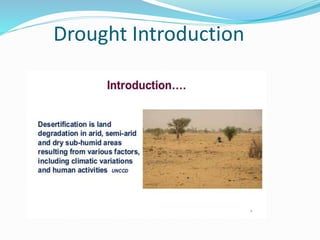
Drought Introduction
Causes of drought
The main causes of drought includes:-
1. Temperature changes of water and land causes drought. Total temperatures increases more water
evaporates and heavy weather conditions changes by increasing.
2. Crops needs more water to live and overall the need for water increases. It is very important to
consider changes in ET when discussing about water savings. You could be using more/less water
depending on weather.
3. Air circulation also causes drought. This changes rapidly.
4. Soil moisture levels also helps in drought. During soil moistures depletion there is less
evaporation of
water making clouds. Surface temperatures rises where more water is needed and less available
which
contributes to more severe drought.
5. Drought can also be a supply and demand of water issue. Region is growing fast demand for
water could exceeds the supply. Temperatures changes pushes a region towards drought and the
demand for water by people is worsen depending on how region reacts. High irrigation is good for
people providing for drought.
6. If timing of water doesn’t match with agricultural season too much water when you don’t need it
and too little when you need it. Proper storage and water collection is key to counter balance this
cycle and in scope of human management.
7. Jet streams are narrow bands of air that move around the earth at very high speeds. Jet streams
can stagnant high pressure system giving sunny weathers without rain. This is a major contribution
to droughts.
Effects of Drought
 Hunger and Famine
Drought conditions often provide too little water to support food crops, through either natural
precipitation or irrigation using reserve water supplies. The same problem affects grass and grain used to
feed livestock and poultry. When drought undermines or destroys food sources, people go hungry. When
the drought is severe and continues over a long period, famine may occur. Many of us remember the 1984
famine in Ethiopia, which was the result of a deadly combination of a severe drought and a dangerously
ineffective government. Hundreds of thousands died as a result.
 Not Enough Drinking Water
All living things must have water to survive. People can live for weeks without food, but only a few days
without water. In places like California, drought is experienced mainly as an inconvenience, perhaps with
some economic losses, but in very poor countries the consequences are much more direct. When
desperate for water to drink, people will turn to untreated sources that can make them sick.
 Disease
Drought often creates a lack of clean water for drinking, public sanitation and personal hygiene, which
can lead to a wide range of life-threatening diseases. The problem of water access is critical: every year,
millions are sickened or die due to lack of clean water access and sanitation, and droughts only make the
problem worse.
 Wildfires
The low moisture and precipitation that often characterize droughts can quickly create hazardous
conditions in forests and across rangelands, setting the stage for wildfires that may cause injuries or
deaths as well as extensive damage to property and already shrinking food supplies. In addition, even
plants generally adapted to dry conditions will drop needles and leaves during a drought, contributing to a
layer of dead vegetation on the ground. This dry duff then becomes a dangerous fuel for damaging
wildfires.
 Wildlife
Wild plants and animals suffer from droughts, even if they have some adaptations to dry
conditions. In grasslands, sustained lack of rain decreases forage production, affecting
herbivores, grain-eating birds, and indirectly, predators and scavengers. Droughts will
lead to increased mortality and reduced reproduction, which is especially problematic for
populations of at-risk species whose numbers are already very low. Wildlife needing
wetlands for breeding (for example, ducks and geese) experience drought as a decline in
available nesting sites.
 Social Conflict and War
When a precious commodity like water is in short supply due to drought, and the lack of
water creates a corresponding lack of food, people will compete—and eventually fight
and kill—to secure enough water to survive. Some believe that the current Syrian civil war
ultimately started after 1.5 million rural Syrians fled the drought-stricken rural areas for
the cities, triggering unrest.
 Electricity Generation
Many areas in the world rely on hydroelectric projects for electricity. Drought will reduce
the amount of water stored in reservoirs behind dams, reducing the amount of power
produced. This problem can be very challenging for the numerous small communities
relying on small-scale hydro, where a small electric turbine is installed on a local creek.
 Migration or Relocation
Faced with the other impacts of drought, many people will flee a drought-stricken area in
search of a new home with a better supply of water, enough food, and without the disease
and conflict that were present in the place they are leaving.
Prevention for drought
 Interlinking of national water resources (rivers). Water
management can be much better that way.
 Proper utilization and monitoring of available water
resources. Water tax is not far away.
 Proper monitoring of areas that are drought prone.
The levels of water need to be updated hourly/daily.
And a benchmark should be set for warning and
alarms to trigger.
 Agriculture and irrigation patterns need a change.
Water intensive crops can’t be sown in water deficit
areas.
 Water transportation channels need to be properly
maintained. Leakages are bad.
 Water intensive industries (alcohol for example) should be away from
water deficit regions.
 Dams, check dams and other water storage mechanism need to be in
place.
 Filtration and purification processes should not waste water. For
examples, Reverse Osmosis (RO) wastes water in the ration of 1:1. It
makes no sense to promote RO. Promote bio sand filters or other
similar equipment.
 More work (scientific, academic, financial, innovation, coordination)
needs to be done on Desalination processes. They still consume a lot
of energy making it currently uneconomical.
 Water meters need to be in place like electricity meters. Asking
someone not to consume excess water has not given good results so
far. Nobody counts water, a water meter will do that for them.
 Population density needs to be monitored. Migration needs a check.
Urban housing needs to have an upper limit. Obviously having a large
no. of people consuming a very small resource will result into
oblivion.
Control measures of drought
 Assess your priorities. ...
 Identify root zones. ...
 Try a root irrigator. ...
 Check soil moisture. ...
 Irrigate slowly. ...
 Build watering basins. ...
 Use soaker hoses. ...
 Apply mulch.
The components of a drought preparedness and mitigation plan are the following:
•Prediction
•Monitoring
•Impact assessment
Prediction can benefit from climate studies which use coupled ocean/atmosphere
models, survey of snow packs, anomalous circulation patterns in the ocean and
atmosphere, soil moisture, assimilation of remotely sensed data into numerical
prediction models, and knowledge of stored water available for domestic, stock, and
irrigation uses.
Monitoring exists in countries which use ground-based information such as rainfall,
weather, crop conditions and water availability. Satellite observations complement
data collected by ground systems. Satellites are necessary for the provision of
synoptic, wide-area coverage.
Impact assessment is carried out on the basis of land-use type, persistence of stressed
conditions, demographics and existing infrastructure, intensity and areal extent, and
its effect on agricultural yield, public health, water quantity and quality, and building
subsidence.
Mitigations of Drought
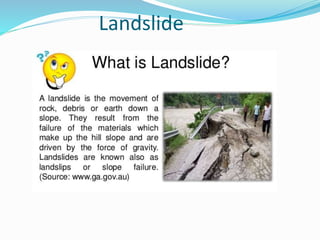
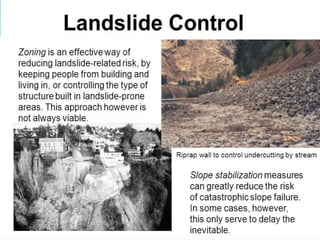
Landslide
DROUGHT AND LANDSLIDE

DROUGHT AND LANDSLIDE

  • 1.
    M.S.SWAMINATHAN SCHOOL OF AGRICULTURE,Parlakhemundi. Subimitted by;  Tadiboina Gopala krishna (233)  Kaki Haneeth Vardhan(234)  Ashirbad Sa (238)  Smarak Ranjan Das (239)  Submitted to;  Mr.Chandrasekhar Sahu Sir COURSE :ENVIRONMENTAL STUDIES AND DISASTER MANAGEMENT –ASES 3101
  • 2.
    Drought  A prolongedperiod of abnormally low rainfall, leading to a shortage of water.
  • 3.
  • 4.
    Causes of drought Themain causes of drought includes:- 1. Temperature changes of water and land causes drought. Total temperatures increases more water evaporates and heavy weather conditions changes by increasing. 2. Crops needs more water to live and overall the need for water increases. It is very important to consider changes in ET when discussing about water savings. You could be using more/less water depending on weather. 3. Air circulation also causes drought. This changes rapidly. 4. Soil moisture levels also helps in drought. During soil moistures depletion there is less evaporation of water making clouds. Surface temperatures rises where more water is needed and less available which contributes to more severe drought. 5. Drought can also be a supply and demand of water issue. Region is growing fast demand for water could exceeds the supply. Temperatures changes pushes a region towards drought and the demand for water by people is worsen depending on how region reacts. High irrigation is good for people providing for drought. 6. If timing of water doesn’t match with agricultural season too much water when you don’t need it and too little when you need it. Proper storage and water collection is key to counter balance this cycle and in scope of human management. 7. Jet streams are narrow bands of air that move around the earth at very high speeds. Jet streams can stagnant high pressure system giving sunny weathers without rain. This is a major contribution to droughts.
  • 5.
    Effects of Drought Hunger and Famine Drought conditions often provide too little water to support food crops, through either natural precipitation or irrigation using reserve water supplies. The same problem affects grass and grain used to feed livestock and poultry. When drought undermines or destroys food sources, people go hungry. When the drought is severe and continues over a long period, famine may occur. Many of us remember the 1984 famine in Ethiopia, which was the result of a deadly combination of a severe drought and a dangerously ineffective government. Hundreds of thousands died as a result.  Not Enough Drinking Water All living things must have water to survive. People can live for weeks without food, but only a few days without water. In places like California, drought is experienced mainly as an inconvenience, perhaps with some economic losses, but in very poor countries the consequences are much more direct. When desperate for water to drink, people will turn to untreated sources that can make them sick.  Disease Drought often creates a lack of clean water for drinking, public sanitation and personal hygiene, which can lead to a wide range of life-threatening diseases. The problem of water access is critical: every year, millions are sickened or die due to lack of clean water access and sanitation, and droughts only make the problem worse.  Wildfires The low moisture and precipitation that often characterize droughts can quickly create hazardous conditions in forests and across rangelands, setting the stage for wildfires that may cause injuries or deaths as well as extensive damage to property and already shrinking food supplies. In addition, even plants generally adapted to dry conditions will drop needles and leaves during a drought, contributing to a layer of dead vegetation on the ground. This dry duff then becomes a dangerous fuel for damaging wildfires.
  • 6.
     Wildlife Wild plantsand animals suffer from droughts, even if they have some adaptations to dry conditions. In grasslands, sustained lack of rain decreases forage production, affecting herbivores, grain-eating birds, and indirectly, predators and scavengers. Droughts will lead to increased mortality and reduced reproduction, which is especially problematic for populations of at-risk species whose numbers are already very low. Wildlife needing wetlands for breeding (for example, ducks and geese) experience drought as a decline in available nesting sites.  Social Conflict and War When a precious commodity like water is in short supply due to drought, and the lack of water creates a corresponding lack of food, people will compete—and eventually fight and kill—to secure enough water to survive. Some believe that the current Syrian civil war ultimately started after 1.5 million rural Syrians fled the drought-stricken rural areas for the cities, triggering unrest.  Electricity Generation Many areas in the world rely on hydroelectric projects for electricity. Drought will reduce the amount of water stored in reservoirs behind dams, reducing the amount of power produced. This problem can be very challenging for the numerous small communities relying on small-scale hydro, where a small electric turbine is installed on a local creek.  Migration or Relocation Faced with the other impacts of drought, many people will flee a drought-stricken area in search of a new home with a better supply of water, enough food, and without the disease and conflict that were present in the place they are leaving.
  • 7.
    Prevention for drought Interlinking of national water resources (rivers). Water management can be much better that way.  Proper utilization and monitoring of available water resources. Water tax is not far away.  Proper monitoring of areas that are drought prone. The levels of water need to be updated hourly/daily. And a benchmark should be set for warning and alarms to trigger.  Agriculture and irrigation patterns need a change. Water intensive crops can’t be sown in water deficit areas.  Water transportation channels need to be properly maintained. Leakages are bad.
  • 8.
     Water intensiveindustries (alcohol for example) should be away from water deficit regions.  Dams, check dams and other water storage mechanism need to be in place.  Filtration and purification processes should not waste water. For examples, Reverse Osmosis (RO) wastes water in the ration of 1:1. It makes no sense to promote RO. Promote bio sand filters or other similar equipment.  More work (scientific, academic, financial, innovation, coordination) needs to be done on Desalination processes. They still consume a lot of energy making it currently uneconomical.  Water meters need to be in place like electricity meters. Asking someone not to consume excess water has not given good results so far. Nobody counts water, a water meter will do that for them.  Population density needs to be monitored. Migration needs a check. Urban housing needs to have an upper limit. Obviously having a large no. of people consuming a very small resource will result into oblivion.
  • 9.
    Control measures ofdrought  Assess your priorities. ...  Identify root zones. ...  Try a root irrigator. ...  Check soil moisture. ...  Irrigate slowly. ...  Build watering basins. ...  Use soaker hoses. ...  Apply mulch.
  • 10.
    The components ofa drought preparedness and mitigation plan are the following: •Prediction •Monitoring •Impact assessment Prediction can benefit from climate studies which use coupled ocean/atmosphere models, survey of snow packs, anomalous circulation patterns in the ocean and atmosphere, soil moisture, assimilation of remotely sensed data into numerical prediction models, and knowledge of stored water available for domestic, stock, and irrigation uses. Monitoring exists in countries which use ground-based information such as rainfall, weather, crop conditions and water availability. Satellite observations complement data collected by ground systems. Satellites are necessary for the provision of synoptic, wide-area coverage. Impact assessment is carried out on the basis of land-use type, persistence of stressed conditions, demographics and existing infrastructure, intensity and areal extent, and its effect on agricultural yield, public health, water quantity and quality, and building subsidence. Mitigations of Drought
  • 11.