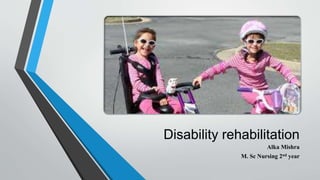

Disability rehabilitation
Alka Mishra
M. Sc Nursing 2nd year
content
1. Introduction
2. Definition
3. Types of Disability
4. Conditions contributing to disability
5. Consequences of disability
6. Objectives of rehabilitation
7. Rehabilitation team
8. Rehabilitation Nurse
9. Types of rehabilitation
10.Assistive technologies
11.Approaches to rehabilitation
12.Barriers
13.Overcoming barriers
14.Legislations
15.Govt. schemes
16.Rehabilitation Council Of India
Introduction
• Rehabilitation , commonly known as rehab is a scientifically developed
procedure for ensuring the recovery from any kind of disability, injury or
the habit.
• Rehabilitation is a slow but a steady process.
• Many of the rehabilitations have ongoing processes involved in them i.e.
some processes in it are continuous.
• Those are set of special instructions to be followed by the patient in order
to ensure that the malfunction does not hit back again.
Definition:
• Disability is
• - the dysfunction of any part of the body or mind leading to difficulty in performing one
or more activities. When a disease progresses to chronic stage leads to impairment of
certain functions.
• -Any restriction or lack of an ability to perform an activity in the manner or within the
range considered normal for a human being
• Impairment is any loss or abnormality of psychologic, physical, or anatomic
structure or function
• Handicap
• -A disadvantage for a given individual resulting from an impairment or disability that
limits or prevents fulfillment of a role that is normal for that particular individual.
Conted..
• Functional limitation
-Any loss of ability to perform tasks and obligations of usual roles and
normal daily life.
• Chronic illness
-An irreversible presence, accumulation, or latency of disease states or
impairments that involves the total human environment
Conted..
• Rehabilitation
-The process of restoring the individual to the fullest physical, mental, social,
vocational, and economic capacity of which he or she is capable
-Relearning of former skills; learning new skills necessary to adapt and live
fully in an altered lifestyle.
-It focuses on the existing capacities of the handicapped individual, and
brings him to the optimum level of his/her functional ability by the combined
and coordinated use of medical, social, educational and vocational measures.
- It must begin from the very onset of a traumatic event or diagnosis of a
chronic illness & every aspect of the individual’s needs and care assessed and
addressed
Types Of Disability
• Physical
• Neurological
• Mental
• Locomotor Disability
• Speech
• Visual
• Hearing
Conditions Contributing To Disability
• Physical: Polio, Amputation, Accidents.
• Hearing: Congenital, Otitis Media, Perforation, Neuro Surgery, Acostic-
Labrynthitis
• Visual: Cataract, Glaucoma, Trachoma, Vit ‘A’ Deficiency.
• Speech: Congenital, Brain Damage
• Mental: Congenital, Cretinism, Depression, Schizophrenia
• Neural: CVA, Hemiplegia, Quadriplegia, Epilepsy
• Psychiatric: Alcoholism- Schizophrenia
• Drug Abuse - -Drug Abuse- Mental Depression D.
• Mal Nutrition -Protein Deficiency, Anaemia, Vita A Deficiency
• Natural Calamities
• Argemon Oil Poisoning
• Trauma, Accidents
Consequences Of Disability
• Individual
• Family Effects
• Community
Objective Of Rehabilitation
• The basic objective of rehabilitation is
To restore the physical, social and psychological potential
to a level, so that he can independently function and carry
on an independent life.
 To prevent disability and return to normalcy.
To maximize level of restoration through different
interventions.
Training in vocational methods to suit working with
residual disability and earn a lively and independently.
Rehabilitation Team
It consists of:
• Physician
• Physiotherapist
• Rehab Nurse
• Health educator
• Nutritionist
• Medical social worker
Rehabilitation Nurse
• Must have a broad knowledge base of pathophysiology of a wide range of
medical-surgical conditions and
• a body of highly specialized knowledge and skills regarding rehabilitation
• Must believe that individuals with functional disabilities have an intrinsic
worth that transcends their disabilities
• Specialized training necessary for the rehabilitation nurse to become an
effective team member
• Practices in a variety of settings
Types of Rehabilitation
• There are different types of rehabilitation available for different types of
disabilities. Some of them are listed below
1. Neurological rehabilitation
2. Cardiac Rehabilitation
3. Drug rehabilitation
4. Alcohol rehabilitation
5. Physical rehabilitation
6. Medical rehabilitation
7. Vocational rehabilitation
8. Vestibular rehabilitation
9. Stroke Rehabilitation
Alcohol rehabilitation
• Program is designed to make an alcoholic free from the
addiction.
• It involves programs that will teach people the various bad
effects of consuming excess alcohol.
• Effective detox programs that will cleanse the body from the
various toxins of alcohol.
Neurological rehabilitation
• In this type of rehabilitation, patients suffering from stroke,
neuromuscular disease, certain types of head trauma and
spinal cord injury are treated.
• It aims at making the patient self-dependent. It helps create a
positive thinking in patient.
• The patient is treated so that he leads a improved life
physically, emotionally, and socially.
Cardiac Rehabilitation
• Program is designed to help those people who have heart
problem. Heart patients are educated to live a healthy life and
reduce stress for the proper functioning of the heart.
• It aims at educating people about the various risk factors that
contribute to developing a heart disease. These risk factors
include, high blood pressure, obesity, smoking, drinking, drug
abuse, lack of physical activity, etc.
• Recovery programs from heart disease/surgery. Educating
people about improving their quality of life.
Drug rehabilitation
• Programs involve programs that are designed to make an
addict free from the addiction of alcohol, prescription drug
and street drugs (cocaine, heroin etc.)
Physical rehabilitation
• It is for those people whose lifestyle has changed after they
have gone through a serious illness, surgery, accident or illness.
• Here the therapist introduces programs to improve the
mobility and functioning of the injured body part of the
patient.
• Proper exercising program is designed to improve the
functioning often physical body. It includes therapies that will
help a patient re-learn the basic physical and cognitive
functioning.
Medical rehabilitation
• It includes treatment programs that help a person perform
better in all his daily physical and mental activities.
• Medical rehabilitation is a follow up treatment after any kind
of treatment program.
• Programs focus on improving major and minor skills that are
required in the basic life. Also assessing patient in every step to
improve the activities of basic living
Vocational rehabilitation
• Program is designed to help those people who find it difficult
to get employment or retain it after they have gone through
certain situation that caused mental or physical disability in
them.
• Providing physiological and medical assessment, Job
placement, job training and on job training.
Vestibular rehabilitation
• It helps in improving the ear deficit by working on the central
nervous system. It also deals in improving eye and head
coordination.
Stroke Rehabilitation
• This treatment type helps to restore damage that is caused
after a stroke, which is the 3rd leading cause for death
worldwide.
• Stroke rehabilitation aims at helping people gain maximum
normal functioning after the occurrence of a stroke.
• This also help the person to get back to normal lifestyle and be
independent in daily activities.
Assistive technologies
• An assistive technology device can be defined as
“any item, piece of equipment, or product, whether it is acquired
commercially, modified, or customized, that is used to increase,
maintain, or improve the functional capabilities of individuals with
disabilities”.
Common examples of assistive devices follows-
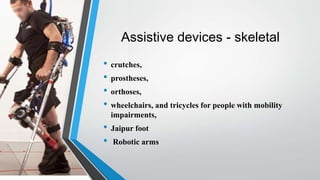
Assistive devices - skeletal
• crutches,
• prostheses,
• orthoses,
• wheelchairs, and tricycles for people with mobility
impairments,
• Jaipur foot
• Robotic arms
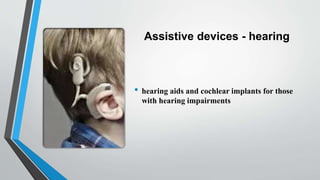
Assistive devices - hearing
• hearing aids and cochlear implants for those
with hearing impairments
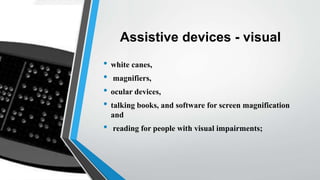
Assistive devices - visual
• white canes,
• magnifiers,
• ocular devices,
• talking books, and software for screen magnification
and
• reading for people with visual impairments;
Assistive devices - speech
• communication boards and
• speech synthesizers for people with speech
impairments
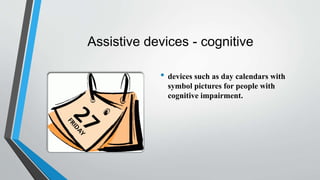
Assistive devices - cognitive
• devices such as day calendars with
symbol pictures for people with
cognitive impairment.
Conted..
• Assistive technologies, when appropriate to the user and the user’s
environment, have been shown to be powerful tools to increase
independence and improve participation.
• A study of people with limited mobility in Uganda (2007) found that
assistive technologies for mobility created greater possibilities for
community participation, especially in education and employment.
Approaches To Rehabilitation
• 1. Community Based Rehabilitation
This is a strategy of developing rehabilitation services in the
community so as to equalization of opportunity for all.
Attempt for social integration of disabled.
There is a collective effort of disabled, family and community in
rehabilitation.
Along with physical exercise, health education and vocational
training are imparted for self & independent working and
earning.
Conted..
• 2. Institutional Based Rehabilitation
Disabled persons are provided training in hospitals/ rehabilitation
centres.
 Exercises under supervision.
 Functions as a referral centre for community rehabilitation
centre.
Conted..
• 3. Out Reach Programmes-
 The experts from hospital visit the community or home for
providing education & training to disables in:-
Self-Care Ambulatory
Effective Communication
Vocational Guidance
Camps are also organized from time to time in rural area where
community facility is not available.
Efforts are on to integrate the community rehabilitation centers
with institutions to provide maximum rehabilitation coverage to
all parts of the country
Barriers To Rehabilitation
• Quality of Life versus Quantity of Life
• Rehabilitation focuses on continually improving the quality
of the person’s life, not merely maintaining life itself.
Conted..
•Care versus Cure
• Many conditions are irreversible; therefore, the focus of
care is related to adaptation and acceptance of an altered
life rather than to resolving an illness.
Conted..
•High Cost of Interdisciplinary Care versus Long-term
Care
• Rehabilitation is expensive. Success is sometimes seen as a
return to productive employment; may be if the individual
becomes sufficiently independent that no caregiver is
required.
Overcoming barriers
• The barriers to rehabilitation service provision can be overcome through
a series of actions, including:
 reforming policies, laws, and delivery systems, including
development or revision of national rehabilitation plans;
developing funding mechanisms to address barriers related to
financing of rehabilitation;
increasing human resources for rehabilitation, including training and
retention of rehabilitation personnel;
expanding and decentralizing service delivery;
increasing the use and affordability of technology and assistive
devices;
expanding research programmes, including improving information
and access to good practice guidelines.
Legislations Protecting Disables In India
• The Constitution of India applies uniformly to all citizens of India irrespective of
their religion, caste, gender, creed etc.
"Disability" has not been defined in the Constitution.
• Govt. of India has enacted the following legislations for empowering the persons
with disability:
• Indian Lunacy act, (1912)
• Mental health act, (1987)
• Rehabilitation council of India act, (1992)
• Persons with disability act, (1995)
• The National Trust for Welfare of Persons with Autism, Cerebral Palsy,
Mental Retardation and Multiple Disabilities Act, 1999
• Right to education act, (2010)
• Other Acts Which Can Contribute
• Right to information act (2005)
Rehabilitation In India (Govt Schemes)
• Department of Empowerment of Persons with Disabilities (DEPwD),
Ministry of Social Justice & Empowerment has conceptualised the
“Accessible India Campaign (Sugamya Bharat Abhiyan)”as a nation-
wide flagship campaign for achieving universal accessibility
• It will enable persons with disabilities to gain access for equal
opportunity and live independently and participate fully in all aspects of
life in an inclusive society.
• The campaign targets at enhancing the accessibility of built environment,
transport system and Information & communication eco-System.
strategies
• A multi-pronged strategy will be adopted for the campaign with key
components as -
leadership endorsements of the campaign,
mass awareness,
capacity building through workshops,
interventions (legal frame-work, technology solutions, resource
generation, etc. and
leverage corporate sector efforts in a Public-Private Partnership.
Others
• Scholarship to physically handicap for going to school.
• Admission quota for disables in schools and colleges.
• Seats are reserved for handicap in Govt. services.
• 3% reservation in identified government jobs.
 1% each for:
• (i) persons with blindness or low vision
• (ii) persons with hearing impairment and
• (iii) persons with loco motor disability or Cerebral Palsy.
Conted..
• Separate employment exchange for handicap.
• Handicap friendly environment in offices and hospitals, lifts,
toilet, ramps, wheel chairs and porters.
• Seats are reserved for handicap persons in buses and
transports.
• Special transport allowance to handicaps and concessional rail
tickets with free attendants.
• Setting up of rehabilitation centres at district and PHC level.
• Availability of artificial limbs, appliances in concessional rates.
RCI
• The Rehabilitation Council of India (RCI) was set up as a registered
society in 1986.
• On September,1992 the RCI Act was enacted by Parliament and it
became a Statutory Body on 22 June 1993.
• The Act was amended by Parliament in 2000 to make it more broad
based.
Conted..
• The mandate given to RCI is to regulate and monitor services given
to persons with disability,
 to standardise syllabi and to maintain a Central Rehabilitation
Register of all qualified professionals and personnel working in
the field of Rehabilitation and Special Education.
• The Act also prescribes punitive action against unqualified persons
delivering services to persons with disability.
Objectives of RCI
• To regulate the training policies and programmes in the field of
rehabilitation of persons with disabilities
• To bring about standardization of training courses for professionals
dealing with persons with disabilities
• To prescribe minimum standards of education and training of
various categories of professionals/ personnel dealing with people
with disabilities
• To regulate these standards in all training institutions uniformly
throughout the country
• To recognize institutions/ organizations/ universities running
master's degree/ bachelor's degree/ P.G.Diploma/ Diploma/
Certificate courses in the field of rehabilitation of persons with
disabilities
Conted..
• To recognize degree/diploma/certificate awarded by foreign universities/
institutions on reciprocal basis
• To promote research in Rehabilitation and Special Education
• To maintain Central Rehabilitation Register for registration of
professionals/ personnel
• To collect information on a regular basis on education and training in the
field of rehabilitation of people with disabilities from institutions in India
and abroad
• To encourage continuing education in the field of rehabilitation and
special education by way of collaboration with organizations working in
the field of disability.
Conted..
• To recognize Vocational Rehabilitation Centres as manpower
development centres
• To register vocational instructors and other personnel working in the
Vocational Rehabilitation Centres
• To recognize the national institutes and apex institutions on disability as
manpower development centres
• To register personnel working in national institutes and apex institutions
on disability under the Ministry of Social Justice & Empowerment
Summary
• Disability rehabilitation focuses on the existing capacities of the
handicapped individual, and brings him to the optimum level of his/her
functional ability.
• There are many approaches to rehabilitation of disabled persons which
one is to choose, depends upon the capabilities and coping abilities of the
person , which differs person to person, even if they have same type of
disability.
conclusion
• Though there are many modalities of treatment available, and also
government, legislations and acts supplementing rehabilitation.
• There is dire need to change the perception of society towards disability
and rehabilitation, in order to integrate specially abled person to the
main stream of society.
Disability rehabilitation

Disability rehabilitation

  • 1.
  • 2.
    content 1. Introduction 2. Definition 3.Types of Disability 4. Conditions contributing to disability 5. Consequences of disability 6. Objectives of rehabilitation 7. Rehabilitation team 8. Rehabilitation Nurse 9. Types of rehabilitation 10.Assistive technologies 11.Approaches to rehabilitation 12.Barriers 13.Overcoming barriers 14.Legislations 15.Govt. schemes 16.Rehabilitation Council Of India
  • 3.
    Introduction • Rehabilitation ,commonly known as rehab is a scientifically developed procedure for ensuring the recovery from any kind of disability, injury or the habit. • Rehabilitation is a slow but a steady process. • Many of the rehabilitations have ongoing processes involved in them i.e. some processes in it are continuous. • Those are set of special instructions to be followed by the patient in order to ensure that the malfunction does not hit back again.
  • 4.
    Definition: • Disability is •- the dysfunction of any part of the body or mind leading to difficulty in performing one or more activities. When a disease progresses to chronic stage leads to impairment of certain functions. • -Any restriction or lack of an ability to perform an activity in the manner or within the range considered normal for a human being • Impairment is any loss or abnormality of psychologic, physical, or anatomic structure or function • Handicap • -A disadvantage for a given individual resulting from an impairment or disability that limits or prevents fulfillment of a role that is normal for that particular individual.
  • 5.
    Conted.. • Functional limitation -Anyloss of ability to perform tasks and obligations of usual roles and normal daily life. • Chronic illness -An irreversible presence, accumulation, or latency of disease states or impairments that involves the total human environment
  • 6.
    Conted.. • Rehabilitation -The processof restoring the individual to the fullest physical, mental, social, vocational, and economic capacity of which he or she is capable -Relearning of former skills; learning new skills necessary to adapt and live fully in an altered lifestyle. -It focuses on the existing capacities of the handicapped individual, and brings him to the optimum level of his/her functional ability by the combined and coordinated use of medical, social, educational and vocational measures. - It must begin from the very onset of a traumatic event or diagnosis of a chronic illness & every aspect of the individual’s needs and care assessed and addressed
  • 7.
    Types Of Disability •Physical • Neurological • Mental • Locomotor Disability • Speech • Visual • Hearing
  • 8.
    Conditions Contributing ToDisability • Physical: Polio, Amputation, Accidents. • Hearing: Congenital, Otitis Media, Perforation, Neuro Surgery, Acostic- Labrynthitis • Visual: Cataract, Glaucoma, Trachoma, Vit ‘A’ Deficiency. • Speech: Congenital, Brain Damage • Mental: Congenital, Cretinism, Depression, Schizophrenia • Neural: CVA, Hemiplegia, Quadriplegia, Epilepsy • Psychiatric: Alcoholism- Schizophrenia • Drug Abuse - -Drug Abuse- Mental Depression D. • Mal Nutrition -Protein Deficiency, Anaemia, Vita A Deficiency • Natural Calamities • Argemon Oil Poisoning • Trauma, Accidents
  • 9.
    Consequences Of Disability •Individual • Family Effects • Community
  • 10.
    Objective Of Rehabilitation •The basic objective of rehabilitation is To restore the physical, social and psychological potential to a level, so that he can independently function and carry on an independent life.  To prevent disability and return to normalcy. To maximize level of restoration through different interventions. Training in vocational methods to suit working with residual disability and earn a lively and independently.
  • 11.
    Rehabilitation Team It consistsof: • Physician • Physiotherapist • Rehab Nurse • Health educator • Nutritionist • Medical social worker
  • 12.
    Rehabilitation Nurse • Musthave a broad knowledge base of pathophysiology of a wide range of medical-surgical conditions and • a body of highly specialized knowledge and skills regarding rehabilitation • Must believe that individuals with functional disabilities have an intrinsic worth that transcends their disabilities • Specialized training necessary for the rehabilitation nurse to become an effective team member • Practices in a variety of settings
  • 13.
    Types of Rehabilitation •There are different types of rehabilitation available for different types of disabilities. Some of them are listed below 1. Neurological rehabilitation 2. Cardiac Rehabilitation 3. Drug rehabilitation 4. Alcohol rehabilitation 5. Physical rehabilitation 6. Medical rehabilitation 7. Vocational rehabilitation 8. Vestibular rehabilitation 9. Stroke Rehabilitation
  • 14.
    Alcohol rehabilitation • Programis designed to make an alcoholic free from the addiction. • It involves programs that will teach people the various bad effects of consuming excess alcohol. • Effective detox programs that will cleanse the body from the various toxins of alcohol.
  • 15.
    Neurological rehabilitation • Inthis type of rehabilitation, patients suffering from stroke, neuromuscular disease, certain types of head trauma and spinal cord injury are treated. • It aims at making the patient self-dependent. It helps create a positive thinking in patient. • The patient is treated so that he leads a improved life physically, emotionally, and socially.
  • 16.
    Cardiac Rehabilitation • Programis designed to help those people who have heart problem. Heart patients are educated to live a healthy life and reduce stress for the proper functioning of the heart. • It aims at educating people about the various risk factors that contribute to developing a heart disease. These risk factors include, high blood pressure, obesity, smoking, drinking, drug abuse, lack of physical activity, etc. • Recovery programs from heart disease/surgery. Educating people about improving their quality of life.
  • 17.
    Drug rehabilitation • Programsinvolve programs that are designed to make an addict free from the addiction of alcohol, prescription drug and street drugs (cocaine, heroin etc.)
  • 18.
    Physical rehabilitation • Itis for those people whose lifestyle has changed after they have gone through a serious illness, surgery, accident or illness. • Here the therapist introduces programs to improve the mobility and functioning of the injured body part of the patient. • Proper exercising program is designed to improve the functioning often physical body. It includes therapies that will help a patient re-learn the basic physical and cognitive functioning.
  • 19.
    Medical rehabilitation • Itincludes treatment programs that help a person perform better in all his daily physical and mental activities. • Medical rehabilitation is a follow up treatment after any kind of treatment program. • Programs focus on improving major and minor skills that are required in the basic life. Also assessing patient in every step to improve the activities of basic living
  • 20.
    Vocational rehabilitation • Programis designed to help those people who find it difficult to get employment or retain it after they have gone through certain situation that caused mental or physical disability in them. • Providing physiological and medical assessment, Job placement, job training and on job training.
  • 21.
    Vestibular rehabilitation • Ithelps in improving the ear deficit by working on the central nervous system. It also deals in improving eye and head coordination.
  • 22.
    Stroke Rehabilitation • Thistreatment type helps to restore damage that is caused after a stroke, which is the 3rd leading cause for death worldwide. • Stroke rehabilitation aims at helping people gain maximum normal functioning after the occurrence of a stroke. • This also help the person to get back to normal lifestyle and be independent in daily activities.
  • 23.
    Assistive technologies • Anassistive technology device can be defined as “any item, piece of equipment, or product, whether it is acquired commercially, modified, or customized, that is used to increase, maintain, or improve the functional capabilities of individuals with disabilities”. Common examples of assistive devices follows-
  • 24.
    Assistive devices -skeletal • crutches, • prostheses, • orthoses, • wheelchairs, and tricycles for people with mobility impairments, • Jaipur foot • Robotic arms
  • 25.
    Assistive devices -hearing • hearing aids and cochlear implants for those with hearing impairments
  • 26.
    Assistive devices -visual • white canes, • magnifiers, • ocular devices, • talking books, and software for screen magnification and • reading for people with visual impairments;
  • 27.
    Assistive devices -speech • communication boards and • speech synthesizers for people with speech impairments
  • 28.
    Assistive devices -cognitive • devices such as day calendars with symbol pictures for people with cognitive impairment.
  • 29.
    Conted.. • Assistive technologies,when appropriate to the user and the user’s environment, have been shown to be powerful tools to increase independence and improve participation. • A study of people with limited mobility in Uganda (2007) found that assistive technologies for mobility created greater possibilities for community participation, especially in education and employment.
  • 30.
    Approaches To Rehabilitation •1. Community Based Rehabilitation This is a strategy of developing rehabilitation services in the community so as to equalization of opportunity for all. Attempt for social integration of disabled. There is a collective effort of disabled, family and community in rehabilitation. Along with physical exercise, health education and vocational training are imparted for self & independent working and earning.
  • 31.
    Conted.. • 2. InstitutionalBased Rehabilitation Disabled persons are provided training in hospitals/ rehabilitation centres.  Exercises under supervision.  Functions as a referral centre for community rehabilitation centre.
  • 32.
    Conted.. • 3. OutReach Programmes-  The experts from hospital visit the community or home for providing education & training to disables in:- Self-Care Ambulatory Effective Communication Vocational Guidance Camps are also organized from time to time in rural area where community facility is not available. Efforts are on to integrate the community rehabilitation centers with institutions to provide maximum rehabilitation coverage to all parts of the country
  • 33.
    Barriers To Rehabilitation •Quality of Life versus Quantity of Life • Rehabilitation focuses on continually improving the quality of the person’s life, not merely maintaining life itself.
  • 34.
    Conted.. •Care versus Cure •Many conditions are irreversible; therefore, the focus of care is related to adaptation and acceptance of an altered life rather than to resolving an illness.
  • 35.
    Conted.. •High Cost ofInterdisciplinary Care versus Long-term Care • Rehabilitation is expensive. Success is sometimes seen as a return to productive employment; may be if the individual becomes sufficiently independent that no caregiver is required.
  • 36.
    Overcoming barriers • Thebarriers to rehabilitation service provision can be overcome through a series of actions, including:  reforming policies, laws, and delivery systems, including development or revision of national rehabilitation plans; developing funding mechanisms to address barriers related to financing of rehabilitation; increasing human resources for rehabilitation, including training and retention of rehabilitation personnel; expanding and decentralizing service delivery; increasing the use and affordability of technology and assistive devices; expanding research programmes, including improving information and access to good practice guidelines.
  • 37.
    Legislations Protecting DisablesIn India • The Constitution of India applies uniformly to all citizens of India irrespective of their religion, caste, gender, creed etc. "Disability" has not been defined in the Constitution. • Govt. of India has enacted the following legislations for empowering the persons with disability: • Indian Lunacy act, (1912) • Mental health act, (1987) • Rehabilitation council of India act, (1992) • Persons with disability act, (1995) • The National Trust for Welfare of Persons with Autism, Cerebral Palsy, Mental Retardation and Multiple Disabilities Act, 1999 • Right to education act, (2010) • Other Acts Which Can Contribute • Right to information act (2005)
  • 38.
    Rehabilitation In India(Govt Schemes) • Department of Empowerment of Persons with Disabilities (DEPwD), Ministry of Social Justice & Empowerment has conceptualised the “Accessible India Campaign (Sugamya Bharat Abhiyan)”as a nation- wide flagship campaign for achieving universal accessibility • It will enable persons with disabilities to gain access for equal opportunity and live independently and participate fully in all aspects of life in an inclusive society. • The campaign targets at enhancing the accessibility of built environment, transport system and Information & communication eco-System.
  • 39.
    strategies • A multi-prongedstrategy will be adopted for the campaign with key components as - leadership endorsements of the campaign, mass awareness, capacity building through workshops, interventions (legal frame-work, technology solutions, resource generation, etc. and leverage corporate sector efforts in a Public-Private Partnership.
  • 40.
    Others • Scholarship tophysically handicap for going to school. • Admission quota for disables in schools and colleges. • Seats are reserved for handicap in Govt. services. • 3% reservation in identified government jobs.  1% each for: • (i) persons with blindness or low vision • (ii) persons with hearing impairment and • (iii) persons with loco motor disability or Cerebral Palsy.
  • 41.
    Conted.. • Separate employmentexchange for handicap. • Handicap friendly environment in offices and hospitals, lifts, toilet, ramps, wheel chairs and porters. • Seats are reserved for handicap persons in buses and transports. • Special transport allowance to handicaps and concessional rail tickets with free attendants. • Setting up of rehabilitation centres at district and PHC level. • Availability of artificial limbs, appliances in concessional rates.
  • 42.
    RCI • The RehabilitationCouncil of India (RCI) was set up as a registered society in 1986. • On September,1992 the RCI Act was enacted by Parliament and it became a Statutory Body on 22 June 1993. • The Act was amended by Parliament in 2000 to make it more broad based.
  • 43.
    Conted.. • The mandategiven to RCI is to regulate and monitor services given to persons with disability,  to standardise syllabi and to maintain a Central Rehabilitation Register of all qualified professionals and personnel working in the field of Rehabilitation and Special Education. • The Act also prescribes punitive action against unqualified persons delivering services to persons with disability.
  • 44.
    Objectives of RCI •To regulate the training policies and programmes in the field of rehabilitation of persons with disabilities • To bring about standardization of training courses for professionals dealing with persons with disabilities • To prescribe minimum standards of education and training of various categories of professionals/ personnel dealing with people with disabilities • To regulate these standards in all training institutions uniformly throughout the country • To recognize institutions/ organizations/ universities running master's degree/ bachelor's degree/ P.G.Diploma/ Diploma/ Certificate courses in the field of rehabilitation of persons with disabilities
  • 45.
    Conted.. • To recognizedegree/diploma/certificate awarded by foreign universities/ institutions on reciprocal basis • To promote research in Rehabilitation and Special Education • To maintain Central Rehabilitation Register for registration of professionals/ personnel • To collect information on a regular basis on education and training in the field of rehabilitation of people with disabilities from institutions in India and abroad • To encourage continuing education in the field of rehabilitation and special education by way of collaboration with organizations working in the field of disability.
  • 46.
    Conted.. • To recognizeVocational Rehabilitation Centres as manpower development centres • To register vocational instructors and other personnel working in the Vocational Rehabilitation Centres • To recognize the national institutes and apex institutions on disability as manpower development centres • To register personnel working in national institutes and apex institutions on disability under the Ministry of Social Justice & Empowerment
  • 47.
    Summary • Disability rehabilitationfocuses on the existing capacities of the handicapped individual, and brings him to the optimum level of his/her functional ability. • There are many approaches to rehabilitation of disabled persons which one is to choose, depends upon the capabilities and coping abilities of the person , which differs person to person, even if they have same type of disability.
  • 48.
    conclusion • Though thereare many modalities of treatment available, and also government, legislations and acts supplementing rehabilitation. • There is dire need to change the perception of society towards disability and rehabilitation, in order to integrate specially abled person to the main stream of society.