DISABILITY REHABILITATION KISHORE JEBASINGH.T MPT, MSW, PGDHM, DAcu PHYSIOTHERAPIST KHORFAKKAN HOSPITAL T. KISHORE JEBASINGH,  MPT, MSW, PGDHM  PHYSIOTHERAPIST  KHORFAKKAN HOSPITAL
Disability According to the World Health Organization, a disability is… “ any restriction or lack (resulting from any impairment) of ability to perform an activity in the manner or within the range considered normal for a human being”  T. KISHORE JEBASINGH, MPT, MSW, PGDHM  PHYSIOTHERAPIST  KHORFAKKAN HOSPITAL
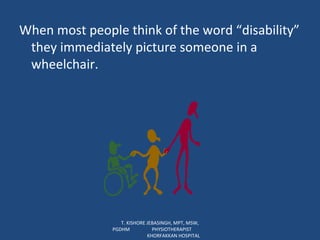
When most people think of the word “disability” they immediately picture someone in a wheelchair. T. KISHORE JEBASINGH, MPT, MSW, PGDHM  PHYSIOTHERAPIST  KHORFAKKAN HOSPITAL
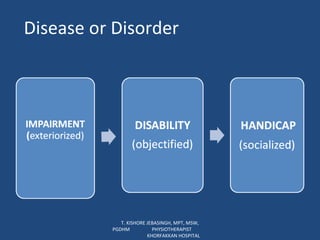
Disease or Disorder T. KISHORE JEBASINGH, MPT, MSW, PGDHM  PHYSIOTHERAPIST  KHORFAKKAN HOSPITAL
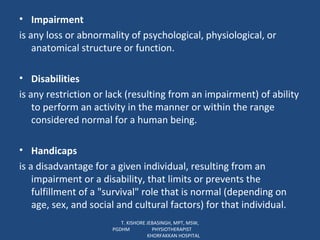
Impairment is any loss or abnormality of psychological, physiological, or anatomical structure or function. Disabilities is any restriction or lack (resulting from an impairment) of ability to perform an activity in the manner or within the range considered normal for a human being. Handicaps is a disadvantage for a given individual, resulting from an impairment or a disability, that limits or prevents the fulfillment of a "survival" role that is normal (depending on age, sex, and social and cultural factors) for that individual. T. KISHORE JEBASINGH, MPT, MSW, PGDHM  PHYSIOTHERAPIST  KHORFAKKAN HOSPITAL
REHABILITATION Rehabilitation is process to restore or helping an individual achieve the highest level of independence and quality of life possible physically, emotionally, socially and spiritually T. KISHORE JEBASINGH,  MPT, MSW, PGDHM  PHYSIOTHERAPIST  KHORFAKKAN HOSPITAL
REHABILITATION TEAM “ COMING TOGETHER IS THE BEGINNING, STAYING TOGETHER IS PROGRESS, WORK TOGETHER IS SUCESS,.” – HENRY FORD T. KISHORE JEBASINGH , MPT, MSW, PGDHM  PHYSIOTHERAPIST  KHORFAKKAN HOSPITAL
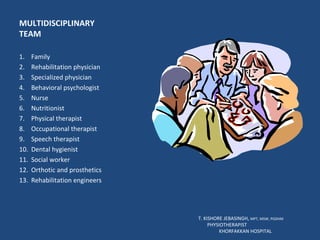
MULTIDISCIPLINARY TEAM Family Rehabilitation physician Specialized physician Behavioral psychologist Nurse Nutritionist Physical therapist Occupational therapist Speech therapist Dental hygienist Social worker Orthotic and prosthetics Rehabilitation engineers T. KISHORE JEBASINGH,  MPT, MSW, PGDHM  PHYSIOTHERAPIST  KHORFAKKAN HOSPITAL
How does the team work Assessment Planning, Referral and Follow-up The family centered approach T. KISHORE JEBASINGH,  MPT, MSW, PGDHM  PHYSIOTHERAPIST  KHORFAKKAN HOSPITAL
Assessment The interdisciplinary team provides comprehensive assessment of  motor, nutritional, functional and eating habits Direct or videotaped observation Individual assessments by team members T. KISHORE JEBASINGH , MPT, MSW, PGDHM  PHYSIOTHERAPIST  KHORFAKKAN HOSPITAL
Planning, Referral and Follow-up The team works with the family to make a written plan for intervention The team communicates closely with community professionals already involved Appropriate referrals are made at the family’s request Periodic follow-up is provided to address changing needs  T. KISHORE JEBASINGH,  MPT, MSW, PGDHM  PHYSIOTHERAPIST  KHORFAKKAN HOSPITAL
The family centered approach The team works with the family to prioritize goals for the child The team works together to make consistent  recommendations The team helps consolidate appointment to the family Team evaluations and planning are sensitive to the cultural background of the family T. KISHORE JEBASINGH,  MPT, MSW, PGDHM  PHYSIOTHERAPIST  KHORFAKKAN HOSPITAL
Working together, the family and team produce  positive outcomes……. A recent study of community teams showed the following positive outcomes Appropriate growth Improved dietary intake decreased illness and hospitalization Improved feeding skills Improved health status T. KISHORE JEBASINGH,  MPT, MSW, PGDHM  PHYSIOTHERAPIST  KHORFAKKAN HOSPITAL
Occupational therapy service Working directly in partnership with person to maintain or develop their occupational performance skills that are meaningful to them to lead productive adult lives Provide specialist assessments appropriate to learning disabilities Provide specialist intervention carried out in most appropriate disabilities T. KISHORE JEBASINGH,  MPT, MSW, PGDHM  PHYSIOTHERAPIST  KHORFAKKAN HOSPITAL
Physiotherapy services Physiotherapy outcomes Which treatment and intervention strategies have been most successful Evaluate the long-term outcomes of early interventions including exercise, electro therapy splint and brace etc.. T. KISHORE JEBASINGH,  MPT, MSW, PGDHM  PHYSIOTHERAPIST  KHORFAKKAN HOSPITAL
Physiotherapy Treatments Electrical stimulation Strength training Motor control approaches Rood  The Bobaths- NDT Brunnstrom PNF Carr & Shepherd T. KISHORE JEBASINGH,  MPT, MSW, PGDHM  PHYSIOTHERAPIST  KHORFAKKAN HOSPITAL
Need of oromotor rehabilitation A poor Oromotor activity leads to poor nutrition.  Poor oral hygiene may leads to frequent (upper) respiratory tract infection Poor coordination between swallowing and breathing leads to excessive chocking Inadequate tongue movement  biomechanically affects neck control  Oral tonicity also influence facilitation techniques by other approaches Oromotor problem leads high social stigma T. KISHORE JEBASINGH, MPT, MSW, PGDHM  PHYSIOTHERAPIST  KHORFAKKAN HOSPITAL
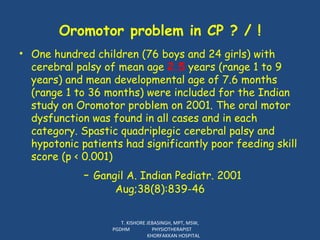
Oromotor problem in CP ? / ! One hundred children (76 boys and 24 girls) with cerebral palsy of mean age  2.5  years (range 1 to 9 years) and mean developmental age of 7.6 months (range 1 to 36 months) were included for the Indian study on Oromotor problem on 2001. The oral motor dysfunction was found in all cases and in each category. Spastic quadriplegic cerebral palsy and hypotonic patients had significantly poor feeding skill score (p < 0.001)  -  Gangil A. Indian Pediatr. 2001  Aug;38(8):839-46  T. KISHORE JEBASINGH, MPT, MSW, PGDHM  PHYSIOTHERAPIST  KHORFAKKAN HOSPITAL
Common symptoms of poor Oromotor control Poor strength and coordination of the lips, tongue, and jaw.  Poor speech clarity (&quot;muddled&quot; speech) Drooling Poor muscle tone in the face (muscles appear to be &quot;sagging&quot;) Difficulty with chewing and swallowing Voice changes - speech sounding  hoarse, nasal,  or  soft Unable to perform coordinated oral movements T. KISHORE JEBASINGH, MPT, MSW, PGDHM  PHYSIOTHERAPIST  KHORFAKKAN HOSPITAL
Developmental - Presence of malocclusions  Teething (Problems for effective lip sealing.) Nausea Foods Emotional stimuli Central nervous system and muscular disorders Mental retardation Oro-pharyngeal lesions Esophageal lesions Gastroesophageal reflux Drugs and chemicals (Antecedents of seizures and the use of antiseizure drugs Common cause for Oromotor problem -  Drooling  T. KISHORE JEBASINGH, MPT, MSW, PGDHM  PHYSIOTHERAPIST  KHORFAKKAN HOSPITAL
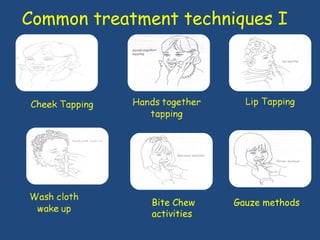
Common treatment techniques I  Bite Chew activities  Gauze methods
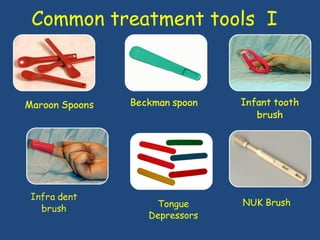
Common treatment tools  I  Tongue   Depressors NUK Brush
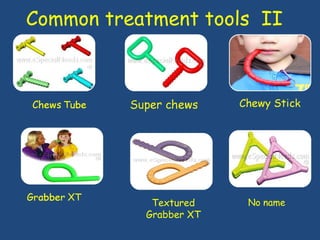
Common treatment tools  II  Textured Grabber XT No name
Selection of food Thicken the liquid by adding fruits or sugar with juice/milk will help to increase the oral alertness.    Strong acid base juice like orange will increase the saliva production.    Milk and milk based products tends to increase the mucos production, leads to difficult in swallowing respiration and swallowing.  T. KISHORE JEBASINGH, MPT, MSW, PGDHM  PHYSIOTHERAPIST  KHORFAKKAN HOSPITAL
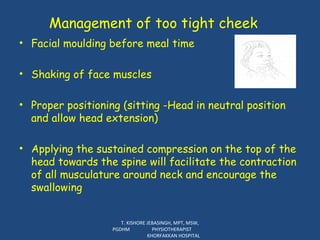
Management of too tight cheek Facial moulding before meal time Shaking of face muscles Proper positioning (sitting -Head in neutral position and allow head extension) Applying the sustained compression on the top of the head towards the spine will facilitate the contraction of all musculature around neck and encourage the swallowing T. KISHORE JEBASINGH, MPT, MSW, PGDHM  PHYSIOTHERAPIST  KHORFAKKAN HOSPITAL
Management of too floppy cheek Face rubbing before meal Vibration of face muscles Encourage quick stretch of face muscles  Cheek tapping before meal Can also try/use  NUK brushing Infra dent finger tooth brush Gum massager T. KISHORE JEBASINGH, MPT, MSW, PGDHM  PHYSIOTHERAPIST  KHORFAKKAN HOSPITAL
Management of too tight tongue Positioning Maroon spoon Beckman spoon NUK massager Avoid tongue over activity T. KISHORE JEBASINGH, MPT, MSW, PGDHM  PHYSIOTHERAPIST  KHORFAKKAN HOSPITAL
Management of too floppy tongue Iced food and liquid strong flavor Infra dent finger brush Gum massager Pressure with NUK massager Downward pressure on tongue by spoon T. KISHORE JEBASINGH, MPT, MSW, PGDHM  PHYSIOTHERAPIST  KHORFAKKAN HOSPITAL
Working for tongue lateralization Bite chew activity Gauze bite activity Tooth brush NUK massager  Hide food in cheek pouches T. KISHORE JEBASINGH, MPT, MSW, PGDHM  PHYSIOTHERAPIST  KHORFAKKAN HOSPITAL
Working for tongue tip elevation Tongue cheek education Encourage jaw control Biting and chewing activities Tongue lateralization NUK, infra dent brushing T. KISHORE JEBASINGH, MPT, MSW, PGDHM  PHYSIOTHERAPIST  KHORFAKKAN HOSPITAL
Working for spontaneous mouth opening Arousal techniques Elicit rooting reflex Assist mouth opening gentle downward pressure and traction to jaw Inhibit jaw clenching vibration to the mouth touch/pressure to gums T. KISHORE JEBASINGH, MPT, MSW, PGDHM  PHYSIOTHERAPIST  KHORFAKKAN HOSPITAL
Electrical stimulation NMES activates a greater number of motor units and produces higher firing rates of the active motor units than can be obtained volitionally  T. KISHORE JEBASINGH,  MPT, MSW, PGDHM  PHYSIOTHERAPIST  KHORFAKKAN HOSPITAL
Exercise Muscles can adapt to training stimuli that target specific muscle architectural parameters, such as fascicle length and cross-sectional area T. KISHORE JEBASINGH,  MPT, MSW, PGDHM  PHYSIOTHERAPIST  KHORFAKKAN HOSPITAL
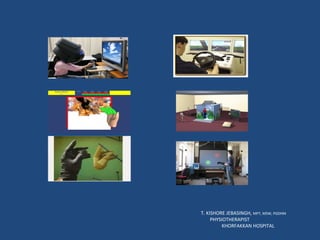
Exercise intervention Engagement Enjoyable Targeted Based on sound theories of motor learning Include sensory-perceptual components Require anticipatory planning Develop cognitive aspects of motor planning for action prediction Computerized music games ‘Magic’ hand tricks  T. KISHORE JEBASINGH,  MPT, MSW, PGDHM  PHYSIOTHERAPIST  KHORFAKKAN HOSPITAL
T. KISHORE JEBASINGH,  MPT, MSW, PGDHM  PHYSIOTHERAPIST  KHORFAKKAN HOSPITAL
Motor control approaches Focus Treatment of paralysis, flaccidity & spasticity of muscles resulting from damage or disease to the central nervous system Treatment of movement disorder Each theorist has a somewhat different approach, assessment technique, and intervention strategies  T. KISHORE JEBASINGH,  MPT, MSW, PGDHM  PHYSIOTHERAPIST  KHORFAKKAN HOSPITAL
Principles of rood Approach Sensory input is required for normalization of tone and evocation of desired muscular response Sensory motor control is developmentally based Movement is purposeful, engagement in activities is required to produce a normal response Repetition of movement is necessary for learning T. KISHORE JEBASINGH,  MPT, MSW, PGDHM  PHYSIOTHERAPIST  KHORFAKKAN HOSPITAL
Facilitation techniques Light stroking Brushing Icing Joint compression Inhibition technique Joint approximation Neutral warmth Pressure on tendon insertion Slow rhythmical movement are used to inhibit unwanted movement T. KISHORE JEBASINGH,  MPT, MSW, PGDHM  PHYSIOTHERAPIST  KHORFAKKAN HOSPITAL
The Bobaths approach NDT focuses on the sensation of movement Reflex inhibiting postures are used to inhibit primitive reflexes Sensory stimulation is regulated with great care Weight bearing, placing and holding, tapping and joint compression are used Compensation using the noninvolved side T. KISHORE JEBASINGH,  MPT, MSW, PGDHM  PHYSIOTHERAPIST  KHORFAKKAN HOSPITAL
Brunnstrom approach Focuses on reflexes which provide the components of normal movement Patients are encouraged to think about the movement and to gain control Brunstrom also uses associated reactions and synergies Stages of recovery T. KISHORE JEBASINGH,  MPT, MSW, PGDHM  PHYSIOTHERAPIST  KHORFAKKAN HOSPITAL
PNF Uses diagonal & spiraling patterns movement Guides thinking about the sequence of normal development Uses two diagonal pattern patterns crossing the mid-line for each major body part, often incorporating verbal commands T. KISHORE JEBASINGH,  MPT, MSW, PGDHM  PHYSIOTHERAPIST  KHORFAKKAN HOSPITAL
Carr & Shepherd’s motor relearning program Uses dynamical systems model or motor control Emphasize interaction between performer and environment Acknowledge critical role of cognition in motor learning Movement pattern practiced in context of tasks, rather than exercises T. KISHORE JEBASINGH,  MPT, MSW, PGDHM  PHYSIOTHERAPIST  KHORFAKKAN HOSPITAL
Rehabilitation Engineering and Assistive Technology Rehabilitation engineering the application of science and technology to improving the quality of life of people with disabilities Assistive technology products, devices or equipment … that are used to maintain, increase or improve the functional capabilities of individuals with disabilities  T. KISHORE JEBASINGH,  MPT, MSW, PGDHM  PHYSIOTHERAPIST  KHORFAKKAN HOSPITAL
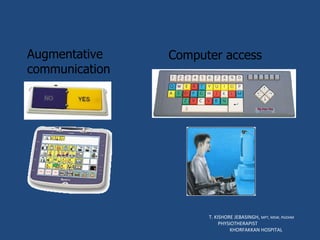
T. KISHORE JEBASINGH,  MPT, MSW, PGDHM  PHYSIOTHERAPIST  KHORFAKKAN HOSPITAL Augmentative communication Computer access
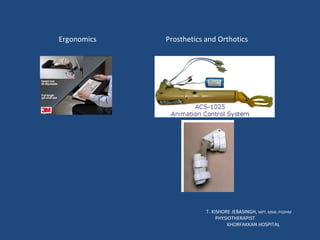
T. KISHORE JEBASINGH,  MPT, MSW, PGDHM  PHYSIOTHERAPIST  KHORFAKKAN HOSPITAL Ergonomics Prosthetics and Orthotics
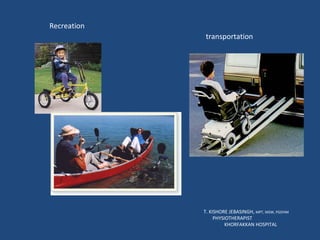
T. KISHORE JEBASINGH,  MPT, MSW, PGDHM  PHYSIOTHERAPIST  KHORFAKKAN HOSPITAL Recreation transportation
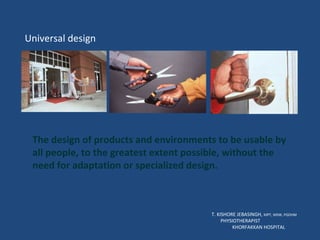
T. KISHORE JEBASINGH,  MPT, MSW, PGDHM  PHYSIOTHERAPIST  KHORFAKKAN HOSPITAL Universal design The design of products and environments to be usable by all people, to the greatest extent possible, without the need for adaptation or specialized design.
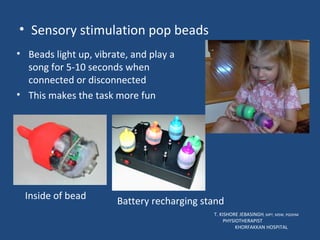
Sensory stimulation pop beads T. KISHORE JEBASINGH , MPT, MSW, PGDHM  PHYSIOTHERAPIST  KHORFAKKAN HOSPITAL Beads light up, vibrate, and play a song for 5-10 seconds when connected or disconnected This makes the task more fun Inside of bead Battery recharging stand
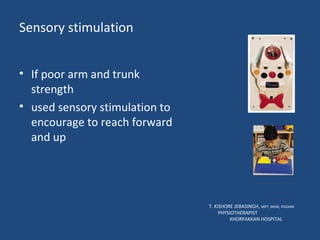
Sensory stimulation T. KISHORE JEBASINGH,  MPT, MSW, PGDHM  PHYSIOTHERAPIST  KHORFAKKAN HOSPITAL If poor arm and trunk strength used sensory stimulation to encourage to reach forward and up
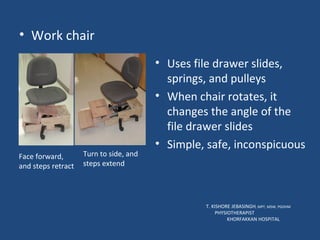
Work chair T. KISHORE JEBASINGH , MPT, MSW, PGDHM  PHYSIOTHERAPIST  KHORFAKKAN HOSPITAL Face forward, and steps retract Turn to side, and steps extend Uses file drawer slides, springs, and pulleys When chair rotates, it changes the angle of the file drawer slides Simple, safe, inconspicuous
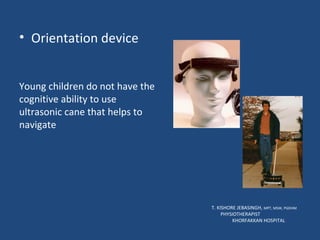
Orientation device T. KISHORE JEBASINGH,  MPT, MSW, PGDHM  PHYSIOTHERAPIST  KHORFAKKAN HOSPITAL Young children do not have the cognitive ability to use ultrasonic cane that helps to navigate

disability rehabilitation

  • 1.
    DISABILITY REHABILITATION KISHOREJEBASINGH.T MPT, MSW, PGDHM, DAcu PHYSIOTHERAPIST KHORFAKKAN HOSPITAL T. KISHORE JEBASINGH, MPT, MSW, PGDHM PHYSIOTHERAPIST KHORFAKKAN HOSPITAL
  • 2.
    Disability According tothe World Health Organization, a disability is… “ any restriction or lack (resulting from any impairment) of ability to perform an activity in the manner or within the range considered normal for a human being” T. KISHORE JEBASINGH, MPT, MSW, PGDHM PHYSIOTHERAPIST KHORFAKKAN HOSPITAL
  • 3.
    When most peoplethink of the word “disability” they immediately picture someone in a wheelchair. T. KISHORE JEBASINGH, MPT, MSW, PGDHM PHYSIOTHERAPIST KHORFAKKAN HOSPITAL
  • 4.
    Disease or DisorderT. KISHORE JEBASINGH, MPT, MSW, PGDHM PHYSIOTHERAPIST KHORFAKKAN HOSPITAL
  • 5.
    Impairment is anyloss or abnormality of psychological, physiological, or anatomical structure or function. Disabilities is any restriction or lack (resulting from an impairment) of ability to perform an activity in the manner or within the range considered normal for a human being. Handicaps is a disadvantage for a given individual, resulting from an impairment or a disability, that limits or prevents the fulfillment of a &quot;survival&quot; role that is normal (depending on age, sex, and social and cultural factors) for that individual. T. KISHORE JEBASINGH, MPT, MSW, PGDHM PHYSIOTHERAPIST KHORFAKKAN HOSPITAL
  • 6.
    REHABILITATION Rehabilitation isprocess to restore or helping an individual achieve the highest level of independence and quality of life possible physically, emotionally, socially and spiritually T. KISHORE JEBASINGH, MPT, MSW, PGDHM PHYSIOTHERAPIST KHORFAKKAN HOSPITAL
  • 7.
    REHABILITATION TEAM “COMING TOGETHER IS THE BEGINNING, STAYING TOGETHER IS PROGRESS, WORK TOGETHER IS SUCESS,.” – HENRY FORD T. KISHORE JEBASINGH , MPT, MSW, PGDHM PHYSIOTHERAPIST KHORFAKKAN HOSPITAL
  • 8.
    MULTIDISCIPLINARY TEAM FamilyRehabilitation physician Specialized physician Behavioral psychologist Nurse Nutritionist Physical therapist Occupational therapist Speech therapist Dental hygienist Social worker Orthotic and prosthetics Rehabilitation engineers T. KISHORE JEBASINGH, MPT, MSW, PGDHM PHYSIOTHERAPIST KHORFAKKAN HOSPITAL
  • 9.
    How does theteam work Assessment Planning, Referral and Follow-up The family centered approach T. KISHORE JEBASINGH, MPT, MSW, PGDHM PHYSIOTHERAPIST KHORFAKKAN HOSPITAL
  • 10.
    Assessment The interdisciplinaryteam provides comprehensive assessment of motor, nutritional, functional and eating habits Direct or videotaped observation Individual assessments by team members T. KISHORE JEBASINGH , MPT, MSW, PGDHM PHYSIOTHERAPIST KHORFAKKAN HOSPITAL
  • 11.
    Planning, Referral andFollow-up The team works with the family to make a written plan for intervention The team communicates closely with community professionals already involved Appropriate referrals are made at the family’s request Periodic follow-up is provided to address changing needs T. KISHORE JEBASINGH, MPT, MSW, PGDHM PHYSIOTHERAPIST KHORFAKKAN HOSPITAL
  • 12.
    The family centeredapproach The team works with the family to prioritize goals for the child The team works together to make consistent recommendations The team helps consolidate appointment to the family Team evaluations and planning are sensitive to the cultural background of the family T. KISHORE JEBASINGH, MPT, MSW, PGDHM PHYSIOTHERAPIST KHORFAKKAN HOSPITAL
  • 13.
    Working together, thefamily and team produce positive outcomes……. A recent study of community teams showed the following positive outcomes Appropriate growth Improved dietary intake decreased illness and hospitalization Improved feeding skills Improved health status T. KISHORE JEBASINGH, MPT, MSW, PGDHM PHYSIOTHERAPIST KHORFAKKAN HOSPITAL
  • 14.
    Occupational therapy serviceWorking directly in partnership with person to maintain or develop their occupational performance skills that are meaningful to them to lead productive adult lives Provide specialist assessments appropriate to learning disabilities Provide specialist intervention carried out in most appropriate disabilities T. KISHORE JEBASINGH, MPT, MSW, PGDHM PHYSIOTHERAPIST KHORFAKKAN HOSPITAL
  • 15.
    Physiotherapy services Physiotherapyoutcomes Which treatment and intervention strategies have been most successful Evaluate the long-term outcomes of early interventions including exercise, electro therapy splint and brace etc.. T. KISHORE JEBASINGH, MPT, MSW, PGDHM PHYSIOTHERAPIST KHORFAKKAN HOSPITAL
  • 16.
    Physiotherapy Treatments Electricalstimulation Strength training Motor control approaches Rood The Bobaths- NDT Brunnstrom PNF Carr & Shepherd T. KISHORE JEBASINGH, MPT, MSW, PGDHM PHYSIOTHERAPIST KHORFAKKAN HOSPITAL
  • 17.
    Need of oromotorrehabilitation A poor Oromotor activity leads to poor nutrition. Poor oral hygiene may leads to frequent (upper) respiratory tract infection Poor coordination between swallowing and breathing leads to excessive chocking Inadequate tongue movement biomechanically affects neck control Oral tonicity also influence facilitation techniques by other approaches Oromotor problem leads high social stigma T. KISHORE JEBASINGH, MPT, MSW, PGDHM PHYSIOTHERAPIST KHORFAKKAN HOSPITAL
  • 18.
    Oromotor problem inCP ? / ! One hundred children (76 boys and 24 girls) with cerebral palsy of mean age 2.5 years (range 1 to 9 years) and mean developmental age of 7.6 months (range 1 to 36 months) were included for the Indian study on Oromotor problem on 2001. The oral motor dysfunction was found in all cases and in each category. Spastic quadriplegic cerebral palsy and hypotonic patients had significantly poor feeding skill score (p < 0.001) - Gangil A. Indian Pediatr. 2001 Aug;38(8):839-46 T. KISHORE JEBASINGH, MPT, MSW, PGDHM PHYSIOTHERAPIST KHORFAKKAN HOSPITAL
  • 19.
    Common symptoms ofpoor Oromotor control Poor strength and coordination of the lips, tongue, and jaw. Poor speech clarity (&quot;muddled&quot; speech) Drooling Poor muscle tone in the face (muscles appear to be &quot;sagging&quot;) Difficulty with chewing and swallowing Voice changes - speech sounding hoarse, nasal, or soft Unable to perform coordinated oral movements T. KISHORE JEBASINGH, MPT, MSW, PGDHM PHYSIOTHERAPIST KHORFAKKAN HOSPITAL
  • 20.
    Developmental - Presenceof malocclusions Teething (Problems for effective lip sealing.) Nausea Foods Emotional stimuli Central nervous system and muscular disorders Mental retardation Oro-pharyngeal lesions Esophageal lesions Gastroesophageal reflux Drugs and chemicals (Antecedents of seizures and the use of antiseizure drugs Common cause for Oromotor problem - Drooling T. KISHORE JEBASINGH, MPT, MSW, PGDHM PHYSIOTHERAPIST KHORFAKKAN HOSPITAL
  • 21.
    Common treatment techniquesI Bite Chew activities Gauze methods
  • 22.
    Common treatment tools I Tongue Depressors NUK Brush
  • 23.
    Common treatment tools II Textured Grabber XT No name
  • 24.
    Selection of foodThicken the liquid by adding fruits or sugar with juice/milk will help to increase the oral alertness.   Strong acid base juice like orange will increase the saliva production.   Milk and milk based products tends to increase the mucos production, leads to difficult in swallowing respiration and swallowing. T. KISHORE JEBASINGH, MPT, MSW, PGDHM PHYSIOTHERAPIST KHORFAKKAN HOSPITAL
  • 25.
    Management of tootight cheek Facial moulding before meal time Shaking of face muscles Proper positioning (sitting -Head in neutral position and allow head extension) Applying the sustained compression on the top of the head towards the spine will facilitate the contraction of all musculature around neck and encourage the swallowing T. KISHORE JEBASINGH, MPT, MSW, PGDHM PHYSIOTHERAPIST KHORFAKKAN HOSPITAL
  • 26.
    Management of toofloppy cheek Face rubbing before meal Vibration of face muscles Encourage quick stretch of face muscles Cheek tapping before meal Can also try/use NUK brushing Infra dent finger tooth brush Gum massager T. KISHORE JEBASINGH, MPT, MSW, PGDHM PHYSIOTHERAPIST KHORFAKKAN HOSPITAL
  • 27.
    Management of tootight tongue Positioning Maroon spoon Beckman spoon NUK massager Avoid tongue over activity T. KISHORE JEBASINGH, MPT, MSW, PGDHM PHYSIOTHERAPIST KHORFAKKAN HOSPITAL
  • 28.
    Management of toofloppy tongue Iced food and liquid strong flavor Infra dent finger brush Gum massager Pressure with NUK massager Downward pressure on tongue by spoon T. KISHORE JEBASINGH, MPT, MSW, PGDHM PHYSIOTHERAPIST KHORFAKKAN HOSPITAL
  • 29.
    Working for tonguelateralization Bite chew activity Gauze bite activity Tooth brush NUK massager Hide food in cheek pouches T. KISHORE JEBASINGH, MPT, MSW, PGDHM PHYSIOTHERAPIST KHORFAKKAN HOSPITAL
  • 30.
    Working for tonguetip elevation Tongue cheek education Encourage jaw control Biting and chewing activities Tongue lateralization NUK, infra dent brushing T. KISHORE JEBASINGH, MPT, MSW, PGDHM PHYSIOTHERAPIST KHORFAKKAN HOSPITAL
  • 31.
    Working for spontaneousmouth opening Arousal techniques Elicit rooting reflex Assist mouth opening gentle downward pressure and traction to jaw Inhibit jaw clenching vibration to the mouth touch/pressure to gums T. KISHORE JEBASINGH, MPT, MSW, PGDHM PHYSIOTHERAPIST KHORFAKKAN HOSPITAL
  • 32.
    Electrical stimulation NMESactivates a greater number of motor units and produces higher firing rates of the active motor units than can be obtained volitionally T. KISHORE JEBASINGH, MPT, MSW, PGDHM PHYSIOTHERAPIST KHORFAKKAN HOSPITAL
  • 33.
    Exercise Muscles canadapt to training stimuli that target specific muscle architectural parameters, such as fascicle length and cross-sectional area T. KISHORE JEBASINGH, MPT, MSW, PGDHM PHYSIOTHERAPIST KHORFAKKAN HOSPITAL
  • 34.
    Exercise intervention EngagementEnjoyable Targeted Based on sound theories of motor learning Include sensory-perceptual components Require anticipatory planning Develop cognitive aspects of motor planning for action prediction Computerized music games ‘Magic’ hand tricks T. KISHORE JEBASINGH, MPT, MSW, PGDHM PHYSIOTHERAPIST KHORFAKKAN HOSPITAL
  • 35.
    T. KISHORE JEBASINGH, MPT, MSW, PGDHM PHYSIOTHERAPIST KHORFAKKAN HOSPITAL
  • 36.
    Motor control approachesFocus Treatment of paralysis, flaccidity & spasticity of muscles resulting from damage or disease to the central nervous system Treatment of movement disorder Each theorist has a somewhat different approach, assessment technique, and intervention strategies T. KISHORE JEBASINGH, MPT, MSW, PGDHM PHYSIOTHERAPIST KHORFAKKAN HOSPITAL
  • 37.
    Principles of roodApproach Sensory input is required for normalization of tone and evocation of desired muscular response Sensory motor control is developmentally based Movement is purposeful, engagement in activities is required to produce a normal response Repetition of movement is necessary for learning T. KISHORE JEBASINGH, MPT, MSW, PGDHM PHYSIOTHERAPIST KHORFAKKAN HOSPITAL
  • 38.
    Facilitation techniques Lightstroking Brushing Icing Joint compression Inhibition technique Joint approximation Neutral warmth Pressure on tendon insertion Slow rhythmical movement are used to inhibit unwanted movement T. KISHORE JEBASINGH, MPT, MSW, PGDHM PHYSIOTHERAPIST KHORFAKKAN HOSPITAL
  • 39.
    The Bobaths approachNDT focuses on the sensation of movement Reflex inhibiting postures are used to inhibit primitive reflexes Sensory stimulation is regulated with great care Weight bearing, placing and holding, tapping and joint compression are used Compensation using the noninvolved side T. KISHORE JEBASINGH, MPT, MSW, PGDHM PHYSIOTHERAPIST KHORFAKKAN HOSPITAL
  • 40.
    Brunnstrom approach Focuseson reflexes which provide the components of normal movement Patients are encouraged to think about the movement and to gain control Brunstrom also uses associated reactions and synergies Stages of recovery T. KISHORE JEBASINGH, MPT, MSW, PGDHM PHYSIOTHERAPIST KHORFAKKAN HOSPITAL
  • 41.
    PNF Uses diagonal& spiraling patterns movement Guides thinking about the sequence of normal development Uses two diagonal pattern patterns crossing the mid-line for each major body part, often incorporating verbal commands T. KISHORE JEBASINGH, MPT, MSW, PGDHM PHYSIOTHERAPIST KHORFAKKAN HOSPITAL
  • 42.
    Carr & Shepherd’smotor relearning program Uses dynamical systems model or motor control Emphasize interaction between performer and environment Acknowledge critical role of cognition in motor learning Movement pattern practiced in context of tasks, rather than exercises T. KISHORE JEBASINGH, MPT, MSW, PGDHM PHYSIOTHERAPIST KHORFAKKAN HOSPITAL
  • 43.
    Rehabilitation Engineering andAssistive Technology Rehabilitation engineering the application of science and technology to improving the quality of life of people with disabilities Assistive technology products, devices or equipment … that are used to maintain, increase or improve the functional capabilities of individuals with disabilities T. KISHORE JEBASINGH, MPT, MSW, PGDHM PHYSIOTHERAPIST KHORFAKKAN HOSPITAL
  • 44.
    T. KISHORE JEBASINGH, MPT, MSW, PGDHM PHYSIOTHERAPIST KHORFAKKAN HOSPITAL Augmentative communication Computer access
  • 45.
    T. KISHORE JEBASINGH, MPT, MSW, PGDHM PHYSIOTHERAPIST KHORFAKKAN HOSPITAL Ergonomics Prosthetics and Orthotics
  • 46.
    T. KISHORE JEBASINGH, MPT, MSW, PGDHM PHYSIOTHERAPIST KHORFAKKAN HOSPITAL Recreation transportation
  • 47.
    T. KISHORE JEBASINGH, MPT, MSW, PGDHM PHYSIOTHERAPIST KHORFAKKAN HOSPITAL Universal design The design of products and environments to be usable by all people, to the greatest extent possible, without the need for adaptation or specialized design.
  • 48.
    Sensory stimulation popbeads T. KISHORE JEBASINGH , MPT, MSW, PGDHM PHYSIOTHERAPIST KHORFAKKAN HOSPITAL Beads light up, vibrate, and play a song for 5-10 seconds when connected or disconnected This makes the task more fun Inside of bead Battery recharging stand
  • 49.
    Sensory stimulation T.KISHORE JEBASINGH, MPT, MSW, PGDHM PHYSIOTHERAPIST KHORFAKKAN HOSPITAL If poor arm and trunk strength used sensory stimulation to encourage to reach forward and up
  • 50.
    Work chair T.KISHORE JEBASINGH , MPT, MSW, PGDHM PHYSIOTHERAPIST KHORFAKKAN HOSPITAL Face forward, and steps retract Turn to side, and steps extend Uses file drawer slides, springs, and pulleys When chair rotates, it changes the angle of the file drawer slides Simple, safe, inconspicuous
  • 51.
    Orientation device T.KISHORE JEBASINGH, MPT, MSW, PGDHM PHYSIOTHERAPIST KHORFAKKAN HOSPITAL Young children do not have the cognitive ability to use ultrasonic cane that helps to navigate