
REHABILITATION TEAM
UNIT -VII
By Mary Teena
MSc Nursing II Year
Learning Objectives
• At the end of the topic the students will be able,
• To introduce the topic.
• To define the Rehabilitation team.
• To list down the goal of Rehabilitation team.
• To enlist the objectives of Rehabilitation.
• To explain the types of rehabilitation team.
• To list down the team members.
• To understand the functions or description of team members.
• To discuss the traits and qualities of Health Worker.
• To summarize the topic.
• To conclude the topic.
Terminology
• Rehabilitation: It is a restoration of ability to function.
• Team: A group of peoples come together or coordinate to achieve a
common goal.
• Rehabilitation team: The individuals involved in establishing a plan
and goals for the achievement of a patient’s maximum potential.
• RCI- Rehabilitation council of India.
• 1986- the rehabilitation council of India was set up.
• 1992- the RCI act was enacted by parliament.
• 2000- The RCI act was amended.
Introduction of Rehabilitation
• Rehabilitation services are “interventions designed to optimise
functioning and reduce disability in individuals with health
conditions in interaction with their environment”.
• These services have the potential to improve an individual’s
functioning and their ability to successfully and optimally
interact with their environment.
• A physiatrist often directs the team. Other specialists also play
important roles in treatment and education. Which team
members take part depends on many factors.
• These include the patient's need, facility resources, and
insurance coverage for services.
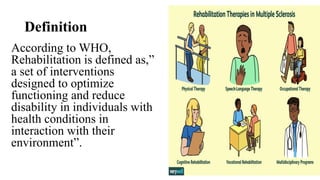
Definition
According to WHO,
Rehabilitation is defined as,”
a set of interventions
designed to optimize
functioning and reduce
disability in individuals with
health conditions in
interaction with their
environment”.
Goal
• Rehabilitation team management as a
tool to improve the quality of the
rehabilitation process.
• In general, goals must be relevant,
expressing what should be accomplished,
positively defined, put in behavioral
terms, easily and clearly understood by
all the team members, attainable, allow
planning etc.
• They must be measurable.
Objectives
Rehabilitation and Therapy Objectives
1. Adapt to life with disability beyond the rehab process.
2. Address swallowing, feeding and nutritional needs.
3. Care for themselves with tasks such as feeding, bathing and
dressing.
4. Improve mobility (e.g., the ability to get out of bed and walk)
5. Overcome balance and coordination impairments.
Types of Rehabilitation Team
•The Rehabilitation Council of India (RCI) was set as a
registered society in 1986.
•The mandate given to RCI is to regulate and monitor
services given to persons with disability to standardize
syllabi and to maintain a Central Rehabilitation Register of
all qualified professionals and personnel working in the
field of Rehabilitation and Special Education.
Cont…
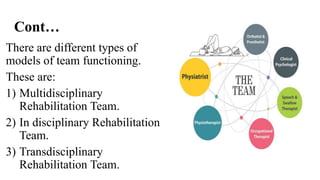
There are different types of
models of team functioning.
These are:
1) Multidisciplinary
Rehabilitation Team.
2) In disciplinary Rehabilitation
Team.
3) Transdisciplinary
Rehabilitation Team.
Cont…
• Multidisciplinary Rehabilitation Team: It is characterized by
discipline-specific goals, clear boundaries between disciplines and
outcomes that are the sum of each disciplines efforts.
• Interdisciplinary Rehabilitation Team: Collaborates to identify
individual goals and is characterized by a combination of expanded
problem solving beyond discipline boundaries and discipline specific
work towards goal attainment.
• Transdisciplinary Rehabilitation Team: characterized by the
blurring of boundaries between discipline as well as by cross training
and flexibility to minimize duplication of effort towards individual
goal attainment .
Team primary consist of
• Patient and family. They are the most important members of the rehab
team.
• Psychiatrist: A medical doctor who evaluates and treats rehab patients.
The psychiatrist is often the team leader. They are responsible for
coordinating patient care services with other team members. A psychiatrist
focuses on restoring function to people with disabilities.
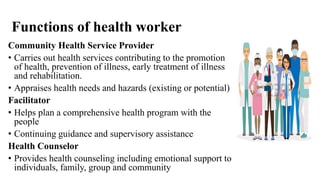
Functions of health worker
Community Health Service Provider
• Carries out health services contributing to the promotion
of health, prevention of illness, early treatment of illness
and rehabilitation.
• Appraises health needs and hazards (existing or potential)
Facilitator
• Helps plan a comprehensive health program with the
people
• Continuing guidance and supervisory assistance
Health Counselor
• Provides health counseling including emotional support to
individuals, family, group and community
Traits and Qualities of a Health Worker
Efficient
• Plans with the people, organizes, conducts, directs health education
activities according to the needs of the community.
• Knowledgeable about everything relevant to his practice; has the necessary
skills expected of him.
Good listener
• Hears what’s being said and what’s behind the words.
• Always available for the participant to voice out their sentiments and
needs.
Keen observer
• Keep an eye on the proceedings, process and participants’ behavior.
Co-researcher
• Provides the community with stimulation necessary for a wider or more
complex study or problems.
• Enforce community to do prompt and intelligent reporting of epidemiologic
investigation of disease.
• Suggest areas hat need research (by creating dissatisfaction).
• Participate in planning for the study in formulating procedures.
• Assist in the collection of data.
• Helps interpret findings collectively.
• Act on the result of the research.
Primary team members
The rehab team may include these members:
• Patient and family. They are the most important members of the rehab team.
• Physiatrist
• Rehab nurse
• Clinical social worker
• Physical therapist
• Occupational therapist
• Speech/language therapist
• Psychiatrist,
• Psychologist, or
• Neuropsychologist.
• Vocational rehabilitation counsellor
• Social worker
• Recreational therapist
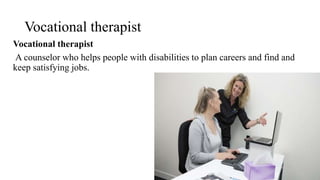
Vocational therapist
A counselor who helps people with disabilities to plan careers and find and
keep satisfying jobs.
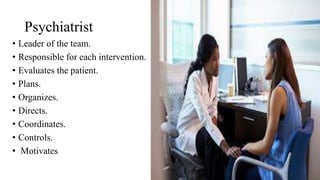
Psychiatrist
• Leader of the team.
• Responsible for each intervention.
• Evaluates the patient.
• Plans.
• Organizes.
• Directs.
• Coordinates.
• Controls.
• Motivates
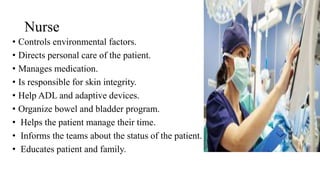
Nurse
• Controls environmental factors.
• Directs personal care of the patient.
• Manages medication.
• Is responsible for skin integrity.
• Help ADL and adaptive devices.
• Organize bowel and bladder program.
• Helps the patient manage their time.
• Informs the teams about the status of the patient.
• Educates patient and family.
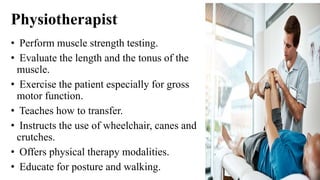
Physiotherapist
• Perform muscle strength testing.
• Evaluate the length and the tonus of the
muscle.
• Exercise the patient especially for gross
motor function.
• Teaches how to transfer.
• Instructs the use of wheelchair, canes and
crutches.
• Offers physical therapy modalities.
• Educate for posture and walking.
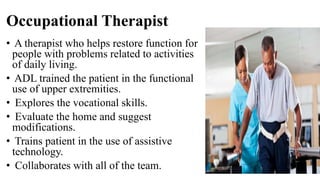
Occupational Therapist
• A therapist who helps restore function for
people with problems related to activities
of daily living.
• ADL trained the patient in the functional
use of upper extremities.
• Explores the vocational skills.
• Evaluate the home and suggest
modifications.
• Trains patient in the use of assistive
technology.
• Collaborates with all of the team.
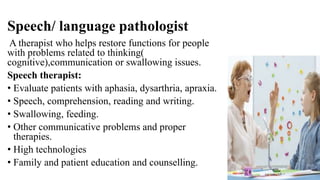
Speech/ language pathologist
A therapist who helps restore functions for people
with problems related to thinking(
cognitive),communication or swallowing issues.
Speech therapist:
• Evaluate patients with aphasia, dysarthria, apraxia.
• Speech, comprehension, reading and writing.
• Swallowing, feeding.
• Other communicative problems and proper
therapies.
• High technologies
• Family and patient education and counselling.
Psychologist
• Evaluate the psychological Status of
the patients.
•Tests intelligence , memory and
perceptual functioning.
• Incorporates the test results into the
care plan.
• Educates family and patient.
• Counselling of the family.
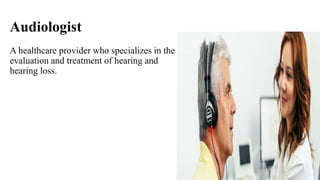
Audiologist
A healthcare provider who specializes in the
evaluation and treatment of hearing and
hearing loss.
Others
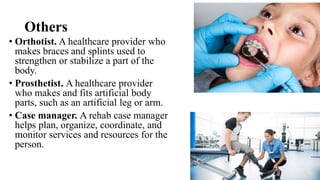
• Orthotist. A healthcare provider who
makes braces and splints used to
strengthen or stabilize a part of the
body.
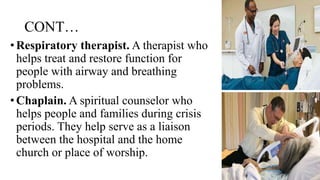
• Prosthetist. A healthcare provider
who makes and fits artificial body
parts, such as an artificial leg or arm.
• Case manager. A rehab case manager
helps plan, organize, coordinate, and
monitor services and resources for the
person.
CONT…
•Respiratory therapist. A therapist who
helps treat and restore function for
people with airway and breathing
problems.
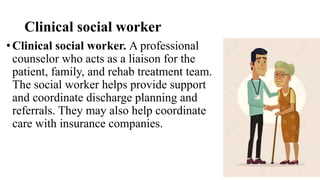
•Chaplain. A spiritual counselor who
helps people and families during crisis
periods. They help serve as a liaison
between the hospital and the home
church or place of worship.
Clinical social worker
• Clinical social worker. A professional
counselor who acts as a liaison for the
patient, family, and rehab treatment team.
The social worker helps provide support
and coordinate discharge planning and
referrals. They may also help coordinate
care with insurance companies.
Social worker
• Evaluate patients (lifestyle, family , finances, employment, environmental
factors).
• Maintains a continuing relationship with the patient and family.
• Co ordinates funding resources.
• Provide assistance in locating alternative living situations.
• Assess vocational barriers.
• Provide emotional support in stressful situation.
• Facilitates discharge planning.
Vocational counsellor
• Assist in developing and attaining realistic vocational goals.
• Evaluate vocational interest, aptitudes, and skills.
• Counsels patients in the work environment.
• Organizes activities to develop employer – employee relationship
behavior.
• Acts as liaison between the patient and agencies that provide training or
job placement services.
• Provide counselling, education and support to potential employers (job
analysis or worksite.)
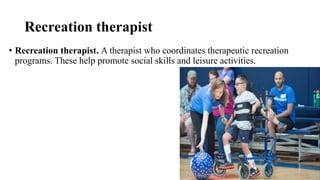
Recreation therapist
• Recreation therapist. A therapist who coordinates therapeutic recreation
programs. These help promote social skills and leisure activities.
Summary
We discussed about rehabilitation team and its importance
in health care services for society those who recovery from
chronic illness, disability etc . The content includes
introduction, meaning, list of team and its description etc .
Conclusion
I hope you all understand the rehabilitation team
and its works
References:
• K.Park Text Book Of Preventive And Social Medicine , Jaypee
Brothers, New Delhi Page No. 55,355
• Kumari Neelam, Community health nursing, 1st edition, P.V.
books publication,Jalandhar city India,2011.pg no-
• Basavanthapa BT, Community health nursing, Jaypee
brother,Ansari Road Daryagenz,New Delhi, 1st edition,2006. pg
no-
• Swarekar Keshav,Community health nursing.N.R.Brother.M.Y.
Hospital Road Indore.1st edition,2004.pg no-328-334.
• Bijayalaxmi Dash, A comprehensive Textbook of community
health nursing, page no- 702-707.
Journals:
• Physio-pedia.com.

REHABILITATION TEAM.pptx

  • 1.
    REHABILITATION TEAM UNIT -VII ByMary Teena MSc Nursing II Year
  • 2.
    Learning Objectives • Atthe end of the topic the students will be able, • To introduce the topic. • To define the Rehabilitation team. • To list down the goal of Rehabilitation team. • To enlist the objectives of Rehabilitation. • To explain the types of rehabilitation team. • To list down the team members. • To understand the functions or description of team members. • To discuss the traits and qualities of Health Worker. • To summarize the topic. • To conclude the topic.
  • 3.
    Terminology • Rehabilitation: Itis a restoration of ability to function. • Team: A group of peoples come together or coordinate to achieve a common goal. • Rehabilitation team: The individuals involved in establishing a plan and goals for the achievement of a patient’s maximum potential. • RCI- Rehabilitation council of India. • 1986- the rehabilitation council of India was set up. • 1992- the RCI act was enacted by parliament. • 2000- The RCI act was amended.
  • 4.
    Introduction of Rehabilitation •Rehabilitation services are “interventions designed to optimise functioning and reduce disability in individuals with health conditions in interaction with their environment”. • These services have the potential to improve an individual’s functioning and their ability to successfully and optimally interact with their environment. • A physiatrist often directs the team. Other specialists also play important roles in treatment and education. Which team members take part depends on many factors. • These include the patient's need, facility resources, and insurance coverage for services.
  • 5.
    Definition According to WHO, Rehabilitationis defined as,” a set of interventions designed to optimize functioning and reduce disability in individuals with health conditions in interaction with their environment”.
  • 6.
    Goal • Rehabilitation teammanagement as a tool to improve the quality of the rehabilitation process. • In general, goals must be relevant, expressing what should be accomplished, positively defined, put in behavioral terms, easily and clearly understood by all the team members, attainable, allow planning etc. • They must be measurable.
  • 7.
    Objectives Rehabilitation and TherapyObjectives 1. Adapt to life with disability beyond the rehab process. 2. Address swallowing, feeding and nutritional needs. 3. Care for themselves with tasks such as feeding, bathing and dressing. 4. Improve mobility (e.g., the ability to get out of bed and walk) 5. Overcome balance and coordination impairments.
  • 8.
    Types of RehabilitationTeam •The Rehabilitation Council of India (RCI) was set as a registered society in 1986. •The mandate given to RCI is to regulate and monitor services given to persons with disability to standardize syllabi and to maintain a Central Rehabilitation Register of all qualified professionals and personnel working in the field of Rehabilitation and Special Education.
  • 9.
    Cont… There are differenttypes of models of team functioning. These are: 1) Multidisciplinary Rehabilitation Team. 2) In disciplinary Rehabilitation Team. 3) Transdisciplinary Rehabilitation Team.
  • 10.
    Cont… • Multidisciplinary RehabilitationTeam: It is characterized by discipline-specific goals, clear boundaries between disciplines and outcomes that are the sum of each disciplines efforts. • Interdisciplinary Rehabilitation Team: Collaborates to identify individual goals and is characterized by a combination of expanded problem solving beyond discipline boundaries and discipline specific work towards goal attainment. • Transdisciplinary Rehabilitation Team: characterized by the blurring of boundaries between discipline as well as by cross training and flexibility to minimize duplication of effort towards individual goal attainment .
  • 11.
    Team primary consistof • Patient and family. They are the most important members of the rehab team. • Psychiatrist: A medical doctor who evaluates and treats rehab patients. The psychiatrist is often the team leader. They are responsible for coordinating patient care services with other team members. A psychiatrist focuses on restoring function to people with disabilities.
  • 12.
    Functions of healthworker Community Health Service Provider • Carries out health services contributing to the promotion of health, prevention of illness, early treatment of illness and rehabilitation. • Appraises health needs and hazards (existing or potential) Facilitator • Helps plan a comprehensive health program with the people • Continuing guidance and supervisory assistance Health Counselor • Provides health counseling including emotional support to individuals, family, group and community
  • 13.
    Traits and Qualitiesof a Health Worker Efficient • Plans with the people, organizes, conducts, directs health education activities according to the needs of the community. • Knowledgeable about everything relevant to his practice; has the necessary skills expected of him. Good listener • Hears what’s being said and what’s behind the words. • Always available for the participant to voice out their sentiments and needs. Keen observer • Keep an eye on the proceedings, process and participants’ behavior.
  • 14.
    Co-researcher • Provides thecommunity with stimulation necessary for a wider or more complex study or problems. • Enforce community to do prompt and intelligent reporting of epidemiologic investigation of disease. • Suggest areas hat need research (by creating dissatisfaction). • Participate in planning for the study in formulating procedures. • Assist in the collection of data. • Helps interpret findings collectively. • Act on the result of the research.
  • 15.
    Primary team members Therehab team may include these members: • Patient and family. They are the most important members of the rehab team. • Physiatrist • Rehab nurse • Clinical social worker • Physical therapist • Occupational therapist • Speech/language therapist • Psychiatrist, • Psychologist, or • Neuropsychologist.
  • 16.
    • Vocational rehabilitationcounsellor • Social worker • Recreational therapist
  • 17.
    Vocational therapist Vocational therapist Acounselor who helps people with disabilities to plan careers and find and keep satisfying jobs.
  • 18.
    Psychiatrist • Leader ofthe team. • Responsible for each intervention. • Evaluates the patient. • Plans. • Organizes. • Directs. • Coordinates. • Controls. • Motivates
  • 19.
    Nurse • Controls environmentalfactors. • Directs personal care of the patient. • Manages medication. • Is responsible for skin integrity. • Help ADL and adaptive devices. • Organize bowel and bladder program. • Helps the patient manage their time. • Informs the teams about the status of the patient. • Educates patient and family.
  • 20.
    Physiotherapist • Perform musclestrength testing. • Evaluate the length and the tonus of the muscle. • Exercise the patient especially for gross motor function. • Teaches how to transfer. • Instructs the use of wheelchair, canes and crutches. • Offers physical therapy modalities. • Educate for posture and walking.
  • 21.
    Occupational Therapist • Atherapist who helps restore function for people with problems related to activities of daily living. • ADL trained the patient in the functional use of upper extremities. • Explores the vocational skills. • Evaluate the home and suggest modifications. • Trains patient in the use of assistive technology. • Collaborates with all of the team.
  • 22.
    Speech/ language pathologist Atherapist who helps restore functions for people with problems related to thinking( cognitive),communication or swallowing issues. Speech therapist: • Evaluate patients with aphasia, dysarthria, apraxia. • Speech, comprehension, reading and writing. • Swallowing, feeding. • Other communicative problems and proper therapies. • High technologies • Family and patient education and counselling.
  • 23.
    Psychologist • Evaluate thepsychological Status of the patients. •Tests intelligence , memory and perceptual functioning. • Incorporates the test results into the care plan. • Educates family and patient. • Counselling of the family.
  • 24.
    Audiologist A healthcare providerwho specializes in the evaluation and treatment of hearing and hearing loss.
  • 25.
    Others • Orthotist. Ahealthcare provider who makes braces and splints used to strengthen or stabilize a part of the body. • Prosthetist. A healthcare provider who makes and fits artificial body parts, such as an artificial leg or arm. • Case manager. A rehab case manager helps plan, organize, coordinate, and monitor services and resources for the person.
  • 26.
    CONT… •Respiratory therapist. Atherapist who helps treat and restore function for people with airway and breathing problems. •Chaplain. A spiritual counselor who helps people and families during crisis periods. They help serve as a liaison between the hospital and the home church or place of worship.
  • 27.
    Clinical social worker •Clinical social worker. A professional counselor who acts as a liaison for the patient, family, and rehab treatment team. The social worker helps provide support and coordinate discharge planning and referrals. They may also help coordinate care with insurance companies.
  • 28.
    Social worker • Evaluatepatients (lifestyle, family , finances, employment, environmental factors). • Maintains a continuing relationship with the patient and family. • Co ordinates funding resources. • Provide assistance in locating alternative living situations. • Assess vocational barriers. • Provide emotional support in stressful situation. • Facilitates discharge planning.
  • 29.
    Vocational counsellor • Assistin developing and attaining realistic vocational goals. • Evaluate vocational interest, aptitudes, and skills. • Counsels patients in the work environment. • Organizes activities to develop employer – employee relationship behavior. • Acts as liaison between the patient and agencies that provide training or job placement services. • Provide counselling, education and support to potential employers (job analysis or worksite.)
  • 30.
    Recreation therapist • Recreationtherapist. A therapist who coordinates therapeutic recreation programs. These help promote social skills and leisure activities.
  • 31.
    Summary We discussed aboutrehabilitation team and its importance in health care services for society those who recovery from chronic illness, disability etc . The content includes introduction, meaning, list of team and its description etc .
  • 32.
    Conclusion I hope youall understand the rehabilitation team and its works
  • 33.
    References: • K.Park TextBook Of Preventive And Social Medicine , Jaypee Brothers, New Delhi Page No. 55,355 • Kumari Neelam, Community health nursing, 1st edition, P.V. books publication,Jalandhar city India,2011.pg no- • Basavanthapa BT, Community health nursing, Jaypee brother,Ansari Road Daryagenz,New Delhi, 1st edition,2006. pg no- • Swarekar Keshav,Community health nursing.N.R.Brother.M.Y. Hospital Road Indore.1st edition,2004.pg no-328-334. • Bijayalaxmi Dash, A comprehensive Textbook of community health nursing, page no- 702-707.
  • 34.