In the name of Allah, the most beneficent, the most merciful.
UPLOADED BY  [email_address] How Insurance Companies Work ? Sami Ullah    ID#9706 Maaz  ID# 9702   Shah Junaid  ID#9722 Naveed Afzal  ID#9713   Imran    ID# 9714 Qazi Fazli Rabi ID#4110  By
Course out lines  from I to B What is insurance Fundamental of insurance  Principles of insurance  Advantages of insurance
Insurance  by  Definition It is a contract or agreement b/t tow parties by which one of them (called insurer) agree to indemnify the other (called insured) against a lost which may occur to  the insured on the happening some event.
Common Terminologies used  in Insurance An insurer  is a company, selling the insurance. An insured  is the person or entity buying the insurance policy.  Premium  is the price paid by the customer to the insurance company to purchase the contract . Indemnity  is the total amount that the insurance company has to pay on behalf of the claim of insured.
What insurance company Do? Collect  premium (Least premium per year 20,000) Funds (premium) are invested in diversified portfolio Company provides the loss suffered by insured person. The insurance company collects its premiums from all clients, invests that money in extremely safe investments, such as government bonds, and keeps capital on hand to pay claims made by its clients.
To whom the benefit will be paid Accumulated cash value along with applicable benefit will be paid to the person nominated by the policyholder.
CAREER PATH IN AN  INSURANCE COMPANY by  Maaz ID:9702
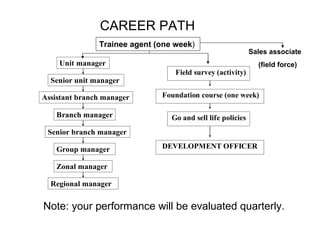
  CAREER PATH  Note: your performance will be evaluated quarterly. Trainee agent (one week ) Sales associate (field force)
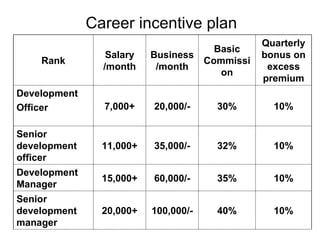
Career incentive plan 20,000+ 15,000+ 11,000+ 7,000+ Salary /month 10% 30% 20,000/- Development Officer 10% 40% 100,000/- Senior development manager 10% 35% 60,000/- Development Manager 10% 32% 35,000/- Senior development officer Quarterly bonus on excess premium Basic Commission Business /month Rank
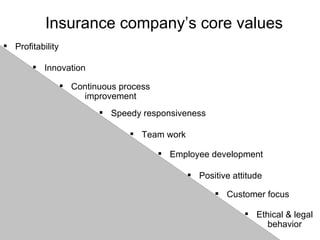
Ethical & legal behavior Customer focus Positive attitude Employee development Team work Speedy responsiveness Innovation Profitability Continuous process improvement Insurance company’s core values
Principles of insurance by  Shah Junaid  ID:9722
Principles of insurance Principle of  Indemnity Principle of  Insurable interest Principle of  Utmost good faith Principle of  Contribution Principle of  Subrogation Principle of  Proximate cause
1. Principle of Indemnity This means the insured cannot make a profit from an insurance claim. For example if you have a four year motorcar and it is damaged, the insurance company will only give you the current value not the value when it was new.
2.  Principle of  insurable Interest To insure anything the Insured must have an insurable interest in the subject matter of insurance, i.e. he/she must benefit by its safety or be biased   by its loss. For example you can insure your own home , but not your friend’s home. In the same way you can take out Assurance on your wife’s life, but not that of your neighbour.
3. Principle of utmost good faith The insured and the insurer are bound by a good faith,honesty and fairness. For examples if the loss occurs, they will check the facts and if in-accurate details have been given they will not pay damages to incurred.
4. Principle of Contribution One can insurance the same propriety item with more then one insurance company, the insured can’t demand more then total loss from all companies put together In sample words there is no advantage insuring the same risk with two companies.
5. Principle of Subrogation Insurance company has the legal right to claim compensation from any other party that caused the accident. For example  Vehicle A hits B, which as a result hits C. C will claim of B’s insurance company, but that insurance company has the right to claim from A’s insurance company, as it was A that really caused the damage to C.
6. Principle of Proximate cause The damage to the prosperity can takes place due to many causes the insurer company will look first cause of damage or the original cause of damage.
Major Types of Insurance by  Naveed Afzal ID:9713
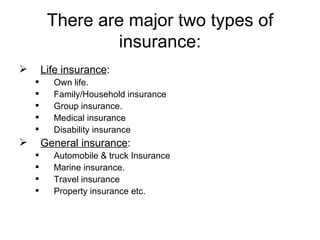
There are major two types of insurance: Life insurance :  Own life. Family/Household insurance  Group insurance. Medical insurance Disability insurance  General insurance : Automobile & truck Insurance Marine insurance. Travel insurance Property insurance etc.
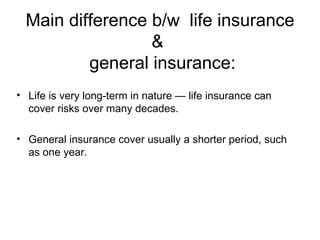
Main difference b/w  life insurance &   general insurance: Life is very long-term in nature — life insurance can cover risks over many decades.  General insurance cover usually a shorter period, such as one year.
(1) Life Insurance On periodic basis premium is paid by insured. If the insured die within that time period, The nominee get a specified amount of money. There are two types of life insurance.
(a)  Term Life Insurance The most basic one. Least expensive.  Open ended. For example: You buy coverage for a certain period of time, such as 10, 15, 20 or 30 years. If you die before the term is over, your nominee gets the benefit. If you live beyond the term, the policy expires. 
(b)  Whole Life Insurance This type of policy never expires.  As long as premiums are paid, it remains in force. Premiums are usually based on your age. You'll pay the same amount of premium for the rest of your life. (Start young and the less expensive the premiums will be)
Steps for Life insurance by  Imran ID:9714 Feedback@ [email_address]
  Step   (I)  Medical Exam Medical exam include:  Age, height, weight, nicotine use and other health factors, such as any history of high blood pressure or depression.  Your health status will determine what rate class category you fit in.
Step  (II)  Rating Class It will determine the price you pay in premiums. As you can guess, a smoker will pay a higher premium than a non-smoker. Similarly an over-weight person will pay more than a thin person. Buying insurance when you are younger, healthier and a non-smoker, you will save your money in many ways.
Step   (III)  Filing a Claim In step (iv) there are four steps in filing a claim. 1. Obtain several copies of the death certificate. 2. Contact your insurance agent. 3. Submit a certified copy of the death certificate (or any  alternative in extraordinary circumstances)  4. Once a life insurance claim is submitted, wait for further inquiries.
Step   (iv)  Settlement Options In some cases there are four settlement options: Critical illness  benefits:  Provide a cash sum upon diagnosis or occurrence of one of 18 critical illnesses, Like: Heart attack, cancer, blindness, deafness, loss of speech, loss of limb, kidney failure, coma etc. Family   income   benefit :  In case of death of individual during the term, monthly income of 01% to 02% of basic sum assured is paid for remaining term. Accidental death and disability : Additional  benefits are paid on accidental death and disability.  Hospital cash benefits:   A daily benefit is paid if you are hospitalized. The benefit is doubled in case of critical illness. In case of  ICU additional 50% cash is paid.  Spouse and children can also be covered under this benefit.
General insurance by  Qazi Fazal Rabi ID:4110
General  insurance It provides protection against risks to property.  It include specialized forms of insurance such as:   Home insurance.  Automobile insurance Marine insurance Travel insurance etc.
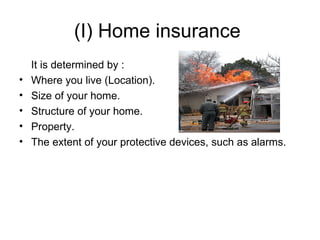
(I) Home insurance  It is determined by : Where you live (Location). Size of your home.  Structure of your home.  Property. The extent of your protective devices, such as alarms.
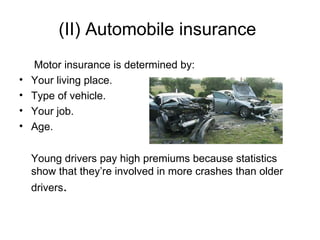
(II) Automobile insurance Motor insurance is determined by: Your living place. Type of vehicle.  Your job.  Age.  Young drivers pay high premiums because statistics show that they’re involved in more crashes than older drivers .
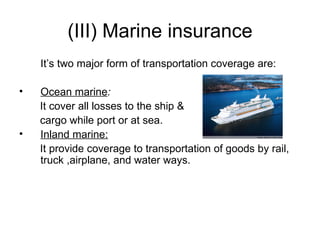
(III)   Marine insurance It’s two major form of transportation coverage are: Ocean marine : It cover all losses to the ship &  cargo while port or at sea. Inland marine:   It provide coverage to transportation of goods by rail, truck ,airplane, and water ways.
(IV)   Travel insurance For limited time of period.  It include personal accident,  medical expenses, loss of Luggage.  The amount of premium is determined  by tour area and time duration. Annual trivial policy is also available.
  We can say insurance:   ---Secure the community.   ---Promote trade. ---Create jobs.
References Personal visit to  efu & NJI .  Introduction to Business  by M.Saeed Nasir. Wikipedia.org eHow.com Research project on “HR policy of NJI regarding motivation”  by M. Ismail & Khalid Usman, BBA (Hons),2004-08,Iqra university Peshawar. Research report on “individual life insurance brands, a perspective study”  by Syed Affan Ahmad & M. Zarak BBA (Hons),2005-09,Iqra university Peshawar.

How Insurance Company works

  • 1.
    In the nameof Allah, the most beneficent, the most merciful.
  • 2.
    UPLOADED BY [email_address] How Insurance Companies Work ? Sami Ullah ID#9706 Maaz ID# 9702 Shah Junaid ID#9722 Naveed Afzal ID#9713 Imran ID# 9714 Qazi Fazli Rabi ID#4110 By
  • 3.
    Course out lines from I to B What is insurance Fundamental of insurance Principles of insurance Advantages of insurance
  • 4.
    Insurance by Definition It is a contract or agreement b/t tow parties by which one of them (called insurer) agree to indemnify the other (called insured) against a lost which may occur to the insured on the happening some event.
  • 5.
    Common Terminologies used in Insurance An insurer is a company, selling the insurance. An insured is the person or entity buying the insurance policy. Premium is the price paid by the customer to the insurance company to purchase the contract . Indemnity is the total amount that the insurance company has to pay on behalf of the claim of insured.
  • 6.
    What insurance companyDo? Collect premium (Least premium per year 20,000) Funds (premium) are invested in diversified portfolio Company provides the loss suffered by insured person. The insurance company collects its premiums from all clients, invests that money in extremely safe investments, such as government bonds, and keeps capital on hand to pay claims made by its clients.
  • 7.
    To whom thebenefit will be paid Accumulated cash value along with applicable benefit will be paid to the person nominated by the policyholder.
  • 8.
    CAREER PATH INAN INSURANCE COMPANY by Maaz ID:9702
  • 9.
    CAREERPATH Note: your performance will be evaluated quarterly. Trainee agent (one week ) Sales associate (field force)
  • 10.
    Career incentive plan20,000+ 15,000+ 11,000+ 7,000+ Salary /month 10% 30% 20,000/- Development Officer 10% 40% 100,000/- Senior development manager 10% 35% 60,000/- Development Manager 10% 32% 35,000/- Senior development officer Quarterly bonus on excess premium Basic Commission Business /month Rank
  • 11.
    Ethical & legalbehavior Customer focus Positive attitude Employee development Team work Speedy responsiveness Innovation Profitability Continuous process improvement Insurance company’s core values
  • 12.
    Principles of insuranceby Shah Junaid ID:9722
  • 13.
    Principles of insurancePrinciple of Indemnity Principle of Insurable interest Principle of Utmost good faith Principle of Contribution Principle of Subrogation Principle of Proximate cause
  • 14.
    1. Principle ofIndemnity This means the insured cannot make a profit from an insurance claim. For example if you have a four year motorcar and it is damaged, the insurance company will only give you the current value not the value when it was new.
  • 15.
    2. Principleof insurable Interest To insure anything the Insured must have an insurable interest in the subject matter of insurance, i.e. he/she must benefit by its safety or be biased by its loss. For example you can insure your own home , but not your friend’s home. In the same way you can take out Assurance on your wife’s life, but not that of your neighbour.
  • 16.
    3. Principle ofutmost good faith The insured and the insurer are bound by a good faith,honesty and fairness. For examples if the loss occurs, they will check the facts and if in-accurate details have been given they will not pay damages to incurred.
  • 17.
    4. Principle ofContribution One can insurance the same propriety item with more then one insurance company, the insured can’t demand more then total loss from all companies put together In sample words there is no advantage insuring the same risk with two companies.
  • 18.
    5. Principle ofSubrogation Insurance company has the legal right to claim compensation from any other party that caused the accident. For example Vehicle A hits B, which as a result hits C. C will claim of B’s insurance company, but that insurance company has the right to claim from A’s insurance company, as it was A that really caused the damage to C.
  • 19.
    6. Principle ofProximate cause The damage to the prosperity can takes place due to many causes the insurer company will look first cause of damage or the original cause of damage.
  • 20.
    Major Types ofInsurance by Naveed Afzal ID:9713
  • 21.
    There are majortwo types of insurance: Life insurance : Own life. Family/Household insurance Group insurance. Medical insurance Disability insurance General insurance : Automobile & truck Insurance Marine insurance. Travel insurance Property insurance etc.
  • 22.
    Main difference b/w life insurance & general insurance: Life is very long-term in nature — life insurance can cover risks over many decades. General insurance cover usually a shorter period, such as one year.
  • 23.
    (1) Life InsuranceOn periodic basis premium is paid by insured. If the insured die within that time period, The nominee get a specified amount of money. There are two types of life insurance.
  • 24.
    (a) TermLife Insurance The most basic one. Least expensive. Open ended. For example: You buy coverage for a certain period of time, such as 10, 15, 20 or 30 years. If you die before the term is over, your nominee gets the benefit. If you live beyond the term, the policy expires. 
  • 25.
    (b) WholeLife Insurance This type of policy never expires. As long as premiums are paid, it remains in force. Premiums are usually based on your age. You'll pay the same amount of premium for the rest of your life. (Start young and the less expensive the premiums will be)
  • 26.
    Steps for Lifeinsurance by Imran ID:9714 Feedback@ [email_address]
  • 27.
    Step (I) Medical Exam Medical exam include: Age, height, weight, nicotine use and other health factors, such as any history of high blood pressure or depression. Your health status will determine what rate class category you fit in.
  • 28.
    Step (II) Rating Class It will determine the price you pay in premiums. As you can guess, a smoker will pay a higher premium than a non-smoker. Similarly an over-weight person will pay more than a thin person. Buying insurance when you are younger, healthier and a non-smoker, you will save your money in many ways.
  • 29.
    Step (III) Filing a Claim In step (iv) there are four steps in filing a claim. 1. Obtain several copies of the death certificate. 2. Contact your insurance agent. 3. Submit a certified copy of the death certificate (or any alternative in extraordinary circumstances) 4. Once a life insurance claim is submitted, wait for further inquiries.
  • 30.
    Step (iv) Settlement Options In some cases there are four settlement options: Critical illness benefits: Provide a cash sum upon diagnosis or occurrence of one of 18 critical illnesses, Like: Heart attack, cancer, blindness, deafness, loss of speech, loss of limb, kidney failure, coma etc. Family income benefit : In case of death of individual during the term, monthly income of 01% to 02% of basic sum assured is paid for remaining term. Accidental death and disability : Additional benefits are paid on accidental death and disability. Hospital cash benefits: A daily benefit is paid if you are hospitalized. The benefit is doubled in case of critical illness. In case of ICU additional 50% cash is paid. Spouse and children can also be covered under this benefit.
  • 31.
    General insurance by Qazi Fazal Rabi ID:4110
  • 32.
    General insuranceIt provides protection against risks to property. It include specialized forms of insurance such as: Home insurance. Automobile insurance Marine insurance Travel insurance etc.
  • 33.
    (I) Home insurance It is determined by : Where you live (Location). Size of your home. Structure of your home. Property. The extent of your protective devices, such as alarms.
  • 34.
    (II) Automobile insuranceMotor insurance is determined by: Your living place. Type of vehicle. Your job. Age. Young drivers pay high premiums because statistics show that they’re involved in more crashes than older drivers .
  • 35.
    (III) Marine insurance It’s two major form of transportation coverage are: Ocean marine : It cover all losses to the ship & cargo while port or at sea. Inland marine: It provide coverage to transportation of goods by rail, truck ,airplane, and water ways.
  • 36.
    (IV) Travel insurance For limited time of period. It include personal accident, medical expenses, loss of Luggage. The amount of premium is determined by tour area and time duration. Annual trivial policy is also available.
  • 37.
    Wecan say insurance: ---Secure the community. ---Promote trade. ---Create jobs.
  • 38.
    References Personal visitto efu & NJI . Introduction to Business by M.Saeed Nasir. Wikipedia.org eHow.com Research project on “HR policy of NJI regarding motivation” by M. Ismail & Khalid Usman, BBA (Hons),2004-08,Iqra university Peshawar. Research report on “individual life insurance brands, a perspective study” by Syed Affan Ahmad & M. Zarak BBA (Hons),2005-09,Iqra university Peshawar.