
Dividend Yield
   Many investors buy shares with the objective of earning a regular income from their
    investment.


   Their primary concern is with the amount that a company gives as dividends.


   Capital appreciation is usually a secondary consideration.


   For such investors, dividends obviously play a crucial role in their investment
    calculations.
But…
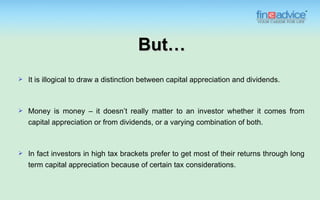
   It is illogical to draw a distinction between capital appreciation and dividends.


   Money is money – it doesn’t really matter to an investor whether it comes from
    capital appreciation or from dividends, or a varying combination of both.


   In fact investors in high tax brackets prefer to get most of their returns through long
    term capital appreciation because of certain tax considerations.
Usually…
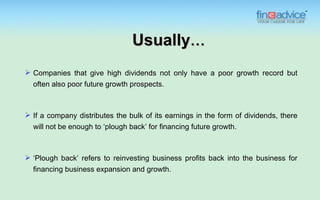
 Companies that give high dividends not only have a poor growth record but
  often also poor future growth prospects.


 If a company distributes the bulk of its earnings in the form of dividends, there
  will not be enough to ‘plough back’ for financing future growth.


 ‘Plough back’ refers to reinvesting business profits back into the business for
  financing business expansion and growth.
On the other hand…
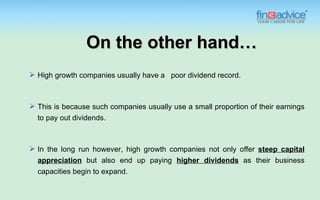
 High growth companies usually have a poor dividend record.


 This is because such companies usually use a small proportion of their earnings
  to pay out dividends.


 In the long run however, high growth companies not only offer steep capital
  appreciation but also end up paying higher dividends as their business
  capacities begin to expand.
On the whole …
 You are likely to get much higher total returns on your investment if you invest for
  capital appreciation rather than for dividends.

 It all boils down to whether you are prepared to sacrifice immediate dividend
  income for greater future capital appreciation and therefore higher future
  dividends.

 It is basically a trade-off between capital appreciation and income.

 This relationship between dividends and the market price of company’s shares is
  expressed by a ratio called ‘Dividend Yield’.
Dividend Yield Ratio
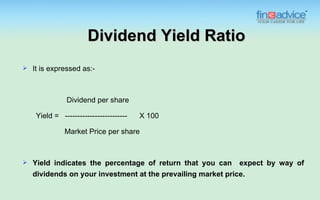
   It is expressed as:-


                Dividend per share

     Yield = -------------------------   X 100

               Market Price per share


   Yield indicates the percentage of return that you can expect by way of
    dividends on your investment at the prevailing market price.
Example…
   Let us assume that you invested Rs. 2000 in buying 100 shares of XYZ Ltd. at Rs. 20
    per share with a face value of Rs. 10 each.


   If XYZ announces a dividend of 20% (Rs. 2 per share), then you will get a total
    dividend of Rs. 200.


   So, the yield on your investment is:-

           Rs. 2 (Dividend)

        -------------------------------- X 100   = 10%

          Rs. 20 (Market Price)
Thus…
 While the dividend was 20%, your actual yield on the dividend earned comes to
  10%.


 The concept of Yield is of far greater practical utility than dividends.


 It gives you an idea of what you are earning through dividends on the current
  market price of your shares.
So…

   A higher dividend yield may be desirable from an investor’s perspective.


   But, a high dividend yield can also mean that the stock is under priced (low
    denominator) or that the future dividends might not be as high as previous
    dividends.


   Similarly, a low dividend yield might mean that the stock is overpriced (higher
    denominator) or that future dividends might be higher.

Dividend Yield Ratio

  • 2.
    Dividend Yield  Many investors buy shares with the objective of earning a regular income from their investment.  Their primary concern is with the amount that a company gives as dividends.  Capital appreciation is usually a secondary consideration.  For such investors, dividends obviously play a crucial role in their investment calculations.
  • 3.
    But…  It is illogical to draw a distinction between capital appreciation and dividends.  Money is money – it doesn’t really matter to an investor whether it comes from capital appreciation or from dividends, or a varying combination of both.  In fact investors in high tax brackets prefer to get most of their returns through long term capital appreciation because of certain tax considerations.
  • 4.
    Usually…  Companies thatgive high dividends not only have a poor growth record but often also poor future growth prospects.  If a company distributes the bulk of its earnings in the form of dividends, there will not be enough to ‘plough back’ for financing future growth.  ‘Plough back’ refers to reinvesting business profits back into the business for financing business expansion and growth.
  • 5.
    On the otherhand…  High growth companies usually have a poor dividend record.  This is because such companies usually use a small proportion of their earnings to pay out dividends.  In the long run however, high growth companies not only offer steep capital appreciation but also end up paying higher dividends as their business capacities begin to expand.
  • 6.
    On the whole…  You are likely to get much higher total returns on your investment if you invest for capital appreciation rather than for dividends.  It all boils down to whether you are prepared to sacrifice immediate dividend income for greater future capital appreciation and therefore higher future dividends.  It is basically a trade-off between capital appreciation and income.  This relationship between dividends and the market price of company’s shares is expressed by a ratio called ‘Dividend Yield’.
  • 7.
    Dividend Yield Ratio  It is expressed as:- Dividend per share Yield = ------------------------- X 100 Market Price per share  Yield indicates the percentage of return that you can expect by way of dividends on your investment at the prevailing market price.
  • 8.
    Example…  Let us assume that you invested Rs. 2000 in buying 100 shares of XYZ Ltd. at Rs. 20 per share with a face value of Rs. 10 each.  If XYZ announces a dividend of 20% (Rs. 2 per share), then you will get a total dividend of Rs. 200.  So, the yield on your investment is:- Rs. 2 (Dividend) -------------------------------- X 100 = 10% Rs. 20 (Market Price)
  • 9.
    Thus…  While thedividend was 20%, your actual yield on the dividend earned comes to 10%.  The concept of Yield is of far greater practical utility than dividends.  It gives you an idea of what you are earning through dividends on the current market price of your shares.
  • 10.
    So…  A higher dividend yield may be desirable from an investor’s perspective.  But, a high dividend yield can also mean that the stock is under priced (low denominator) or that the future dividends might not be as high as previous dividends.  Similarly, a low dividend yield might mean that the stock is overpriced (higher denominator) or that future dividends might be higher.