WHAT IS MOOCs
 A MOOC is a massive open online course on different
topics—varying from the sciences and finance to music,
humanities and information technology, offered for free via
the web by top performing universities around the world.
 MOOCS are there to open learning opportunities to
everyone who would like to use this learning opportunity to
gain more knowledge from it.
What is MOOCs
 Everyone who is computer literate and eager to participate
in MOOCs is permitted to do so.
 No entry requirements, e.g. you don’t need qualifications
for you to join MOOCS.
 However, it is different from informal learning because you
don’t have a teacher or someone who gives instruction.
 Thus; participant create their own content and share
knowledge amongst themselves-it becomes chaotic in this
sense.
What is MOOCs
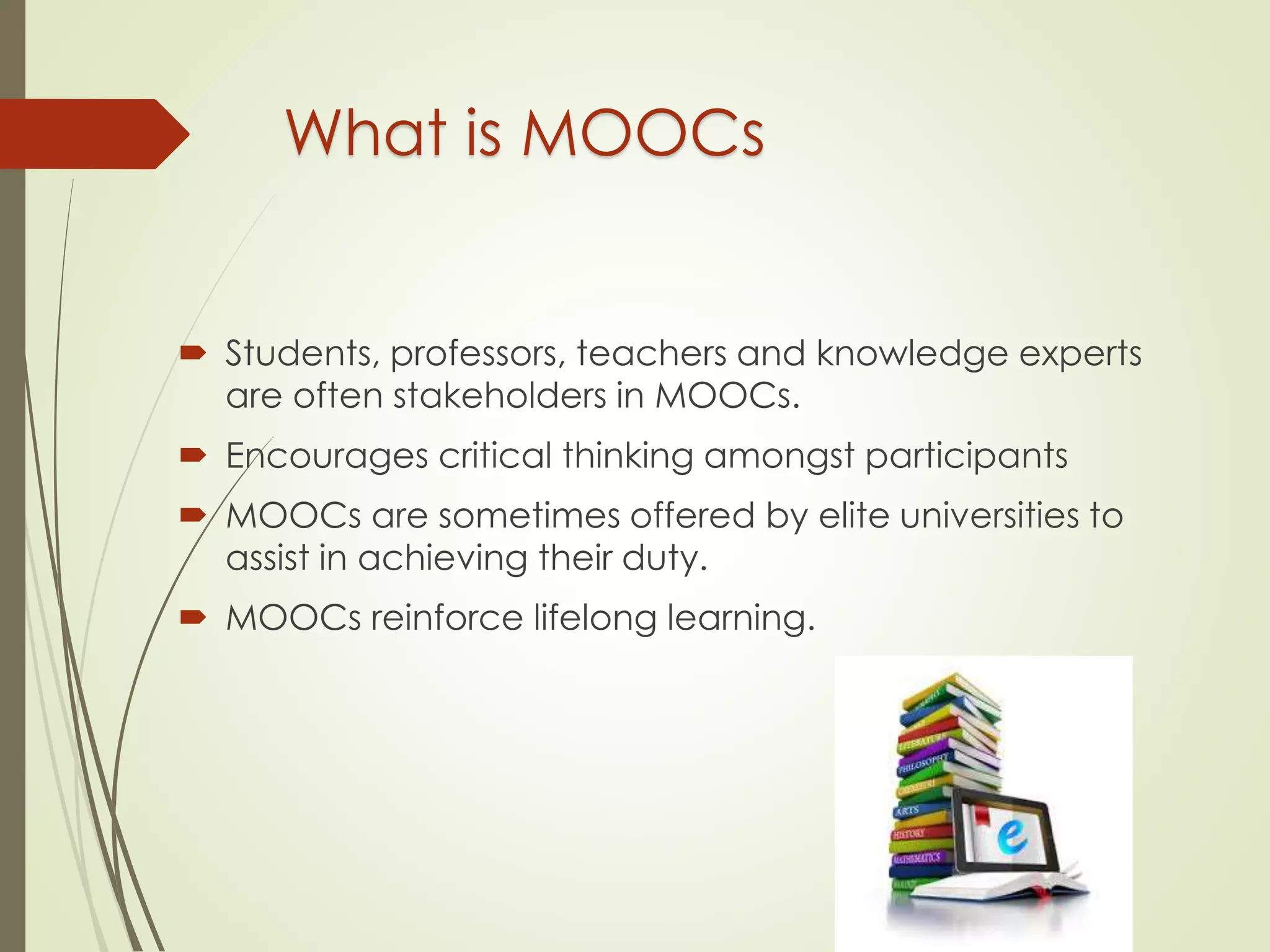
 Students, professors, teachers and knowledge experts
are often stakeholders in MOOCs.
 Encourages critical thinking amongst participants
 MOOCs are sometimes offered by elite universities to
assist in achieving their duty.
 MOOCs reinforce lifelong learning.
 2008
 2012
2013
First MOOC was
launched by
educators Stephen
Downes and
George Siemens
Two professors from university of
Stanford namely Sebastian Thrun
and Peter Norvig introduced
another MOOC for free
It was called ‘
Connectivism and
Connective Knowledge/
2008’(2008)
2,200 people
registered
It was called ‘Introduction
to Artificial Intelligence’.
160 000 people
registered
Open university built its
own MOOC called
Futurelearn featuring
universities from UK
CourseraEdX
xMOOCs
 Behaviorist approach
 Traditional leaning-
discussions , lectures,
assignments
 Higher education
schools/colleges
 Coursera and EdX
cMOOCs
 Connectivist approach
 Peer learning
 Discussion forums
 Individuals, Academics,
Non-profits
 Disruptive
 Participants create own
content
ADVANTAGES OF MOOCS
• Able to organise a MOOC in any
setting with connectivity
• Use any online tools that are
relevant
• Use your own devices
• Work across time zones and
boundaries
• Connect across disciplines and
institutions
• Do not need a degree to enter
• Improve lifelong learning skills
DISADVANT
AGES OF
MOOKS.
 Feeling of being confused
 Request digital literacy
 It want an ability to be able to learn on your
own.
 Demand more time
 Possible steep learning curve
 Technology can disturb from learning
purpose and content
REFERENCE LIST
 http://www.slideshare.net/oerafrica/the-rise-of-moocs
 http://www.slideshare.net/LynGoodnight/multmedia-
presentation-goodnight
 http://www.slideshare.net/Downes/2013-05-06-moose
o http://www.slideshare.net/Downes/education-as-
platform?from_search=11

Dina moocs

  • 2.
    WHAT IS MOOCs A MOOC is a massive open online course on different topics—varying from the sciences and finance to music, humanities and information technology, offered for free via the web by top performing universities around the world.  MOOCS are there to open learning opportunities to everyone who would like to use this learning opportunity to gain more knowledge from it.
  • 3.
    What is MOOCs Everyone who is computer literate and eager to participate in MOOCs is permitted to do so.  No entry requirements, e.g. you don’t need qualifications for you to join MOOCS.  However, it is different from informal learning because you don’t have a teacher or someone who gives instruction.  Thus; participant create their own content and share knowledge amongst themselves-it becomes chaotic in this sense.
  • 4.
    What is MOOCs Students, professors, teachers and knowledge experts are often stakeholders in MOOCs.  Encourages critical thinking amongst participants  MOOCs are sometimes offered by elite universities to assist in achieving their duty.  MOOCs reinforce lifelong learning.
  • 5.
     2008  2012 2013 FirstMOOC was launched by educators Stephen Downes and George Siemens Two professors from university of Stanford namely Sebastian Thrun and Peter Norvig introduced another MOOC for free It was called ‘ Connectivism and Connective Knowledge/ 2008’(2008) 2,200 people registered It was called ‘Introduction to Artificial Intelligence’. 160 000 people registered Open university built its own MOOC called Futurelearn featuring universities from UK CourseraEdX
  • 6.
    xMOOCs  Behaviorist approach Traditional leaning- discussions , lectures, assignments  Higher education schools/colleges  Coursera and EdX cMOOCs  Connectivist approach  Peer learning  Discussion forums  Individuals, Academics, Non-profits  Disruptive  Participants create own content
  • 7.
    ADVANTAGES OF MOOCS •Able to organise a MOOC in any setting with connectivity • Use any online tools that are relevant • Use your own devices • Work across time zones and boundaries • Connect across disciplines and institutions • Do not need a degree to enter • Improve lifelong learning skills
  • 8.
    DISADVANT AGES OF MOOKS.  Feelingof being confused  Request digital literacy  It want an ability to be able to learn on your own.  Demand more time  Possible steep learning curve  Technology can disturb from learning purpose and content
  • 9.
    REFERENCE LIST  http://www.slideshare.net/oerafrica/the-rise-of-moocs http://www.slideshare.net/LynGoodnight/multmedia- presentation-goodnight  http://www.slideshare.net/Downes/2013-05-06-moose o http://www.slideshare.net/Downes/education-as- platform?from_search=11